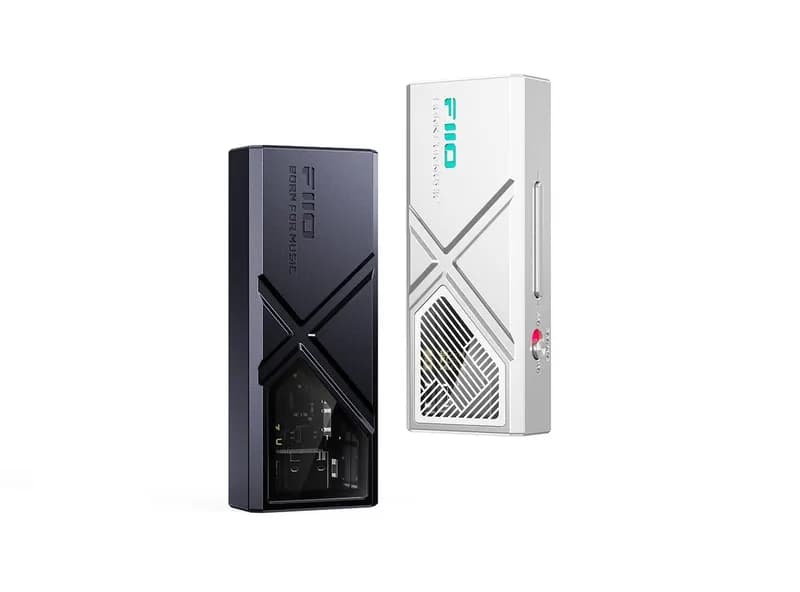
Key Specifications
Specification | Value |
Model | FiiO KA13 |
DAC Chipset | Dual Cirrus Logic CS43131 |
Op-Amp Chipset | Dual SGM8262 |
Supported Formats | PCM up to 384kHz/32-bit, DSD256 (Native) |
Adaptive Impedance | PO: 16 – 150 Ω / BAL: 16 – 300 Ω |
Max Output Power (3.5mm SE) | L+R ≥ 170 mW + 170 mW @ 32Ω (Desktop Mode ON, THD+N < 1%) L+R ≥ 50 mW + 50 mW @ 32Ω (Desktop Mode OFF, THD+N < 1%) |
Max Output Power (4.4mm BAL) | L+R ≥ 550 mW + 550 mW @ 32Ω (Desktop Mode ON, THD+N < 1%) L+R ≥ 170 mW + 170 mW @ 32Ω (Desktop Mode OFF, THD+N < 1%) |
Peak Output Voltage | SE ≥ 2.3 V (32Ω, THD+N < 1%) BAL ≥ 4.2 V (32Ω, THD+N < 1%) |
Signal-to-Noise Ratio (SNR) | ≥ 122 dB (32Ω, A-weighted) |
THD+N | < 0.0005% (32Ω) |
Noise Floor | SE < 1.7 μV (A-weighted) BAL < 3.1 μV (A-weighted) |
Crosstalk | SE ≥ 72 dB (1kHz, 32Ω) BAL ≥ 110 dB (1kHz, 32Ω) |
Frequency Response | 20 Hz – 20 kHz (damping ≤ 0.1 dB) 20 Hz – 50 kHz (damping ≤ 0.2 dB) |
Output Impedance | SE < 1.7 Ω (32Ω load) BAL < 1.8 Ω (32Ω load) |
Input Port | USB Type-C (USB 2.0) |
Output Ports | 3.5mm Single-ended (supports SPDIF coaxial output) 4.4mm Balanced |
Control & Features | Hardware Desktop Mode Switch, Physical Volume Buttons, FiiO Control App Support |
RGB Indicator | Blue (≤48kHz) / Yellow (>48kHz) / Green (DSD) |
Dimensions (L x W x H) | 56.3 mm x 22 mm x 10.5 mm |
Weight | ~18.5 g (excluding cable) |
Compatibility | Windows, macOS, Android, iOS |
ReviewFull Review →
The FiiO KA13 is a compact USB DAC and headphone amplifier designed for listeners who want more power and flexibility than a typical smartphone dongle can provide. Instead of focusing solely on high-resolution decoding specifications, the KA13 combines a dual-DAC architecture with a relatively powerful amplification stage, making it suitable for a wider range of IEMs and headphones. Its 3.5mm single-ended and 4.4mm balanced outputs also make it more versatile than many entry-level USB DAC dongles.
The KA13's biggest advantage is its output capability. With its high-power operating mode, it can deliver substantially more power than a basic USB-C audio adapter. This is useful for listeners who use less sensitive IEMs, planar IEMs, or moderately demanding full-size headphones. For highly efficient IEMs, however, most of the KA13's available power may simply be unnecessary. In that situation, a smaller and lower-power dongle can offer a more convenient experience with less impact on smartphone battery life.
Sound-wise, the KA13 is better described as a clean, controlled and relatively versatile portable source rather than a heavily colored DAC. Its main strength is not adding an obvious bass boost or artificially emphasizing treble detail, but providing a capable output stage with enough headroom to maintain control when paired with more demanding headphones. The final sound will still depend heavily on the connected IEM or headphone, so buyers should not expect the KA13's DAC chip alone to fundamentally change the character of their system.
The KA13 is particularly interesting for users who switch between different types of headphones. Someone who owns only highly sensitive IEMs may not need such a powerful dongle, while a listener using both IEMs and moderately demanding headphones can benefit much more from its additional amplification capability. The 4.4mm output is another practical advantage, especially for users who already own balanced-compatible cables.
There are also trade-offs. Higher output power means greater power consumption and potentially more heat during demanding use. The KA13 is portable, but it is not necessarily the most efficient choice for someone who spends all day connected to a smartphone. It also should not be considered a universal replacement for a desktop DAC/amp when driving particularly demanding full-size headphones.
Overall, the FiiO KA13 makes the most sense as a high-power portable DAC/amp for listeners who need more than a basic dongle can provide. Its value depends less on the DAC specifications alone and more on the headphones you use, the amount of amplification you actually need, and whether portability is more important than the lower power consumption and greater output capability of a larger desktop system.
Related Guides
AULA Keyboard Review: Complete Lineup and Buying Guide
AULA offers a broad lineup of mechanical and Hall Effect keyboards, from compact 75% models to full-size boards and magnetic gaming keyboards. This guide compares the F75 Pro, F87 Pro, F99 Pro, F108 Pro, Hero series, and WIN models, covering layouts, switches, wireless connectivity, Rapid Trigger, typing, gaming, and office use to help you choose the right AULA keyboard.
Read guide →MCHOSE Keyboard Series Guide: Ace, Jet, Mix, K99, and GX87
MCHOSE offers a wide range of keyboards, from Hall Effect gaming models such as the Ace, Jet, and Mix to traditional mechanical boards including the K99, G98, G75, GX87, and UT98. This guide compares their layouts, switches, gaming features, connectivity, customization, and use cases to help you choose the right MCHOSE keyboard for FPS gaming, office work, programming, or everyday typing.
Read guide →Wooting 80HE vs Huntsman V3 Pro 8KHz: Which Gaming Keyboard Should You Buy?
The Wooting 80HE and Razer Huntsman V3 Pro 8KHz are premium gaming keyboards built around adjustable actuation, Rapid Trigger, and high polling rates. This comparison examines their switch technologies, gaming performance, typing feel, build quality, layouts, software, connectivity, and value to help competitive gamers decide which keyboard better matches their setup and priorities.
Read guide →Ready to buy? Check the latest price for FiiO FiiO KA13 Dongle DAC.
Check PricePaid link