Detailed Review
The FiiO KA13 is a compact USB DAC and headphone amplifier designed for listeners who want considerably more output power than a basic phone dongle without carrying a full-size desktop amplifier. Its defining feature is the combination of dual CS43131 DAC chips, dual SGM8262 op-amps, 3.5mm single-ended output, 4.4mm balanced output, and a dedicated Desktop Mode. FiiO rates the balanced output at up to 550mW per channel at 32Ω, while the single-ended output reaches 170mW per channel at 32Ω under its specified conditions.
The KA13 is therefore less interesting as a “DAC chip upgrade” and more interesting as a portable DAC/amp with unusually high output capability. It makes the most sense for IEM users who want substantial headroom, listeners using moderately demanding headphones, and anyone who wants both 3.5mm and 4.4mm outputs in a very small device.
Its main limitations are equally practical: the higher-power operating mode can increase power consumption and heat, and the 550mW figure should not be interpreted as meaning that every difficult-to-drive headphone will perform like it is connected to a full-size desktop amplifier. Extremely sensitive IEM users may also have different priorities from listeners who need maximum output power.
Overall rating: 4.4/5
What Is the FiiO KA13?
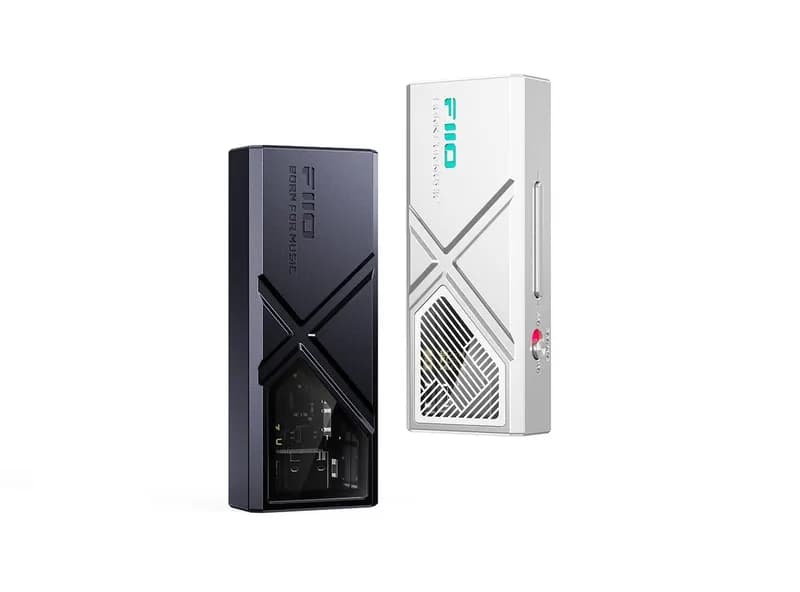
The FiiO KA13 is a USB DAC/headphone amplifier released as a successor to the KA3 concept, but with a substantially more powerful output stage. FiiO describes it as a “mini desktop” DAC/amp because of its Desktop Mode and high balanced output power.
Its hardware uses two CS43131 DAC chips and two SGM8262 op-amps. It supports PCM up to 384kHz/32-bit and native DSD256. The device uses USB-C for digital input and provides both 3.5mm and 4.4mm headphone outputs.
The physical design is also an important part of the product. The KA13 measures roughly 56.3 × 22 × 10.5mm and weighs about 18.5g without its cable. It is small enough to attach to a phone or carry alongside a laptop, while its metal housing also helps with heat dissipation.
This gives the KA13 a fairly specific identity: it is a high-output portable DAC/amp rather than an ultra-minimalist dongle designed only to replace a missing headphone jack.
FiiO KA13 Specifications
Specification | FiiO KA13 |
|---|---|
DAC | Dual CS43131 |
Op-amps | Dual SGM8262 |
PCM | Up to 384kHz / 32-bit |
DSD | Up to DSD256 |
3.5mm output | Yes |
4.4mm balanced output | Yes |
USB | USB-C |
Single-ended power | ≥170mW + 170mW @ 32Ω |
Balanced power | ≥550mW + 550mW @ 32Ω |
Output impedance | <1.7Ω SE / <1.8Ω balanced |
SNR | ≥123dB SE / ≥122dB balanced |
THD+N | <0.0005% at 32Ω |
Size | Approx. 56.3 × 22 × 10.5mm |
Weight | Approx. 18.5g excluding cable |
Controls | Volume buttons, track control |
Desktop Mode | Yes |
App support | FiiO Control on supported platforms |
S/PDIF | Supported through 3.5mm output |
Reference price | Around the mid-$70–$100 class depending on market and retailer |
The power figures need some context. FiiO's current specifications list different output levels depending on impedance and whether Desktop Mode is enabled. For example, the 4.4mm output is rated above 550mW + 550mW at 32Ω with Desktop Mode enabled, while the normal mode is substantially lower.
That distinction matters because 550mW is not simply the “power of the KA13.” It is a specific maximum output figure under a defined load and operating condition.
How Much Power Does the FiiO KA13 Really Have?
Power is the KA13's strongest selling point, but it is also the specification most likely to be misunderstood.
At 32Ω, FiiO specifies at least 170mW per channel from the 3.5mm output and up to 550mW per channel from the 4.4mm balanced output with Desktop Mode enabled. FiiO's published measurements also list a peak output voltage of at least 4.2V at 32Ω for the balanced output.
Independent testing has confirmed that the KA13 can reach unusually high output levels for a dongle. FiiO's own published teardown/testing article reports approximately 168mW from the single-ended output and 567mW from the balanced output under its test conditions.
This is enough to make the KA13 unusually capable with demanding portable headphones and many moderately difficult full-size headphones.
However, power requirements depend on both impedance and sensitivity. A 300Ω headphone with relatively low sensitivity can be more demanding than a higher-impedance headphone with high sensitivity. Likewise, a planar headphone may require more current than its impedance figure alone suggests.
So the practical answer is:
The KA13 has plenty of power for virtually all conventional IEMs and a large number of portable and moderately demanding headphones, but it should not be treated as a universal replacement for a dedicated desktop amplifier.
Is the FiiO KA13 Good for IEMs?
Yes, and IEMs are arguably where the KA13 makes the most sense.
Its output impedance is specified below 1.7Ω for the single-ended output and below 1.8Ω for balanced output. That is low enough to minimize frequency-response interaction with most modern low-impedance IEMs.
For sensitive IEMs, however, raw power is not necessarily the most important feature.
A very sensitive IEM may require only a tiny fraction of the KA13's maximum output. In that situation, a lower-powered dongle can already provide sufficient volume, while the KA13's additional output headroom offers little practical benefit.
The KA13 becomes more interesting when an IEM has:
relatively low sensitivity;
higher power requirements;
a 4.4mm balanced cable;
a preference for greater volume headroom;
or a user wants one dongle that can also handle larger headphones.
The key point is that more power does not automatically mean better sound from an easy-to-drive IEM.
Sound Quality: What Does the KA13 Actually Sound Like?
The KA13 should not be evaluated simply by saying that it uses two CS43131 chips.
Modern DAC chips can provide excellent technical performance, but the final sound depends on the complete implementation, analog stage, output level, headphones and listening chain.
In practical listening, the KA13's biggest audible advantage is its ability to maintain control and headroom with more demanding loads rather than producing an obviously different “DAC flavor.”
Bass
The KA13 tends toward a controlled and relatively clean low-frequency presentation.
Its higher output capability can be particularly useful with headphones that become less convincing when driven by weak sources. Bass notes can sound more controlled when the amplifier has sufficient voltage and current headroom.
That does not mean the KA13 artificially boosts bass. Its appeal is more about control and dynamics than coloration.
FiiO's own listening tests describe stronger low-frequency definition and punch compared with the older KA3 in some material.
Midrange
The midrange is relatively clean and transparent rather than deliberately warm.
Vocals do not appear to be pushed forward simply to create an obvious “Hi-Fi sound.” With a neutral or mildly colored IEM, the KA13 generally allows the character of the headphone itself to remain important.
This makes it easier to use as a general-purpose source rather than a device intended to compensate for a particular tonal balance.
Treble
The high-frequency presentation is detailed without being defined solely by exaggerated brightness.
The KA13's technical performance provides good separation and detail retrieval, but whether the treble sounds smooth or aggressive ultimately depends heavily on the connected headphone.
This is important because a bright IEM will not suddenly become warm simply because it is connected to the KA13.
Soundstage and Separation
The KA13's higher output capability can help preserve dynamics and separation with more demanding headphones.
However, it would be misleading to claim that the dongle itself creates a dramatically larger soundstage.
Soundstage remains strongly dependent on the headphone or IEM, recording, mastering and listening volume.
The more defensible conclusion is that the KA13 provides a clean and capable amplification platform that does not impose an obvious narrow or congested presentation.
FiiO KA13 and 4.4mm Balanced Output
The 4.4mm output is one of the KA13's most important features.
It provides substantially more output power than the 3.5mm connection, with FiiO specifying up to 550mW per channel at 32Ω in Desktop Mode.
But balanced output should not be treated as a magical sound-quality upgrade.
The main practical advantages are:
higher available output;
potentially better channel separation;
compatibility with headphones and IEMs equipped with 4.4mm balanced cables.
If your headphones already have a suitable 4.4mm cable, the KA13 can take advantage of its stronger output stage.
If your IEM only has a 3.5mm cable and already reaches comfortable listening levels, buying a new balanced cable solely to obtain “better sound” is not necessarily worthwhile.
FiiO KA13 for High-Impedance Headphones
The KA13 can drive many higher-impedance headphones substantially better than basic phone dongles.
FiiO's specifications list output at 300Ω, but the available power is much lower than the headline 550mW figure because the 550mW specification applies to a 32Ω load.
This illustrates why looking only at the headline power figure can be misleading.
For high-impedance headphones, voltage capability becomes increasingly important. A headphone that needs substantial voltage swing may still benefit from a dedicated desktop amplifier.
Therefore:
The KA13 is a strong portable solution for many headphones, but it is not automatically sufficient for every 250Ω or 300Ω headphone.
The headphone's sensitivity and actual power requirement should be considered alongside impedance.
Android, iPhone, iPad and Computer Compatibility
The KA13 uses USB-C and is designed to work with phones, tablets and computers.
FiiO supplies USB-C-to-USB-C, USB-C-to-Lightning and USB-C-to-USB-A connection options, making the package relatively flexible.
Android
Android is one of the most natural use cases.
The KA13 can operate as a USB audio device, and third-party testing has found it straightforward to use with multiple Android phones without requiring traditional desktop-style drivers.
Some Android applications can handle USB audio differently, however, so application-level behavior can vary.
iPhone and iPad
Compatibility depends on the device connector and operating system.
The included Lightning cable is useful for compatible Lightning devices, while USB-C iPhones and iPads can connect directly with the appropriate cable.
One important consideration is power. A high-output dongle draws more power when operating near its maximum capability, so heavy portable use can affect phone battery life more than a basic low-power adapter.
Windows
The KA13 can be used as a USB audio device with computers. Its higher output makes it useful not only for music but also for desktop headphone listening and gaming.
macOS
The KA13 can also function as a USB audio output on Mac computers. However, users who need advanced software features should distinguish basic USB audio compatibility from the availability of every FiiO configuration function on every operating system.
FiiO Control and Desktop Mode
The KA13 includes more functionality than a simple passive USB-to-headphone adapter.
Its physical controls allow volume adjustment and track control, while the Desktop Mode switch increases the available output level. FiiO also provides FiiO Control support for configuration features on supported devices.
The RGB window is not purely decorative. It indicates the incoming sampling-rate category, providing a quick visual indication of the active digital stream.
The KA13 can also provide S/PDIF output through the 3.5mm connection when configured accordingly, allowing it to function as a small digital interface rather than only as a headphone amplifier.
This is useful for enthusiasts but unnecessary for users who simply want to plug in headphones and listen.
Heat and Smartphone Battery Consumption
The KA13's output capability comes with an obvious physical trade-off: it needs more electrical power than a very simple dongle when operating at higher levels.
This is particularly relevant when Desktop Mode is enabled.
The KA13 is still small enough for mobile use, but users should not expect the same power efficiency as a basic USB DAC that only needs to provide enough output for efficient IEMs.
The practical takeaway is:
For short listening sessions, the KA13's power consumption is unlikely to be a major issue. For long listening sessions at high output, especially from a phone, battery consumption and heat become more relevant.
The metal chassis also serves as part of the thermal design, but users should still expect the device to become warm under sustained high-power operation.
Build Quality and Portability
The KA13 is one of its category's more compact high-output designs.
At approximately 18.5g without its cable, it adds relatively little weight to a phone or laptop setup. Its metal housing provides a more substantial feel than basic plastic dongles, while the detachable USB cable is an important advantage for long-term usability.
The detachable cable is particularly useful because the cable is one of the components most likely to experience mechanical stress in portable use.
The RGB window and physical controls also make the KA13 easier to operate than an ultra-minimal dongle with no buttons.
The trade-off is that it is slightly more substantial than the simplest USB DAC adapters.
FiiO KA13 for Gaming
The KA13 can be a good gaming DAC/amp, but its strengths should not be confused with dedicated gaming features.
Its main advantages are:
clean headphone output;
substantial power;
good channel separation;
compatibility with conventional wired gaming headphones;
physical volume controls.
It does not become a better gaming device simply because it has a 4.4mm balanced output.
For FPS games, headphone imaging and tuning are generally much more important than the difference between DAC chips.
The KA13 is therefore most useful when the existing source cannot provide enough clean output for the headset.
FiiO KA13: Main Advantages
Very high output for its size, particularly through the 4.4mm balanced connection.
3.5mm and 4.4mm outputs cover most modern wired IEM and headphone setups.
Low output impedance makes it suitable for many low-impedance IEMs.
Detachable USB cable improves flexibility and long-term practicality.
Physical volume controls are useful for phone and laptop use.
Desktop Mode provides additional output capability.
USB-C connectivity works across phones, tablets and computers.
The device can also function as an S/PDIF digital output interface in supported configurations.
FiiO KA13: Main Disadvantages
High output capability can mean higher power consumption during demanding use.
The device can become warm during sustained high-power operation.
The headline 550mW figure only applies under specific conditions, so it should not be interpreted as universal headphone-driving capability.
Users with extremely efficient IEMs may gain little from the extra output power.
Some advanced configuration features depend on device and software support.
It is still a USB-powered dongle, not a true battery-powered desktop amplifier.
FiiO KA13 vs Other Dongle DACs
The most useful way to compare the KA13 with competing dongles is not simply to compare DAC chip names.
Category | FiiO KA13 | Typical Basic Dongle | Higher-End Dongle |
|---|---|---|---|
3.5mm | Yes | Usually | Usually |
4.4mm | Yes | Often no | Usually |
Output Power | Very high for size | Low | Varies |
Desktop Mode | Yes | Rare | Sometimes |
Detachable Cable | Yes | Varies | Usually |
IEM Compatibility | Very broad | Broad | Very broad |
Demanding Headphones | Better suited | Limited | Depends on model |
Portability | Excellent | Excellent | Excellent |
Power Efficiency | Moderate | Usually better | Varies |
Physical Controls | Yes | Often limited | Varies |
The KA13's strongest competitive argument is therefore not that its DAC chip is inherently superior. It is the combination of small size, high output, 3.5mm + 4.4mm connectivity and relatively complete controls.
A lower-powered dongle can be more sensible for an efficient IEM-only setup. A more sophisticated high-end dongle may offer different features or tuning. A desktop DAC/amp remains the better choice when maximum power, multiple inputs and sustained desktop operation are the priority.
Who Should Buy the FiiO KA13?
The KA13 makes the most sense for:
IEM users who want substantial output headroom;
listeners with 4.4mm balanced cables;
users who want one dongle for both IEMs and headphones;
people whose phones or laptops have weak headphone outputs;
listeners who frequently switch between mobile and desktop environments;
users who want physical volume controls;
enthusiasts who need more power without carrying a full-size DAC/amp.
Who Does Not Need the KA13?
It may be unnecessary for:
users with extremely efficient IEMs who already have sufficient volume;
people who never use wired headphones;
users who prioritize minimum battery consumption above output capability;
owners of a good desktop DAC/amp that already meets their needs;
people looking for an ultra-simple adapter rather than a configurable DAC/amp.
FiiO KA13 Rating
Category | Rating |
|---|---|
Sound Quality | 4.5/5 |
Driving Power | 4.5/5 |
IEM Compatibility | 4.5/5 |
Output Options | 4.5/5 |
Noise Performance | 4.0/5 |
Phone Compatibility | 4.5/5 |
Portability | 4.5/5 |
Power Efficiency | 4.0/5 |
Build Quality | 4.5/5 |
Value for Money | 4.5/5 |
Overall | 4.4/5 |
Why the KA13 Scores 4.4/5
The KA13 scores highly because it combines characteristics that are difficult to fit into such a small enclosure: strong output, dual headphone connections, physical controls, a detachable cable and broad USB-device compatibility.
Its rating is not higher simply because maximum power is not the only criterion for a dongle DAC. Battery consumption, heat, headphone matching and actual user requirements matter as well.
For an efficient IEM user, the KA13's extra power may have limited practical value. For someone who needs one compact DAC/amp capable of handling both sensitive IEMs and more demanding headphones, its feature set becomes considerably more useful.
FiiO KA13 FAQ
Is the FiiO KA13 worth buying?
The KA13 is worth considering if you need a compact DAC/amp with unusually high output power and both 3.5mm and 4.4mm outputs. It is less compelling if your current dongle already drives your IEMs comfortably.
How is the FiiO KA13's sound quality?
Its presentation is generally clean, controlled and technically capable. The biggest practical benefit is not an exaggerated “DAC sound,” but sufficient amplification headroom and a relatively transparent signal path.
Is the FiiO KA13 powerful enough?
For IEMs, it has more than enough output capability in most cases. It can also handle many full-size headphones, although particularly demanding high-impedance or low-sensitivity headphones may still benefit from a desktop amplifier.
Does the FiiO KA13 have 4.4mm balanced output?
Yes. It has both 3.5mm single-ended and 4.4mm balanced headphone outputs. The balanced output is capable of substantially higher power.
Does the FiiO KA13 work with phones?
Yes. It can be used with compatible Android and iOS/iPadOS devices, as well as computers. FiiO supplies different connection cables for USB-C and Lightning devices.
Does the FiiO KA13 get hot?
It can become warm, particularly when operating at higher output levels or with Desktop Mode enabled. This is a normal consequence of packing a relatively powerful amplifier into a small USB-powered enclosure.
Does the FiiO KA13 need a balanced cable?
No. A 3.5mm headphone or IEM can be used directly. The 4.4mm connection is useful when you already have a compatible balanced cable and want access to the KA13's higher output capability.
Is the FiiO KA13 good for high-impedance headphones?
It can work well with many higher-impedance headphones, but impedance alone does not determine whether an amplifier is sufficient. Sensitivity and required voltage also matter. The KA13 should not automatically be considered a replacement for a dedicated desktop amplifier.
Does the FiiO KA13 support high-resolution audio?
Yes. FiiO specifies PCM support up to 384kHz/32-bit and DSD256.
Final Verdict: Who Is the FiiO KA13 For?
The FiiO KA13 is best understood as a high-output portable DAC/amp, not simply another USB-C headphone adapter.
If you mainly use sensitive IEMs: the KA13 gives you plenty of headroom, but a cheaper and lower-powered dongle may already be sufficient.
If you use a 4.4mm balanced IEM cable: the KA13 becomes more interesting because its balanced output is substantially more powerful.
If you want to drive headphones as well as IEMs: this is one of the KA13's strongest use cases. Its output capability gives it considerably more flexibility than basic dongles.
If you mainly use a phone: its compact size, detachable cable and physical controls make it practical, although power consumption becomes more relevant than with a low-powered dongle.
If you already own a good desktop DAC/amp: the KA13 is mainly valuable as a portable second system rather than a direct replacement.
If you want maximum portability with minimum battery drain: a simpler dongle may make more sense.
Ultimately, the KA13's appeal comes from a straightforward proposition: it puts unusually high amplification capability into a very small USB DAC. Its value therefore depends less on whether its DAC chip sounds “better” on paper and more on whether your headphones actually benefit from the additional output, balanced connectivity and flexibility.