2026 Smartwatch Innovations: Which New Features Are Worth Buying?
Smartwatches in 2026 bring new readiness scores, AI health coaches, dual-frequency GPS, sleep apnea notifications, and longer battery life—but not every upgrade is worth the money. This guide compares the latest Apple Watch, Samsung Galaxy Watch, and Google Pixel Watch models, separating manufacturer claims from independent testing. Find out which features justify an upgrade, which require a subscription, and when keeping your current watch is the smarter choice.
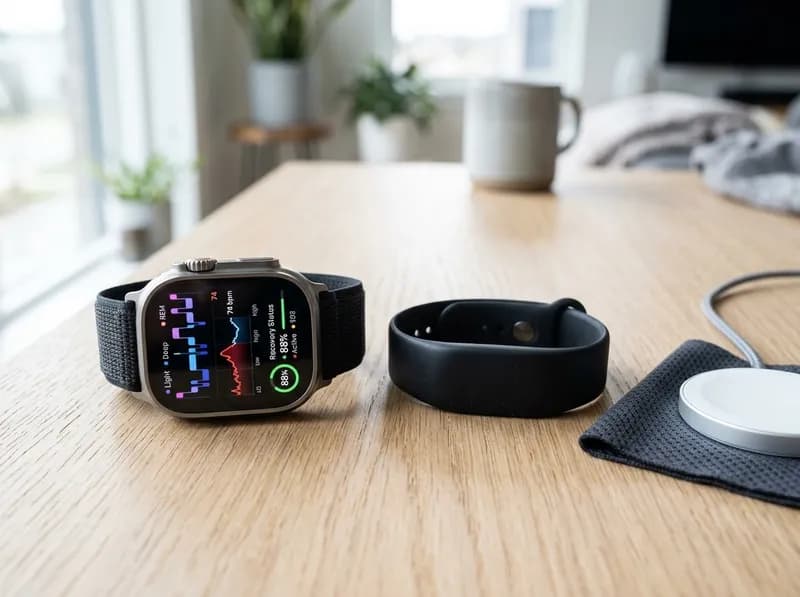
Every fall brings a new round of smartwatch announcements, but a longer feature list doesn't necessarily make an upgrade worthwhile. In 2026, the biggest talking points include readiness scores, AI health coaching, sleep apnea notifications, blood pressure monitoring, dual-frequency GPS, and screenless fitness bands. Some offer practical benefits; others are still limited by subscriptions, compatibility, or the gap between manufacturers' claims and independent test results.
This guide examines the major smartwatch innovations in 2026 and explains which are worth paying for, which matter only to certain users, and which aren't compelling reasons to replace an existing watch.
Two distinctions matter when comparing this year's models. First, a feature that's new to Apple or Google isn't necessarily new to the smartwatch market. Garmin, Fitbit, Samsung, and Whoop have offered versions of several health and recovery features for years. Second, manufacturer specifications don't always reflect real-world performance. Where independent testing is available, it helps put claims about battery life, charging speed, and GPS accuracy into perspective.
Prices in this guide reflect U.S. launch prices or retail listings collected during research on October 20, 2026. Retail promotions change frequently, so check current prices before buying. This article does not claim hands-on testing; measured results are attributed to the independent reviewers cited in the research, while manufacturer specifications and regulatory information are identified separately.
How We Evaluated the New Smartwatch Features
The focus here is practical value rather than a simple ranking of the latest watches. Each feature is assessed against three questions:
Does it improve everyday use? A feature should solve a recognizable problem, not just add another number to an app.
Is it genuinely new to the model? An upgrade is less compelling if the same capability already exists on an older watch or a competing platform.
Does it justify the extra cost? Hardware premiums, subscriptions, compatibility restrictions, and real-world performance all affect the value of an upgrade.
The main comparisons cover the Apple Watch Series 12 and Ultra 4 against the Series 11 and Ultra 3; the Samsung Galaxy Watch9 and Galaxy Watch Ultra 2 against the Watch8 and original Ultra; and the Google Pixel Watch 5 against the Pixel Watch 4. The Apple Watch SE 3 is also included as a lower-cost option for iPhone owners.
Manufacturer claims are distinguished from independent measurements, and prices are identified as launch or retail figures where the difference matters. Regulatory status is discussed separately from general wellness functionality.
Smartwatch Innovations in 2026: Quick Verdicts
Feature | Verdict | Why it matters |
|---|---|---|
Apple readiness scores | Worth paying for if you want this feature | Available only on the Series 12 and Ultra 4 |
Sleep apnea notifications | Worth considering | Available on selected Apple, Samsung, and Withings devices, but eligibility is model-specific |
Dual-frequency GPS | Useful for some | Most beneficial in cities and other difficult reception environments |
AI health coaches | Useful for some | Subscription costs vary widely, and Samsung's approach differs from Google's and Garmin's |
Larger batteries | Useful for some | The Galaxy Watch Ultra 2 offers the clearest capacity increase |
Blood pressure monitoring | Not a reason to upgrade on its own | Wellness features are not substitutes for validated medical measurements |
Non-invasive blood glucose monitoring | Not a reason to upgrade | No smartwatch currently provides reliable, direct, non-invasive glucose measurement as a replacement for a CGM |
Brighter displays | Not a reason to upgrade on their own | Most improvements are incremental |
LTE cellular | Useful for some | Valuable for phone-free activities, but adds hardware and recurring carrier costs |
Screenless health bands | Worth considering for tracking-focused users | They prioritize sleep, recovery, and training data over apps and notifications |
What's Actually New in 2026 — and What's Not?
Several of this year's headline features have been available on competing wearables for years. The important change is often that a feature has reached another ecosystem, not that the underlying technology is new.
Readiness scores: Apple's 2026 implementation brings a dedicated readiness score to the Series 12 and Ultra 4. Garmin's Training Readiness and Body Battery, along with Fitbit's Daily Readiness, have offered related ways to interpret recovery and energy for years.
Sleep apnea notifications: This is an established feature, not a 2026 invention. Apple introduced its notifications with the Series 9 generation, while Samsung received FDA De Novo authorization for its feature in February 2024.
AI health coaching: Conversational coaching existed before 2026. The more important development is how companies are packaging it, which features require subscriptions, and whether the service is included with the hardware.
Dual-frequency GPS: Garmin and recent Galaxy Watches already offer dual-frequency positioning. Its arrival on the Pixel Watch 5 makes the technology available to more Google smartwatch buyers.
If you already own a recent Garmin, Galaxy Watch, or Whoop device, some of the year's biggest announcements may be familiar. That makes it worth checking the actual hardware and software differences before spending money on a new model.
Apple Watch: Series 12, Ultra 4, and SE 3
Apple Watch Series 12 vs. Series 11: Is the Upgrade Worth It?
The Apple Watch Series 12 is primarily a software and feature update rather than a major hardware redesign. Screen resolution, storage, water resistance, and the general battery-life rating remain broadly similar to the Series 11 generation.
Apple's battery messaging emphasizes improved endurance during outdoor workouts, with a claim of up to 25% better battery life in that scenario. The company also promotes the ability to get up to 12 hours of use from a 15-minute charge. These claims describe particular usage and charging conditions, rather than a guarantee that every owner will see the same improvement.
Independent testing provides a more useful picture of everyday performance. Macworld's Series 12 testing reported that a 30-minute charge brought the battery to approximately 58%–72%, depending on watch size. Its average battery-life result was around 45.5 hours with the always-on display enabled, without a clear, consistent improvement over the Series 11.
The most distinctive new feature is Apple's readiness score, a daily 0–10 assessment intended to help users interpret recovery and decide how demanding a workout should be. It is limited to the Series 12 and Ultra 4, so owners of older Apple Watches cannot simply update their software to get it.
Verdict: Most Series 11 owners should keep their current watch. The Series 12 makes more sense if you specifically want Apple's readiness score or have another reason to replace your device. The battery and charging claims alone are not strong enough to justify an upgrade.
Apple Watch Ultra 4 vs. Ultra 3: Who Should Upgrade?
Battery specifications for the Ultra 4 can look inconsistent because Apple and launch coverage refer to different usage conditions. Apple's figures include up to 45 hours during outdoor exercise with GPS active, while some coverage cites up to 50 hours for general use. These numbers should not be treated as interchangeable.
In DC Rainmaker's real-world testing, the Ultra 4 delivered approximately two days of full-feature use. Actual endurance depends on GPS activity, display settings, notifications, cellular use, and other factors.
The upgrade from the Ultra 3 is otherwise difficult to justify for most people. The display, case design, and core sensor hardware remain broadly similar, and the Ultra 3 is already a capable outdoor smartwatch. The readiness score and the latest health-software features provide the clearest reasons to choose the newer model.
Verdict: Ultra 3 owners can generally skip the Ultra 4. Owners of older Apple Watches who want a rugged design, longer endurance, and the full Ultra feature set face a different decision because the upgrade changes more than one or two specifications.
Apple Watch SE 3: A More Affordable Way Into the Ecosystem
Flagship launches tend to dominate smartwatch coverage, but the Apple Watch SE 3 deserves attention from buyers who want the basics without paying for every premium feature.
At around $249, the SE 3 offers the core Apple Watch experience and supports sleep apnea notifications. Its processor is based on the previous generation's Series 10 chip, and it omits some higher-end capabilities, including the ECG app and Apple's new readiness score.
For iPhone owners who mainly want notifications, activity tracking, sleep information, and selected health features, the SE 3 may be a better purchase than an expensive flagship. It also puts the cost of upgrading into perspective: not every useful smartwatch feature requires the newest or most expensive model.
Best for: iPhone users who want a capable everyday smartwatch at a lower price.
Less suitable for: People who specifically need the ECG app, Apple's readiness score, or the Ultra range's rugged design and endurance.
Samsung Galaxy Watch: Watch9, Watch8, and Ultra 2
Galaxy Watch9 vs. Galaxy Watch8: A Modest Upgrade
The Galaxy Watch9 is an iterative update rather than a major redesign. Its 40mm Bluetooth version starts at $379.99, compared with the Galaxy Watch8's $349.99 launch price.
The core BioActive sensor hardware is broadly unchanged from the Watch8 generation. The main updates include a new processor, refinements to on-device Galaxy AI software, dual-frequency GPS, a revised Armor Aluminum 2 chassis, and Bluetooth 6.0.
Price history also matters. Although the Watch8 launched at $349.99, retail listings have put it around $299.99. Those figures refer to different points in the product cycle, so a comparison based only on current prices can make the Watch9's premium look different from a comparison of launch prices.
Verdict: Most Galaxy Watch8 owners should keep their current watch. The Watch9 is more appealing to owners of older models, particularly those coming from the Watch4, Watch5, Watch6, or Watch7. Dual-frequency GPS and the newer processor and software are more meaningful changes for those users.
Galaxy Watch Ultra 2: Battery Life Is the Main Attraction
The Galaxy Watch Ultra 2 costs $699.99 and comes with LTE connectivity. Its biggest hardware change is an 800mAh battery, approximately 35% larger than the battery in the original Galaxy Watch Ultra.
Samsung promotes multi-day battery life, while independent reviews generally report around three to five days depending on settings and usage. GPS-heavy workouts, an always-on display, cellular activity, and frequent health measurements can all reduce endurance.
For people who already own the first Ultra, the larger battery is the clearest reason to consider the new model. Other changes are more incremental.
Verdict: The Ultra 2 is worth considering if battery life is a persistent problem with your first-generation Ultra, or if you want a rugged Samsung smartwatch that can last several days between charges. For other users, the price is difficult to justify on the strength of incremental updates alone.
Google Pixel Watch 5: What's New?
The Pixel Watch 5 was announced on August 12, 2026, and went on sale in the United States on August 20.
Configuration | U.S. launch price |
|---|---|
41mm Bluetooth | $399 |
45mm Bluetooth | $429 |
41mm LTE | $499 |
45mm LTE | $529 |
The Pixel Watch 5 introduces 64GB of storage, 3GB of RAM, Google's W5 Gen 2 chip, dual-frequency GPS, Health Guardian proactive monitoring, and on-device Gemini features.
Google claims that dual-frequency GPS provides twice the accuracy of the previous generation. That is a manufacturer claim, not a settled independent finding. It should not be interpreted as proof that the Pixel Watch 5 is more accurate than every Apple Watch Ultra or Garmin Fenix model.
Pixel Watch 5 vs. Pixel Watch 4
The storage increase, new chip, dual-frequency GPS, and Health Guardian features give the Pixel Watch 5 a clearer generational advantage than some other 2026 smartwatch updates.
Battery life is less of a selling point because the official rating remains broadly similar to the Pixel Watch 4. Launch prices also increased by $50 across the two sizes: the Pixel Watch 4 launched at $349 for the smaller model and $379 for the larger one.
Discounts change the comparison. By October 2026, U.S. promotions had brought the Pixel Watch 5 down to around $349–$379 in some listings. That puts it close to the previous generation's launch pricing, although actual discounts vary by retailer and configuration.
Verdict: Pixel Watch 4 owners can wait another generation unless the new GPS, storage, or health features solve a specific problem. Owners of the Pixel Watch 3 or earlier have a stronger reason to upgrade. New buyers should compare current promotional prices rather than automatically choosing the older watch.
Smartwatch Readiness Scores Compared: Why the Numbers Differ
Readiness scores are among the most prominent smartwatch features in 2026, but comparing scores across brands can be misleading.
1. The scales are different
Apple's readiness score uses a 0–10 scale, while Garmin's Training Readiness uses 0–100. Fitbit and Google use their own scoring systems. An Apple score of 7 is not equivalent to a Garmin score of 70, even if the numbers appear proportional.
2. Similar names can describe different things
Garmin Body Battery estimates energy reserves, while Training Readiness is intended to help users assess their preparedness for a workout. The two can give different signals because they serve different purposes.
A comparison between Apple's readiness score and Garmin Body Battery is therefore not a direct comparison of equivalent measurements.
3. The measurement methods and baselines differ
Smartwatch platforms collect heart-rate variability (HRV), sleep, activity, and recovery information in different ways. They may use different sampling windows, algorithms, and personal baselines. Many systems also need roughly 14–30 days of data before their scores become more representative of an individual's patterns.
The same person can receive different readiness scores from two watches after the same night of sleep. That does not automatically mean one device is wrong; the devices may be measuring and weighting different inputs.
Compatibility is particularly important for Apple buyers. The readiness score is available only on the Series 12 and Ultra 4. Older Apple Watch models, including the Series 11, Series 10, Series 9, and SE range, do not receive it. Samsung and Google offer related features on a broader range of supported devices.
Verdict: Readiness scores are most useful for tracking your own trends over time on the same platform. They are not standardized measurements, and comparing your score with another person's score or a different brand's score tells you relatively little.
HRV and Heart-Rate Sampling: What Sits Behind the Scores?
Readiness and recovery features rely partly on heart-rate variability, sleep data, and activity measurements. The quality and timing of those measurements affect the resulting scores.
Continuous optical measurements during sleep can produce different results from a brief morning reading. Wrist-based optical sensors also have limitations during intense exercise, when a chest strap generally provides more reliable heart-rate data.
The major 2026 watches do not fundamentally change these measurement limitations. What has changed is how prominently manufacturers present the resulting data as a single score.
Look for trends across several weeks rather than reacting to one unusually high or low reading. Your watch's HRV value also should not be expected to match a dedicated chest strap or a medical ECG measurement exactly.
Smartwatch Battery Life and Charging in 2026: Claims vs. Real-World Results
Battery life remains one of the biggest differences between manufacturer specifications and everyday experience.
Smartwatch | Manufacturer claim or specification | Independent findings or practical context |
|---|---|---|
Apple Watch Series 12 | Up to 12 hours of use from a 15-minute charge; improved outdoor-workout endurance | Macworld reported around 58%–72% after 30 minutes of charging and approximately 45.5 hours of average battery life in its testing |
Apple Watch Ultra 4 | Up to 45 hours during outdoor exercise; some coverage cites 50 hours for general use | DC Rainmaker reported around two days of full-feature use |
Galaxy Watch9 | Similar general battery rating to the Watch8 | No clear, major battery-generation improvement has emerged from the available coverage |
Galaxy Watch Ultra 2 | 800mAh battery and multi-day endurance claims | Independent reviews generally report around three to five days, depending on settings and use |
Pixel Watch 5 | Battery rating broadly similar to the Pixel Watch 4 | No major battery-life leap over the previous generation |
The Galaxy Watch Ultra 2 offers the clearest capacity increase among these models. Most mainstream flagships retain broadly similar battery expectations.
Apple's fast-charging figures also deserve careful interpretation. The Series 12 charges quickly, but Macworld's reported results did not consistently reproduce the level implied by the most optimistic interpretation of Apple's charging claims. A test result can vary by watch size, battery level, temperature, and charging conditions, so one figure should not be treated as universal.
Buying advice: If you want fewer charging interruptions, look beyond the advertised maximum. Consider the battery performance reported under conditions resembling your own use, especially if you frequently use GPS, LTE, sleep tracking, or the always-on display.
AI Health Coaches in 2026: What Do They Cost?
AI coaching is becoming a larger part of the smartwatch market, but access and pricing vary substantially by platform.
Platform | Coaching or health software | U.S. pricing snapshot |
|---|---|---|
Google Health, formerly Fitbit | AI coach in the Google Health app | $9.99/month or $99.99/year for Premium; included for Google AI Pro subscribers |
Samsung | On-device Galaxy AI health features | Included with the watch |
Garmin | Garmin Active Intelligence | $6.99/month |
Oura | Oura Advisor | $5.99/month |
Whoop | AI coaching | Included in membership, listed at $359/year in the pricing range covered here |
Apple | No equivalent dedicated AI health coach | Core health features do not require a coaching subscription |
Google's May 19, 2026, rebranding of the Fitbit app to Google Health also changed the subscription picture. Google Health Premium costs $9.99 per month or $99.99 per year, up from the previous $79.99 annual price. Eligible Google AI Pro subscribers receive the service as part of their plan.
The broader market is split between companies that include health software with the watch and those that treat coaching as a recurring service. Samsung and Apple emphasize features included with their devices, while Google, Garmin, Oura, and Whoop use subscription models for at least some coaching or analysis features.
That difference can matter more than a processor upgrade. A lower-priced wearable may cost more over several years once subscriptions are included.
Before buying a Pixel Watch 5, Fitbit Air, Garmin device, or screenless band, check exactly which coaching features are included and which require payment. Samsung's included Galaxy AI features and Apple's core health functions have a different long-term cost structure from subscription-dependent services.
Verdict: AI coaching is useful if you regularly consult it and act on the recommendations. If you mainly want heart-rate, sleep, and activity tracking, a subscription may offer little additional value.
Blood Pressure and Blood Glucose Monitoring: What Changed in 2026?
Blood pressure and glucose monitoring attract attention because they could make wearables more useful for health management. However, the two technologies have different limitations, and regulatory status matters.
Blood Pressure Monitoring
In 2024 and 2025, the FDA warned consumers about smartwatches and rings claiming to measure blood pressure without appropriate cuff-based validation. The agency also issued warning letters, including one to Whoop concerning its blood pressure feature.
In January 2026, the FDA issued two final guidance documents that clarified the regulatory approach to certain wellness products. Validated cuffless blood pressure features may be positioned as general wellness tools under the applicable conditions. That does not make every smartwatch blood pressure claim reliable, nor does it make a wellness feature equivalent to a medical diagnostic device.
Whoop's warning letter was reported as closed in June 2026. Separately, several outlets have reported that Apple's blood pressure feature received FDA 510(k) clearance. That claim should be checked against the FDA's public database before being treated as confirmed regulatory status. In any case, a smartwatch blood pressure trend feature should not be treated as a replacement for a validated upper-arm cuff or professional assessment.
The distinction is important: estimating a trend, notifying a user of a possible issue, and measuring blood pressure with clinical accuracy are not interchangeable functions.
Blood Glucose Monitoring
The situation with non-invasive blood glucose measurement is more straightforward. As of October 2026, no smartwatch or ring offers a proven, direct, non-invasive glucose measurement that replaces a continuous glucose monitor (CGM).
Devices from Dexcom and Abbott use dedicated sensors to measure glucose and can display readings on compatible smartwatches. The watch serves as a display or companion device; it does not independently measure glucose through its optical sensors.
Whoop's publicly discussed glucose work remains in the research and development category rather than a generally available smartwatch feature.
Verdict: Neither blood pressure nor glucose monitoring is a good standalone reason to upgrade. Treat blood pressure features according to their exact validation and regulatory status, and do not trust claims that a watch can directly measure blood glucose without a sensor.
Sleep Apnea Notifications: Which Smartwatches Support Them?
Sleep apnea notifications are among the most potentially useful health-related smartwatch features, but availability depends on the exact device and its authorization status.
Device or family | Status described in the available research |
|---|---|
Apple Watch Series 9 and later, including SE 3 and Ultra 2 and later | Authorized breathing-disturbance notifications for signs associated with sleep apnea |
Samsung Galaxy Watch 4 and later | FDA De Novo authorization for Samsung's sleep apnea feature in February 2024 |
Withings ScanWatch family | FDA-authorized sleep apnea-related functionality on eligible models |
Galaxy Ring | Authorization was reported in fall 2026; check the current FDA record and exact product details |
Oura, Whoop, Fitbit/Google Health, Garmin | No FDA authorization for sleep apnea detection identified in the research for this guide |
Samsung's reported performance figures include approximately 82.7% for moderate-to-severe obstructive sleep apnea and 87.7% for severe cases. These figures should be understood in the context of the relevant study and device, rather than interpreted as a guarantee of individual accuracy.
Two limitations are especially important.
First, an authorized notification feature is not a diagnosis. A sleep study and clinical assessment may be needed to determine whether someone has sleep apnea and how severe it is. These features are generally intended to flag possible signs in eligible users, not to replace professional diagnosis or management for someone already diagnosed.
Second, receiving no notification does not rule out sleep apnea. If you snore heavily, wake feeling unrefreshed, or someone notices pauses in your breathing during sleep, a lack of alerts should not stop you from seeking medical advice.
Verdict: Sleep apnea notifications are worth considering if you want this type of screening support. Check the exact model and regional availability before buying; a feature available on one watch is not automatically available across an entire brand.
Screenless Fitness Bands in 2026: Fitbit Air, Whoop MG, Garmin Cirqa, and Luna Band
A notable trend in 2026 is the growth of wearables that deliberately leave out the screen. Rather than competing with smartwatches on apps, notifications, and payments, these devices concentrate on sleep, recovery, training load, and health-data analysis.
Fitbit Air: Low Hardware Cost, Subscription-Based Coaching
At $99.99, Fitbit Air is the lower-cost option among the products covered here. Its screenless design focuses on tracking, while more advanced AI coaching is tied to Google Health's subscription offering.
The overall cost depends on how much of that software you want. The hardware is relatively affordable, but users who subscribe to Google Health Premium should include the recurring fee in their comparison.
Whoop MG: Built Around Training and Recovery
Whoop MG takes a membership-based approach. The screenless device is designed around recovery, sleep, training load, and coaching, with the service included in the membership.
Its appeal is strongest for users who actively follow training and recovery metrics. The drawback is the ongoing cost: the membership is an essential part of the product rather than an optional extra.
Garmin Cirqa: Health Data Without a Monthly Fee
At $199.99, Garmin Cirqa is notable for its no-subscription approach. It targets people who want health and training information without adding a monthly coaching bill.
Garmin's established training ecosystem may appeal to runners and athletes who already use its devices. Buyers should still check which metrics and analysis tools are available on the specific product rather than assuming every Garmin feature is included.
Luna Band: A Different Approach to AI Coaching
Luna Band stands out for promoting AI coaching without a recurring coaching subscription. That makes it a different proposition from products that keep more advanced analysis behind a paid tier.
As with any newer wearable, check the supported features, app experience, data access, and long-term service model before buying. A free coaching feature is only valuable if its advice and analysis meet your needs.
Should You Buy a Screenless Band Instead of a Smartwatch?
A screenless band may be the better choice if you mainly want sleep tracking, recovery information, and training-load analysis. It can also reduce distractions and remove the need to charge a bright display as frequently.
The trade-off is straightforward: screenless devices are not full smartwatch replacements. They generally do not offer the same on-wrist access to apps, notifications, payments, or interactive features.
Consider the total three-year cost rather than just the purchase price. A $99.99 Fitbit Air with a $9.99 monthly subscription would cost approximately $460 before taxes over three years, assuming the subscription price stays unchanged. That can bring the total close to some midrange smartwatches, so the decision depends on whether you value its tracking and coaching more than a screen and apps.
Best for tracking-focused users: Garmin Cirqa if avoiding subscriptions is the priority; Fitbit Air if low upfront cost matters most; Whoop MG if training and recovery analysis justify the membership; and Luna Band if its no-subscription coaching model fits your needs.
Dual-Frequency GPS, LTE, and Displays: Are They Worth Paying For?
Dual-Frequency GPS: Most Useful in Cities
Dual-frequency GPS can improve positioning in environments where signals are obstructed or reflected, such as streets lined with tall buildings. It is particularly relevant to runners whose recorded routes sometimes jump between roads or across buildings.
The technology is now available across more of the 2026 flagship range, including the Galaxy Watch9 and Pixel Watch 5, as well as Apple's Ultra line.
The improvement depends on the environment, antenna design, satellite visibility, and software. Google's claim that the Pixel Watch 5 is twice as accurate as its predecessor needs independent verification before it should influence a purchase.
For city runners, dual-frequency GPS is a useful improvement. For people who mainly exercise in open areas, the difference may be much smaller.
Verdict: Useful for urban runners and users who frequently encounter GPS errors. Not a compelling reason to upgrade if your current watch already records reliable routes.
LTE Cellular: Freedom From Your Phone, at a Price
LTE lets a compatible smartwatch make calls, send messages, and use supported data services without relying on a nearby phone. It is especially useful for running, hiking, or commuting when carrying a phone is inconvenient.
Across the 2026 models, the upfront price difference is roughly $50–$130, depending on the watch and configuration. The Pixel Watch 5's LTE versions cost $100 more than their Bluetooth counterparts, while the Galaxy Watch Ultra 2 comes with LTE.
A compatible carrier plan may add a recurring fee. That makes LTE a convenience purchase rather than a universal upgrade.
Verdict: Worth paying for if you regularly leave your phone behind. If your watch is almost always connected to your phone, Bluetooth is usually the better value.
Brighter Displays: A Minor Improvement for Most Buyers
Brighter displays can help outdoors, but peak brightness figures rarely tell the whole story. Actual readability also depends on reflections, automatic brightness control, contrast, and viewing angle.
The 2026 flagship displays have improved in some respects, but brightness alone is not a compelling reason to replace a recent smartwatch. For most buyers, battery life, comfort, tracking accuracy, and software support are more consequential.
Verdict: Treat display improvements as a bonus rather than a primary upgrade reason.
Smartwatch Privacy: What Happens to Your Health Data?
Smartwatches can collect sleep patterns, heart rate, activity, location, and other personal information. AI coaching introduces another consideration: how those measurements are processed, retained, and used to generate recommendations.
The privacy picture differs by platform, and broad statements about one company being entirely private or another sharing all your data are rarely useful. On-device processing, cloud analysis, advertising policies, account settings, and data-sharing permissions all matter.
Apple emphasizes on-device processing and privacy protections for health information. Google integrates Fitbit-derived health services into Google Health, making its broader account and data policies relevant. Samsung offers on-device Galaxy AI functionality for selected features, while Whoop's product is built around training and recovery analysis.
These differences do not automatically make one platform the right choice for everyone. Before committing to an ecosystem for several years, review:
Which health measurements are stored on the device and which are uploaded to the cloud.
Whether AI coaching processes personal data remotely.
How long health data is retained and whether it can be exported or deleted.
Whether information is shared with third-party services.
Which features depend on an account or paid subscription.
Privacy deserves the same consideration as battery life and compatibility, especially if you plan to use a smartwatch for sleep, recovery, or other sensitive health information.
Should You Upgrade Your Smartwatch in 2026?
The right decision depends more on your current watch than on the number of features announced this year.
Your current device | Upgrade recommendation | Main reason |
|---|---|---|
Apple Watch Series 11 | Usually no | The hardware improvements are modest; upgrade mainly for the readiness score |
Apple Watch Series 9 or 10 | Usually no | Existing sleep apnea notifications cover an important part of the health-feature story |
Apple Watch Ultra 3 | No, for most users | The Ultra 4 offers limited reasons to replace a recent model |
Apple Watch Series 8 or earlier, or original SE | Worth considering | A newer model provides a broader set of current features; the SE 3 is the value option |
Galaxy Watch8 | Usually no | The Watch9 is an incremental update with a higher launch price |
Galaxy Watch4, 5, 6, or 7 | More compelling | The newer processor, GPS, and software offer a clearer generational step |
Original Galaxy Watch Ultra | Only if battery life is a problem | The Ultra 2's larger battery is its main advantage |
Pixel Watch 4 | Usually wait | The Pixel Watch 5 adds useful features but not a major battery improvement |
Pixel Watch 3 or earlier | Worth considering | The Pixel Watch 5 brings newer hardware and additional tracking features |
Any recent smartwatch used mainly for health tracking | Consider a screenless band | It may provide the metrics you care about without the cost or distractions of a full smartwatch |
Is Black Friday 2026 Worth Waiting For?
The Pixel Watch 5 had already appeared in U.S. promotions at prices roughly $50 below launch within two months of release. The Galaxy Watch8 has also been listed below its original launch price.
That does not guarantee larger discounts during Black Friday. Prices depend on retailer inventory, configuration, and demand. Apple products often have a different discount pattern from Android wearables, so the value of waiting varies by brand.
If the watch you want is already discounted to a price you're comfortable paying, there is no guarantee that waiting until November will produce a better deal. Compare the current price with the launch price and recent retail history rather than relying on the calendar alone.
Frequently Asked Questions
Is it worth upgrading your smartwatch in 2026?
For most owners of recent flagships such as the Apple Watch Series 11, Galaxy Watch8, and Pixel Watch 4, the answer is no. The main hardware gains are relatively modest, and some of the biggest new features are tied to specific models or subscriptions.
Owners of watches from 2022–2023 have a stronger reason to upgrade. For Apple users, the readiness score is the clearest feature exclusive to the Series 12 and Ultra 4.
How much does the Google Pixel Watch 5 cost in the U.S.?
The Pixel Watch 5 launched on August 20, 2026, at $399 for the 41mm Bluetooth model and $429 for the 45mm Bluetooth model. LTE versions launched at $499 and $529, respectively. Some U.S. promotions had reduced the Bluetooth models to around $349–$379 by October 2026, although prices vary by retailer and configuration.
Do smartwatch readiness scores actually work?
They can be useful for tracking personal trends over time. Readiness scores draw on measurements such as HRV, sleep, and activity, but each manufacturer uses its own scale and algorithm.
They are not directly comparable across brands. A score of 7 on one watch does not mean the same thing as 70 on another, and readings may differ because of sampling methods and personal baselines.
Does Apple's readiness score work on older Apple Watches?
No. The feature is limited to the Apple Watch Series 12 and Ultra 4. Older models, including the Series 11, Series 10, Series 9, and SE range, do not receive it.
What do AI health coaches cost in 2026, and which are free?
Google Health Premium costs $9.99 per month or $99.99 per year, and is included for eligible Google AI Pro subscribers. Garmin Active Intelligence is listed at $6.99 per month, while Oura Advisor costs $5.99 per month. Whoop includes AI coaching in its membership, with the relevant annual price depending on the plan. Samsung's Galaxy AI health features are included with the watch, and Apple does not offer an equivalent dedicated AI health coach.
Subscription prices and bundles can change, so confirm the current terms before buying.
Can smartwatches measure blood pressure or blood glucose in 2026?
Some watches offer blood pressure-related wellness features, but their accuracy, validation, and regulatory status vary. A cuffless trend feature is not automatically equivalent to a clinically validated blood pressure measurement.
For glucose, no smartwatch directly measures blood glucose non-invasively as a replacement for a continuous glucose monitor. Compatible watches can display data from dedicated CGM sensors, but the sensor performs the measurement.
Which smartwatches are authorized for sleep apnea notifications?
The devices identified in this guide include Apple Watch Series 9 and later, including the SE 3 and Ultra 2 and later; Samsung Galaxy Watch 4 and later; and eligible Withings ScanWatch models. Galaxy Ring authorization was reported in fall 2026, but buyers should check the current FDA record and exact model details.
An authorized notification feature can flag possible signs of sleep apnea, but it cannot replace a sleep study or clinical diagnosis. No notification does not rule out the condition.
Does the Galaxy Watch Ultra 2 battery really last three days?
Independent reviews generally report around three to five days, depending on settings and usage. Its 800mAh battery is approximately 35% larger than that of the original Galaxy Watch Ultra. Heavy GPS use, LTE activity, and an always-on display can reduce battery life.
Is Apple's fast-charging claim accurate?
Macworld's testing of the Apple Watch Series 12 reported approximately 58%–72% charge after 30 minutes, depending on watch size. That fell short of the roughly 80% level implied by some interpretations of Apple's fast-charging claims.
The watch still charges quickly, but actual results depend on charging conditions, battery level, and device size.
What happened to Fitbit Premium?
Google renamed the Fitbit app to Google Health on May 19, 2026, and raised the Premium price to $9.99 per month or $99.99 per year. The relevant features now sit under Google Health Premium, with access included for eligible Google AI Pro subscribers. Check Google's current subscription terms for the latest feature and pricing details.
Should I buy a screenless fitness band instead of a smartwatch?
If sleep, recovery, and training data are your priorities, a screenless band is worth considering. Garmin Cirqa is the subscription-free option in this comparison; Fitbit Air has a lower upfront price but ties advanced coaching to Google Health Premium; Whoop focuses on training analytics through its membership; and Luna Band promotes free AI coaching.
If you want notifications, apps, calls, and payments on your wrist, a full smartwatch remains the better choice.
When is the best time to buy a smartwatch in 2026?
There is no single best date for every brand. The Pixel Watch 5 had already received discounts within two months of launch, and the Galaxy Watch8 has been listed below its original price. Apple pricing can follow a different pattern.
Compare the current offer with the launch price and recent retail history. Waiting for Black Friday may help, but it is not guaranteed to produce the lowest price.
Final Verdict: Which Smartwatch Innovations Are Worth Buying in 2026?
Four developments stand out in the 2026 smartwatch market.
Apple's readiness score is useful, but restricted to newer hardware. If you want a daily recovery indicator integrated into the Apple Watch ecosystem, the Series 12 and Ultra 4 are the only options covered here. For Series 11 owners, that feature is the main reason to consider upgrading.
Sleep apnea notifications are worth considering, provided the specific device supports them. They can flag possible signs that warrant further assessment, but they are not a diagnosis and cannot rule out sleep apnea when no alert appears.
The Galaxy Watch Ultra 2 offers a meaningful battery-capacity increase. For owners of the original Ultra who are tired of frequent charging, that is a concrete benefit rather than a minor specification change.
The Pixel Watch 5 is a more substantial update for older Google watch owners. Dual-frequency GPS, additional storage, a new chip, and Health Guardian make it more attractive to people upgrading from the Pixel Watch 3 or earlier. Pixel Watch 4 owners have less reason to rush.
Other features deserve a more selective approach. Dual-frequency GPS is most useful in difficult reception environments. LTE is valuable when you regularly leave your phone behind. AI health coaching can help people who use it consistently, but subscriptions may add hundreds of dollars over several years. Brighter screens alone rarely justify an upgrade, while blood pressure and glucose claims require particular care.
For owners of the Apple Watch Series 11, Galaxy Watch8, or Pixel Watch 4, keeping the current watch is usually the better financial decision. The 2026 generation has added useful capabilities, but it has not made every recent smartwatch obsolete. The best upgrade is the one that solves a problem your current device cannot.
Related GuidesMore →
Best Lenovo Legion Gaming Laptops in 2026: Which Model Should You Buy?
Lenovo Legion's 2026 lineup includes gaming laptops, handheld PCs, Android tablets, desktop towers, and gaming monitors. This guide explains the differences between the Legion 5, Pro 5, 7i, Pro 7i, and flagship 9i, along with the newer 7a models and the entry-level LOQ series. Compare GPU power, displays, upgrade options, U.S. prices, and independent test results to find the right system for your budget and gaming needs.
Best 75% Keyboards in 2026: Top Picks for Gaming, Work, and Everyday Use
Looking for the best 75% keyboard for gaming, work, or everyday typing? This guide compares six keyboards across different budgets and priorities, including the Keychron V1 Max, EPOMAKER x AULA F75, WOBKEY Rainy75, NuPhy Air75 V3, Wooting 80HE, and ASUS ROG Azoth. Compare dimensions, connectivity, switch compatibility, battery claims, customization, and approximate U.S. prices to find a keyboard that fits your workflow and desk.
How to Choose a JBL Bluetooth Speaker: Go, Clip, Flip, Charge, Xtreme, and Boombox Compared
Choosing a JBL Bluetooth speaker is easier when you match the model to how you actually listen. This guide compares the Go 5, Clip 5, Grip, Flip 7, Charge 6, Xtreme 5, Boombox 4, and PartyBox lineup by sound, portability, battery life, durability, and price. Find out which JBL speaker suits travel, everyday listening, outdoor gatherings, or parties, and when an older generation may offer better value than the newest model.