DSPIAE ST-A 3.0 vs GodHand SPN-120: Which Single-Blade Nipper Should You Buy?
The DSPIAE ST-A 3.0 and GodHand SPN-120 are two premium single-blade nippers designed for precise Gunpla gate removal. This comparison examines their cutting performance, handling, durability, limiter design, value, and suitability for different Gunpla grades. It also explains why a conventional nipper plus one precision single-blade tool is often a more practical setup than owning multiple premium nippers.
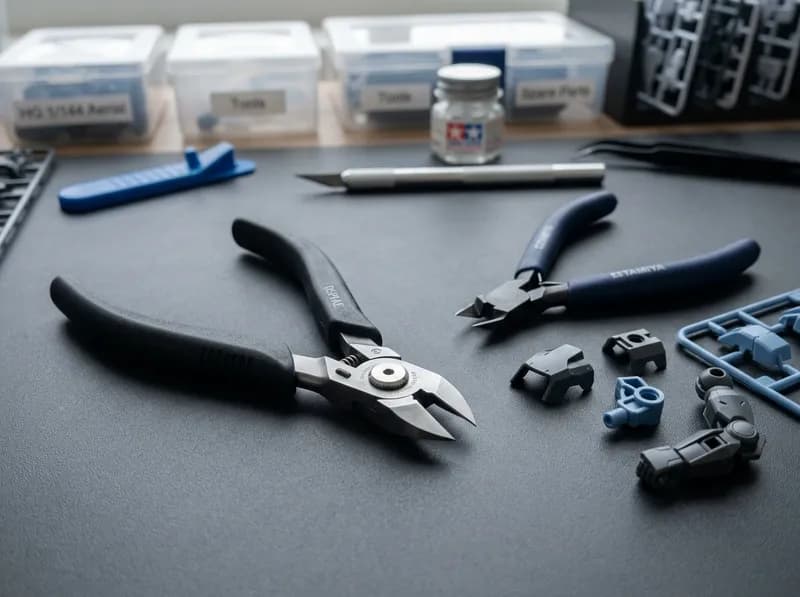
The DSPIAE ST-A 3.0 and GodHand SPN-120 are two high-end single-blade nippers designed for precision plastic-model work. Both target the same basic problem: removing sprue gates cleanly while reducing the amount of cutting, scraping, and sanding required afterward.
The important question is not simply which one is “better.” Both are already far beyond a conventional double-blade hobby nipper in terms of precision. The more useful comparison is how much difference there is between these two premium tools, what each one does particularly well, and whether the SPN-120's higher price is justified for your particular workflow.
The ST-A 3.0 stands out for its combination of fine cutting performance, a built-in limiting mechanism, and relatively accessible pricing. The GodHand SPN-120, part of the Ultimate Nipper line, is positioned as a flagship precision nipper with an extremely thin cutting edge and a strong reputation among experienced Gunpla builders.
For most builders upgrading from a standard nipper, either tool can represent a significant improvement. The difference becomes much smaller when comparing the ST-A 3.0 directly with another premium single-blade nipper. At that point, cutting feel, technique, durability, price, and personal preference become more important than simply asking which one produces a cleaner cut.
Two Nippers With the Same Basic Purpose
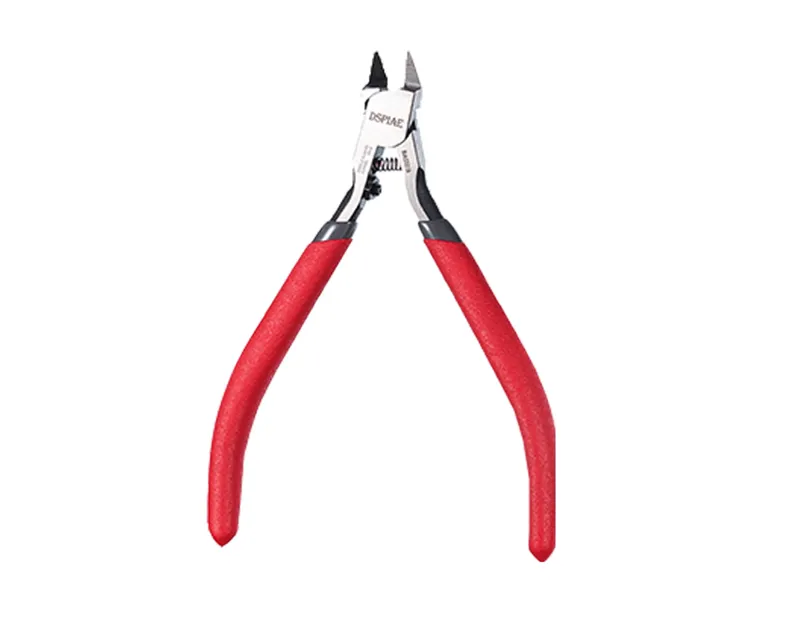
The DSPIAE ST-A 3.0 is a premium single-blade plastic-model nipper from DSPIAE's ST-A line. DSPIAE says the original ST-A was introduced in 2016, followed by the ST-A 2.0 and then the ST-A 3.0 in 2020, which introduced further manufacturing and design improvements.
The ST-A 3.0 uses a very thin single cutting edge and incorporates an adjustable limiting mechanism intended to reduce excessive blade closure. Product information also describes a polished cutting edge and hardness in the approximately 58–64 HRC range.
The GodHand SPN-120 is the standard model in the Ultimate Nipper 5.0 family. It is designed around an extremely thin single cutting edge and is specifically intended for precision cutting of plastic model parts.
GodHand's own specifications list the SPN-120 at approximately 120 mm long and 60 g, with a recommended cutting capacity of up to 3 mm for suitable plastics. For harder transparent or translucent materials, the recommended limit is lower.
The most important thing to understand is that neither product should be treated as a heavy-duty sprue cutter.
They are precision finishing tools.
A sensible workflow is still:
Conventional double-blade nipper → leave a small amount of gate → premium single-blade nipper → final cleanup if necessary.
Key Specifications
Feature | DSPIAE ST-A 3.0 | GodHand SPN-120 |
|---|---|---|
Type | Precision single-blade nipper | Ultimate Nipper 5.0 single-blade |
Blade design | Ultra-thin single edge | Ultra-thin precision edge |
Length | Approximately 120 mm | Approximately 120 mm |
Weight | Around 52–55 g depending on source | Approximately 60 g |
Recommended cutting capacity | Around the 3 mm class for suitable plastic | Up to 3 mm for suitable plastic |
Limiting mechanism | Adjustable limiter | No directly equivalent external limiter |
Intended use | Precision plastic-model cutting | Precision plastic-model cutting |
Protection | Protective/storage accessories depending on package | Protective blade cover |
Positioning | Premium precision tool | Flagship precision tool |
Official Japanese price | Varies by market | ¥5,940 |
Exact specifications can vary by market, package, or product revision, so official documentation should take priority over retailer listings.
More importantly, maximum cutting capacity should not be confused with the recommended everyday workflow. A premium single-blade nipper may technically be capable of cutting a relatively thick piece of plastic, but repeatedly doing so is not the same as using the tool for what it was designed to do.
What Does a Single-Blade Nipper Actually Do Better?
A conventional double-blade nipper cuts from both sides. As the two blades close, they compress and deform the plastic before completely separating it.
That is perfectly acceptable for removing parts from a runner, but it becomes less desirable when the goal is to make the final cut close to the surface of the part.
A single-blade nipper works differently. One side contains the cutting edge while the opposite side acts more like a flat supporting surface. When used correctly, this allows the remaining gate to be cut much closer to the part while reducing the amount of compression around the cut.
That is the fundamental reason premium single-blade nippers can produce cleaner gates.
The advantage is therefore not simply:
“The blade is sharper.”
The real benefit is:
less remaining plastic → less knife work → less sanding → faster cleanup.
This is especially valuable for Gunpla builders who build frequently or prefer clean builds without extensive post-processing.
Cutting Performance: Where the Difference Matters
The most useful way to compare the ST-A 3.0 and SPN-120 is to consider the complete cutting process.
The First Cut
The first cut should normally be handled by a conventional nipper.
The goal is to remove the part from the runner while leaving enough material around the gate to protect the precision blade.
This is particularly important for larger HG and MG gates, as well as larger parts with substantial runner connections.
Using either the ST-A 3.0 or SPN-120 as a general-purpose sprue cutter defeats much of the point of owning a precision single-blade tool.
The Second Cut
This is where the premium nipper starts to make sense.
After the bulk of the runner has been removed, the remaining gate can be approached with the single-blade nipper.
Both the ST-A 3.0 and SPN-120 are capable of leaving a much cleaner surface than a conventional double-blade nipper when used correctly.
The exact result depends on the plastic, the gate shape, blade condition, cutting direction, and operator technique.
The Final Cut
The biggest benefit appears when the remaining gate is small enough to be safely removed close to the part.
This is where the differences between premium nippers become much harder to judge.
The SPN-120 has an excellent reputation for very fine cutting, while the ST-A 3.0 is also capable of producing extremely clean gates. For many builders, the difference is less dramatic than the jump from an ordinary double-blade nipper to either of these tools.
That distinction is important when considering the price difference.
What About Stress Marks and Whitening?
Plastic whitening is one of the most frequently discussed advantages of premium single-blade nippers, but it is also one of the easiest areas to oversimplify.
Whitening can occur when the plastic experiences localized stress during cutting. Dark-colored PS parts tend to make these marks particularly visible.
A precision single-blade nipper can reduce the amount of deformation involved in the cut, but no nipper can guarantee zero whitening under every condition.
The final result depends on:
Plastic type
Plastic color
Gate thickness
Cutting direction
Blade condition
Cutting angle
Amount of force
Remaining gate thickness
GodHand specifically promotes the SPN-120 as a tool capable of producing clean cuts with reduced whitening. However, the company also warns that the extremely thin blade requires appropriate handling.
The same principle applies to the ST-A 3.0.
If a thick gate is forced through the blade at the wrong angle, even an expensive precision nipper can leave marks or suffer damage.
The ST-A 3.0's Limiting Mechanism
One of the most distinctive features of the ST-A 3.0 is its rear limiting mechanism.
The limiter and adjustment screw are designed to restrict excessive blade movement and reduce the risk associated with over-closing the handles.
This does not make the nipper inherently sharper. Its value is protection.
A precision single-blade tool can be damaged by:
Excessive force
Cutting material that is too thick
Closing the handles too aggressively
Twisting the nipper during a cut
Using the tip of the blade incorrectly
Applying sideways pressure
The limiter provides an additional layer of protection against some forms of misuse.
It does not make the ST-A 3.0 indestructible, however. The user still needs to understand how a thin single-blade nipper should be operated.
Handling and Ergonomics
The ST-A 3.0 is relatively light and uses an ergonomic handle design. Depending on the source and packaging, its weight is generally listed in the low-to-mid 50-gram range.
The SPN-120 is listed by GodHand at approximately 60 g.
In practice, weight alone does not determine which one feels better.
Hand size, spring tension, handle shape, finger position, and individual cutting technique all affect the experience.
GodHand emphasizes the light cutting force of the SPN-120, while reviews of the ST-A 3.0 generally describe it as comfortable and easy to control.
For long Gunpla sessions, both are considerably more refined than a cheap, stiff double-blade nipper.
It would be misleading, however, to claim that one is universally more comfortable. Ergonomics are partly personal.
Tolerance for Mistakes
This is an important consideration for beginners.
A premium single-blade nipper is not necessarily more beginner-friendly simply because it cuts better.
In fact, its precision can make correct technique more important.
The user should avoid:
Cutting thick sprue directly
Twisting the tool during a cut
Prying with the blade
Cutting metal
Using the blade tip as a lever
Excessive handle pressure
Closing the blade beyond its intended range
The ST-A 3.0's limiter provides a useful safeguard, but the SPN-120 also requires careful handling.
The more important lesson is:
A sharper nipper does not eliminate the need for proper technique.
Durability
Durability is difficult to summarize with a single number.
DSPIAE has published durability testing involving thousands of cuts under controlled conditions. Such manufacturer testing is useful evidence of the product's design goals, but it should not be interpreted as a guarantee of identical service life for every user.
The same principle applies to GodHand.
The actual life of a precision nipper depends heavily on:
Cutting frequency
Gate thickness
Plastic type
Cutting technique
Whether the blade is twisted
Whether the tool is dropped
Whether it is used on inappropriate materials
Blade maintenance
A builder who uses a conventional nipper for rough cutting and reserves the ST-A 3.0 or SPN-120 for final gates may get dramatically different results from someone who uses the precision tool for every cut.
How They Work With Different Gunpla Grades
HG
HG kits are a particularly good match for premium single-blade nippers because they contain many gates and are often built as relatively straightforward snap-fit models.
The ST-A 3.0 is more than capable of handling final gate cleanup on typical HG builds.
The SPN-120 offers the same fundamental benefit, but whether its additional refinement is worth the extra cost depends on the buyer.
RG
RG kits contain smaller parts and often require more precise handling.
This makes the clean-cut capability of a premium single-blade nipper particularly useful.
Both tools are appropriate, although careful handling is even more important because many RG components are small and delicate.
MG
MG kits have many more parts and a wider range of gate sizes.
For this reason, a two-nipper workflow becomes especially useful:
Heavy-duty double-blade nipper for initial cuts + precision single-blade nipper for final cleanup.
For builders producing MG kits regularly, the time saved on each gate can add up considerably.
PG and Large Kits
Large kits can contain substantial gates, making a conventional rough-cutting nipper even more important.
Neither the ST-A 3.0 nor SPN-120 should be treated as a replacement for a dedicated heavy-duty cutter.
ST-A 3.0 vs SPN-120
Category | ST-A 3.0 | SPN-120 |
|---|---|---|
Cutting performance | Excellent | Excellent |
Final gate quality | Excellent | Excellent |
Whitening control | Excellent with correct technique | Excellent with correct technique |
Cutting feel | Light and controlled | Extremely refined |
Limiting mechanism | Yes | No directly equivalent external system |
Error tolerance | Requires care | Requires care |
Durability | Good with correct use | Good with correct use |
Build quality | High | Flagship |
Learning curve | Moderate | Moderate |
Value | Strong depending on price | More expensive, but highly refined |
The important takeaway is that the difference is much smaller than the difference between either of these tools and a conventional hobby nipper.
That is why the buying decision should not be based solely on which one produces the absolute cleanest theoretical cut.
Is the SPN-120 Worth Paying More For?
This is the key question.
The SPN-120 is positioned as a flagship tool and carries the reputation and refinement associated with GodHand's Ultimate Nipper line.
If you build models frequently, care deeply about gate quality, already understand how to use a single-blade nipper, and are comfortable paying more for a premium tool, the SPN-120 has a clear reason to exist.
But if you are buying your first high-end single-blade nipper, the ST-A 3.0 can already cover the central use case extremely well.
In other words:
The ST-A 3.0 is not simply a cheaper substitute for a premium nipper. It is itself a serious precision tool.
The SPN-120 represents a further step toward the flagship end of the category.
Whether that final step matters depends on how much you value it.
Who Should Buy the ST-A 3.0?
The ST-A 3.0 makes particular sense for builders who:
Build Gunpla regularly
Already own a rough-cut nipper
Want cleaner gates
Want to reduce sanding
Prefer a clean, unpainted finish
Want a high-end single-blade nipper without spending as much as a flagship tool
Appreciate the additional protection provided by the limiting mechanism
For many hobbyists, this is enough.
Who Should Buy the SPN-120?
The SPN-120 is more compelling for:
Experienced builders
High-frequency Gunpla builders
Users who care heavily about final gate quality
Builders who already understand single-blade nipper technique
Users who are willing to pay more for a flagship tool
Modelers who simply prefer the feel and reputation of the Ultimate Nipper platform
The important point is that these benefits are incremental rather than transformational.
Should You Own Both?
For most builders, no.
The ST-A 3.0 and SPN-120 occupy essentially the same role.
Buying both usually creates significant functional overlap.
A more useful setup is:
Double-blade rough-cut nipper + ST-A 3.0
or:
Double-blade rough-cut nipper + SPN-120
That combination gives you a tool for removing large gates and another tool for precision finishing.
It is generally more practical than owning two premium single-blade nippers.
Ratings
Category | ST-A 3.0 | SPN-120 |
|---|---|---|
Cutting performance | 4.5/5 | 5/5 |
Gate finish | 4.5/5 | 5/5 |
Whitening control | 4.5/5 | 4.5/5 |
Handling | 4.5/5 | 5/5 |
Error tolerance | 4/5 | 4/5 |
Durability | 4.5/5 | 4.5/5 |
Build quality | 4.5/5 | 5/5 |
Learning curve | 4/5 | 4/5 |
Value | 4.5/5* | 4/5* |
Overall | 4.5/5 | 4.5/5 |
* Value depends heavily on local retail pricing.
These scores should not be interpreted as saying the two products are identical. The SPN-120 remains a flagship-level precision tool, while the ST-A 3.0 delivers much of the same core functionality at a potentially lower price.
Final Verdict: Which One Should You Buy?
If you are upgrading from an ordinary double-blade nipper and want your first serious single-blade tool, the DSPIAE ST-A 3.0 is likely to provide the larger practical upgrade than the price difference between the ST-A 3.0 and SPN-120 might suggest.
Its single-blade design, fine cutting performance, limiting mechanism, and overall design make it suitable for regular HG, RG, and MG work.
The GodHand SPN-120 makes more sense when you already know that you want a flagship single-blade nipper and are willing to pay more for its refined cutting experience.
The most important distinction is therefore not “budget tool versus professional tool.”
Both are professional-level precision tools.
The more useful distinction is:
ST-A 3.0: high-end precision with strong practical value.
SPN-120: flagship precision for builders who want to push the single-blade experience further.
If your current nipper is an ordinary double-blade model, either upgrade can be highly noticeable. If you already own a good ST-A 3.0, however, moving to an SPN-120 is unlikely to transform the appearance of every model you build. The improvement is more subtle and depends heavily on your technique, expectations, and local price difference.
For most Gunpla builders, the most rational setup remains simple: use a conventional nipper for the first cut and reserve one premium single-blade nipper for the final gate.
FAQ
Is the ST-A 3.0 better than the SPN-120?
Neither should be treated as an absolute winner. The SPN-120 is positioned as a flagship precision nipper, while the ST-A 3.0 offers a very similar core use case with a different design approach and a limiting mechanism.
What is the main difference between the ST-A 3.0 and SPN-120?
Both use an extremely thin single-blade design for precision plastic cutting. The ST-A 3.0 emphasizes practical value and includes an adjustable limiting mechanism, while the SPN-120 represents GodHand's flagship Ultimate Nipper platform.
Can the ST-A 3.0 replace the SPN-120?
For most Gunpla builders, yes in terms of the basic job it performs: precision gate removal. That does not mean the cutting feel and extreme performance are identical.
Is the ST-A 3.0 suitable for beginners?
It can be, but beginners need to learn proper single-blade technique. It should not be used as a heavy-duty sprue cutter.
Is the SPN-120 fragile?
It is a precision tool with an extremely thin blade. GodHand warns that excessive force, twisting, or inappropriate cutting can damage the blade.
Can a single-blade nipper replace a normal model nipper?
Not ideally. A conventional double-blade nipper remains useful for rough cutting, especially on large gates. A single-blade nipper is better reserved for precision finishing.
Is the SPN-120 worth the extra money?
That depends on the price difference and how frequently you build models. Experienced builders who place a high value on precision may appreciate the upgrade, while many users will find the ST-A 3.0 sufficient.
Should I buy both?
Usually not. Their functions overlap heavily. A rough-cut nipper plus either one of these premium single-blade tools is generally a more useful combination.
Products in this guide
DSPIAE
DSPIAE ST-A 3.0 nipper
The DSPIAE ST-A 3.0 is a precision single-blade nipper designed primarily for cleaning up plastic model nub marks. Its biggest advantage is
DSPIAE ST-A 3.0 nipperRelated GuidesMore →
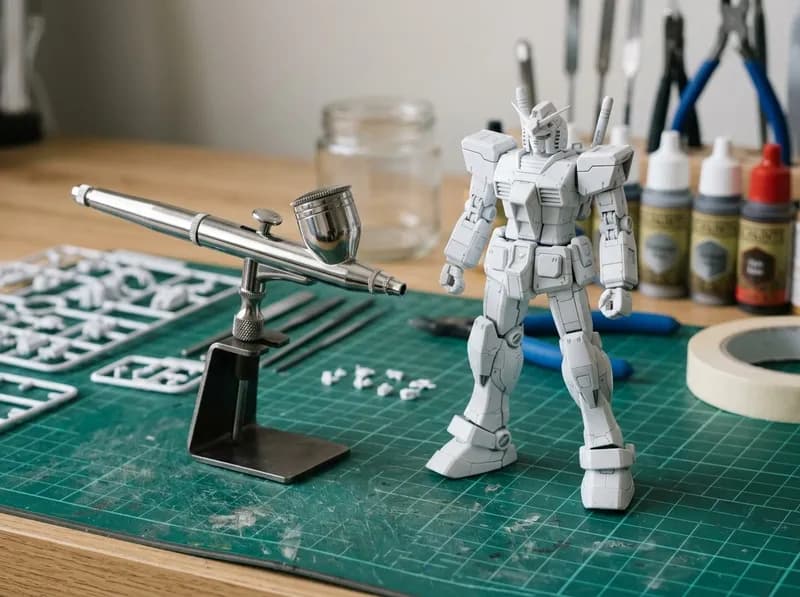
Best Airbrush for Miniatures and Model Kits: Top Picks for Gunpla, Plamo, and Scale Modeling
Looking for the best airbrush for model kits without overspending on features you may not need? This buying guide compares airbrushes for Gunpla, plamo, aircraft, tanks, and car models, from the entry-level Iwata NEO CN to the versatile Eclipse HP-CS and configurable Evolution 2024 CRplus. Learn how 0.3 mm, 0.35 mm, and 0.5 mm nozzles differ in practice, when a dual-action gravity-feed brush makes sense, and what to check before buying.
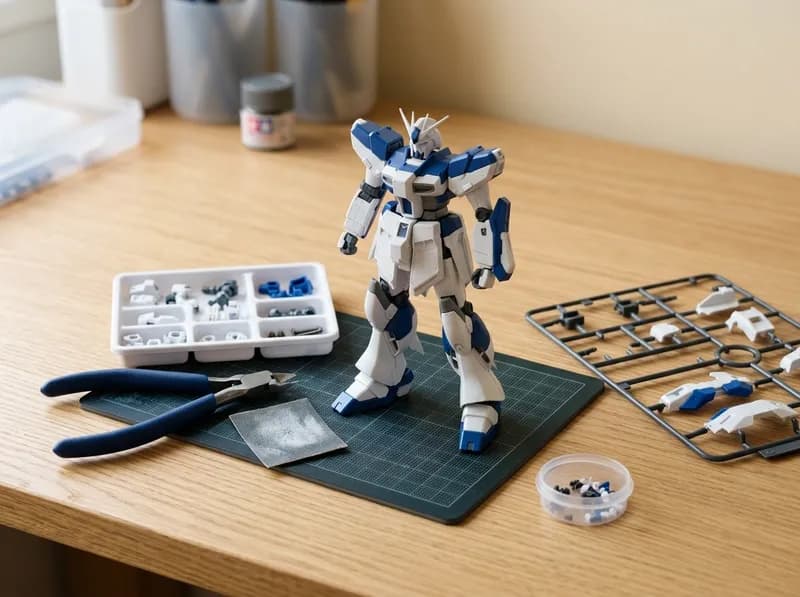
Best Model Tools for Beginners: What You Actually Need First
Looking for the best model tools for beginners? This practical buying guide separates essential supplies from optional upgrades, so you can spend money on tools you will actually use. Learn when basic double-blade nippers are enough, how files and sanding materials help clean up parts, and when a hobby knife, tweezers, cement, or painting supplies become useful. It also compares starter setups for different budgets and skill levels.
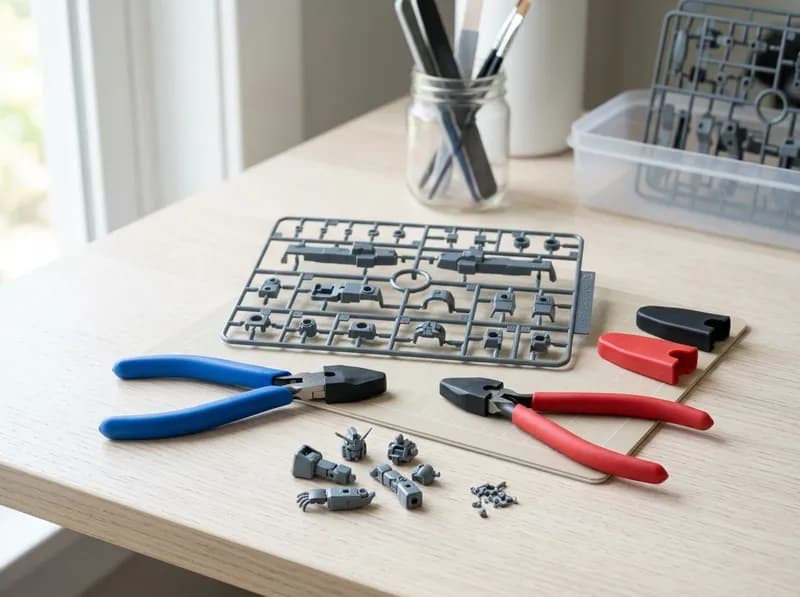
How to Choose Model Nippers: Single-Blade vs. Double-Blade
Choosing the right model nippers depends on the materials you cut, the size of the gates, and how clean you want the finished parts to look. This buying guide explains the differences between single-blade and double-blade nippers, when a two-tool workflow makes sense, and which features matter most. Compare options from GodHand, DSPIAE, and Tamiya, including blade geometry, jaw clearance, cutting limits, and price.