Best Airbrush for Miniatures and Model Kits: Top Picks for Gunpla, Plamo, and Scale Modeling
Looking for the best airbrush for model kits without overspending on features you may not need? This buying guide compares airbrushes for Gunpla, plamo, aircraft, tanks, and car models, from the entry-level Iwata NEO CN to the versatile Eclipse HP-CS and configurable Evolution 2024 CRplus. Learn how 0.3 mm, 0.35 mm, and 0.5 mm nozzles differ in practice, when a dual-action gravity-feed brush makes sense, and what to check before buying.
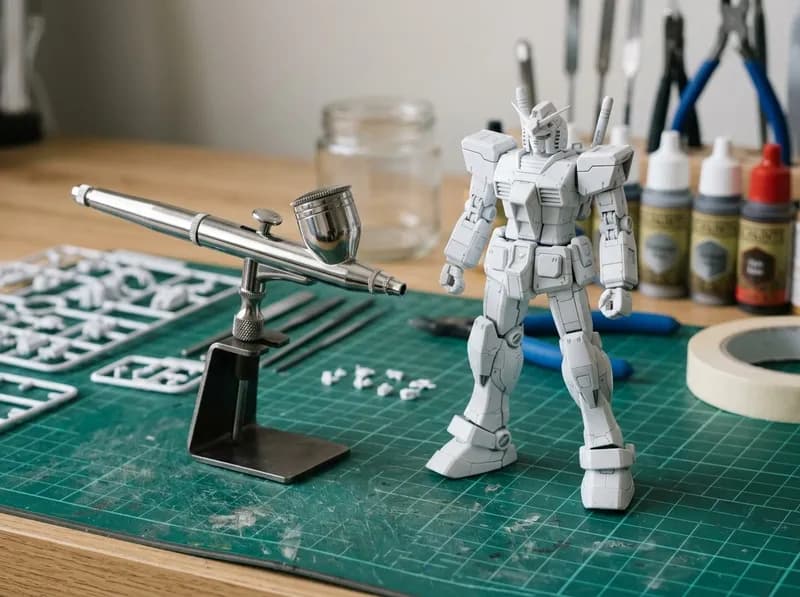
The best airbrush for Gunpla and scale modeling needs to do more than spray a fine line. It should handle primer, base coats, shading, and clear coats without making routine cleaning or replacement parts a constant headache. For most builders, a gravity-feed, dual-action airbrush with a 0.3–0.35 mm nozzle is the most practical place to start.
The Iwata Eclipse HP-CS is our top all-around pick for 2026. Its general-purpose setup works well across Gundam kits, aircraft, tanks, and model cars. The Harder & Steenbeck Ultra 2024 offers better value for beginners, while the GSI Creos Mr. Procon Boy PS-289 Platinum Ver.2 is worth considering if you prefer Japanese-made equipment. Builders who want interchangeable nozzle configurations should look at the Harder & Steenbeck Evolution 2024 CRplus.
There are also less expensive ways to get started. The Iwata NEO CN is a sensible entry-level brush, the Gaahleri GHAD-39 includes two needle sizes at a low price, and the Master Airbrush G22 + TC-77 kit bundles a brush with a compressor. The Badger Patriot 105 is another solid option for builders who prioritize broad coverage and U.S. parts support.
These recommendations are based on manufacturer specifications, U.S. retail listings, independent reviews, and scale-modeling community resources. They are not the result of hands-on spray testing for this article. Prices are approximate U.S. listing snapshots from late 2026, not guaranteed current prices.
Best airbrushes for Gunpla and scale models at a glance
Prices below are for the airbrush alone unless the entry is identified as a complete kit. Most standalone brushes require a separate compressor, hose, cleaning supplies, and suitable ventilation equipment.
Airbrush | Best for | Nozzle and feed | Approx. U.S. price | Main drawback |
|---|---|---|---|---|
Iwata Eclipse HP-CS | Best overall for Gunpla and scale models | 0.35 mm, gravity feed, dual action | $165–$190 | More expensive than entry-level brushes |
Harder & Steenbeck Ultra 2024 | Best value for beginners | 0.45 mm, gravity feed, dual action | About $100 | Less suited to very fine lines |
GSI Creos PS-289 Platinum Ver.2 | Japanese-made general-purpose option | 0.3 mm, gravity feed, dual action | About $130 | U.S. stock and pricing vary |
Harder & Steenbeck Evolution 2024 CRplus | Interchangeable nozzle configurations | Package-dependent, gravity feed, dual action | About $167–$250 | Conversion parts and package differences add complexity |
Badger Patriot 105 | Primers and broad coverage | 0.5 mm, gravity feed, dual action | About $100 | Requires an adapter for standard 1/8-inch hoses |
Iwata NEO CN | First airbrush from an established maker | 0.35 mm, gravity feed, dual action | About $70 | Less refined than the Eclipse |
Gaahleri GHAD-39 | Low-cost brush with two needle sizes | 0.35 and 0.5 mm, gravity feed, dual action | About $45 | Long-term parts support is less established |
Master Airbrush G22 + TC-77 | Complete starter package | 0.3 mm brush plus compressor | About $100 | Budget-level components |
Check the exact package before ordering. Some U.S. listings for the Evolution 2024 CRplus Solo describe a 0.28 mm headset with a 2 mL cup, while others list a 0.45 mm headset with a 5 mL cup. The HP-CS cup is another point of disagreement: Iwata and some reviewers specify 7 mL, while at least one major retailer lists 9 mL. Confirm the SKU and included accessories rather than relying on a generic product title.
How to choose an airbrush for Gunpla and scale modeling
Nozzle size matters, but control matters more
A smaller nozzle can help with fine lines, but it does not automatically produce a better finish. Paint consistency, air pressure, spray distance, needle movement, and nozzle cleanliness all affect the result.
For a first airbrush, 0.3–0.35 mm is a useful middle ground. It provides enough flow for ordinary armor parts and model bodies while remaining capable of controlled shading. A 0.2 mm setup can be useful for fine camouflage and narrow lines, but it demands more attention to thinning and cleaning. A 0.5 mm setup is convenient for primers and broad coats, particularly when working with thicker products.
Gravity feed or siphon feed?
A gravity-feed airbrush holds paint in a cup above the body. It is convenient for small batches, frequent color changes, and custom mixes, which makes it a natural fit for Gunpla and other detailed scale models.
A siphon-feed brush draws paint from a bottle underneath. That arrangement can be useful for larger quantities of one color, but it is less convenient when switching between small amounts of several paints.
For most hobby builders, gravity feed is the better default.
Dual action or single action?
A dual-action airbrush uses trigger movement to control airflow and paint delivery separately: pressing down starts the air, and pulling back introduces paint. This gives you more control over preshading, panel modulation, camouflage, and localized color work.
A single-action brush is simpler to operate and can handle broad coats, but it offers less control over paint flow while spraying. If you plan to do more than basic coverage, dual action is the more versatile choice.
All eight brushes in this guide use dual-action triggers.
Paint cup size and color changes
Cup capacity matters most when you consider how you paint.
Small cups: Better for small parts, touch-ups, and short sessions. They also reduce leftover paint and make color changes easier.
Larger cups: More convenient for painting many parts in the same color or covering large model surfaces.
Interchangeable cups: Useful if your workload varies, but check whether different cup sizes are included or sold separately.
The Iwata NEO CN includes 7 mL and 1.5 mL cups. Evolution 2024 cup sizes depend on the exact package, so check the listing before buying.
Cleaning, replacement parts, and long-term ownership
Every airbrush needs cleaning. The important differences are how easily you can maintain the paint path, how forgiving the nozzle assembly is, and whether replacement needles, nozzles, and seals remain available.
The Iwata Eclipse HP-CS uses a drop-in, self-centering nozzle that avoids some of the fiddliness associated with small threaded nozzle parts. Badger's Patriot 105 is known for its durable construction, but its M5 hose connection requires an adapter when used with standard 1/8-inch fittings. GSI Creos and Harder & Steenbeck publish model-specific replacement-part information.
Before buying an inexpensive airbrush, check whether you can actually purchase replacement needles and nozzles in the U.S. A low initial price is less attractive if a damaged component leaves the entire brush unusable.
The best airbrushes for miniatures and model kits
1. Iwata Eclipse HP-CS — Best overall
<text>Gravity feed · Dual action · 0.35 mm nozzle · Approx. $165–$190</text>
The Iwata Eclipse HP-CS is the strongest all-around choice for builders who want one airbrush for most model-painting tasks. Its 0.35 mm configuration sits in a useful middle ground: enough flow for primers and base coats, with sufficient control for panel shading and smaller parts.
That versatility makes it suitable for Gunpla, aircraft, tanks, cars, and other scale models. The drop-in, self-centering nozzle also makes routine maintenance less fiddly than systems that rely on small threaded nozzle components.
What works well
A versatile nozzle size for everyday model painting.
Suitable for primers, base coats, shading, and many clear-coat applications when used according to the paint manufacturer's instructions.
An established brand with extensive documentation and U.S. replacement-part availability.
A sensible long-term primary brush for builders who paint regularly.
What to consider
It costs substantially more than entry-level brushes.
Its standard configuration is not designed specifically for the finest possible linework.
A compressor, hose, and other painting equipment must be budgeted separately.
Buy it if: You paint regularly and want one dependable airbrush for different model types and finishes.
Consider something cheaper if: You are still deciding whether airbrushing suits your hobby. The NEO CN or a complete starter kit costs less upfront.
Verdict: The best airbrush for most Gunpla and scale-model builders who are ready to invest in a long-term primary tool.
2. Harder & Steenbeck Ultra 2024 — Best value for beginners
<text>Gravity feed · Dual action · 0.45 mm nozzle · 5 mL cup · About $100</text>
The Ultra 2024 is designed to make learning dual-action airbrushing less intimidating. Its beginner-focused Start Control feature limits trigger travel while you learn to coordinate airflow and paint delivery. The self-centering nozzle seat and straightforward cleaning design also make routine maintenance more approachable.
Its 0.45 mm nozzle favors general coverage over extremely fine detail, but that is not necessarily a disadvantage for a first airbrush. Priming parts, applying base colors, and painting larger surfaces are common tasks for new builders.
What works well
Good value for an airbrush around the $100 mark.
Start Control helps beginners develop consistent trigger technique.
Straightforward nozzle handling and cleaning.
Official parts documentation and conversion components are available.
What to consider
Very fine lines require more careful technique and paint preparation.
The 0.45 mm setup is less specialized for close-up detail work.
Builders who already know they want a premium long-term brush may prefer the Eclipse.
Buy it if: You are new to airbrushing and want a purpose-designed learning tool without paying premium prices.
Consider something else if: Fine-line work is your main priority or you already have enough experience to know exactly which nozzle configuration you need.
Verdict: A strong beginner airbrush for Gunpla and scale modeling, particularly if ease of learning matters more than fine-detail specialization.
3. GSI Creos Mr. Procon Boy PS-289 Platinum Ver.2 — Best Japanese-made alternative
<text>Gravity feed · Dual action · 0.3 mm nozzle · About $130</text>
The PS-289 is a good option for builders who prefer GSI Creos equipment and already use Mr. Hobby paints. Its 0.3 mm nozzle suits general-purpose color coats and panel shading, while the integrated air-adjustment valve provides a convenient way to adjust airflow at the brush.
For Gunpla builders using Mr. Color or Gundam Color, the PS-289 fits naturally into an established Japanese hobby-painting workflow. Replacement parts are cataloged, although U.S. availability and pricing can vary between specialist retailers.
What works well
A versatile 0.3 mm configuration.
Integrated air adjustment.
A natural match for common Mr. Hobby paint systems.
Model-specific replacement parts are available through the brand's parts ecosystem.
What to consider
U.S. stock and prices are less consistent than those of more widely stocked models.
A 0.3 mm nozzle is not automatically better at fine detail than a well-controlled 0.35 mm brush.
Verify the included accessories for the Platinum Ver.2 version.
Buy it if: You prefer GSI Creos equipment and find the PS-289 at a competitive price.
Consider the Eclipse instead if: The two cost about the same and you prefer a straightforward purchase with a broad U.S. support network.
Verdict: A credible general-purpose alternative, especially for builders already comfortable with the Mr. Hobby ecosystem.
4. Harder & Steenbeck Evolution 2024 CRplus — Best for interchangeable configurations
<text>Gravity feed · Dual action · Package-dependent nozzle and cup · About $167–$250</text>
The Evolution 2024 CRplus is worth considering if you want to change nozzle configurations as your work develops. The system supports different matched needle, nozzle, and air-cap assemblies, allowing one airbrush body to serve different spraying needs.
That flexibility can be useful when a single brush must cover both broad priming work and more controlled shading. It is less compelling if you only need a reliable all-purpose setup.
Important package differences: U.S. retailers do not consistently describe the Evolution 2024 CRplus Solo. Some listings specify a 0.28 mm headset and 2 mL cup; others describe a 0.45 mm headset and 5 mL cup. The Solo and 2-in-1 packages should not be assumed to contain the same components. Confirm the precise SKU and included headset before purchasing.
What works well
A modular system that can adapt to different tasks.
Published conversion-part information.
The option to expand an existing setup instead of buying a second complete airbrush.
What to consider
Conversion headsets add to the total cost.
The needle, nozzle, and air cap must be compatible as a matched assembly.
Package descriptions vary, making it important to verify the exact contents.
Buy it if: You know you will use more than one nozzle configuration and value the flexibility of a modular system.
Choose the HP-CS or Ultra instead if: You want a single dependable setup with fewer parts and less purchasing complexity.
Verdict: Best for builders who will genuinely use its configurability, rather than those attracted to the number of possible upgrades.
5. Badger Patriot 105 — Best American-made workhorse
<text>Gravity feed · Dual action · 0.5 mm nozzle · About $100</text>
The Badger Patriot 105 is a longstanding model-painting option, particularly for builders who prioritize durability, repairability, and broad coverage. Its 0.5 mm configuration is well suited to primers and base coats, including products that can be more demanding to spray through a finer setup.
It is less specialized for very fine shading than the 0.3–0.35 mm options in this guide, but that does not make it a poor choice. A larger nozzle can be useful when the work involves many parts, larger surfaces, or frequent primer sessions.
What works well
A robust, established design.
Good suitability for primers and broad coverage.
Longstanding U.S. manufacturer support and replacement-part availability.
A practical choice for builders who value repairability.
What to consider
The 0.5 mm configuration is less suited to very fine lines.
The M5 air-hose connection requires an adapter for standard 1/8-inch fittings.
Its construction prioritizes function over premium finish and refinement.
Buy it if: You spray a lot of primer and base coats and prefer an established American-made airbrush.
Consider a finer setup if: Most of your work involves tight shading, small localized color transitions, or narrow camouflage patterns.
Verdict: A durable general-purpose workhorse, especially for broad coverage and primer-heavy workflows.
6. Iwata NEO CN — Best entry-level airbrush from an established brand
<text>Gravity feed · Dual action · 0.35 mm nozzle · 7 mL and 1.5 mL cups · About $70</text>
The Iwata NEO CN offers a relatively affordable way to learn dual-action airbrushing. Its 0.35 mm nozzle is suitable for the same broad range of model-painting tasks that make the Eclipse HP-CS popular, and the two included cup sizes accommodate both larger paint batches and small touch-ups.
The difference is mainly in refinement, construction, and the overall feel of the tool. For someone painting a few kits each year, those differences may not justify paying considerably more for the Eclipse.
What works well
An accessible entry point into Iwata's product range.
A practical nozzle size for general model painting.
Two cup sizes for different workloads.
Manufacturer documentation and an established support ecosystem.
What to consider
Less refined than the Eclipse HP-CS.
Fewer configuration options than some modular alternatives.
Frequent painters may appreciate the more substantial investment in a higher-tier brush.
Buy it if: You want a genuine dual-action airbrush for occasional Gunpla or scale-model projects without spending $150 or more.
Consider the Eclipse if: You already know you will paint regularly and want a more refined long-term primary brush.
Verdict: A sensible first airbrush that can remain useful as a backup after you upgrade.
7. Gaahleri GHAD-39 — Best budget airbrush with two needle sizes
<text>Gravity feed · Dual action · 0.35 mm and 0.5 mm sets · About $45</text>
The Gaahleri GHAD-39 is attractive because it offers two needle/nozzle configurations at a price well below established premium brushes. The 0.35 mm setup covers general-purpose work, while the 0.5 mm option is useful for broader coverage. Its floating-nozzle design is intended to simplify assembly and maintenance.
Gaahleri has gained visibility in the hobby airbrush market, and independent reviews have given some of its products favorable attention. However, the brand has a shorter track record than Iwata, Badger, and GSI Creos, so long-term parts availability and service consistency deserve consideration.
What works well
Two nozzle configurations included.
Low initial cost.
A design intended to simplify nozzle handling.
Replacement components are sold directly through the brand's channels.
What to consider
Long-term support is less established than that of older manufacturers.
Documentation and service history are not as extensive.
Confirm the availability of replacement parts before relying on it as your only airbrush.
Buy it if: You want to experiment with different nozzle sizes on a tight budget or need an inexpensive secondary brush.
Choose an established alternative if: You value a longer service history and a well-developed replacement-parts network more than features per dollar.
Verdict: A compelling budget option, provided you verify spare-part availability and accept the shorter track record.
8. Master Airbrush G22 + TC-77 — Best complete starter kit
<text>Gravity feed · Dual action · 0.3 mm brush · Compact tank compressor · About $100 for the kit</text>
For someone starting with no equipment, the Master Airbrush G22 + TC-77 kit has one clear advantage: it bundles the airbrush and air supply into a single purchase. The package typically includes the G22 brush, hose, and a compact compressor with a small tank, regulator, pressure gauge, and moisture filter. Exact contents should be checked against the current listing.
The tank helps smooth airflow compared with a basic tankless diaphragm compressor, making the package a more practical starting point for ordinary hobby painting.
What works well
Brush and compressor in one package.
A 0.3 mm brush suited to general-purpose painting.
A small tank, regulator, gauge, and moisture filter in the typical configuration.
Less initial research and fewer compatibility decisions.
What to consider
The brush and compressor are budget-level components.
The compressor is intended for hobby use rather than a demanding workshop.
A spray booth, appropriate respirator, paint, thinner, and cleaning supplies are generally separate purchases.
Buy it if: You want an inexpensive way to begin airbrushing without assembling a system from individual parts.
Choose a standalone brush if: You already own a suitable compressor and air hose. In that case, the Ultra 2024 or NEO CN may be a better use of your money.
Verdict: A practical starter package for first-time users, with value coming from the complete setup rather than premium performance from any individual component.
What nozzle size is best for Gunpla?
For most builders, a 0.3–0.35 mm airbrush nozzle is the best starting point for general Gunpla painting. It can handle armor color coats, controlled shading, and many smaller parts without the additional maintenance demands of a specialist fine-detail setup.
Painting task | Nozzle size to consider | Other factors that matter |
|---|---|---|
General color coats on armor | 0.3–0.35 mm | Paint thinning, pressure, distance, trigger control |
Small parts and localized shading | 0.2–0.3 mm | Consistent paint flow and working distance |
Fine camouflage and narrow lines | 0.2–0.3 mm | Needle design, paint formulation, practice |
Primers and surfacers | 0.3–0.5 mm | Viscosity and manufacturer recommendations |
Metallic paints | 0.3–0.5 mm | Pigment size, suspension, thinning instructions |
Wings, car bodies, and large panels | 0.3–0.5 mm | Spray pattern, overlap, and consistent coverage |
There is no universal winner between 0.3 mm and 0.5 mm. A 0.3 mm brush is versatile and offers good control for general model painting. A 0.5 mm brush can make primer work and broad coverage easier, particularly with thicker products.
A 0.2 mm setup can produce fine lines, but only when paint consistency, air pressure, distance, and cleaning are under control. For a first airbrush, those variables usually matter more than buying the smallest nozzle available.
What PSI should you use for miniature painting?
The following are starting ranges rather than fixed settings. The right pressure depends on the airbrush, paint, thinning ratio, working distance, and desired spray pattern.
Task | Starting pressure |
|---|---|
Fine details and close work | 8–12 PSI |
General color coats | 15–20 PSI |
Primers and thicker products | 20–30 PSI |
GSI Creos guidance for Mr. Color is commonly around 15 PSI for airbrushing, but the paint's consistency and the specific task can require adjustments.
Set pressure with the trigger open so you can account for airflow rather than relying solely on the static gauge reading. If paint sputters or flow becomes inconsistent, check thinning, nozzle cleanliness, and pressure before assuming you need another airbrush.
Airbrush vs. spray cans for Gunpla: which costs less?
Airbrushing has a higher initial cost than spray cans, but it becomes more attractive as the number of projects increases.
A typical hobby spray can may cost around $12–$18, depending on the product and retailer. A complete budget airbrush setup might cost $200–$300 once you include a starter kit, basic ventilation equipment, and initial paint and thinner supplies. Higher-quality compressors, booths, and respiratory protection can push the total higher.
At those illustrative prices, the equipment cost alone is equivalent to roughly 12–25 cans at $12–$18 each. That is not a direct break-even calculation, because cans and airbrush setups do not necessarily replace one another one-for-one. The result depends on how many cans a project uses, whether you already own ventilation equipment, and which products you spray.
Airbrushing offers benefits beyond material cost:
More control over thin, even coats.
Easier preshading, panel modulation, and custom color mixing.
Less dependence on aerosol cans and their remaining propellant.
More flexibility when painting small parts or several models in different colors.
Spray cans still have advantages. They require less setup, avoid routine airbrush cleaning, and remain convenient for some primers and topcoats.
An airbrush makes the most sense if you paint regularly and want control over the finish. If you build only one or two kits a year, spray cans may be more economical and convenient.
Choosing an airbrush compressor for model painting
A good airbrush needs a steady air supply. Compressor choice affects pressure consistency, noise, moisture management, and how comfortable long painting sessions are.
Look for three basic features:
Pressure regulator and gauge: Lets you set repeatable pressure for different paints and tasks.
Moisture trap: Helps keep condensed water out of the air line, reducing water-related spitting and finish defects.
Storage tank: Smooths airflow and allows the compressor motor to cycle off between periods of operation.
Airbrush compressors worth considering
Compressor | Type | Main advantage | Trade-off |
|---|---|---|---|
Master Cool Runner II TC-326T | 3 L tank | Regulator, gauge, moisture trap, and tank in a common beginner configuration | Manufacturer's noise figure should not be treated as an independent measurement |
Timbertech AS186 | 3 L tank | Established budget compressor design with a long hobby-community presence | Availability and build quality can vary between sellers and versions |
Master TC-40 | Tankless | Compact format with regulator, gauge, and moisture trap in typical listings | Runs continuously and may produce more vibration or pressure fluctuation |
Gaahleri GTS-06 | Portable tankless | Compact, quiet-oriented design with adjustable pressure | Published maximum pressure and lack of a moisture trap can limit some tasks |
The Master Cool Runner II TC-326T and Timbertech AS186 are worth considering if you want a conventional tank compressor. A tankless unit can work for occasional painting, but it may be less comfortable during long sessions.
The Gaahleri GTS-06 is aimed at users who value a compact, quiet setup. Its published noise and pressure figures should be checked against the exact model, and its lack of a moisture trap is a practical limitation.
For apartment use, consider the noise of the compressor, vibration transmitted through the desk, and where the exhaust from your spray booth will go. A quiet compressor does not make solvent fumes safe to release indoors.
Check hose fittings before buying
Most hobby airbrushes use 1/8-inch fittings, but not every model follows that convention. The Badger Patriot 105 uses an M5 connection, so an adapter is generally required for a standard 1/8-inch hose.
Check the complete connection chain: airbrush, hose, compressor outlet, and any quick-disconnect fittings. Confirm compatibility before ordering rather than discovering that the parts do not connect when the package arrives.
Paint compatibility, thinning, and cleaning
Airbrush compatibility depends on the specific paint formulation, the seals in the brush, and the manufacturer's instructions. The words acrylic, lacquer, and enamel alone do not tell you everything you need to know about thinning or cleaning.
Using Mr. Color and Gundam Color
GSI Creos sells different paint chemistries within its Mr. Hobby and Gundam Color ranges. Its lacquer products and aqueous, water-based products do not use interchangeable thinning and cleaning methods.
For Mr. Color lacquer paints, a commonly cited starting point is approximately one part paint to one or two parts thinner. The appropriate ratio varies with the paint, desired coverage, pressure, and working distance. Mr. Color Leveling Thinner is often used when a smoother finish is desired, but it is not a substitute for following the instructions for the specific product.
Aqueous paints should be thinned with the recommended thinner or other medium specified by the manufacturer. Do not assume every hobby acrylic can be thinned with water.
For metallic paints, follow the paint maker's recommendations for thinning and application. Pigment characteristics can affect how smoothly a particular formulation sprays through a given nozzle.
Lacquer, enamel, and clear-coat considerations
Lacquer paints are popular for Gunpla and scale modeling because they dry quickly and can support durable layered finishes. Their solvents also create inhalation and fire hazards that require careful handling.
Enamels remain useful for panel lining and weathering. Clear coats deserve particular care because an incompatible product or application technique can damage the underlying finish.
Test unfamiliar paint combinations on a spare part or plastic spoon before applying them to a finished model.
A practical airbrush cleaning routine
Flush the paint path with a cleaner compatible with the paint system after each session and between color changes.
Wipe accessible surfaces gently rather than scraping them.
Remove the needle and nozzle only as directed by the airbrush manual.
Never force a dirty needle through a seated nozzle.
Check seal compatibility before using stronger solvents.
Deep-clean when paint flow becomes irregular or normal flushing no longer restores performance.
You do not need to disassemble every component after every short session. Follow the maintenance instructions for your exact model, especially when handling delicate nozzle parts.
Ventilation and respiratory protection for airbrushing
Airbrushing produces airborne paint mist. Lacquer paints and their thinners can also release solvent vapors, so a small airbrush should not be treated as harmless simply because it uses relatively little paint.
Local exhaust ventilation is more important than opening a window. A suitable spray booth should capture overspray near the model and exhaust it safely. For solvent-based paints, plan the ducting and discharge location before choosing a booth. A recirculating desktop filter should not be assumed to remove hazardous solvent vapors.
Respiratory protection must match the actual paint and thinner hazards. A properly fitted half-face respirator with appropriate organic-vapor cartridges and particulate filtration may be necessary for solvent-based hobby painting. Cartridge selection, replacement schedules, and fit all matter. An ordinary dust mask does not protect against organic solvent vapors.
Read the safety data sheet (SDS) for the paint and thinner you intend to use. Keep ignition sources away from flammable vapors and follow the product's storage and handling instructions.
If you cannot provide suitable ventilation and protection for your chosen paint system, consider switching to a less hazardous system or changing the painting arrangement. The airbrush itself does not eliminate exposure risks.
Common airbrush buying mistakes
Choosing by nozzle size alone. A 0.2 mm nozzle is not automatically better for Gunpla than a 0.3–0.35 mm setup.
Ignoring the compressor. Inconsistent airflow can undermine an otherwise good airbrush.
Forgetting hose adapters. Badger's M5 connection is a common compatibility issue.
Buying without checking replacement parts. Confirm that needles and nozzles are available before committing to an unfamiliar budget brand.
Assuming all acrylic paints thin the same way. Different formulations require different thinning and cleaning methods.
Underestimating ventilation. A dust mask and an open window are not adequate substitutes for appropriate protection.
Misreading kit contents. Starter packages do not usually include a spray booth, paints, a respirator, and every cleaning accessory.
Confusing product versions. Check the exact Evolution 2024 CRplus package instead of assuming every Solo listing contains the same headset.
Buying more airbrushes than necessary. Start with one versatile brush and learn to control thinning, pressure, and distance before adding specialist equipment.
Frequently asked questions
What is the best airbrush for Gunpla?
The Iwata Eclipse HP-CS is the strongest all-around choice for most builders who paint regularly. The Harder & Steenbeck Ultra 2024 is a better value option for beginners, while the GSI Creos PS-289 Platinum Ver.2 is worth considering if you prefer Japanese-made equipment and the Mr. Hobby paint ecosystem.
Is an airbrush worth it for Gunpla compared with spray cans?
It can be, particularly if you paint several kits a year and want better control over thin coats, shading, and custom colors. A complete budget setup may cost around $200–$300 before more advanced equipment, so occasional builders may find spray cans more economical. The break-even point depends on how many cans each project uses and what equipment you already own.
What airbrush nozzle size is best for miniatures?
For a single all-purpose airbrush, start with 0.3–0.35 mm. A 0.2 mm setup can help with fine lines, while 0.5 mm is useful for primers and broad coverage. Paint preparation, pressure, distance, and technique remain important at every nozzle size.
What PSI should I use for miniature painting?
Reasonable starting points are 8–12 PSI for fine details, 15–20 PSI for general color coats, and 20–30 PSI for many primers and thicker products. Adjust to the specific paint and airbrush, and set the regulator while air is flowing.
How do I thin Mr. Color or Gundam Color for airbrushing?
For Mr. Color lacquer paints, approximately 1:1 to 1:2 paint to thinner is a common starting range, but the correct ratio depends on the product and spraying conditions. Use the recommended thinner for the specific paint. Gundam Color lacquer and aqueous formulations require different thinning and cleaning approaches.
Do I need a respirator for airbrushing miniatures?
Respiratory protection depends on the paint, thinner, ventilation, and exposure conditions. Solvent-based paints require particular care; an ordinary dust mask does not protect against organic solvent vapors. Read the relevant SDS and use suitable, properly fitted protection together with effective local exhaust ventilation.
Do I need an airbrush compressor with a tank?
No. A tankless compressor can work for occasional hobby spraying, while a tank can smooth airflow and reduce how often the motor runs during a session. A conventional 3 L tank compressor is a practical choice for many home model-painting setups.
Should I buy the Harder & Steenbeck Evolution 2024 CRplus Solo or 2-in-1?
Check the exact SKU and included headsets first. Retailer listings for the Solo package disagree about nozzle and cup sizes, while a 2-in-1 package is intended to provide more than one configuration. The extra cost makes sense if you will use both setups; otherwise, a simpler single-configuration brush may be better value.
Are inexpensive airbrushes such as the Gaahleri GHAD-39 good enough?
The GHAD-39 offers useful features for its price, including 0.35 mm and 0.5 mm configurations. It can be a reasonable budget choice, but its long-term support history is shorter than that of established manufacturers. Check replacement-part availability and warranty terms before buying.
How often should I clean an airbrush?
Flush the paint path after every session and between color changes. Clean more thoroughly when flow becomes inconsistent or routine flushing no longer works. Full disassembly is not necessary after every short session; follow the maintenance instructions for your specific model.
Can one airbrush handle both fine details and large model parts?
Yes. A well-controlled 0.3–0.35 mm brush can handle small parts, shading, and larger surfaces with adjustments to thinning, pressure, distance, and spray pattern. A second brush or interchangeable headset becomes useful when you regularly switch between fine detail and high-volume coverage.
Why does the Iwata Eclipse HP-CS cost more than the Harder & Steenbeck Ultra 2024?
The difference is not simply the nozzle size. Build refinement, trigger feel, the overall design, and long-term ownership support also affect the price. At the approximate prices in this guide, the Ultra is the more accessible learning tool, while the Eclipse is the stronger all-around investment for frequent painting.
Can I use lacquer paints in an airbrush marketed for acrylics?
Often, but do not assume compatibility without checking the manufacturer's guidance. Confirm that the seals are suitable for the solvent system and follow the correct cleaning procedure. Lacquer spraying also requires appropriate ventilation, fire precautions, and respiratory protection.
Is the Iwata NEO CN good enough, or should I save for the Eclipse?
The NEO CN is a reasonable choice for learning dual-action control and painting a few kits a year. The Eclipse HP-CS is worth considering if you paint regularly and value its more refined design and long-term use. The difference is not that the NEO cannot paint a good model; it is whether the upgrade justifies the additional cost for your workload.
Final verdict: which airbrush should you buy?
The best airbrush for miniatures and model kits depends on how often you paint, which finishes you use, and whether you need a single versatile tool or a more specialized setup.
Best overall: Iwata Eclipse HP-CS — a versatile 0.35 mm airbrush for regular Gunpla and scale-model painting.
Best for beginners: Harder & Steenbeck Ultra 2024 — beginner-oriented controls and strong value.
Best Japanese-made alternative: GSI Creos PS-289 Platinum Ver.2 — a general-purpose choice that fits naturally into the Mr. Hobby ecosystem.
Best configurable option: Harder & Steenbeck Evolution 2024 CRplus — worth the extra complexity if you will use multiple nozzle configurations.
Best American-made workhorse: Badger Patriot 105 — particularly suitable for primers and broad coverage.
Best budget airbrush: Gaahleri GHAD-39 — two nozzle configurations at a low initial price, with a shorter support track record.
Best established-brand entry option: Iwata NEO CN — suitable for occasional painting and learning.
Best complete starter kit: Master Airbrush G22 + TC-77 — a convenient way to get both a brush and compressor in one purchase.
For most people starting out, a dependable 0.3–0.35 mm airbrush is a better first purchase than a specialist fine-detail model. Learn to thin paint consistently, regulate pressure, control spray distance, and clean the brush properly before deciding that you need another nozzle size.
Remember to budget for the entire painting setup. The airbrush is only one part of the system: a compatible compressor and hose, effective exhaust ventilation, appropriate respiratory protection, and paint-specific cleaning supplies all contribute to a workable and safer Gunpla or scale-model painting space.
Related GuidesMore →
Best Model Tools for Beginners: What You Actually Need First
Looking for the best model tools for beginners? This practical buying guide separates essential supplies from optional upgrades, so you can spend money on tools you will actually use. Learn when basic double-blade nippers are enough, how files and sanding materials help clean up parts, and when a hobby knife, tweezers, cement, or painting supplies become useful. It also compares starter setups for different budgets and skill levels.
How to Choose Model Nippers: Single-Blade vs. Double-Blade
Choosing the right model nippers depends on the materials you cut, the size of the gates, and how clean you want the finished parts to look. This buying guide explains the differences between single-blade and double-blade nippers, when a two-tool workflow makes sense, and which features matter most. Compare options from GodHand, DSPIAE, and Tamiya, including blade geometry, jaw clearance, cutting limits, and price.
DSPIAE ST-A 3.0 vs GodHand SPN-120: Which Single-Blade Nipper Should You Buy?
The DSPIAE ST-A 3.0 and GodHand SPN-120 are two premium single-blade nippers designed for precise Gunpla gate removal. This comparison examines their cutting performance, handling, durability, limiter design, value, and suitability for different Gunpla grades. It also explains why a conventional nipper plus one precision single-blade tool is often a more practical setup than owning multiple premium nippers.