Amazon Landscape Lighting Kits vs. Professional Brass/Copper Systems
Amazon landscape lighting kits can be excellent value for small DIY projects, but larger properties require more than inexpensive fixtures. This guide compares budget kits with professional brass and copper systems, covering fixture materials, cable gauge, voltage drop, transformers, connectors, replaceable bulbs, warranties, and replacement parts to help homeowners choose a system that fits both their property and long-term maintenance needs.
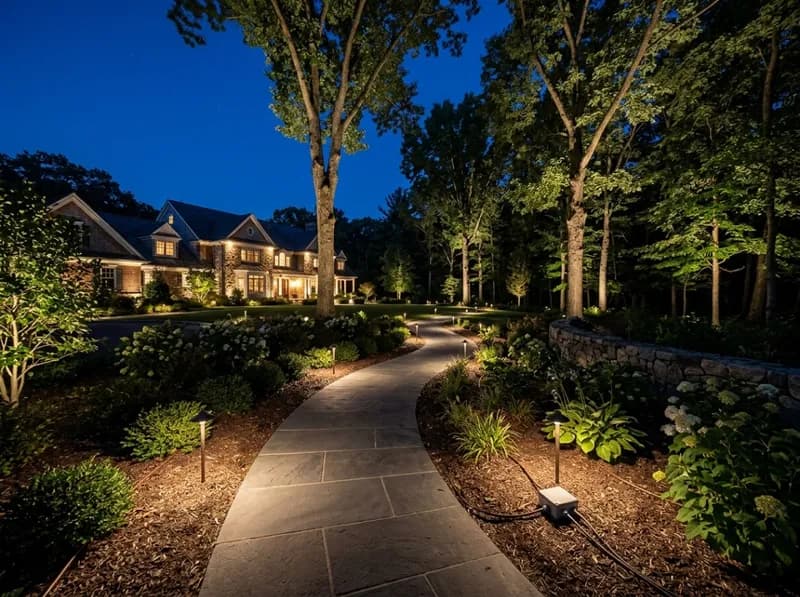
If you need to light a short walkway, a few shrubs, or several small trees, a $100–$250 landscape lighting kit can be a perfectly reasonable choice. Spending three or four times as much on brass fixtures doesn't automatically give you three or four times the light.
The decision gets more complicated when the lighting becomes a permanent system: 12, 20, or more fixtures; long cable runs; multiple zones; year-round use; hard-to-reach fixtures; or plans to expand later.
At that point, you're not really comparing plastic lights with brass lights. You're comparing two different ways of building and maintaining a landscape lighting system.
Fixture material matters, but so do the cable gauge, transformer, connectors, voltage drop, replacement parts, warranty, and whether you can still get compatible components several years from now.
That's why a cheap Amazon landscape lighting kit can be the best value for one property and a poor choice for another.
Amazon Kits vs. Professional Systems at a Glance
The most useful comparison isn't the price of one fixture. It's the architecture of the complete system.
Factor | Typical Low-Cost Amazon Kit | Professional Brass/Copper System |
|---|---|---|
Upfront cost | Usually lowest | Higher |
Fixture materials | Plastic, aluminum, zinc alloy, or mixed | Brass, copper, aluminum, or bronze |
Cable | Often 16/2; varies by kit | More gauge and length choices, often 14/2 or heavier |
Connectors | Quick-connect, piercing, or clamp styles are common | More connector and splice options |
Transformer | Often basic and fixed-capacity | More sizes, voltage taps, and control options |
Voltage management | Best suited to compact layouts | Better suited to long or complex runs |
Light source | Often integrated LED | Replaceable bulbs or serviceable modules are common |
Replacement parts | Depends heavily on seller and brand | Usually easier to source |
Expansion | Often limited | Usually part of the product ecosystem |
Installation | Simple | Requires more planning |
Warranty | Highly variable | Often stronger, but terms vary |
Long-term maintenance | Product-dependent | Usually easier to service |
Best use | Small, simple projects | Permanent or expandable systems |
One important caveat: "Amazon kit" and "professional system" aren't technical categories.
Amazon carries everything from inexpensive plastic kits to legitimate aluminum systems with decent transformers. Professional manufacturers also sell integrated-LED aluminum fixtures.
For this comparison, "Amazon kit" means the typical inexpensive bundled kit, while "professional system" means a modular low-voltage system built around individually specified components.
That distinction matters because the cheapest Amazon kit and a high-end contractor-grade system are not the only two choices.
The Price Gap Isn't Always Huge
The cheapest kits make the difference look enormous because everything comes in one box.
For example, Home Depot currently lists a six-pack Hampton Bay plastic integrated-LED path-light kit with a transformer for $39.97. Larger aluminum kits with 12 lights, a 60W transformer, and 100 feet of 16/2 wire cost more, but are still firmly in DIY territory.
At the professional end, the numbers can be surprisingly close.
VOLT's Basics Landscape Lighting Kit currently lists at $230.99 on sale, versus $329.99 regular. The kit includes four cast-brass spotlights, two brass path lights, a 100W transformer, LED lamps, 50 feet of direct-burial cable, connectors, and stakes.
SUNVIE's 12-light aluminum KT-W12S kit is around $259.99 and includes a 300W transformer, 12W spotlights, aluminum housings, IP65-rated fixtures, and 12–24V AC/DC compatibility.
So the market doesn't break neatly into "cheap Amazon kit" and "$1,000 professional system."
A decent aluminum DIY kit and an entry-level brass system can be separated by only a few dozen dollars.
The larger price differences show up with bigger systems, premium brass or copper fixtures, heavier cable, specialty fixtures, larger transformers, and professional installation.
What are you paying for?
A low-cost kit puts most of the value into convenience:
Fixtures in one box
One transformer
One cable configuration
Preselected connectors
Simple installation
One purchase
A modular system costs more because it gives you more choices:
Different fixture types
Different cable gauges
Multiple transformer sizes
Voltage taps
Replaceable lamps
Individual replacement components
Expansion fixtures
More connector options
Longer or more detailed warranty coverage
The difference is less about the amount of light produced by each fixture and more about what happens to the system after installation.
Fixture Materials: Plastic vs. Aluminum vs. Zinc vs. Brass vs. Copper
Material is important, but it shouldn't be treated as a universal lifespan chart.
You'll find outdoor-lighting claims saying plastic fixtures last 3–5 years, 10–15 years, or even longer, while brass is sometimes described as lasting 30–50 years or more. Those numbers aren't reliable enough to use as a buying formula.
Actual service life depends on the material, alloy, coating, climate, installation, physical abuse, electrical components, and maintenance.
The more useful question is: what happens to this fixture as it ages, and can I replace or service the parts that fail?
Plastic
Plastic keeps costs down, reduces weight, and works well for inexpensive path-light kits.
It makes sense when:
The installation is small
Fixtures aren't likely to be hit
Appearance isn't critical
Replacement is inexpensive
You don't expect to expand the system
The weaknesses are mostly physical. UV exposure can degrade some plastics, stakes can become brittle, and adjustment hardware may not survive repeated movement.
For a $40–$100 system lighting a small walkway, that may not matter. Replacing the fixture later can be cheaper than maintaining a more expensive system.
Plastic isn't automatically a bad material. It's simply a material that makes more sense when replacement is inexpensive.
Aluminum
Aluminum covers a huge range of quality, which makes it harder to judge from the material name alone.
It's lightweight, widely used outdoors, and naturally forms a protective oxide layer. Coatings can provide additional protection, but the alloy, surface treatment, and environment still matter.
For many DIY buyers, aluminum is the middle ground worth considering first.
A well-made aluminum fixture can be considerably more substantial than a cheap plastic light without approaching the cost of a solid-brass system. SUNVIE's KT-W12S, for example, uses die-cast aluminum and IP65-rated fixtures.
The finish matters, particularly in coastal environments. A properly coated outdoor aluminum fixture is a different proposition from thin aluminum with a low-quality painted finish.
Zinc Alloy
Zinc alloy appears frequently in inexpensive outdoor fixtures because it can be die-cast into complex shapes at relatively low cost.
The problem is that "zinc alloy" doesn't tell you enough about long-term outdoor performance.
Look at the specific alloy if the manufacturer provides it, the finish, warranty, installation environment, and availability of replacement parts.
A zinc-alloy fixture from a company with a real parts ecosystem can be perfectly usable. A mystery-metal fixture with no replacement support is a different proposition.
Brass
Brass has become a standard material for higher-end landscape lighting because it combines mechanical strength with good outdoor corrosion resistance.
It also works well with a serviceable design. Brass fixtures commonly use replaceable MR16, MR11, or G4 lamps, removable lenses, replaceable stakes, and other individual components.
Gardenreet, for example, sells brass spotlights with replaceable MR16 lamps, glass lenses, IP65 ratings, ETL certification, and lifetime fixture warranties. VOLT's brass fixtures use similar serviceable designs across much of its range.
Brass isn't immune to outdoor aging. It develops patina, and corrosion behavior depends on the environment and alloy.
The practical advantage is simpler:
Outdoor aging doesn't necessarily turn a solid-brass fixture into a disposable product.
Also pay attention to the wording in the listing. Solid brass and brass-plated fixtures are not the same thing.
Copper
Copper is another durable outdoor material and is particularly popular with homeowners who like the natural patina that develops over time.
It has the same limitation as brass, however: the fixture material doesn't solve electrical problems.
Copper doesn't reduce voltage drop. It doesn't make an undersized cable adequate. It doesn't increase transformer capacity, and it doesn't repair a bad underground connection.
Brass and copper address fixture construction. They don't replace good electrical design.
A useful apples-to-apples comparison
Material comparisons are normally difficult because the brass and aluminum versions are completely different products.
WAC's 5011 accent light is a useful exception. It is offered in both solid die-cast brass and aluminum versions with the same 2700K output, the same 50–1,160 lumen range, and the same beam adjustment.
A specialty retailer's September 2026 pricing showed the brass version at about $265.98 and the aluminum version at $229.98 — roughly a $36 difference per fixture.
The brass version also carried a 10-year finish warranty compared with five years for the aluminum version.
Across six fixtures, that difference becomes about $216.
That's a useful reminder that the brass premium isn't always several hundred percent.
Serviceability: What Happens When a Light Fails?
This is one of the biggest differences between a cheap kit and a modular system.
Imagine a fixture stops working five years after installation.
With an inexpensive integrated-LED kit, you may need to check:
The connector
The cable
The transformer
The LED module
Whether the exact fixture is still available
If the fixture cost $15–$25, replacing it may be perfectly reasonable.
The problem becomes more obvious when there are 15 or 20 fixtures spread around a property.
A modular brass fixture may allow you to replace the bulb, socket, lens, stake, connector, lead, or fixture head individually.
VOLT's warranty documentation covers individual fixture components such as fixture bodies, glare guards, knuckles, O-rings, seals, socket assemblies, and lenses across its brass and copper products. The company also states that it retains inventory of discontinued products for warranty replacement.
Gardenreet similarly sells separate transformers, cable, LED bulbs, connectors, stakes, mounts, lenses, and individual fixtures.
That doesn't guarantee every component will remain available indefinitely.
It does mean the system was designed around replaceable components rather than treating the entire light as one disposable unit.
For a small $40 lighting kit, that distinction may not matter.
For a permanent 20-fixture installation, it can matter a lot.
Voltage Drop Is More Important Than Fixture Material
Voltage drop has nothing to do with whether a fixture is brass, aluminum, or plastic.
Low-voltage landscape lighting operates with relatively low voltage. As cable length increases, resistance causes voltage to fall along the run. Fixtures near the end of a long run can receive less voltage than those closer to the transformer.
Three variables are especially important:
Total load
Cable length
Wire gauge
CAST Lighting recommends considering cable gauge and wiring topology as runs become longer and describes daisy-chain, hub, T, and combination layouts for larger systems.
A simple example
Suppose you have 10 fixtures at 5W each.
That's a 50W load.
A brass fixture and a plastic fixture operating at the same voltage don't change the voltage drop simply because of their housing material.
The electrical conditions depend on the load, cable, distance, topology, and voltage.
Kichler's published voltage-drop planning table provides a useful illustration. Under its stated assumptions, a 50W 12V load corresponds to roughly:
10 feet on 16 AWG
16 feet on 14 AWG
24 feet on 12 AWG
39 feet on 10 AWG
Those aren't universal limits. They're Kichler's planning figures under specific assumptions.
The important point is that wire gauge becomes increasingly important as distance and load increase.
Our best low voltage landscape lighting kits guide goes deeper into transformer sizing, cable gauge, and wiring layouts.
12V vs. 24V
A 24V system has an electrical advantage on longer runs because the same wattage requires less current.
But voltage isn't interchangeable.
A 12V AC fixture shouldn't simply be connected to a 24V system because 24V is theoretically better.
Some products are designed for a range of voltages. SUNVIE's aluminum kit, for example, specifies 12–24V AC/DC compatibility. Gardenreet's systems are generally built around 12V AC/DC fixtures with transformer taps in the 12–15V range.
Choose the voltage architecture around the fixtures, transformer, cable layout, and future expansion.
Cable Gauge Matters
One of the easiest mistakes is to spend more on the fixtures while underestimating the cable.
Common landscape lighting cable sizes include:
16/2
14/2
12/2
10/2
The lower the gauge number, the thicker the conductor.
A short, low-wattage walkway can work perfectly well with 16/2. Larger properties with longer runs and heavier loads may need 12/2 or 10/2.
The advantage of a modular professional system isn't that it automatically uses thicker cable.
It's that you have more choices.
CAST sells landscape cable in gauges from 8 through 16. Gardenreet's kits include 14/2 oxygen-free copper cable in 100- or 250-foot configurations.
A budget kit may give you one cable option. A modular system lets you design the cable around the property.
Wiring Topology Matters on Larger Properties
A simple kit naturally encourages a simple layout.
That's perfectly fine for a short walkway.
It becomes less convenient when lights are spread across a large yard.
Common approaches include:
Daisy chain
Hub
T
Combination
Daisy chains are easy to install, but voltage can fall toward the far end.
Hub and T layouts allow shorter branches and can distribute the load more effectively.
This is one reason modular systems scale better. The advantage isn't that the brass fixture produces better light. The advantage is that the electrical system can be designed around the property instead of forcing the property into one bundled cable layout.
Connectors Are a Small Cost With a Big Job
Landscape lighting connections have to deal with:
Rain
Irrigation
Soil moisture
Temperature changes
Corrosion
Gardening and landscaping work
The fixture itself can be perfectly healthy while an underground connection fails.
You'll encounter piercing connectors, clamp connectors, gel-filled connectors, waterproof wire nuts, crimp connections, screw terminals, and proprietary quick-connect systems.
Don't automatically assume that a quick connector is bad.
SUNVIE's FastLock2 system is designed around quick installation. CAST offers dedicated crimp and hub-splice hardware for permanent installations. Gardenreet supplies connectors with its kits and sells replacements.
The more useful questions are:
Is the connection appropriate for a wet outdoor environment?
Can it be serviced later?
Are replacement connectors available?
Is the installation method documented?
A $100 fixture doesn't compensate for a bad splice.
Transformers: The Part That Determines How the System Grows
The transformer controls much more than whether the lights turn on.
It determines:
Available wattage
Output voltage
Voltage taps
Control features
Expansion capacity
Installation requirements
A well-specified $250 system can be a better electrical installation than a $500 system with an undersized transformer.
Don't size the transformer exactly to today's load
If the fixtures total 80W, an 80W transformer leaves no practical room for expansion.
Manufacturers use slightly different recommendations for headroom.
VOLT recommends keeping the load at or below about 80% of transformer capacity. Kichler's guidance for its low-voltage LED systems calls for roughly 10–20% headroom. Gardenreet recommends at least 20%.
The exact number isn't universal.
The consistent advice is: don't design the transformer around 100% of the current load.
If you're planning to add four more fixtures next year, include them in the calculation now.
Voltage taps
Professional transformers often provide multiple output taps.
VOLT's current transformers provide 12–15V output ranges with multi-tap designs. Gardenreet's kit transformers similarly use 12–15V multi-tap output and sealed stainless-steel housings.
A multi-tap transformer doesn't eliminate voltage drop. It gives you another tool for managing it.
Integrated LED vs. Replaceable Bulbs
Integrated LED fixtures aren't automatically low quality.
They have some obvious advantages:
Simple installation
Compact fixture design
No separate bulb purchase
Consistent optical performance
The trade-off is what happens when the LED source eventually fails.
With a replaceable MR16 or G4 lamp, you replace the lamp.
With an integrated LED fixture, you may need to replace the LED module or the entire fixture.
VOLT sells lamp-ready brass fixtures using replaceable lamps, and Gardenreet's brass spotlights use replaceable MR16 bulbs.
Budget products such as Hampton Bay's six-pack path-light kit use integrated LEDs.
For a six-light walkway, integrated LED may be the simpler choice.
For a 15- or 20-fixture permanent system, replaceable lamps can make maintenance easier over time.
Warranty Length Isn't the Whole Story
"Lifelong" or "lifetime" warranty sounds impressive, but check what the manufacturer actually covers.
Look for separate terms for:
Fixture housing
Finish
Socket
Lens
LED module
Transformer
Cable
Connectors
Timer
Photocell
VOLT, for example, provides lifetime residential coverage for brass and copper fixture components, while aluminum components generally have five-year coverage. Transformers and accessories have their own terms.
Gardenreet also lists lifetime coverage for its brass fixtures and kit transformers, with different coverage for accessories.
A lifetime fixture warranty doesn't mean the entire lighting system is covered for life.
Parts availability matters too.
A five-year warranty from a company that still sells the same fixture, bulb, stake, and connector can be more useful than a longer warranty on a product that disappears after one season.
Replacement Parts Are a Long-Term Buying Factor
Before buying, ask:
If one fixture fails in 2029, can I buy another one?
That's an important question with marketplace products.
An Amazon listing is a sales channel, not a long-term parts catalog. A seller can disappear. A brand can change its model numbers. A product can be replaced by a newer version.
That doesn't make Amazon products unreliable.
It means you shouldn't assume that today's listing will still exist when you need a replacement.
Established landscape-lighting manufacturers have more incentive to maintain a compatible product family.
VOLT, for example, maintains discontinued-product inventory for warranty replacement and sells expansion kits, bulbs, transformers, and individual fixtures. Its Basics line has matching spotlight and path-light expansion kits, currently promoted around $139.99 and $181.99.
Gardenreet similarly sells individual fixtures, transformers, cable, bulbs, connectors, and stakes.
For a permanent installation, that parts ecosystem is worth considering alongside the initial price.
Installation: Simpler Can Be Better
One advantage of a bundled kit is obvious: it's easier.
The fixtures, transformer, cable, connectors, and stakes arrive together. For six lights around a walkway, that's often exactly what you want.
A modular system requires more decisions:
Fixture type
Bulb
Transformer
Cable gauge
Cable length
Wiring topology
Connector type
Voltage tap
Future expansion
That's useful on a large property but unnecessary for a simple installation.
Complexity isn't automatically a benefit.
The right system is the simplest system that handles the property properly.
Also separate component cost from professional installation cost.
A professionally installed landscape-lighting system can include design, load calculations, trenching or burial, cable routing, splicing, voltage testing, fixture placement, and aiming.
A $1,500 professional installation is not equivalent to buying $1,500 worth of lighting components.
Long-Term Cost of Ownership
The better comparison isn't simply:
$199 vs. $999
It's:
Initial cost + replacements + expansion + maintenance + installation effort
There isn't enough reliable failure-rate data across generic landscape lighting kits to assign a meaningful five-year failure rate. It's better to look at the kind of installation you're actually building.
Scenario A: Small suburban walkway
Think:
6–8 fixtures
Short runs
Simple layout
No expansion
Moderate use
A good inexpensive kit makes a lot of sense.
If the complete system costs $100–$200 and one fixture eventually needs replacement, you're still likely ahead.
Best value: quality budget kit.
Scenario B: Front yard and driveway
Now you're looking at:
12–20 fixtures
Path lights and spotlights
Longer cable runs
Trees and planting beds
Year-round operation
Possible future expansion
At this point, cable gauge and transformer capacity become much more important.
A budget kit can still work, but you need to check its actual electrical specifications.
A modular system becomes more attractive because you can choose the transformer, cable, branches, and fixtures around the property.
Best value: depends on the layout, but modular systems become much more compelling.
Scenario C: Large permanent property
Think:
20+ fixtures
Multiple zones
Long cable runs
Large trees
Architectural lighting
Future additions
This is where system architecture becomes the priority.
You need enough transformer capacity, appropriate cable gauge, reliable connections, voltage management, and a source for replacement parts.
The cost of fixing a bad design can quickly exceed the original savings. Digging up a long cable run because of voltage-drop problems isn't an attractive way to save $200.
Best value: modular system.
Real Product Examples
These products show how much space exists between a $40 plastic kit and a large contractor-grade installation.
Product | Current price | Material | Fixtures | Transformer | Cable | Light source | Warranty |
|---|---|---|---|---|---|---|---|
Hampton Bay 6-pack path kit | $39.97 | Plastic | 6 | Included | Included | Integrated LED | Product-specific |
SUNVIE KT-W12S | $259.99 | Die-cast aluminum | 12 | 300W | Lead wires; system cable varies | Integrated LED | 2 years |
VOLT Basics Kit (LOWKIT1) | $230.99 sale / $329.99 regular | Brass | 4 spot + 2 path | 100W | 50 ft | Replaceable MR11/G4 LED | Lifetime for brass fixtures |
Gardenreet Spot + Path Kit | From $592.09 | Solid brass | 6–12 spot + 2–6 path | 150W or 300W | 100–250 ft, 14/2 OFC | Replaceable MR16/G4 | Lifetime for brass + transformer |
Gardenreet Spotlight Kit, no transformer | From $196.19 | Solid brass | 4–6 spot | Not included | Included | Replaceable MR16 | Lifetime for brass |
The Hampton Bay kit is the budget extreme.
SUNVIE sits in the middle with aluminum construction, 12 fixtures, and a 300W transformer.
VOLT's Basics kit is probably the most interesting comparison because it shows that "professional" doesn't necessarily mean four figures. Six brass fixtures, a transformer, cable, bulbs, and connectors can cost around $231 on promotion.
Gardenreet moves toward a larger modular setup with more cable, larger transformer options, replaceable lamps, and a broader component ecosystem.
The takeaway isn't that one of these products is universally better.
It's that fixture count alone tells you very little about value.
How to Choose Based on Your Property
Small walkway
For six to eight path lights on short runs, keep the system simple.
A quality budget kit with a properly sized transformer is usually enough.
Trees and architectural lighting
Pay more attention to:
Beam angle
Lumens
Optics
Adjustability
Fixture stability
Cable routing
Transformer capacity
A well-designed aluminum spotlight can be excellent value. Brass isn't automatically brighter.
Large front yard
Start calculating the system rather than counting fixtures.
Look at:
Total wattage
Cable lengths
Wire gauge
Branches
Transformer capacity
Future fixtures
This is where modular systems start making more sense.
Large property
Favor a modular system with:
Standard low-voltage cable
Multiple transformer options
Replaceable lamps or serviceable LEDs
Reliable connectors
Individual replacement fixtures
Expansion components
Documented specifications
You want a system that still makes sense when one component fails several years later.
When Is an Amazon Landscape Lighting Kit the Better Buy?
A good inexpensive kit is usually the better choice when most of these are true:
Fewer than about 10 fixtures
Short cable runs
Simple layout
No major expansion plans
DIY installation
Limited budget
You're comfortable replacing an inexpensive fixture later
But don't choose purely by fixture count.
Look for:
Clearly specified transformer capacity
Adequate cable gauge
Outdoor-rated cable
Reasonable connectors
Aluminum construction where appropriate
Replaceable bulbs if available
A real warranty
Individual replacement fixtures
Also check the exact configuration.
A "12-light kit" can still have a relatively small transformer and thin cable. The number printed on the box doesn't tell you whether the electrical system is suitable for your property.
When Is Professional Brass or Copper Worth It?
The premium becomes easier to justify when:
The installation is permanent
The property is large
Cable runs are long
There are multiple zones
You expect to expand
Fixtures are difficult to access
You want replaceable lamps
You expect to own the property for many years
The argument isn't simply that brass is stronger.
It's the combination of:
better fixture construction + more electrical options + better serviceability + stronger parts support.
That's a much more useful way to think about the premium.
Quick Comparison
Factor | Typical Amazon Kit | Professional Brass/Copper System |
|---|---|---|
Upfront cost | Low | Moderate to very high |
Fixture material | Plastic/aluminum/zinc/mixed | Brass/copper/aluminum depending on model |
Corrosion resistance | Highly product-dependent | Generally strong, but alloy and environment still matter |
UV resistance | Depends on plastic and coating | Metal housings avoid most plastic-aging issues |
Connector quality | Varies widely | More choices and serviceable methods |
Cable options | Often limited | Broad gauge and length range |
Voltage management | Best for basic layouts | Better suited to long or complex runs |
Transformer options | Usually one bundled model | Multiple wattages and voltage taps |
Serviceability | Often fixture-level | More often component-level |
Replacement parts | Seller-dependent | Stronger manufacturer ecosystem |
Expandability | Limited | Usually a core strength |
Installation difficulty | Low | Moderate |
Maintenance | Simple initially | More deliberate, but easier to service |
Best use | Small DIY project | Permanent, complex, or expandable installation |
Ownership model | Buy, install, replace as needed | Install, maintain, repair, expand |
The word typical matters.
There are inexpensive kits with good aluminum fixtures, and there are professional systems using integrated LEDs.
The product's actual architecture matters more than the category printed on the product page.
Three Things to Check Before Buying
If you only check three things, make them these.
1. Transformer capacity
Don't count lights. Add up watts.
Then check how much capacity remains for future fixtures.
2. Cable
Find the:
Gauge
Length
Total load
Longest run
If a kit gives you 16/2 cable and you're planning a large property around one long run, calculate voltage drop before buying.
3. Replacement parts
Ask what happens when a fixture fails.
Can you buy another fixture?
Can you buy the bulb, stake, connector, or transformer separately?
If the answer isn't clear, treat the product as a low-cost lighting project rather than permanent infrastructure.
FAQ
Are cheap Amazon landscape lights worth it?
Yes, for the right project. A good inexpensive kit can be excellent value for a small walkway or modest DIY installation. Long runs, many fixtures, future expansion, and long-term maintenance make the decision more complicated.
Are brass landscape lights worth the money?
They can be, particularly for permanent installations where serviceability and long-term parts availability matter. For a small walkway, the additional cost may never pay for itself.
Is brass better than aluminum for landscape lighting?
Not universally. Brass offers strong outdoor durability and mechanical serviceability, while aluminum is lighter, less expensive, and can perform well when properly designed and finished.
How long do brass landscape lights last?
There is no reliable universal lifespan. Claims range widely because service life depends on the alloy, finish, climate, installation, and maintenance. Solid brass can develop patina without becoming a disposable fixture, which is one of its practical advantages.
What is the difference between cheap and professional landscape lighting?
Usually the system rather than one fixture. Professional product lines tend to offer more cable choices, transformer options, replaceable components, documented specifications, expansion parts, and long-term parts support.
Does landscape lighting wire gauge matter?
Yes. Wire gauge affects resistance and voltage drop. Longer runs and higher loads generally require thicker cable.
How far can you run low-voltage landscape lighting?
There is no universal maximum distance. It depends on voltage, total load, wire gauge, topology, and acceptable voltage drop.
What causes voltage drop in landscape lighting?
Resistance in the cable. Longer runs and higher loads increase voltage drop; thicker wire and higher operating voltage can reduce it.
What does a lifetime warranty on landscape lights cover?
It depends on the manufacturer. A lifetime fixture warranty may not cover the transformer, cable, connectors, timer, or other accessories for the same period.
Are integrated LED landscape lights worth it?
They can be. Integrated LEDs simplify installation and can provide consistent output. The main trade-off is serviceability when the LED source eventually fails.
Can landscape lighting fixtures be repaired?
Some can. Replaceable-bulb and modular fixtures are generally easier to maintain than sealed integrated-LED fixtures.
How much does a professional landscape lighting system cost?
Components can range from roughly $231 for an entry-level brass kit to $500–$1,000 or more for larger modular systems. Professional installation is a separate expense and can substantially increase the total project cost.
Can I mix different landscape lighting brands?
Sometimes. Check voltage, AC/DC compatibility, wattage, connector design, transformer capacity, and bulb compatibility. Brand matching is less important than electrical compatibility.
What cable size should I use for low-voltage landscape lighting?
There isn't one correct size. 16/2 can work for short, light runs, while 14/2, 12/2, or heavier cable may be appropriate as distance and load increase. Use the manufacturer's voltage-drop guidance or a reliable calculator.
Are professional brass systems always better?
No. A properly designed aluminum system can outperform a badly designed brass system. The professional system's advantage is the greater range of components and design options available for building and maintaining a complex installation.
What I'd Buy
Small DIY project: a good kit
For six to eight lights, short runs, and a simple layout, I'd keep the system inexpensive.
There's little reason to spend hundreds more on brass simply to light a walkway.
The SUNVIE 12-pack/300W configuration is an interesting value if you need more fixtures and want aluminum rather than plastic.
Permanent landscape installation: modular brass
For a property you'll own for many years, brass becomes easier to justify.
Replaceable bulbs and individual components can make maintenance less expensive and less frustrating later.
VOLT's Basics kit starts around $231 on promotion, while larger Gardenreet systems add heavier cable and larger transformer options.
Long cable runs: modular system
The reason isn't brighter light.
It's the ability to choose cable gauge, transformer taps, wiring topology, and multiple runs.
Future expansion: buy the infrastructure first
If today's six fixtures could become 15 next year, don't size the transformer and cable only for six.
Design for the likely end state.
Long-term serviceability: modular system
A replaceable bulb and an available replacement fixture become valuable the first time something fails.
Lowest upfront cost: budget kit
If the goal is simply to get basic landscape lighting installed inexpensively, a good kit wins.
Best value overall: it depends on the property
For a small yard, a $100–$250 kit can be the clear value winner.
For a large permanent installation, a $300–$800 modular system can cost more initially and still be the better long-term purchase.
The mistake is assuming that the lowest purchase price automatically means the lowest ownership cost — or that the most expensive system automatically provides it.
Final Verdict
The real difference between a cheap landscape lighting kit and a professional brass or copper system isn't simply plastic versus brass.
It's how the system is built and what happens after installation.
For six or eight lights on a short walkway, an inexpensive kit can be exactly the right answer. If a fixture eventually fails, replacing a $20 light may be more economical than maintaining a much more expensive system.
The calculation changes when you're lighting 15 or 20 fixtures across a large property.
Cable gauge matters. Voltage drop matters. Transformer capacity matters. Connectors matter. Replacement parts matter.
That's where modular brass and copper systems earn their higher price. Not because brass produces better light, but because a well-designed system gives you more options to repair, maintain, replace, and expand the installation.
Before paying the premium, separate the problems:
Fixture material, electrical design, connector quality, and serviceability are different things.
Brass can solve a fixture-construction problem. It can't fix voltage drop.
A larger transformer can't repair a bad underground connection.
A lifetime fixture warranty doesn't help much if you can't get the replacement part you need.
For a small DIY project, buy the simple system that meets the electrical requirements.
For a large permanent installation, buy a system you can still understand, maintain, and expand five or ten years from now.
Spend 3–5× more when the property genuinely needs a long-term lighting system. Don't spend it simply because "professional" sounds better.
Related GuidesMore →
Best Pergolas of 2026: A Buying Guide to Roof Types, Weather Ratings, and Cost
Shopping for the best pergola in 2026? This buying guide compares wood, aluminum, retractable-canopy, and louvered pergolas, with product recommendations for different budgets and backyard layouts. Learn how to evaluate wind ratings, snow loads, roof drainage, anchoring, and installation requirements before you buy. It also explains why manufacturer specifications sometimes conflict with retailer listings and how to estimate the total cost beyond the advertised kit price.
Best Metal Raised Garden Beds in 2026: 10 Options Compared
Choosing the best metal raised garden bed involves more than comparing dimensions and sticker prices. This 2026 guide compares options from Vegega, Vego Garden, Birdies, Epic Gardening, and budget brands, covering steel thickness, protective coatings, structural reinforcement, warranties, and assembly formats. It also explains how bed height affects growing conditions and soil costs, helping gardeners choose a setup that fits their space, budget, and long-term expectations.
Best Low Voltage Landscape Lighting Kits (2026): A DIY Buying Guide
Compare the best low voltage landscape lighting kits for 2026, from budget DIY systems to premium brass setups. This guide looks beyond fixture count to transformer capacity, cable gauge, connectors, brightness, expandability, and replacement parts, helping homeowners choose a system that fits their yard and can handle future additions.