Best 64 Audio IEMs in 2026: U4s, U6t, U12t, Volür and More
Choosing a 64 Audio IEM means deciding what kind of sound, fit and listening experience you want. The U4s emphasizes bass and engagement, the U6t offers an all-balanced-armature alternative, and the U12t targets a more versatile reference presentation. This guide compares their specifications, published measurements and reviewer opinions while explaining how technologies such as tia, apex, LID and Apex Core affect the buying decision.
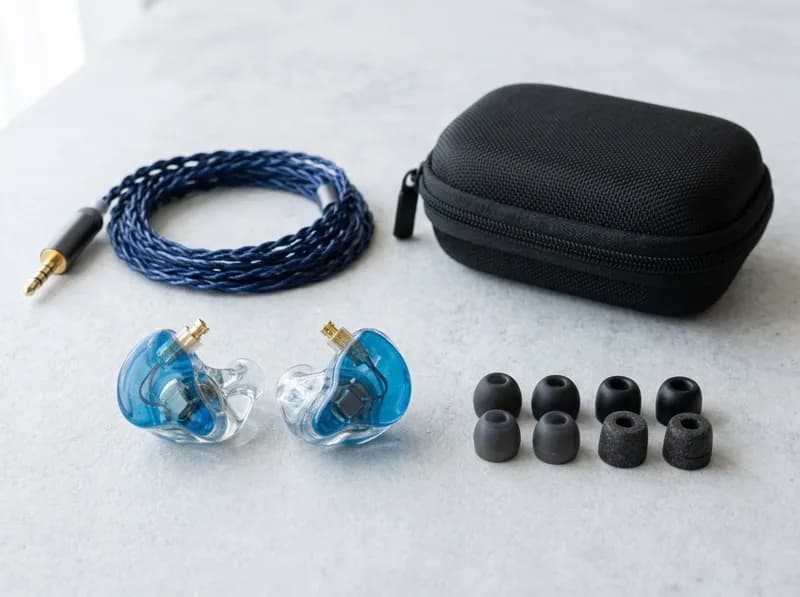
64 Audio's 2026 U.S. lineup spans a $349.99 entry-level stage monitor and a $3,999 tunable flagship. The catalog includes 16 universal-fit models, nine custom-fit models, and a separate official B-stock selection. These products are not arranged on a simple performance ladder. The $1,199 U4s is a four-driver hybrid with a dynamic bass driver, the $1,399 U6t uses six balanced armatures, the $1,399 Solo relies on a single planar driver, and the $2,299 Trió combines three drivers with 64 Audio's full tia system. More drivers do not automatically mean better sound.
The more useful question is what kind of sound and fit you need. A balanced reference IEM, a bass-focused hybrid, a treble-forward design, and a secure stage monitor serve different purposes. Technologies such as tia, apex, LID, Apex Core, True Isobaric and Helmholtz resonators help define those designs, but none is a quality ranking by itself.
There is also a substantial measurement record behind several of the best-known models. Twenty-seven squig.link rigs aggregated for the U12t show a median 3 kHz dip of -8.2 dB. Audio Science Review's GRAS 45C measurement describes a similar feature as "a failing." SoundStageNetwork measured the Nio on a GRAS 43AG and reported 95.1 dB sensitivity against a 105 dB manufacturer claim. The HEADPHONE Community has published B&K 5128 and GRAS measurements of the Volür's apex modules. Other useful evidence includes Crinacle's Harman preference scores, Headphones.com's 0-ohm versus 75-ohm test of LID, and Klaus Eulenbach's IEC 60318-4 work on insertion depth. These tests do not always agree, and those differences matter when comparing expensive IEMs.
Ownership costs deserve the same attention as sound quality. 64 Audio's U.S. terms allow eligible universal-fit returns within 30 days but charge a 15% restocking fee. On a $3,999 Ocean, that is about $600 before return shipping. Custom products are final sale, and several authorized U.S. dealers do not accept opened in-ear monitors at all. A buyer who gets the tuning or fit wrong can face a substantial loss.
This guide brings together the official U.S. catalog, independent measurements and reviews, owner reports, current and discontinued model status, B-stock and used prices, and the return and warranty terms that affect the real cost of ownership. Where published sources disagree, the different figures are identified rather than treated as interchangeable.
The guide is based on manufacturer specifications, named independent reviews and laboratory measurements, owner reports, retailer listings and price trackers. No new listening tests or measurements were performed for this article. All measured figures are attributed to their original sources.
Quick Verdict: The Best 64 Audio IEM for Most Buyers
Best all-round reference: U12t, $1,999. The U12t uses 12 balanced armatures in a four-way crossover, alongside tia, apex and LID technologies. Its 2025 revision introduced a T6061 aluminum shell, a Pearl Premium Cable with both 3.5 mm and 4.4 mm connections, and all four apex modules as standard. It remains the most versatile and extensively documented model in the lineup. The main caveat is a measurable 3 kHz recession: the median dip is -8.2 dB across 27 squig.link rigs. Reviewer opinions on value are also divided, with a 59/41 split in one aggregation. Official B-stock costs $1,559.20, while the used market is around $985.
Best bass-focused option under $1,200: U4s, $1,199. One dynamic driver handles low frequencies, while three balanced armatures cover the rest of the range, including a tia high-frequency driver. The HEADPHONE Community considered it particularly compelling around $1,000, and Headphones.com argued that it had replaced the more expensive Nio as the better value. Some owners and community discussions raise concerns about its 2–4 kHz midrange response. The m12 apex module has been suggested as a possible workaround, although the U4s ships with M15 and M20 modules rather than m12.
Best musical all-BA alternative: U6t, $1,399. Six balanced armatures, a 10-ohm impedance rating and 108 dB/mW sensitivity make the U6t a different proposition from the hybrid U4s. Community impressions often describe its midrange as natural, particularly with vocals and acoustic instruments. It is a tuning preference, not an automatic upgrade over the U4s.
Best for bass impact, with a treble warning: Volür, $2,499. Two 9 mm dynamic drivers operate in a True Isobaric arrangement alongside eight balanced armatures. Headphones.com identified a broad 12–14 kHz peak that can add a shimmery, sibilant quality to female vocals and a clicky edge to cymbals. The review considered it a potential dealbreaker and placed the Volür's resolution below the U12t and only marginally above the U4s. Divinus Velvet tips have been reported to reduce the treble peak, but that is not a guaranteed fix.
Best stage monitor under $800: Aspire 3, $649.99. MusicRadar's April 2026 review found it the strongest model in the Aspire range for vocal clarity and separation. It adds a custom high-frequency waveguide to the range-wide Helmholtz resonators and Apex Core design. The Aspire 1 at $349.99 is a less expensive choice when basic personal monitoring is the main requirement.
Best custom stage monitor: A6t, $1,399. Six balanced armatures in a four-way configuration make the A6t a versatile option for vocalists, guitarists, drummers and engineers. The custom shell can provide a more secure fit, but the purchase requires approved ear impressions and is final sale.
Best planar option: Solo, $1,399. The Solo uses one 14.2 mm planar driver, two Helmholtz resonators, Apex Core and LID. It comes with both 3.5 mm and 4.4 mm cables. Nine squig.link rigs place its response within approximately ±3 dB of the $219 7Hz Timeless between 20 Hz and 10 kHz, although the Solo has a -6.4 dB dip near 3.5 kHz. That comparison is important when assessing its price.
Best tunable flagship: Ocean, $3,999. Ocean combines six drivers, four apex modules, two tia screens and four back-vent filters. It appeared at CanJam events in August and September 2026 before its formal Chinese launch on October 30. At the November 8 research cutoff, it had barely a week of retail history and no independent bench measurements. The U12t, by comparison, has years of measurements and owner feedback behind it.
Why the 64 Audio Lineup Is Difficult to Compare
Three different product categories overlap in the 64 Audio catalog: fit, intended use and driver architecture. A model's position in one category does not necessarily tell you where it belongs in the others.
Comparison axis | Options | Why it matters |
|---|---|---|
Fit | Universal or custom | Affects returns, resale, ear impressions and possible refitting costs |
Intended use | Stage monitoring or audiophile listening | Isolation, fit stability, cable routing and sound priorities differ |
Driver architecture | Dynamic, BA-only, planar, hybrid, isobaric dual-DD or full tia | Influences bass response, treble character and source requirements |
Tuning control | Swappable apex modules or integrated Apex Core | Determines whether accessories such as m12 and mX can be used |
Catalog status | Current, limited edition, discontinued or B-stock | Affects warranty, service eligibility and resale value |
Price overlaps make comparisons even less straightforward. The U6t and Solo both cost $1,399, despite using six balanced armatures and one planar driver respectively. The U12t and A12t share a $1,999 price but differ in fit. The U18t, U18s and A18t all cost $2,999 and use 18 drivers, yet target different listening and monitoring needs. None of these models is simply an upgraded version of the others.
Catalog status also needs careful checking. A discontinued label in one country does not necessarily mean that all remaining stock has disappeared. Likewise, a dealer listing does not prove that a model is still in production.
Model or family | Status evidence at research date | Buying guidance |
|---|---|---|
Original U2–U12 and A1–A12 families | Listed on 64 Audio's discontinued-products page | Treat as used-market models and verify the exact specifications |
U4-SE and A4t | Discontinued | Check service eligibility before buying used |
Duo | Production ended in September 2024 | Still appears on the official B-stock page at $959.20 and in a 2026 dealer guide |
Fourté Noir / Blanc | Described as discontinued in some guides | Still listed in the Chinese official catalog at RMB 29,999; Blanc Founders Edition at RMB 34,999. A Taiwan dealer marks Noir discontinued |
Original Twelve Ti | Limited to 199 units | Chinese homepage reports it sold out; a European distributor lists it as "NEW IN STOCK" at EUR 2,089.90 ex-VAT |
U18t | Marked discontinued by a Taiwan dealer | U.S. and European dealers list U18T V2 in stock; a 2025 U18t revision is official |
Ocean, Aspire 1–4 and Solo | 2026 additions | Ocean is the newest model without independent bench data; Aspire and Solo have named reviews |
Before buying an older model, confirm the exact revision, seller and warranty terms. 64 Audio states that it cannot guarantee serviceability more than 12 months after a product is discontinued. If a discontinued model cannot be repaired, the company may offer a replacement of equal or greater value. That policy creates a meaningful service risk for used purchases.
How the Models Were Selected
The comparison covers 64 Audio's current U.S. universal and custom collections, 2026 launches such as Ocean, legacy models that remain on official pages, and the official B-stock selection.
A model receives a full buying-guide section when its core specifications can be checked against an official page and a U.S. sales channel can be identified. Conflicting specifications are shown separately rather than silently reconciled. Models found only in regional or discontinued listings are treated as catalog-status references, not automatically as current U.S. recommendations.
Regional prices in RMB, NT,HK,HK, SGD, EUR and AUD are included only when they help establish availability or catalog status. They are not presented as U.S. prices. The $219 7Hz Timeless is included as a lower-cost planar reference for evaluating the Solo.
Independent 64 Audio IEM Measurements
Published measurements offer a useful way to distinguish tuning preferences from measurable response differences. They also need to be read in context: couplers, insertion depth, ear tips and reference curves can all affect the result.
Source and measurement setup | Model or subject | Published finding | Why it matters |
|---|---|---|---|
27 aggregated squig.link rigs, 500 Hz-normalized, default m20, Harman IE 2019 reference | U12t | Median -1.1 dB at 20 Hz, +1.1 dB at 100 Hz and +1.2 dB at 200 Hz; ear-gain peak at 2.1–2.4 kHz; median 3 kHz dip of -8.2 dB, ranging from -6.3 to -9.8 dB | The U12t's vocal-region recession appears consistently across the aggregated rigs |
Audio Science Review, GRAS 45C, Amir | U12t | Similar 3 kHz response shape, described as "a failing"; the reviewer still recommended the IEM but said the price was difficult to justify personally | A popular reference IEM has a measurable and contested tuning feature |
Crinacle / AutoEQ Harman preference scores | Multiple models | IER-Z1R 74, Solo 70, Trió 65, U12t 64 and Duo 49 | The scores provide a target-curve comparison, not a complete measure of performance |
SoundStageNetwork, GRAS 43AG plus Clio 12 | Nio | m20 adds about 2 dB of bass over m15; mX reduces bass by 5 dB at 100 Hz and 10 dB at 20 Hz; measured sensitivity was 95.1 dB against a 105 dB claim; impedance was roughly 5 ohms and flat | Apex modules produce measurable tonal changes, and the measured sensitivity differs substantially from the published claim |
Headphones.com, 0-ohm versus 75-ohm adapter | U12t LID | Frequency response "barely changed at all"; qdc Anole VX and Hidition Viento-R shifted substantially | Supports the effectiveness of LID in this particular test |
HEADPHONE Community, B&K 5128 and GRAS module sweeps | Volür | Bass response ranked m20 above m15, m12 and mX; m15-to-m20 difference was about 1 dB at 20 Hz; mX produced flatter bass | The most expensive module options do not necessarily create large changes between adjacent settings |
Klaus Eulenbach, IEC 60318-4 | tia coupler behavior | The tia driver was very sensitive to insertion depth; the m15/m20 difference was described as "almost negligible" | Shows why insertion depth and coupler methodology matter |
Nine squig.link rigs | Solo | Within approximately ±3 dB of the $219 7Hz Timeless from 20 Hz to 10 kHz, with a -6.4 dB dip near 3.5 kHz; Harman score 70 | Raises a direct value question for a $1,399 planar IEM |
Crinacle's Harman scores measure how closely a frequency response follows a particular target curve. They do not measure resolution, soundstage, isolation, build quality or fit. They also cannot tell a stage vocalist whether a custom shell will remain sealed during a performance. Nor do they account for the cost of a 15% restocking fee.
Two limitations are especially important. First, measurements from different couplers should not be treated as directly interchangeable. Second, Klaus Eulenbach's work shows that tia designs can change significantly with insertion depth. A single graph cannot establish exactly how a particular listener will hear an IEM.
There is also no independent isolation measurement for the U12t in the sources reviewed here. Its -10 to -20 dB apex module ratings are manufacturer specifications, not independent laboratory results. They should not be treated as a substitute for appropriate hearing protection on a loud stage.
What apex, LID, tia and Apex Core Actually Do
Published measurements of apex modules use different rigs and methods. The results should be treated as separate measurement sets rather than combined into one definitive calibration.
Four different measurements of apex module changes
Measurement reference | Source | Reported result |
|---|---|---|
Manufacturer isolation ratings | 64 Audio apex page | m20 -20 dB, m15 -15 dB, m12 -12 dB and mX -10 dB isolation; m15 is described as providing an additional 4 dB bass reduction at 20 Hz relative to m20 |
Dealer specification copy | Hong Kong dealer page | m20 adds approximately 1–2 dB from 40 Hz to 20 Hz; m12 reduces bass by 1–4 dB from 130 Hz to 20 Hz; mX reduces it by roughly 1–10 dB from 350 Hz to 20 Hz |
GRAS 43AG plus Clio 12 | SoundStageNetwork, Nio | m20 adds about 2 dB of bass over m15; mX reduces bass by 5 dB at 100 Hz and 10 dB at 20 Hz |
Aggregated rigs and B&K 5128 sweeps | squig.link aggregates and HEADPHONE Community, Volür | m15 is about 1–2.4 dB below m20 at 20 Hz; mX is approximately 9–10.5 dB lower; the Volür m15-to-m20 difference is about 1 dB |
IEC 60318-4 coupler work | Klaus Eulenbach | The m15/m20 difference was described as "almost negligible"; insertion depth had a larger influence on tia behavior |
The practical takeaway is that mX is the module with the most consistently substantial bass reduction across the published measurements, at roughly 10 dB near 20 Hz in some tests. The difference between m15 and m20 is generally much smaller, around 1–2.4 dB in the cited measurements, and one test found it almost negligible.
64 Audio also notes that each IEM is designed around a particular apex module. Swapping modules does not necessarily produce the same response change across different models.
Module | Rated isolation | U.S. accessory price or package | Compatibility |
|---|---|---|---|
m20 | -20 dB | Supplied with most universal models | Standard swappable module |
m15 | -15 dB | Supplied with most universal models | U4s ships with M15 and M20 only |
m12 | -12 dB | $99 per pair, listed as "Coming Soon" | Not compatible with Duo, Trió or Fourté |
mX | -10 dB | $99 per pair; on backorder at research date | Not compatible with Duo, Trió or Fourté |
m26 solid plug | No vent | NZ$85 at a New Zealand dealer; mX, m15 and m20 listed together at NZ$209 | Regional accessory listing |
Ocean package | Four modules | All four included with the $3,999 IEM | Also includes two tia screens and four back-vent filters |
Correcting the technology map
Some 64 Audio specifications are easy to misread when older and newer models are grouped together. The following distinctions are important when buying accessories or comparing technologies.
Common claim | Verified position | Source |
|---|---|---|
U18s, U18t and Fourté all lack LID | A18t, U18t and Fourté are the models identified as lacking LID; U18s has LID and an electrical lowpass filter | 64 Audio LID page, Sweetwater U18s page and a 2024 Head-Fi post from 64 Audio staff |
U18s ships with m20, m15, m12 and mX modules | Sweetwater describes U18s as using Apex Core, an integrated design without swappable modules | Sweetwater U18s page |
Aspire 1 and 2 use Helmholtz resonators, while Aspire 3 and 4 use a waveguide | Helmholtz micro-cavities and Apex Core are shared across the Aspire range; Aspire 3 adds a custom high-frequency waveguide; Aspire 2 and 3 use LID | MusicRadar's April 2026 series review and 64 Audio B-stock page |
Apex modules work with every model | The $99 m12 and mX modules explicitly exclude Duo, Trió and Fourté | 64 Audio accessory pages |
Every 64 Audio IEM uses the complete tia system | The complete three-part tia system appears on Trió, Fourté and discontinued Duo; U4s and Volür use a tia high driver and single-bore elements | 64 Audio tia page and model pages |
Other technologies serve more specific purposes:
Wave Sync is an all-pass time-alignment approach documented in the discontinued Duo.
True Isobaric dual dynamic drivers appear in Volür and Ocean.
Apex Core is an integrated, non-removable pressure-relief design used in Solo, Trió, Fourté, Duo, the Aspire range and, according to Sweetwater, U18s.
The full tia system is an acoustic architecture used in selected models. It is not a rating of sound quality.
Source impedance is another area where the evidence is useful. Headphones.com's 0-ohm versus 75-ohm U12t test found almost no response change. SoundStageNetwork's Nio test at 75 ohms still showed about +1 dB of bass and -1 dB of treble. Both results support the general idea that LID reduces sensitivity to source impedance. Neither provides a reason to spend $1,000 on a DAC specifically for a low-impedance IEM.
The Complete 2026 64 Audio Lineup and U.S. Prices
The prices below are published U.S. catalog prices at the research date. Official B-stock prices are taken from 64 Audio's B-stock page and are generally 80% of MSRP. Used and open-box prices come from named trackers, dealer listings and owner reports. Regional prices are excluded from the U.S. price columns.
Universal-fit models
Model | Drivers and architecture | Official U.S. price | Official B-stock | Price or specification note |
|---|---|---|---|---|
Aspire 1 | 1 dynamic | $349.99 | $279.20 | Official collection and B-stock page |
Aspire 2 | 1DD + 1BA | $499.99 | $399.20 | Official collection and B-stock page |
Aspire 3 | 1DD + 2BA | $649.99 | $519.20 | Official collection and B-stock page |
Aspire 4 | 4-driver hybrid | $799.99 | $639.20 | Official collection and B-stock page |
U4s | 1DD + 3BA | $1,199 | $959.20 | One dealer comparison lists $1,099 |
U6t | 6BA | $1,399 | $1,119.20 | One dealer database lists $1,299 |
Solo | 14.2 mm planar | $1,399 | Not listed | 16 ohms in the official specification; 12 ohms in one measurement aggregate |
Nio | 9-driver hybrid | $1,699 | Not listed | Manufacturer sensitivity claim of 105 dB versus 95.1 dB measured by SoundStageNetwork |
U12t | 12BA | $1,999 | $1,559.20 | Bloom open-box listing at $1,799; used value around $985 per Precogvision |
Trió | 3-driver hybrid, full tia | $2,299 | Not listed | Audio46 advertises B-stock Trió with a two-year warranty |
Volür | 2DD isobaric + 8BA | $2,499 | Not listed | Independent Headphones.com review with B&K and GRAS module sweeps |
TWELVE Ti | 12BA, titanium | $2,499 | Not listed | Limited to 199 units worldwide; regional prices vary |
U18t | 18BA | $2,999 | Not listed | V2 stock listed in the U.S. and EU; discontinued by one Taiwan dealer |
U18s | 18BA | $2,999 | Not listed | LID confirmed by the official LID page and Sweetwater |
Fourté | 4-driver hybrid, full tia | $3,599 | Not listed | No LID; Noir and Blanc variants remain listed regionally |
Ocean | 2DD isobaric + 4BA | $3,999 | Not listed | Launched October 30, 2026; no independent bench measurement at the research cutoff |
Custom-fit models
Model | Drivers | Official U.S. price | Primary role |
|---|---|---|---|
A2e | 2 | $549 | Entry-level professional monitoring |
A3e | 3 | $749 | Balanced monitoring |
A3t | 3 | $949 | Reference-oriented stage monitoring |
A4s | 4 | $1,199 | Hybrid monitoring with dynamic bass |
A6t | 6 | $1,399 | Versatile professional monitoring |
N8 | 9 | $1,699 | Bass-oriented design developed with Nathan East |
A12t | 12 | $1,999 | Reference and professional monitoring |
A18t | 18 | $2,999 | High-resolution reference without LID |
A18s | 18 | $2,999 | Warmer reference and stage monitoring |
Several specifications and prices have more than one published figure. U4s is $1,199 on the official U.S. site but appears at $1,099 in one dealer comparison. U6t is officially $1,399 but appears at $1,299 in a dealer database. Solo is listed at 16 ohms in the official specification and 12 ohms in a measurement aggregate, with both sources reporting 100 dB sensitivity. Aspire 1 also has conflicting sensitivity and impedance figures: 104 dB / 11 ohms versus 106 dB / 30 ohms.
These are meaningful differences, not simple rounding variations. Regional prices such as RMB 15,999 for the U12t should likewise not be mistaken for U.S. retail prices.
Aspire 1–4 ($349.99–$799.99): Stage Monitoring Under $800
The Aspire range is 64 Audio's entry point for professional monitoring. Its models use lightweight ABS shells, stainless-steel nozzles and Apex Core rather than the aluminum shells found on the audiophile universal models.
According to MusicRadar's April 2026 series review and 64 Audio's B-stock descriptions, all four models use 3D-printed Helmholtz resonator-style micro-cavities and integrated pressure relief. Aspire 3 adds a custom high-frequency waveguide, while Aspire 2 and Aspire 3 include LID.
Model | Configuration | Price | Notable review finding |
|---|---|---|---|
Aspire 1 | 1 dynamic, multiple Helmholtz resonators | $349.99 | Basic stage-monitor option; specifications conflict at 104 dB / 11 ohms versus 106 dB / 30 ohms |
Aspire 2 | 1DD + 1BA, integrated Helmholtz resonator, LID | $499.99 | MusicRadar positions it as a fuller-range step up |
Aspire 3 | 1DD + 2BA, high-frequency waveguide, LID | $649.99 | MusicRadar found it the strongest model in the range for vocal clarity and separation |
Aspire 4 | 4-driver hybrid | $799.99 | MusicRadar reported a logo badge falling off during initial handling and a cable that could not be shaped; review also cited 20 Hz–18 kHz response and -20 dB isolation |
Aspire 3 is the strongest starting point for musicians who need more than basic monitoring. It has a named independent review behind its vocal clarity and separation claims. Aspire 1 is more economical when the priority is simply a dependable personal monitor.
Aspire 4 costs $150 more than Aspire 3, but the available independent evidence does not establish a universal audible advantage for that premium. MusicRadar's build-quality observations are also worth considering before buying a monitor that will spend much of its life in a gig bag.
Official B-stock prices are $279.20 for Aspire 1 and $639.20 for Aspire 4. Both represent 80% of MSRP and come with a six-month U.S. warranty and final-sale status. For a stage monitor, that warranty trade-off may matter more than the difference in driver count.
U4s, U6t and Solo ($1,199–$1,399): Three Different Midrange Choices
These three models sit close together in price but use very different driver designs. The right choice depends more on preferred tuning and architecture than on the number of drivers.
U4s, $1,199
The U4s combines one dynamic low-frequency driver with three balanced armatures: a midrange driver, a high-mid driver and a tia high-frequency driver.
The HEADPHONE Community described it as particularly compelling around $1,000. Headphones.com also argued in its Volür review that the U4s had effectively replaced the $1,699 Nio as the better value proposition.
There is, however, an ongoing community discussion about its 2–4 kHz midrange response. Some listeners find this region less convincing, and an m12 apex module has been suggested as a possible workaround. The U4s package includes M15 and M20 modules, not m12, so buyers should account for the additional accessory cost and compatibility before relying on that option.
The official U.S. price is $1,199, although one dealer comparison lists $1,099. Official B-stock is $959.20.
U6t, $1,399
The U6t uses six balanced armatures in a four-way configuration: one tia high-frequency driver, one high-mid driver, two midrange drivers and two low-frequency drivers.
Published specifications include a 10 Hz–20 kHz frequency range, 10-ohm impedance and 108 dB/mW sensitivity. Community impressions often describe its midrange as natural, especially with vocals and acoustic instruments. Some listeners prefer the stronger bass impact of the U12t, but that is a tuning preference rather than a technical ranking.
One dealer database lists the U6t at $1,299 and gives a 2021 release date. The package includes three apex modules rather than four.
Solo, $1,399
Solo takes a very different approach: one 14.2 mm planar magnetic driver, two Helmholtz resonators, Apex Core, LID and a single-bore design. Both 3.5 mm and 4.4 mm cables are included.
The official specification lists 16 ohms, while one measurement aggregate reports 12 ohms. Both sources give a sensitivity figure of 100 dB.
The HEADPHONE Community review describes a vocal emphasis around 2 kHz, a 3–4 kHz dip, average soundstage width and moderate resolution. An impression aggregation divides opinions into 59% warm and vocal-forward, 29% thin male vocals and 12% relaxed mids. TechPowerUp places the Helmholtz-related dips near 5 and 8.5 kHz, with their positions changing according to insertion depth.
The central question is whether Solo's single-planar presentation, two included cables and integrated pressure relief justify paying $1,180 more than the $219 7Hz Timeless. Buyers who specifically want interchangeable apex modules should also know that Solo uses Apex Core and cannot accept m12 or mX.
Nio and Trió ($1,699–$2,299): Warm Hybrids With Different Trade-Offs
Nio, $1,699
Nio is a nine-driver hybrid with dynamic-driver bass. Its tuning is generally positioned toward warmth rather than strict reference neutrality.
SoundStageNetwork's GRAS 43AG and Clio 12 measurements reported 95.1 dB sensitivity, compared with the manufacturer's 105 dB claim, and an approximately 5-ohm flat impedance. The same test provides some of the clearest published apex module measurements: m20 adds about 2 dB of bass over m15, while mX reduces bass by 5 dB at 100 Hz and 10 dB at 20 Hz.
Headphones.com has argued that the less expensive U4s has replaced Nio as the stronger value choice. That makes the Nio more of a warmth-oriented preference than an obvious price-performance purchase.
Trió, $2,299
Trió uses three drivers with the complete tia system: one tia high-frequency driver, one high-mid driver and one dynamic mid/low driver. It also uses integrated Apex Core.
Published specifications include 5.5-ohm impedance and 104 dB/mW sensitivity. Crinacle's Harman preference score is 65.
Descriptions of its soundstage are less consistent. Some listening accounts characterize Trió as expansive and relaxed, while ExtremeHiFi's independent comparison reports bass that can become overbearing with m15 or m20 and describes its soundstage as the most intimate in the lineup. These are subjective listening impressions rather than laboratory findings, but the disagreement is worth noting. Buyers who specifically want a wide presentation should audition it rather than relying on the more expansive descriptions.
Trió is also one of the models excluded from m12 and mX compatibility.
The broader lesson from Nio and Trió is that a warm hybrid is a tuning choice, not an automatic upgrade. The Nio's sensitivity discrepancy and the conflicting descriptions of Trió's stage are more useful buying considerations than broad labels such as "musical" or "immersive."
U12t ($1,999): The Reference IEM With a Measurable 3 kHz Recession
The U12t uses 12 balanced armatures in a four-way passive crossover: one tia high-frequency driver, one high-mid driver, six midrange drivers and four low-frequency drivers. It combines tia, apex and LID technologies.
Its official specifications include 12.6-ohm impedance, 108 dB/mW sensitivity and a 10 Hz–20 kHz frequency range. The U12t has one of the longest measurement and ownership histories in the 64 Audio catalog, making it both a common reference point and one of the most closely scrutinized models.
What changed in the 2025 revision?
The 2025 update involved more than a cosmetic refresh. MajorHiFi, eCoustics, Audio46 and the Chinese official announcement describe a T6061 aluminum shell, an electroformed stainless-steel faceplate, raised metal logos, updated white packaging and the Pearl Premium Cable.
The U12t's silver faceplate is paired with the new cable, which includes both 3.5 mm and 4.4 mm connections. All four apex modules are also included as standard.
MajorHiFi described the cable as contributing to a "slightly more spacious presentation." That is a reviewer impression, not a measured change in frequency response. Older complaints about the stock cable should also be read in context: they refer to the earlier package. Sound On Sound's 2020 review cited a 12-month warranty, while the current U.S. warranty term is 24 months.
The U12t's measurement and value debate
Measurement or verdict | Figure or finding | Source |
|---|---|---|
3 kHz region on a GRAS 45C | Described as "a failing" | Audio Science Review |
Value split across 22 sources | 59% considered it a safe blind buy; 41% believed the competition had caught up | Review aggregation |
Value score | 2.4 out of 10 | Resolve |
Overall verdict | Recommended, although the reviewer said the price was difficult to justify personally | Audio Science Review |
Used purchase reported in 2026 | One owner paid $850 and described it as "hardly any better than airpods pro 2" | ASR owner thread |
These opinions should not be averaged into a single verdict. The 3 kHz recession may sound like natural, non-fatiguing vocals to one listener and reduced vocal presence to another. The same review aggregation that reports the dip also found that approximately 67% of listeners described the vocals as natural.
What the measurements establish is that the U12t is not a strictly neutral reference. Anyone paying $1,999 primarily for neutrality should examine the response before buying.
U12t prices: list, B-stock, open-box and used
The available prices make the U12t one of the more interesting models to buy outside the standard retail channel.
Purchase channel | Reported price | Important conditions |
|---|---|---|
Official U.S. retail | $1,999 | 24-month U.S. warranty |
Official B-stock | $1,559.20 | Six-month warranty, final sale; described as sonically identical |
Bloom open box | $1,799 | Dealer-listed open-box price |
Used-market tracker | About $985 | Precogvision estimate |
Recent used sales | $900–$1,000 | StereoNET RADAR estimate |
Documented owner purchase | $850 | One 2026 ASR owner report |
Official B-stock saves about $440 compared with the standard price, but the shorter warranty and final-sale terms matter. Used examples can cost roughly half the retail price, although buyers should verify condition, original proof of purchase and warranty-transfer eligibility.
The difference between a new U12t and a used one is much larger than the price gap between the U6t and U12t. That makes the used market worth considering for buyers who already know they like the U12t's tuning.
Volür ($2,499): A Bass Flagship With a Documented Treble Peak
Volür uses two custom 9 mm dynamic drivers in a True Isobaric arrangement, six low-mid balanced armatures, one high-mid BA and one tia high-frequency driver. Its architecture also includes a tia waveguide, a four-way crossover and an m12 module in the package.
It is the clearest bass-focused flagship in the lineup, but it also has one of the most important negative findings in the independent review record.
Finding | Detail | Source |
|---|---|---|
Treble response | A broad 12–14 kHz peak adds a shimmery, potentially sibilant quality to female vocals and a clicky, tizzy edge to cymbals; the reviewer called it a likely dealbreaker | |
Resolution | One step below U12t and only marginally above U4s | |
Price comparison | More than 2.5 times the price of U4s without a dramatic bass improvement | |
Possible mitigation | Divinus Velvet ear tips were reported to tame the peak | |
Soundstage | One independent description noted limited height, contrasting with the broader spatial presentation suggested by some catalog descriptions | Independent reviews |
There are owner reports that describe the bass as controlled and not overwhelming the midrange or treble. One Reddit discussion, for example, reports a more balanced experience. That is useful context, but it is an individual impression rather than a systematic measurement. Headphones.com's review identifies a specific frequency-region issue and is the stronger source for buyers concerned about the upper treble.
Listeners who mainly enjoy female vocals or cymbal-forward jazz should treat the 12–14 kHz peak as the main risk. Tip rolling may help, but Divinus Velvet tips should be considered a reported mitigation rather than a guaranteed solution.
The $500 premium over U12t buys a different bass architecture and tuning, not a universal improvement. The $1,300 premium over U4s is harder to justify if resolution is the main priority, given Headphones.com's assessment that Volür is only marginally ahead of the less expensive model. It makes the most sense for buyers who specifically want its bass presentation.
U18t, U18s and Fourté ($2,999–$3,599): Three Flagships, Not Three Upgrade Steps
Model | Price | Configuration | LID | Pressure relief | Status note |
|---|---|---|---|---|---|
U18t | $2,999 | 18BA, 9 ohms, 111 dB/mW | No | Swappable apex modules | 2025 vermilion revision; marked discontinued in Taiwan, with V2 stock in the U.S. and EU |
U18s | $2,999 | 18BA: 1 tia high, 1 high-mid, 8 mid and 8 low; 8 ohms, 106 dB/mW, 10 Hz–20 kHz | Yes, plus an electrical lowpass filter | Apex Core according to Sweetwater | Current |
Fourté | $3,599 | 4-driver hybrid, full tia: 1 tia high, 1 high-mid, 1 tia mid and 1 dynamic low; 10 ohms, 114 dB/mW, 5 Hz–22 kHz | No | Integrated Apex Core | Noir and Blanc variants remain listed in the Chinese official catalog |
One of the most important distinctions is the U18s's LID and apex configuration. 64 Audio's LID page, its Chinese official technology page and a 2024 Head-Fi post from 64 Audio staff identify A18t, U18t and Fourté as the current models without LID. Sweetwater's U18s page explicitly lists LID and an electrical lowpass filter.
Sweetwater also describes U18s as using Apex Core. That means buyers following older guides that claim the U18s accepts four swappable modules could end up purchasing m12 or mX accessories that do not fit.
The three models serve different purposes:
U18t: An analytical reference-style option without LID.
U18s: A warmer reference design with LID and an electrical lowpass filter.
Fourté: A distinctive full-tia presentation with no LID and a documented dip around 1 kHz.
U18t and U18s share a price and driver count, but they are not interchangeable. Fourté costs $600 more despite using four drivers. For buyers who want a well-documented reference IEM, the U12t at $1,999 remains the more straightforward starting point.
Ocean ($3,999): 64 Audio's October 2026 Flagship
Ocean is a six-driver, four-way hybrid. Its configuration includes two isobaric dynamic low-frequency drivers, two midrange balanced armatures, one high-mid BA and one tia high-frequency driver with a waveguide.
Published specifications include a 5 Hz–22 kHz frequency range, 9.5-ohm impedance at 1 kHz and 103.7 dB/mW sensitivity at 1 kHz. The aluminum shell and faceplate are supplied with four apex modules: m20, m15, m12 and mX. Both 3.5 mm and 4.4 mm cables are included.
Launch timeline and availability
Ocean debuted at CanJam SoCal on August 29–30, 2026, and subsequently appeared at CanJam Shanghai. Its formal Chinese launch took place on October 30, with Singapore dealer listings appearing in October and November.
At the November 8 research cutoff, Ocean had only a short retail history and no independent bench measurement. The official U.S. price is $3,999. Regional listings include AUD 6,499 from StereoNET Melbourne, SGD 5,899 for a Singapore pre-order and EUR 3,439.90 ex-VAT from a European distributor.
How many tuning combinations does Ocean offer?
Ocean's Passive Acoustic Control system is described differently across published sources.
eCoustics, Audio46 and a dealer specification sheet describe a combination of two tia screens, four back-vent filters and four apex modules:
2 × 4 × 4 = 32 configurations.
The Chinese launch release describes three high-frequency filter sets instead of two. With the same four back-vent filters and four apex modules, that would imply:
3 × 4 × 4 = 48 configurations.
The two figures have not been reconciled in an official English specification sheet. The 32-configuration figure is the more widely reported version, but both should be acknowledged until the manufacturer clarifies the difference.
First-listening reports are available from Audio46, MajorHiFi, StereoNET and Chinese show coverage. These are retailer editorial pieces or show impressions, not independent laboratory tests.
Ocean's main disadvantage at launch is the lack of long-term evidence. It has no independent bench measurement, no established owner history and no published independent isolation measurement. The U12t, by contrast, has nine years of measurement and ownership history.
That difference matters at $3,999. Ocean costs $2,000 more than the U12t and offers a much more configurable presentation, while the U12t has a known tuning profile and a documented 3 kHz recession. Ocean is a purchase for buyers who specifically value its acoustic controls, not a proven across-the-board upgrade.
The return terms also deserve attention. A 15% restocking fee on $3,999 is approximately $600, before return shipping. Confirming the seller's policy before ordering is particularly important when buying a newly launched flagship without an established measurement record.
Custom-Fit Models: A2e Through A18s
A custom IEM is not simply a more expensive version of a universal model. Its shell is molded from approved ear impressions, changing the purchase process, fit options, return rights and resale value.
64 Audio's custom fit guarantee covers approved impressions, with a 30-day period and a 45-day rule for international orders. Custom products are final sale, however, and a buyer cannot return a finished IEM simply because the sound signature is not a good match.
The 64 CarePlan extends coverage to four years and is available only for custom IEMs at the time of purchase. It includes one deep cleaning per year, up to three cable replacements and up to two remolds. Those services can be useful for a working musician who depends on a consistent fit. They do not solve the problem of buying a custom IEM whose tuning turns out to be unsuitable.
TWELVE Ti is a separate case because it is a universal-fit model, not a custom IEM. Production is limited to 199 units worldwide. The Chinese homepage reports it sold out, while a European distributor lists it as "NEW IN STOCK" at EUR 2,089.90 ex-VAT. The U.S. price is $2,499, compared with RMB 19,999 in China. No published evidence establishes a sonic improvement over the regular U12t. Buyers should confirm regional stock, warranty and revision before treating a limited-edition listing as a straightforward purchase.
Sources, Cables and Fit: Do You Need an Expensive DAC?
For most 64 Audio models, no. LID is designed to reduce the effect of source output impedance, and the available measurements support that claim.
Headphones.com's 0-ohm versus 75-ohm U12t test found that the frequency response barely changed. SoundStageNetwork's Nio measurement at 75 ohms showed a residual difference of about +1 dB in bass and -1 dB in treble. Head-Fi owners have also reported similar results with Apple USB-C dongles on several models.
Model group | Source guidance | Why |
|---|---|---|
Most current models with LID | A modern low-output-impedance dongle, portable DAC/amp or DAP is sufficient | Headphones.com's 75-ohm U12t test found almost no response change |
A18t, U18t and Fourté | Pay attention to output impedance and choose a low-impedance source | These are the three current models without LID |
U18s | No special impedance precaution is needed on LID grounds | The official LID page and Sweetwater confirm LID |
Very sensitive IEMs | Check the source's noise floor | Audible hiss depends on source noise and IEM sensitivity, not just DAC chip rankings |
There is no published evidence that spending $1,000 on a DAC will meaningfully improve the U12t's sound. Choose a source for the connections, power, portability and features your system actually needs.
Cable packages vary by model and revision. The 2025 U12t package and Solo both include 3.5 mm and 4.4 mm cables. Other models may ship with different configurations.
Fit is usually more important than cable upgrades. Ear tips affect bass response, isolation, comfort and tonal balance. Divinus Velvet tips have specifically been reported to reduce the Volür's 12–14 kHz peak, although the result will depend on the listener's ears and fit.
Insertion depth matters as well. Klaus Eulenbach's IEC 60318-4 work found that tia driver measurements are sensitive to coupler insertion depth. TechPowerUp also reported that Solo's Helmholtz-related dips near 5 and 8.5 kHz shift with insertion depth. 64 Audio includes foam and silicone tips with its universal models, so experimenting with fit is a sensible first step.
A cable upgrade can improve handling, durability or balanced-source compatibility. The independent evidence reviewed here does not establish that exotic conductor materials produce a major improvement in sound quality. One warranty detail is worth knowing: Pearl White cable oxidation is treated as cosmetic rather than a manufacturing defect. Retailer-hosted cable comparisons should also be treated as retailer editorial, not independent laboratory evidence.
Where the Money Goes: Price Tiers, B-Stock and the Used Market
The catalog can be divided into four broad price bands, but these bands describe different use cases rather than a simple progression in sound quality.
Price band | Models | Main purchase |
|---|---|---|
Professional entry: $349.99–$799.99 | Aspire 1–4 | Stage monitoring, ABS shells and Apex Core |
Advanced midrange: $1,199–$1,699 | U4s, U6t, Solo, Nio and A6t | A wide range of tuning and driver architectures |
Premium: $1,999–$2,499 | U12t, Trió, Volür, A12t and TWELVE Ti | Reference, musical and bass-focused options |
Flagship: $2,999–$3,999 | U18t, U18s, Fourté, A18t, A18s and Ocean | Specialized tuning, custom reference and configurability |
Official B-stock
The official B-stock selection is one of the most attractive ways to reduce the purchase price. 64 Audio generally lists B-stock at exactly 80% of MSRP and describes the products as sonically identical to retail units.
The trade-off is the shorter warranty and final-sale status. The U.S. official page lists a six-month warranty, while the Chinese official warranty page states 90 days. Audio46 advertises a two-year limited warranty on its B-stock Trió listing. The Chinese page also lists a one-year universal IEM warranty compared with two years in the U.S.
These terms should not be treated as interchangeable. Before ordering, ask the seller to confirm the applicable warranty period in writing.
Used and open-box prices
The U12t has a particularly useful secondary-market record. Precogvision's tracker puts its value at around $985. StereoNET RADAR estimates recent sales at $900–$1,000, while one ASR owner reported buying a used example for $850 in 2026. Bloom has listed an open-box unit at $1,799.
Used custom IEMs require more caution. Their shells were molded for someone else's ears, and the original purchase documentation may be needed for warranty transfer. Unauthorized third-party repairs can also void coverage.
For a universal-fit model, a used purchase can be an effective way to save money. For a custom-fit model, the fit itself may make the discount less attractive.
Best 64 Audio IEMs by listening priority
The following shortlist is based on the published tuning and review record. These are starting points for auditions, not universal rankings.
Priority | First model to audition | Alternative | Main caveat |
|---|---|---|---|
Mixed-genre reference | U12t | U6t | U12t's median -8.2 dB dip near 3 kHz |
Bass impact | Volür | U4s | Volür's 12–14 kHz treble peak |
Electronic and hip-hop | U4s | Nio | U4s's 2–4 kHz midrange discussion |
Vocals and acoustic music | U6t | Solo | Solo's 2 kHz hump and 3–4 kHz dip |
Planar presentation | Solo | 7Hz Timeless ($219) | Similarity of measured response over much of the range |
Classical and critical listening | U12t | U18t | U18t lacks LID; U12t has the documented 3 kHz dip |
Warm, relaxed listening | Nio or Trió | A18s | Nio's sensitivity discrepancy; Trió's conflicting stage descriptions |
Stage monitoring | A6t | Aspire 3 | A6t requires custom impressions and is final sale |
Tunable flagship | Ocean | U12t | No independent Ocean bench data and about $600 in potential restocking fees |
The key prices to keep in mind are U4s at $1,199 versus $1,099 in one dealer listing, U6t at $1,399 versus $1,299, Solo at 16 versus 12 ohms, and Aspire 1's conflicting sensitivity specifications. The U12t's price range is especially wide: $1,999 new, $1,559.20 official B-stock, $1,799 open box and approximately $985 used.
A comparison that includes only MSRP does not show the full range of prices a buyer may encounter.
Ownership, Warranty, Returns and the 2026 Competitive Field
The return policy should be part of the buying decision before placing an order, especially for a $2,000–$4,000 IEM.
64 Audio's U.S. Terms page allows eligible universal-fit returns within 30 days, subject to a 15% restocking fee. Products must be in as-new condition with the original packaging and accessories. Missing items may be charged separately, return shipping is paid by the buyer, and an RMA ticket must be requested within 30 days. The item must be shipped within 10 business days after the RMA submission.
What does the 15% restocking fee cost?
Model | Price | 15% restocking fee | Cost before return shipping |
|---|---|---|---|
Aspire 3 | $649.99 | About $97.50 | About $97.50 |
U4s | $1,199 | About $180 | About $180 |
U12t | $1,999 | About $300 | About $300 |
Volür | $2,499 | About $375 | About $375 |
Ocean | $3,999 | About $600 | About $600 |
Custom products are final sale. There is no refund for a sound-signature preference, no refund once the build has started, and a five-business-day cancellation window applies. B-stock is final sale and non-refundable. Demo units are non-serviceable and non-returnable.
Some authorized U.S. retailers impose stricter rules for opened in-ear monitors. Sweetwater states that earphones are not returnable once opened. Bay Bloor Radio and headphone.shop also cite hygiene reasons for refusing opened IEM returns.
That means a purchase through an authorized dealer may remove the manufacturer's 30-day return option entirely, even if the manufacturer warranty still applies. Check the retailer's policy before ordering.
64 Audio warranty terms
Coverage item | Published term | Source and caveat |
|---|---|---|
Current universal IEMs | 2 years in the U.S. | Chinese official page states 1 year |
Current custom IEMs | 2 years in the U.S. | Chinese official page contains conflicting statements |
Cables | 90 days | Official warranty page |
Official B-stock universal IEMs | 6 months in the U.S. | Chinese page states 90 days; Audio46 lists 2 years for its B-stock Trió |
64 CarePlan | 4 years | Custom models only; must be purchased with the IEM; includes annual deep cleaning, up to 3 cable replacements and up to 2 remolds |
Warranty transfer | Original owner's proof of purchase required | Used buyers should obtain documentation |
Third-party repair | Voids coverage | Official warranty exclusions |
Service after discontinuation | No guarantee beyond 12 months | 64 Audio may offer an equal-or-greater-value replacement |
The 2026 competitive field
The high-end IEM market has changed, and two brands or products that appear in older comparisons are no longer straightforward new-purchase alternatives.
Competitor | 2026 U.S. status and price | Relevance |
|---|---|---|
Sony IER-Z1R | Discontinued; new U.S. stock largely gone. Used examples around $800–$1,400. Published MSRP figures include $1,700, $1,799 and $1,999.99 | Headphones.com's comparison favored its bass impact and soundstage, while preferring U12t's balance; it is now primarily a used-market option |
Empire Ears | Ceased operations February 27, 2026 | ECT ended agency business September 1, with support limited to four universal models purchased through authorized Hong Kong or Macau dealers within the original one-year warranty; Aiuto support ends December 31. QC disputes have also been reported |
ThieAudio Monarch MKIII | $999 | A lower-priced tribrid alternative ranked first in one aggregator |
Campfire Audio | Chimera $7,500; Andromeda 10 $1,799 (Launch Editions $2,499); Astrolith $2,199; Clara $1,999 (sold out); Grand Luna $1,399; Alien Brain $999; Fathom $799 | A broad current lineup rather than a small selection of models |
Shure SE846 Gen 2 | $899 U.S. MSRP | Four balanced armatures with interchangeable sound signatures; a universal-fit alternative to the $1,399 custom A6t |
Ultimate Ears Premier | $2,999, 21 drivers | Custom-fit alternative with $50–$150 ear scans |
7Hz Timeless | $219 | Lower-cost planar reference for evaluating the Solo |
64 Audio's authorized U.S. dealers include its official store, Bloom Audio, Headphones.com, Sweetwater, Audio46, Moon Audio and ListenUp. Their return policies differ. For a $2,000–$4,000 purchase, ask the seller to confirm the opened-IEM return policy, restocking fee and warranty term in writing.
Which 64 Audio should you buy?
Eight common buyer profiles help narrow the choices.
Mixed-genre listening with a $2,000 budget: Start with the U12t, but examine the 3 kHz measurement before buying. Official B-stock at $1,559.20 is worth considering if a six-month warranty and final-sale terms are acceptable.
Bass-focused listening under $1,200: The U4s at $1,199 is the most direct choice. Read the 2–4 kHz midrange discussion before deciding.
Bass-focused listening with a $2,500 budget: Consider Volür only if its 12–14 kHz peak is acceptable. Divinus Velvet tips are a reported mitigation, not a guaranteed fix.
Stage vocalist or instrumentalist: Aspire 3 at $649.99 is the universal-fit starting point. A6t at $1,399 is the custom option for buyers who need a molded fit.
Engineer looking for a custom reference: Compare A12t at $1,999 with A18t at $2,999. Remember that A18t does not have LID.
Buyer who values extensive tuning controls: Ocean is the $3,999 option. Its October 30 launch, lack of independent bench data, 32-versus-48 filter-count discrepancy and approximately $600 restocking exposure should all be understood before purchase.
Buyer comparing other brands: Consider Monarch MKIII at $999, Andromeda 10 at $1,799, SE846 Gen 2 at $899 or Ultimate Ears Premier at $2,999.
Buyer who wanted the Sony IER-Z1R: Look at the used market, where reported prices are around $800–$1,400. It is no longer a reliable new-purchase alternative in the U.S.
The final decision is more specific than choosing the highest-ranked model. Driver count is not a performance ladder, and price is not a reliable proxy for resolution. The useful question is what the extra money actually buys: a different bass architecture, a custom shell, reduced source-impedance sensitivity, more tuning options or additional accessories.
Look for independent measurements where they exist. Where they do not, consider whether the purchase is worth making without them. For some buyers, the official B-stock U12t, a used U12t or even the $219 7Hz Timeless will be a more defensible purchase than a newer and more expensive model. For others, the U4s, Volür or Ocean may be worth the premium because their particular architecture and tuning are exactly what they want.
The U12t's 3 kHz recession and the Volür's 12–14 kHz peak are measurable examples of why it pays to read the evidence before spending the money.
Sources and methodology
This guide draws on 64 Audio's official catalog, technology, warranty, Terms, CarePlan, accessory and B-stock pages; measurements and preference data from Crinacle and AutoEQ, Audio Science Review (GRAS 45C), SoundStageNetwork (GRAS 43AG and Clio 12), 27 aggregated squig.link rigs, Klaus Eulenbach (IEC 60318-4) and TechPowerUp; and reviews from Headphones.com, the HEADPHONE Community, MusicRadar, Sound On Sound, eCoustics, MajorHiFi, Resolve, StereoNET and Precogvision.
Retailer editorial and listings from Audio46, Sweetwater, Bloom Audio, Moon Audio and Bay Bloor Radio were used for pricing, availability and policy comparisons. Owner discussions from Head-Fi, Reddit and the ASR forum provide additional context, while price trackers and dated trade reporting were used for discontinued products and company status.
Headphones.com states that its U12t review unit was loaned by an authorized retailer. Retailer-hosted reviews are identified as editorial rather than independent laboratory measurements. AI-generated roundups with unsupported rankings were not treated as authoritative sources.
No independent isolation measurement of the U12t was located. Its isolation figures are manufacturer ratings. No new listening tests or measurements were conducted for this guide.
Frequently Asked Questions
1. Which 64 Audio IEM should I buy in 2026?
The U12t at $1,999 is the most versatile starting point for mixed genres, while the U4s at $1,199 is a strong bass-focused choice under $1,200. Volür at $2,499 is worth auditioning if you want stronger bass and can accept its documented 12–14 kHz treble peak. For custom stage monitoring, consider the A6t at $1,399. Choose based on sound signature and intended use rather than driver count.
2. Is the U12t still worth $1,999 in 2026?
The published opinions are divided. A 22-source aggregation places 59% in the safe-blind-buy camp and 41% in the group that believes competing models have caught up. Audio Science Review's Amir recommended the U12t but said the price was difficult to justify personally, while Resolve gave its value a score of 2.4 out of 10. Official B-stock at $1,559.20 and used examples around $985 make the value proposition more attractive.
3. What do the 64 Audio apex modules actually change?
The published results depend on the model and measurement setup. SoundStageNetwork's Nio measurement found that m20 adds about 2 dB of bass over m15, while mX reduces bass by 5 dB at 100 Hz and 10 dB at 20 Hz. A 27-rig U12t aggregate places m15 about 1–2.4 dB below m20 at 20 Hz and mX roughly 9–10.5 dB lower. 64 Audio's official copy describes m15 as providing an additional 4 dB reduction at 20 Hz. Klaus Eulenbach found the m15/m20 difference almost negligible and noted that tia designs are sensitive to insertion depth.
4. Can I return a $3,999 Ocean if I dislike the tuning?
An eligible universal-fit return within 30 days is subject to a 15% restocking fee, or about $600 on a $3,999 purchase, plus return shipping. The IEM must be in as-new condition with its accessories and original packaging. An RMA is required, and the item must be shipped within 10 business days after RMA submission. Sweetwater, Bay Bloor Radio and headphone.shop refuse opened in-ear monitors outright, so the retailer's policy may remove the return option.
5. Does the 64 Audio U18s have LID?
Yes. The official LID page, Sweetwater's U18s page and a 2024 Head-Fi post from 64 Audio staff agree that A18t, U18t and Fourté are the current models without LID. Sweetwater also lists an electrical lowpass filter for U18s.
6. Which 64 Audio models use Apex Core instead of swappable apex modules?
Solo, Trió, Fourté, Duo, the Aspire range and, according to Sweetwater, U18s use Apex Core. The m12 and mX modules cost $99 per pair and are not compatible with Duo, Trió or Fourté. A New Zealand dealer lists mX, m15 and m20 together at NZ$209 and the m26 solid plug at NZ$85.
7. Do 64 Audio IEMs need an expensive DAC?
No, not for most models. Headphones.com's 0-ohm versus 75-ohm U12t test found almost no change in frequency response. SoundStageNetwork's Nio test at 75 ohms showed only about +1 dB of bass and -1 dB of treble. Some Head-Fi owners also report similar performance with Apple dongles. A18t, U18t and Fourté lack LID, so source output impedance deserves more attention with those models.
8. Is Ocean better than U12t?
Ocean is newer and offers more tuning options, but it has not been shown to be objectively better. It launched in China on October 30, 2026, had no independent bench measurement at the November 8 research cutoff and costs $2,000 more than U12t. The U12t has years of measurement and ownership history, including a documented 3 kHz recession. Ocean is best understood as a configurability purchase rather than a proven upgrade.
9. How many tuning combinations does Ocean have?
eCoustics, Audio46 and a dealer specification sheet describe 32 combinations: two tia screens multiplied by four back-vent filters and four apex modules. The Chinese launch release describes three high-frequency filter sets, which would imply 48 combinations. The discrepancy has not been reconciled in an official English specification sheet.
10. Is the Volür a safe choice for bass-focused listening?
It has a specific treble risk. Headphones.com found a broad 12–14 kHz peak that can add a shimmery, sibilant quality to female vocals and a clicky, tizzy edge to cymbals. The review considered it a possible dealbreaker, placed resolution one step below U12t and only marginally above U4s, and noted that Volür costs more than 2.5 times as much as U4s. Divinus Velvet tips have been reported to reduce the peak, but the result is not guaranteed.
11. Is the Solo worth $1,399 compared with a $219 planar IEM?
Nine squig.link rigs place Solo within approximately ±3 dB of the $219 7Hz Timeless from 20 Hz to 10 kHz, with a -6.4 dB dip near 3.5 kHz and a Crinacle Harman score of 70. The HEADPHONE Community review describes a 2 kHz vocal hump, a 3–4 kHz dip, average soundstage width and moderate resolution. Solo's two included cables and Apex Core design are real differences, but the published frequency-response evidence does not establish a clear advantage over the less expensive planar.
12. What does the 64 CarePlan cover?
The 64 CarePlan is available only for custom IEMs and must be purchased at the same time as the IEM. It extends coverage to four years and includes one deep cleaning per year, up to three cable replacements and up to two remolds. It cannot be added after purchase and does not cover universal models. The standard U.S. warranty is two years for current universal and custom IEMs, 90 days for cables and six months for official B-stock.
13. Can a discontinued 64 Audio IEM still be serviced?
64 Audio states that it cannot guarantee serviceability more than 12 months after discontinuation. If a model cannot be serviced, the company may offer a replacement of equal or greater value. Duo production ended in September 2024, but it still appears on the official B-stock page at $959.20. Warranty transfer requires the original owner's proof of purchase, and unauthorized third-party repairs void coverage.
14. Should I choose universal-fit or custom-fit 64 Audio IEMs?
Universal models are easier to resell, use replaceable ear tips and may qualify for a 30-day return subject to a 15% restocking fee. Custom models require approved ear impressions, are final sale and are harder to resell because the shells are molded for one person's ears. Custom fit is most compelling for working musicians who need a stable seal and consistent fit on stage.
15. Which 64 Audio competitors are still available in 2026?
Sony's IER-Z1R is discontinued, with new U.S. stock largely gone and used examples around $800–$1,400. Empire Ears ceased operations on February 27, 2026. Current alternatives include the ThieAudio Monarch MKIII at $999, Campfire Andromeda 10 at $1,799, Shure SE846 Gen 2 at $899, Ultimate Ears Premier at $2,999 and 7Hz Timeless at $219.
16. What is the least expensive way to buy a 64 Audio IEM?
For basic stage monitoring, Aspire 1 costs $349.99, or $279.20 through official B-stock with a six-month warranty and final-sale status. For audiophile listening, U4s starts at $1,199, with official B-stock at $959.20. A used U12t around $985 is a lower-cost way to own the reference model, provided the original proof of purchase and warranty-transfer requirements are addressed.
17. How much is the 15% restocking fee on different 64 Audio models?
The fee is approximately $97.50 on Aspire 3 at $649.99, $180 on U4s at $1,199, $300 on U12t at $1,999, $375 on Volür at $2,499 and $600 on Ocean at $3,999. Return shipping is additional. Custom products, official B-stock and demo units are not eligible for standard returns.
18. Are 64 Audio warranty terms the same in every country?
No. The U.S. official page states two years for current universal and custom IEMs and six months for B-stock. The Chinese official page lists one year for universal models and 90 days for B-stock, while also containing conflicting custom coverage statements. Audio46 advertises a two-year warranty on its B-stock Trió, and Sound On Sound's 2020 review cites a 12-month term. Confirm the applicable warranty with the actual seller before making a high-value purchase.
Related GuidesMore →
Which MOONDROP IEM Should You Buy in 2026? Every Model Compared
Choosing a MOONDROP IEM involves more than comparing specifications. Some models use conventional analog connections, while others depend on USB-C audio, DSP tuning and the MOONDROP Link app. This guide explains the differences, compares published measurements for models such as the BLESSING 3, HARMON and STELLARIS, and highlights compatibility and reliability concerns that may affect the ownership experience.
Best TRUTHEAR IEMs in 2026: GATE, ZERO:RED, HEXA, PURE and More
TRUTHEAR's IEM lineup is not a simple progression from cheaper to better. This comparison explains the differences between its single-dynamic, dual-dynamic, and hybrid models, using published laboratory results, reviewer measurements, and owner reports. Discover why ZERO:RED is a strong value candidate, HEXA suits more analytical listening, and PURE offers a warmer, smoother alternative despite sharply divided reviews.
Fosi Audio DAC Lineup Explained: From Portable Dongles to Desktop Hubs
Fosi Audio's 2026 DAC lineup includes everything from affordable USB-C dongles to feature-rich desktop systems. This buying guide compares the ZD3, ZH3, K7, ZH1, Q6, SK02 and portable models by price, connectivity, headphone power and intended use. It also examines independent measurements, firmware issues, warranty terms and competing alternatives to help you choose a DAC that fits your actual setup.