Litter-Robot Models Compared: EVO, 4, 5, and 5 Pro
The current Litter-Robot lineup includes the EVO, Litter-Robot 4, Litter-Robot 5, and 5 Pro, but the differences go beyond price. This guide compares cat and weight limits, capacity, sensing, WasteID, cameras, accessories, ownership costs, and long-term serviceability to help you choose the right model for your cats and decide whether the 5 Pro is worth the extra $100.
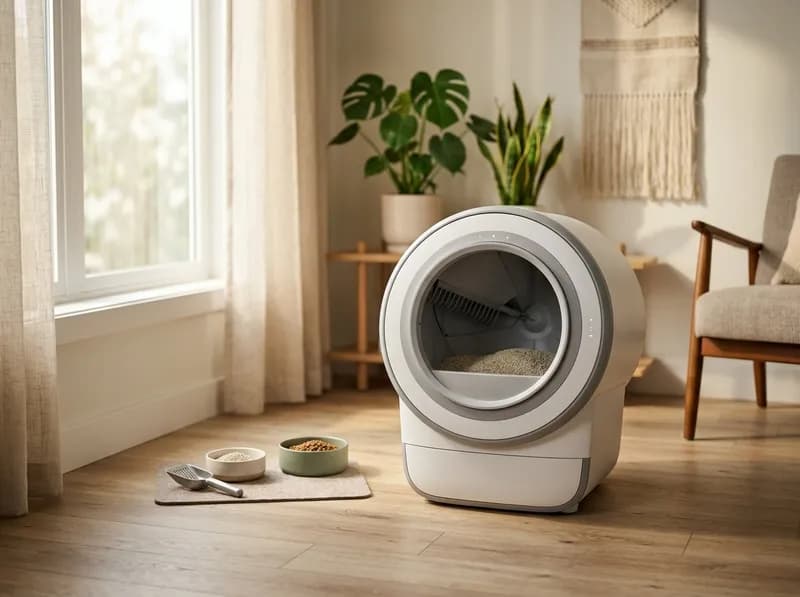
Whisker currently sells four Litter-Robot models in the U.S.: the EVO, Litter-Robot 4, Litter-Robot 5, and Litter-Robot 5 Pro. They are not simply four versions of the same machine. Each one has a different limit on cat size and household size, and the $100 steps between them do not always buy an equally useful upgrade.
The EVO is the compact entry point. The Litter-Robot 4 is the older platform that still has a strong case for buyers who want proven hardware. The Litter-Robot 5 adds WasteID and more capacity. The 5 Pro adds cameras and visual cat identification, which is also the least convincing reason to spend the extra $100.
Here is what each model actually adds, where its limitations show up, and which type of household makes the most sense for it. Prices and specifications were checked in October 2026.
Litter-Robot lineup at a glance
Model | Price | Cats | Cat weight | Drawer, 1 cat | Interior height | Footprint |
|---|---|---|---|---|---|---|
Litter-Robot EVO | $599 | 2 | 3–19 lb | ≈7 days | 14.5 in | 20.6 × 24.3 in |
Litter-Robot 4 | $699 | 4 | 3–25 lb | ≈8 days | 16.5 in | 22 × 27 in |
Litter-Robot 5 | $799 | 5 | 3–30 lb | ≈10 days | 17.5 in | 22.2 × 27.25 in |
Litter-Robot 5 Pro | $899 | 5 | 3–30 lb | ≈10 days | 17.5 in | 22.2 × 27.25 in |
These are Whisker's U.S. list prices and published specifications as of October 2026. Bundles and promotions can change the street price. Drawer estimates are Whisker's figures for one cat, so a multi-cat household will empty the drawer more often.
There is another option worth checking before paying full price: manufacturer-reconditioned Litter-Robots. Whisker periodically sells refurbished Litter-Robot 4 and 5 units, sometimes at discounts of up to $100. A reconditioned Litter-Robot 4 has recently been listed around $599, putting it at the same price as a new EVO. Refurbished units carry the same 90-day in-home trial and one-year warranty as new units, although availability is intermittent.
Which Litter-Robot should you buy?
For most buyers, the decision is fairly simple once the limits are clear.
Buy the EVO if you have one or two cats, both under 19 lb, and floor space matters more than advanced monitoring.
Buy the Litter-Robot 4 if you want the more established platform, need room for up to four cats, and do not care about WasteID or cameras. A refurbished 4 is particularly interesting if you can find one near $599.
Buy the Litter-Robot 5 if you have a larger cat, several cats, carpeted placement, or you specifically want WasteID. For many households, this is the sweet spot in the current lineup.
Buy the 5 Pro only if camera monitoring and visual cat identification are features you genuinely want. The cleaning mechanism is the same as the 5, and the additional identification feature has not proved consistently reliable in the longest independent test.
That last point is important. The 5 Pro is not a better litter box than the 5. It is a 5 with a camera and software layer added to it.
What all four Litter-Robots have in common
All four models use the same basic idea. After a cat leaves, the globe waits for the litter to clump and then rotates, separating the waste from the clean litter. Waste falls into a sealed drawer, while the clean litter returns to the litter bed.
That eliminates daily scooping, but it does not eliminate litter-box maintenance.
You still have to empty the drawer, add litter, clean the globe and sensors, maintain the waste drawer and periodically clean the machine more thoroughly. Whisker's own guidance works out to roughly weekly drawer emptying for one cat, with more frequent emptying as the number of cats increases.
The common features include:
QuietSift cycling with adjustable delay settings
A sealed, carbon-filtered waste drawer
Wi-Fi connectivity and the Whisker app
Weight and visit tracking through SmartScale
Support for standard clumping or scoopable litter
A 90-day in-home trial
A one-year standard warranty, with an optional extended plan
Carbon filters are shared across the current models, although some structural accessories are not.
This is worth keeping in mind when comparing them. The app, automatic cycling and basic weight tracking are not reasons to spend more on one model than another. The meaningful differences are cat capacity, weight limits, sensing, physical size, accessory compatibility and the camera system on the 5 Pro.
Litter-Robot EVO
The EVO is the smallest Litter-Robot currently sold and the only one in the lineup specifically positioned around compact living. Its footprint is 20.6 × 24.3 inches, and at $599 it undercuts the Litter-Robot 4 by $100.
It is rated for up to two cats weighing between 3 and 19 lb. For a typical single-cat household, that is enough. The problem appears when the household or the cat is outside those limits: a third cat or a 20-plus-pound cat immediately rules it out.
The EVO also has a couple of features that make the lineup less intuitive than it first appears. It has a full-color LCD display, while the more expensive Litter-Robot 4 uses a simpler indicator system. It also includes a built-in carpet tray, so carpet placement does not require the separate tray that Whisker recommends for the 4.
The compromises are mostly in capacity and sensing.
The EVO does not provide the Litter-Robot 4's litter-level sensing. Its waste monitoring is also simpler, with the system indicating when the drawer needs attention rather than providing the same level of fill tracking as the 4.
The drawer is smaller, with Whisker estimating roughly seven days between emptying for one cat. It also cannot use the LitterHopper, so there is no automatic litter-refill option.
Hands-on coverage of the EVO is still relatively limited compared with the Litter-Robot 4, although longer tests do exist. Apartment Therapy found the smaller footprint useful in a compact home, while The Verge tested the EVO over six months as a lower-cost alternative to the 5 Pro.
The EVO makes the most sense for a small household that wants an automatic litter box without paying for features it will not use. It is a poor fit for larger cats, multi-cat households, or anyone who already knows they want automatic litter refilling.
Litter-Robot 4
The Litter-Robot 4 occupies an unusual position because it is the previous generation but is still officially sold alongside the newer models.
At $699, it sits directly between the EVO and Litter-Robot 5. It supports up to four cats weighing 3–25 lb and adds more sophisticated sensing than the EVO, including litter-level and waste-level monitoring.
It also has a larger interior and drawer, an automatic night light, and compatibility with the LitterHopper and Shield accessories. The LitterHopper designed for the 4 holds 13 cups of litter and costs $129.
Compared with the 5, however, the 4 lacks WasteID and cameras. It also has no color screen. Carpet and uneven flooring are another consideration: Whisker recommends using the Carpet Tray with the 4 to keep SmartScale readings accurate.
Its biggest advantage is something that does not appear on the specification sheet: time on the market.
The Litter-Robot 4 has been around since 2022, so there is considerably more long-term ownership experience available than there is for the newer models. Good Housekeeping's reviewer used one for four years and continued to recommend it, while WIRED's pet-tech reviewer kept the 4 as a personal favorite after testing numerous automatic litter boxes.
That does not mean the Litter-Robot 4 is trouble-free. Owners have reported sensor errors, interrupted cycles and connectivity problems, and Whisker's own support documentation addresses those issues. There is no reliable public failure-rate figure, so claims that a certain percentage of Litter-Robot 4 units fail are not something worth treating as established fact.
The more defensible conclusion is that the 4 has a large body of real-world experience behind it. That gives you more evidence about both what works and what can go wrong.
The Litter-Robot 4 is the sensible choice for buyers who value established hardware over the newest features. It is also worth checking refurbished inventory before buying an EVO at the same price.
Litter-Robot 5
The Litter-Robot 5 costs $799 and is the current middle ground in the lineup.
It supports up to five cats weighing 3–30 lb, has a 17.5-inch interior, and uses the largest drawer in the current range. Whisker estimates roughly ten days between emptying for one cat.
The main reason to choose the 5 over the 4 is WasteID.
WasteID distinguishes urine from solid waste and changes the cycling behavior accordingly. That is more significant than simply making the machine larger. It changes how the robot handles different types of waste rather than simply increasing capacity.
The 5 also raises the cat-weight limit from 25 to 30 lb and the household limit from four to five cats. Its larger interior gives bigger cats more room, and it can be placed on carpet without the additional Carpet Tray required for the 4.
The LitterHopper also gets larger. The version designed for the 5 and 5 Pro holds 17.3 cups compared with 13 cups for the Litter-Robot 4's hopper.
The 5 does have cameras, but they are not the same thing as the 5 Pro's camera-based identification system. If you are buying the 5 because you want to know which cat used the box, its weight-based SmartScale system is still the primary identification method.
Cats.com tested the Litter-Robot 5 with two cats and rated it well for cleaning, odor control and construction. The more interesting part of the review was the value question: the reviewer was not convinced that the $799 model was automatically a better investment than the $699 Litter-Robot 4.
That is a reasonable conclusion. The 5 is more capable, but the extra $100 only matters if you need those capabilities.
The Litter-Robot 5 is the best fit for larger cats, larger households and buyers who specifically want WasteID. For a single average-size cat, the Litter-Robot 4 can still be the better value.
Litter-Robot 5 Pro
The Litter-Robot 5 Pro is the top model at $899, but most of the hardware is shared with the regular 5.
It has the same footprint, 3–30 lb weight range, five-cat rating, WasteID system, interior and waste drawer. The extra $100 pays for dual cameras and the software built around them.
The cameras add live viewing, recording and visual identification intended to distinguish individual cats. That addresses a genuine limitation of weight-based identification: two cats can easily weigh enough alike that SmartScale cannot reliably tell them apart.
The problem is that the camera identification has not been demonstrated to work consistently enough to make the $100 upgrade an obvious recommendation.
The Verge's Jennifer Pattison Tuohy tested the 5 Pro alongside the EVO for six months and was unable to get the system to reliably distinguish her two cats. Her conclusion was particularly negative about the AI identification feature.
Other reviews have been more favorable about the product as a whole. Cats.com rated the 5 Pro highly for cleaning, odor control, appearance and construction. WebVet documented the camera setup and app onboarding successfully, although a setup test cannot establish long-term identification accuracy.
Those reviews are not necessarily contradictory. A fountain or litter box can be excellent at cleaning while its AI identification feature remains unreliable. The relevant question is what each test actually measured.
There is also an ongoing cost that is easy to overlook. The 5 Pro's facial recognition and unlimited video streaming require an active Whisker+ membership, currently $7.99 per month or $79.90 per year.
Without the subscription, the 5 Pro still functions as a litter box, but the headline camera features are significantly limited.
For owners who want per-cat identification without paying for the camera system, Whisker's PetTag is another option. The RFID collar tag costs $29 and supports individual cat identification and a lost-pet feature.
The 5 Pro only makes sense when camera monitoring is itself a priority. If the main thing you want is a better automatic litter box, the regular Litter-Robot 5 gives you essentially the same cleaning hardware for $100 less.
What each extra $100 actually buys
The $100 price increments make the lineup look neatly structured, but the upgrades are quite different.
Upgrade | What you actually get |
|---|---|
EVO → Litter-Robot 4 | Four-cat capacity instead of two, a 6 lb higher weight limit, litter-level and waste-level sensing, a larger interior and drawer, night light, and access to LitterHopper and Shield |
Litter-Robot 4 → 5 | WasteID, five-cat capacity, a 5 lb higher weight limit, larger interior and drawer, carpet placement without an additional tray, and a color screen |
Litter-Robot 5 → 5 Pro | Dual cameras, visual cat identification, live/recorded video, and a Whisker+ subscription for the full camera experience |
The first two upgrades expand what the machine can handle.
The last one mostly expands what you can see.
That distinction is why the 5 Pro is the easiest upgrade to skip. Unless you have a specific reason to monitor your cats through cameras, the extra $100 does not improve the actual litter-sifting mechanism.
The EVO-to-4 jump is more substantial. You are buying a machine that can accommodate more cats and larger cats, with better sensing and access to the LitterHopper.
Litter-Robot ownership costs
The purchase price is only part of the cost.
Cost | EVO | Litter-Robot 4 | Litter-Robot 5 | 5 Pro |
|---|---|---|---|---|
Hardware | $599 | $699 | $799 | $899 |
LitterHopper | Not compatible | $129 · 13 cups | $129 · 17.3 cups | $129 · 17.3 cups |
Whisker+ | Optional | Optional | Optional | Needed for full camera features |
Carbon filters | Yes | Yes | Yes | Yes |
Drawer liners | Yes | Yes | Yes | Yes |
Odor packs | Optional | Optional | Optional | Optional |
Litter | Ongoing | Ongoing | Ongoing | Ongoing |
Warranty extension | Optional | Optional | $149 | $149 |
Accessory prices were observed in October 2026 and can change.
Whisker recommends replacing the carbon filter roughly monthly, although actual replacement frequency depends on use. You do not have to buy Whisker's drawer liners; the company says appropriately sized bags can be used.
The LitterHopper is the accessory that requires the most attention when comparing models. The 4 uses a 13-cup version that is specific to that model. The 5 and 5 Pro use a 17.3-cup version. If you move from an LR4 to an LR5, your old hopper does not simply move with the machine.
WhiskerCare is another optional cost. The $149 extension adds two years to the standard one-year warranty, giving three years of coverage and including accidental damage and shipping.
There is no useful single annual running-cost figure for a Litter-Robot. Litter consumption varies considerably by household, while filters and liners are relatively predictable. Anyone giving a precise annual cost without knowing the number and size of cats is mostly making assumptions.
Litter requirements and placement
All four current Litter-Robot models are designed for clumping or scoopable litter. They do not require a proprietary litter brand, but the litter needs to form a sufficiently solid clump for the rotating sifting process.
Strictly absorbent non-clumping litter, loose-clumping litter, newspaper litter and wood pellets are not suitable for the mechanism. Certain crystal litters can also interfere with litter-level or drawer readings.
Placement is another area where the models differ.
The EVO has a built-in carpet tray. The Litter-Robot 5 and 5 Pro are designed to work on both hard flooring and carpet without the additional tray. The Litter-Robot 4 is the exception: Whisker recommends the Carpet Tray on carpet or uneven flooring to maintain accurate SmartScale measurements.
Cat size needs more than a simple weight check, too.
A 25 lb cat might technically fall within the Litter-Robot 4's rating but still have a poor experience if the interior feels cramped. Likewise, an older cat may fit comfortably inside but struggle with the entry height.
Kittens are another special case. The current models are rated from 3 lb, but Whisker's acclimation guidance still matters. A very young kitten should not simply be left alone with an automatic litter box because it meets the stated weight minimum.
Think of the published weight and interior dimensions as screening criteria, not a guarantee of comfort.
Litter-Robot health tracking: useful data, not a diagnosis
One of the more useful aspects of the Litter-Robot system is that it can establish a baseline for your cat's litter-box habits.
The app can track weight, visits and visit duration. The Litter-Robot 5 and 5 Pro add waste-type information through WasteID. Whisker+ adds more detailed history and the Patterns feature, which is intended to highlight changes in routine.
That information can be useful because gradual changes are easy to miss when you are cleaning a traditional litter box.
But the system does not diagnose illness.
A change in litter-box frequency, urine output or weight can have many causes. If your cat suddenly visits the box much more often, strains, produces very little urine, has blood in the urine or shows a major change in litter-box behavior, the appropriate next step is veterinary care rather than relying on the app.
In particular, urinary obstruction can be an emergency. Treat Litter-Robot data as an additional observation tool, not as a medical test.
Are older Litter-Robot models still worth buying?
The Litter-Robot 3 and Litter-Robot 3 Connect are no longer part of Whisker's current lineup. They still appear in search results and older reviews, and some LR3 accessories remain available.
A used LR3 can still work, but the price needs to reflect its age.
You are buying an older sensing system, hardware with an unknown amount of wear and a shorter remaining support horizon. If a used LR3 costs $500 while a new EVO costs $599, the older machine is difficult to justify.
At around $200–250, the calculation is different. At that price, an older Litter-Robot can be a reasonable way to get automatic scooping without paying for a current model.
Refurbished current-generation units are more attractive.
A manufacturer-reconditioned Litter-Robot 4 around $599 is particularly interesting because it puts a four-cat machine at the same price as a new two-cat EVO. With the same 90-day trial and one-year warranty, it is arguably the strongest value opportunity in the current lineup when inventory is available.
Litter-Robot reliability: what can actually be said
There is plenty of discussion online about Litter-Robot reliability, but not much reliable failure-rate data.
Owner complaints commonly involve sensors, interrupted cycles, connectivity and mechanical issues. Whisker's support documentation covers many of these problems and provides troubleshooting steps.
What is missing is a credible, independently collected failure-rate study across thousands of machines. That means statements such as "X% of Litter-Robots fail within two years" should not be treated as established facts unless they are backed by a transparent dataset.
The Litter-Robot 4 has one advantage here: there are simply more years of owner experience available. That does not make it immune to problems, but it makes the potential problems easier to understand before buying.
For a machine this expensive, serviceability matters. Check the warranty, replacement parts and accessory availability rather than relying entirely on a generic reliability score.
Frequently asked questions
Which Litter-Robot is best?
There is no single model that is best for every household.
For one or two smaller cats, the EVO is the least expensive way into the current lineup. The Litter-Robot 4 is a strong choice if you want established hardware and better sensing without WasteID or cameras. The Litter-Robot 5 is the better fit for larger cats, larger households and buyers who want WasteID.
The 5 Pro is mainly for people who specifically want camera monitoring and visual cat identification.
Is the Litter-Robot 4 being discontinued?
Whisker still lists the Litter-Robot 4 as a current product alongside the EVO, 5 and 5 Pro. It is the previous generation, but that is not the same as being discontinued.
If you are considering one, accessory availability is worth watching over the longer term, particularly the LitterHopper and other model-specific parts.
How long does a Litter-Robot last?
There is no reliable universal lifespan.
Owners report several years of use, but motors, sensors, seals and other components can eventually need replacement. How often that happens depends on usage and maintenance.
Rather than treating a specific number of years as guaranteed, look at the warranty and whether replacement parts remain available. That is a better indicator of the machine's long-term value.
Do Litter-Robots actually control odor?
They can reduce odor substantially by moving waste into a sealed, carbon-filtered drawer rather than leaving it exposed in the litter box.
They are not odor-proof.
The difference depends on the number of cats, how quickly the drawer fills, the litter being used, how well it clumps, how often the globe is cleaned and the ventilation around the machine. A poorly maintained Litter-Robot 5 can smell worse than a clean Litter-Robot 4.
Which accessories work across Litter-Robot models?
Some consumables are shared, but structural accessories are not universally interchangeable.
Carbon filters fit the current models, while drawer liners can generally be replaced with appropriately sized bags.
The LitterHopper is model-specific. The 4 uses the 13-cup version, while the 5 and 5 Pro use the 17.3-cup version. Other accessories such as the LR4 Fence are also model-specific.
Check compatibility before assuming an accessory will transfer to another Litter-Robot.
How much does a Litter-Robot cost per year to run?
There is no useful single annual figure because litter is the largest recurring expense and varies with the number of cats and the type of litter.
The predictable costs are carbon filters, drawer liners and optional odor products. Whisker+ is another recurring cost if you want its additional monitoring features, and it is required for the full camera experience on the 5 Pro.
Can a kitten use a Litter-Robot?
The current models are rated from 3 lb, but meeting the weight requirement does not automatically mean a kitten should use the machine without supervision.
Follow Whisker's acclimation guidance and supervise a young kitten while it is learning to use the robot.
Can senior cats use a Litter-Robot?
Many can, but weight is not necessarily the limiting factor.
Entry height, mobility and the cat's willingness to climb into the globe can matter more. A senior cat that technically fits within the published weight range may still prefer a lower-entry litter box.
If mobility is already an issue, prioritize ease of entry over additional smart features.
Bottom line
The current Litter-Robot lineup is easier to choose once the differences are reduced to what actually changes the ownership experience.
The EVO is the compact, lower-cost option for one or two smaller cats.
The Litter-Robot 4 remains relevant because it has a mature platform, useful sensing and a large base of long-term ownership experience. A refurbished 4 at around $599 is particularly compelling.
The Litter-Robot 5 is the best all-around upgrade when you need more capacity, a higher weight limit, carpet compatibility or WasteID. For many households, this is the model to buy.
The Litter-Robot 5 Pro is harder to justify. Its cleaning hardware is essentially the same as the 5, while its main upgrade is camera-based monitoring and cat identification. If you specifically want that feature and are comfortable with the Whisker+ subscription, it can make sense. Otherwise, the regular 5 saves $100 and does the important part just as well.
And if the choice comes down to a new EVO at $599 or a manufacturer-refurbished Litter-Robot 4 at roughly the same price, check the refurbished 4 first. That is one of the few cases where spending less can actually get you the more capable machine.
Related GuidesMore →
Best Dog Ramps for Cars and Beds: Top Picks and How to Choose
Choosing the best dog ramp starts with measuring your vehicle's cargo-floor height or your bed's surface, then matching the ramp length to a manageable incline. This guide compares popular dog ramps for cars, SUVs, trucks, couches, and beds, including options from PetSafe, WeatherTech, HerCcreta, Pet Gear, and DoggoRamps. Learn how to compare slope, traction, width, stability, storage, and weight capacity before buying.
Best Cat Trees: Stable Picks for Large Cats, Multi-Cat Homes, and Small Spaces
A tall cat tree is not necessarily a stable one. This buying guide compares popular models from New Cat Condos, Feandrea, Frisco, Yaheetech, and Mau, using published specifications and owner feedback rather than claiming hands-on testing. Learn how base geometry, construction, platform layout, and wall anchoring affect your choice, along with the trade-offs between budget towers and premium designs.
Dog Crate End Table Dimensions: A Buying Guide to Size, Design, and Cost
Furniture-style dog crates can double as end tables or living-room furniture, but their usable space, door openings, materials, and prices vary considerably. This guide compares seven popular dog crate furniture models from New Age Pet, Fable, Diggs, Casual Home, and Unipaws. It examines interior dimensions, space efficiency, price per square foot, and practical design differences to help you find a crate that fits both your dog and your home.