Best Dog Ramps for Cars and Beds: Top Picks and How to Choose
Choosing the best dog ramp starts with measuring your vehicle's cargo-floor height or your bed's surface, then matching the ramp length to a manageable incline. This guide compares popular dog ramps for cars, SUVs, trucks, couches, and beds, including options from PetSafe, WeatherTech, HerCcreta, Pet Gear, and DoggoRamps. Learn how to compare slope, traction, width, stability, storage, and weight capacity before buying.
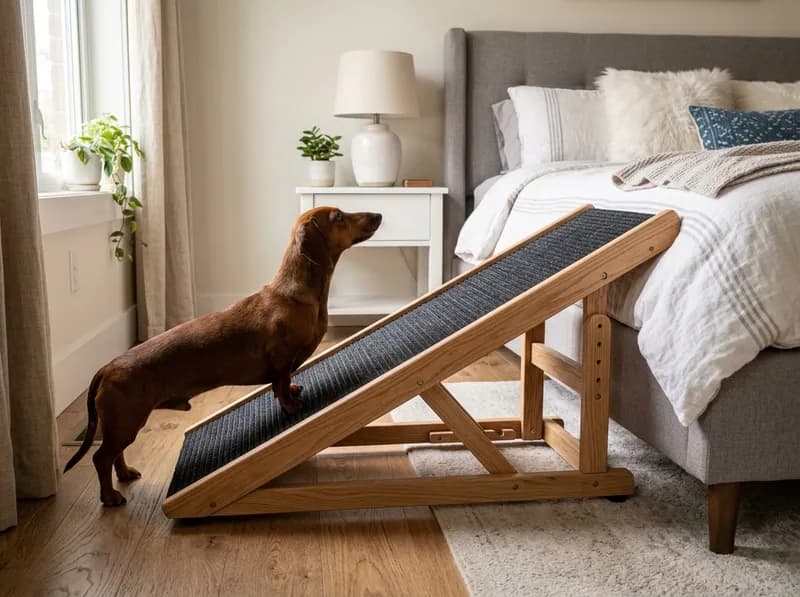
The best dog ramp for a car is long enough to create a manageable incline, wide enough for your dog to walk comfortably, and stable at both ends. For a tall SUV or pickup truck, an adjustable ramp that extends to 80 inches or more can make a noticeable difference. For a bed or couch, a furniture-specific ramp is usually easier to position and leave in place than a portable vehicle ramp.
Before buying, measure three things: the height your dog needs to reach, the ramp’s usable walking length, and the amount of floor space available. Weight capacity matters, but it cannot tell you whether a ramp will be too steep, too narrow, or difficult to secure. Those details are especially important for large dogs, senior dogs, and breeds prone to back problems.
This guide compares dog ramps for cars, SUVs, trucks, beds, and couches, including telescoping, folding, tri-fold, adjustable wooden, and foam-step designs. The recommendations draw on manufacturer specifications, retailer listings, review information, and published buying guides. The products have not been independently load-tested for this article. Prices are U.S. listing snapshots and may change, so check the current listing before ordering.
Quick Comparison: Best Dog Ramps
Dog ramp | Best for | Usable length or height | Width | Weight capacity | Approx. U.S. price |
|---|---|---|---|---|---|
PetSafe Happy Ride Extra Long Telescoping | Tall SUVs and pickup trucks | 47–87 in | 20 in | 300 lb | $179.99 |
PetSafe Happy Ride Folding Ramp | Lower vehicles and tighter budgets | About 62 in | 18 in | 150 lb | $59.99 |
WeatherTech PetRamp | Premium folding design | 67 in | 15 in | 300 lb | $109.95–$126.95 |
HerCcreta wigge 71-Inch Ramp | Budget-friendly vehicle access | 71 in | About 20 in | 270 lb | About $110.99 |
Pet Gear Tri-Fold Portable Ramp | Compact storage | 71 in | 19.5 in | 200 lb | About $95.45 |
DoggoRamps Small Bed Ramp | Beds and dogs at risk of IVDD | Adjustable to about 37 in in height | About 16 in | 120 lb for the small model | From $325 |
VEVOR Adjustable Wooden Pet Ramp | Large dogs indoors | About 13.8–27.6 in in height | About 16–20 in | 250 lb | About $168 |
ZOMISIA 5-Step Foam Stairs | Small dogs and high beds | Five steps | About 16 in | Varies by size | Varies by size |
Prices, availability, and retailer review counts are snapshots rather than guarantees. Confirm the exact model and current specifications before buying.
Three distinctions are worth keeping in mind when comparing dog ramps.
Deployed length is not storage length. Telescoping and folding ramps pack differently. Check the dimensions of the folded product if trunk space is limited.
Weight capacity does not determine incline. A ramp rated for a 300-pound dog can still be too steep or narrow for your pet.
Vehicle ramps and furniture ramps are not interchangeable by default. The top contact point, height range, stability, and space requirements differ.
How These Dog Ramps Compare
The selection covers several common buying situations rather than treating every ramp as the same kind of product. The PetSafe Happy Ride Extra Long is aimed at high vehicle access points, while the shorter Happy Ride Folding Ramp suits lower trunks and hatchbacks. WeatherTech and Pet Gear offer established alternatives for owners who prefer folding designs. The HerCcreta wigge provides a longer vehicle ramp at a lower price than many premium models.
Indoor access calls for a different approach. DoggoRamps is designed for furniture, including taller beds, while the adjustable VEVOR model accommodates larger dogs that exceed the capacity of many small indoor ramps. Foam stairs such as the ZOMISIA are another option for small, healthy dogs, although stairs are not the same as a ramp and may be unsuitable for pets with certain mobility problems.
The specifications and prices below reflect available manufacturer and retailer information. Retail rankings, review counts, and stock status can change, so treat them as supporting evidence rather than permanent measures of quality.
How to Choose the Right Dog Ramp Length
The length of a dog ramp determines how steep the climb will be for a given height. A longer ramp generally creates a gentler slope, but it also needs more room behind a vehicle or in front of a bed.
Three measurements matter:
Rise (h): The vertical distance from the ground to the surface your dog needs to reach.
Ramp length (L): The length measured along the sloping walking surface.
Horizontal run (d): The ground distance from the bottom of the ramp to the point directly beneath its upper end.
If the advertised length is the actual sloping length, calculate the incline angle with:
θ = arcsin(h / L)
The horizontal run is:
d = √(L² − h²)
Use the same units for both measurements, such as inches.
A common calculation error is to divide the height by the sloping ramp length and then use that result in an arctangent formula. The ratio h/Lh/L is the sine of the incline angle, not its tangent. Use the inverse-sine formula above when you know the vertical rise and sloping length.
Dog ramp angle examples
Vertical rise | Usable ramp length | Approx. incline | Practical interpretation |
|---|---|---|---|
20 in | 48 in | 24.6° | Noticeable incline for a lower access point |
24 in | 60 in | 23.6° | Gentler than the 48-inch example, but needs more room |
28 in | 72 in | 22.9° | A useful combination for a higher loading point |
30 in | 48 in | 38.7° | Steep for dogs that struggle with inclines |
30 in | 72 in | 24.6° | Substantially gentler at the same height |
The last two rows show why ramp length matters. Both ramps reach a surface 30 inches high, but the 48-inch ramp creates a much steeper climb than the 72-inch version. Weight capacity alone will not reveal that difference.
For example, a PetSafe Happy Ride Extra Long extended to 87 inches has a calculated incline of about 20.2° at a 30-inch rise and about 16.7° at a 25-inch rise. A 70-inch ramp at a 24-inch rise would have an incline of about 20.1°. These calculations describe geometry, not a guarantee of safety or suitability for a particular dog.
What Angle Should a Dog Ramp Be?
There is no single incline angle that guarantees comfort or safety for every dog. As a practical starting point, many buying guides recommend looking for a slope in the neighborhood of 18–25°, then adjusting for your dog’s size, confidence, mobility, and ability to walk down under control.
Around 18–20°: A gentler target to consider for senior dogs, small breeds, and dogs with spinal or joint concerns.
Around 20–25°: A practical range for many dogs that can walk comfortably and confidently.
Above 25–30°: The ramp may be difficult for some dogs, particularly when descending.
These are guidelines, not clinically validated cutoffs. A dog with pain, weakness, poor balance, or a history of spinal problems may need a different setup and veterinary advice.
A useful sizing rule is to look for a ramp whose sloping length is roughly 2.5–3 times the vertical rise. For a 24-inch rise, that means approximately 60–72 inches of ramp length. A ramp only twice the rise is much steeper.
Suggested dog ramp lengths by access height
Access point | Typical rise | Approx. ramp length at 2.5–3× the rise |
|---|---|---|
Sedan trunk or low hatchback | 22–26 in | 55–78 in |
Crossover or midsize SUV cargo floor | 28–34 in | 70–102 in |
Full-size SUV or pickup tailgate | 34–40 in | 85–120 in |
Couch | 18–22 in | 45–66 in |
Standard bed | 24–26 in | 60–78 in |
Tall bed or pillow-top mattress | 30–37 in | 75–111 in |
These ranges are starting points, not minimum safety standards. Available floor space, ramp design, the dog's movement, and the manufacturer's permitted setup may limit what works in practice.
Veterinary mobility guidance commonly favors reducing jumping for dogs with orthopedic or spinal concerns. Research comparing movement patterns can help explain why ramps may be useful, but the precise reduction in force depends on the dog, ramp, speed, and experimental setup. Do not treat a single force comparison or a calculated angle as proof that a particular ramp prevents injury.
How to Measure Your Car, SUV, Truck, Bed, or Couch
Measure the actual access point before shopping. A few minutes with a tape measure can prevent buying a ramp that is too short or cannot sit securely.
For cars and SUVs
Park on level ground and measure vertically from the ground to the cargo floor where your dog's paws will land. Do not use the bumper height as a substitute.
Check where the top of the ramp will rest. It must make secure contact without rocking or placing pressure on an unsuitable part of the vehicle.
Measure the available ground space behind the vehicle. An 87-inch ramp at a 30-inch rise has a horizontal run of roughly 81.7 inches, so allow enough room for positioning and safe footing.
Consider the type of vehicle. A pickup tailgate is often much higher than a crossover cargo floor, and access through a side door may require a different setup.
Read the manufacturer's instructions to confirm the ramp is suitable for the intended loading position.
For beds and couches
Measure from the floor to the surface your dog will step onto, including the actual mattress and bedding height.
Check the available floor space in front of the furniture.
Make sure the ramp's upper end can rest securely without sliding or damaging the furniture.
Consider whether the ramp can remain in place. For daily indoor use, a dedicated furniture ramp is often more convenient than repeatedly moving a vehicle ramp.
Before ordering, check the intended use, vertical rise, available horizontal space, maximum usable length, your dog's weight, walking width, storage requirements, traction, and contact points at both ends.
Best Dog Ramps for Cars and Beds
1. PetSafe Happy Ride Extra Long Telescoping Dog Ramp — Best for Tall SUVs and Trucks
The PetSafe Happy Ride Extra Long Telescoping Ramp is designed for owners who need to adjust ramp length to suit different vehicle heights. It extends from 47 to 87 inches, measures 20 inches wide, weighs about 18 pounds, and has a stated capacity of 300 pounds.
Its aluminum construction, high-traction walking surface, side rails, and locking mechanism are intended to make vehicle access more manageable. The telescoping design also lets you shorten the ramp when a full extension is unnecessary. The listed price used for this comparison is $179.99.
At full extension, the ramp has a calculated incline of about 20.2° at a 30-inch cargo-floor height. Its 20-inch width is also generous compared with narrower models. Both characteristics can be useful for larger dogs or pets that are hesitant about narrow walking surfaces.
Trade-offs: The ramp weighs about 18 pounds, requires considerable clearance when fully extended, and still needs a secure upper contact point. Its extra length will not help if it cannot be positioned safely at your vehicle.
Buy it if: You have a tall SUV or pickup and enough space to deploy the ramp.
Consider another option if: You mainly need access to a bed or couch, or your parking area cannot accommodate the extended ramp.
2. PetSafe Happy Ride Folding Ramp — Best Value for Lower Vehicles
The PetSafe Happy Ride Folding Ramp is a straightforward option for owners who do not need an extra-long telescoping design. It is listed at about $59.99, with approximately 62 inches of usable length, an 18-inch width, and a 150-pound weight capacity.
Its popularity on Amazon is reflected in a large review count, although reviews are not a substitute for checking the ramp's fit and condition. The folding format is practical for owners who want a simple vehicle ramp without paying for an adjustable aluminum model.
At a 24-inch rise, a 62-inch sloping length produces a calculated incline of about 22.8°. At a 30-inch rise, the angle increases to about 28.9°, which may be challenging for dogs that struggle with slopes.
Buy it if: Your car or hatchback has a relatively low cargo floor and you want an affordable folding ramp.
Consider another option if: You have a tall SUV or truck. A longer ramp may make a more meaningful difference than spending extra on features.
3. WeatherTech PetRamp — Best Premium Folding Ramp
The WeatherTech PetRamp is a folding ramp with a 67-inch deployed length, 15-inch width, approximately 16-pound weight, and stated capacity of 300 pounds. Its molded surface has a ribbed, skid-resistant design, and rubber feet help provide grip at the contact points. WeatherTech lists a limited lifetime warranty.
Its relatively narrow walking surface is worth considering if your dog is large, nervous, or reluctant to use ramps. Check the usable width, not just the outside dimensions, before deciding.
Availability has varied across sales channels. Retail listings have shown the ramp at around $126.95, while other listings have shown a price closer to $109.95. Manufacturer and retailer stock status can differ, so verify current availability rather than assuming the product is discontinued or readily available everywhere.
At a 28-inch rise, a 67-inch sloping length gives a calculated incline of about 24.7°. At a 24-inch rise, it is about 21.0°.
Buy it if: You want a folding ramp with a molded, skid-resistant surface and can find it at a reasonable price.
Consider another option if: You need adjustable length or prefer a wider walking surface.
4. HerCcreta wigge 71-Inch Dog Ramp — Best Budget-Friendly Long Ramp
The HerCcreta wigge 71-inch ramp is an aluminum folding design aimed at owners who want a long vehicle ramp without paying premium-brand prices. The listing used for this comparison shows a width of about 20 inches, a 270-pound capacity, a price around $110.99, and a traction surface with a vehicle attachment tether.
The geometry is appealing for the price. At a 28-inch rise, a 71-inch ramp produces a calculated incline of about 23.2°. At a 24-inch rise, it is about 19.8°. Those figures make it worth considering for some crossovers and lower SUVs, provided the ramp fits the vehicle and the dog.
The listing has also shown a substantial review base and prominent sales placement. Amazon badges and review counts change, however, and should be checked on the live product page.
Buy it if: You want a long ramp around the $100 price point and the specifications suit your dog and vehicle.
Consider another option if: You place a high priority on a long-established brand, a clearly documented warranty, or readily available replacement parts.
5. Pet Gear Tri-Fold Portable Ramp — Best for Compact Storage
The standard Pet Gear Tri-Fold Portable Ramp measures 71 inches when deployed and 19.5 inches wide. Published specifications list a weight of about 26 pounds and a 200-pound capacity. Features include a skid-resistant tread, raised edges, rubber grippers, and a safety tether. The price used here is approximately $95.45.
The tri-fold layout divides the ramp into three sections, making its stored shape different from that of a conventional bi-fold ramp. Check the folded dimensions against your trunk or storage space before ordering.
At a 24-inch rise, the 71-inch ramp has a calculated incline of about 19.8°. At a 28-inch rise, the incline is about 23.2°.
Pet Gear also sells a 71-inch Travel Lite version. That model has different dimensions and weight specifications, so confirm the exact product name and capacity rather than assuming the standard and Travel Lite ramps are interchangeable.
Buy it if: You want a long ramp from an established pet-accessory brand and prefer a tri-fold storage design.
Consider another option if: Your dog is close to the 200-pound limit. Leave a margin rather than choosing a ramp based solely on its maximum rating.
6. DoggoRamps Small Bed Ramp — Best Indoor Ramp for High Beds and IVDD-Prone Dogs
DoggoRamps focuses on furniture access rather than vehicle loading. Its Small Bed Ramp uses solid maple construction, an adjustable design that can reach approximately 37 inches in height, and a PAWGRIP walking surface intended to provide traction. The listed starting price for the Small Bed Ramp is about $325. Other models, including larger and couch-height options, cost more.
The adjustable height is particularly useful for tall beds and pillow-top mattresses, where a fixed indoor ramp may not reach the required surface. A dedicated furniture ramp can also be left in position instead of being unfolded and stored every day.
For dachshunds, corgis, and other dogs at risk of intervertebral disc disease (IVDD), reducing repeated jumps on and off furniture is an important consideration. The ramp should still be selected and positioned for the individual dog; no product can guarantee that spinal injury will be prevented.
Buy it if: Your dog needs regular access to a high bed and you want a dedicated indoor ramp with adjustable height.
Consider another option if: Your bed is a standard height and a less expensive fixed or adjustable ramp fits your dog's weight and mobility needs. The PetSafe CozyUp Bed Ramp is another product to investigate; confirm its current dimensions, capacity, and price before purchase.
7. VEVOR Adjustable Wooden Pet Ramp — Best for Large Dogs Indoors
Many indoor pet ramps are intended for small or medium-sized dogs. The VEVOR adjustable wooden pet ramp is an option to investigate when a larger dog needs access to a bed or couch.
Listings for similar VEVOR models describe adjustable heights of roughly 13.8–27.6 inches, a stated capacity of 250 pounds, a carpeted walking surface, and prices around $168. VEVOR sells products with similar names and different configurations, so verify the exact model, dimensions, and load limit on the listing.
At its maximum height, the ramp may create a steeper incline than ideal for a dog with limited mobility. Measure the actual rise and calculate the angle before buying, especially for a senior dog or one with a history of back or joint problems.
Buy it if: You need an indoor ramp for a large dog and the exact model fits your furniture height and available space.
Consider another option if: Your dog is small and a lighter, less expensive ramp will provide the same access with an appropriate slope.
8. ZOMISIA 5-Step Foam Stairs — Best Alternative for Small Dogs
A ramp is not the only way for a dog to reach a bed. The ZOMISIA five-step foam stairs offer an alternative for small dogs that can comfortably manage shallow steps but cannot jump onto a tall mattress.
The foam design, removable cover, and compact footprint may suit bedrooms where a long ramp would occupy too much floor space. Capacity and dimensions vary by size, so check the specific version rather than relying on specifications from another model.
Stairs are not equivalent to ramps. Each step requires the dog to lift its legs, and the movement pattern differs from walking along a continuous slope. For dogs with known spinal disease, painful joints, weakness, or balance problems, ask a veterinarian whether stairs are appropriate.
Buy it if: Your dog is small, comfortable with steps, and needs a space-saving way to reach the bed.
Consider another option if: Your dog has orthopedic or spinal concerns, struggles to climb, or slips on stairs.
Dog Ramps for Dachshunds and Other IVDD-Prone Breeds
For dachshunds and other dogs at increased risk of intervertebral disc disease, a ramp can help reduce the need to jump on and off furniture. It is worth setting up an appropriate access route before mobility problems appear, rather than waiting until a dog is in pain.
IVDD involves degeneration or herniation of the discs between the vertebrae. Dachshunds are particularly predisposed, and other breeds with similar body proportions, including corgis, may also be affected. Breed-level risk estimates vary by study and population; a commonly cited estimate for dachshunds is roughly one in four over a lifetime, but that is not a prediction for any individual dog.
A ramp can make access more controlled than jumping, but it is not a guarantee against spinal injury. Its usefulness depends on the slope, traction, stability, the dog's condition, and whether the dog can walk down without slipping or losing balance.
Practical steps for owners include:
Reduce jumping opportunities. Provide a suitable ramp for frequently used furniture or block access when the dog cannot use it safely.
Introduce the ramp early. A dog that is comfortable with the ramp before developing symptoms may find it easier to use later.
Choose a manageable incline. For a 24-inch bed, a ramp around 60–72 inches long gives a gentler slope than a short ramp, provided there is enough room.
Supervise use. Do not let a dog rush down a steep or slippery ramp.
Ask your veterinarian about individual risk. A dog with known IVDD, weakness, pain, or a recent episode may need specific activity restrictions or rehabilitation advice.
If your dog suddenly refuses to jump, hesitates on stairs, cries out, develops a limp, or shows weakness or coordination changes, do not assume a ramp alone will solve the problem. Seek veterinary advice.
What Makes a Dog Ramp Easier to Use?
Traction and surface texture
Dogs need grip when climbing and descending. A dog that goes up a ramp confidently may still hesitate on the way down.
Common surfaces include carpet, molded or ribbed plastic, rubberized material, and removable traction mats. Carpet can feel familiar underfoot but may collect hair and moisture. Molded surfaces are easier to wipe clean, but their grip varies by design. Rubberized surfaces may provide useful traction, although no surface stays slip-proof in every condition.
Check the walking surface regularly for dirt, moisture, loose material, and wear. Follow the manufacturer's cleaning instructions, and do not assume a marketing claim such as “non-slip” guarantees safe footing.
Width and side edges
A wider walking surface may help a large or hesitant dog feel more secure. In this comparison, some vehicle ramps are about 15 inches wide, while others approach 20 inches.
Raised edges can help define the walking path, but they do not eliminate the risk of a dog stepping off. Check the usable walking width where side rails or raised edges reduce the space available to your dog.
Stability and secure contact points
A ramp should sit securely at both ends. Before each use, check that:
The upper end rests firmly against the intended vehicle or furniture contact point.
The bottom feet grip the ground.
The ramp is fully unfolded or extended and locked according to the instructions.
Safety tethers are attached when required.
The ramp does not rock or shift under load.
Rubber feet, locking mechanisms, and tethers can help, but they do not compensate for an incorrect setup. Never prop a ramp on an unstable object or improvise an attachment the manufacturer has not approved.
Weight capacity: leave a margin
Do not choose a ramp solely because its advertised maximum equals your dog's weight. A dog that stops suddenly, turns, or stumbles may load the ramp differently from a dog walking steadily. Actual forces depend on the movement and ramp design, so there is no universal multiplier that guarantees safety.
As a conservative shopping rule, some buying guides suggest selecting a ramp rated for at least 1.5 times the dog's weight. Using that rule of thumb:
A 150-pound-rated ramp would be considered for dogs up to about 100 pounds.
A 200-pound-rated ramp would be considered for dogs up to about 130 pounds.
A 270-pound-rated ramp would be considered for dogs up to about 180 pounds.
A 300-pound-rated ramp would be considered for dogs up to about 200 pounds.
This is a purchasing margin, not a formal engineering or veterinary standard. Follow the manufacturer's instructions and any lower limits that apply to the exact product. A higher capacity also does not make a ramp safe if the incline, width, traction, or setup is unsuitable.
Dog Ramp vs. Dog Stairs: Which Is Better?
Option | Potential advantages | Limitations | Best suited to |
|---|---|---|---|
Dog ramp | Continuous walking surface; can provide a gentler incline | Needs more floor space; traction and stability are essential | Dogs that struggle with jumping, including some senior and IVDD-prone dogs |
Dog stairs | Often take up less floor space near furniture | Require repeated stepping and leg lifting | Healthy small dogs that can manage steps comfortably |
Lifting the dog | Avoids the jump when done correctly | Can be impractical for large dogs; incorrect handling may hurt either party | Small dogs that can be lifted safely |
Support harness or sling | Allows an owner to assist movement | Requires suitable fit and may need professional instruction | Some rehabilitation and mobility-support situations |
A ramp is often worth considering for a dog that should avoid jumping, but it is not automatically the right answer for every mobility problem. A steep, slippery ramp may be difficult for a dog that is frightened or weak. If your dog struggles with both ramps and stairs, consult a veterinarian before buying more equipment.
How to Train Your Dog to Use a Ramp
Some dogs hesitate because the surface feels unfamiliar, the ramp moves, or the incline looks intimidating. Give your dog time to get comfortable instead of forcing a first attempt.
Set up the ramp securely. Follow the manufacturer's instructions and start with the lowest practical incline.
Allow an initial inspection. Let your dog sniff and investigate the ramp while it is at ground level or otherwise easy to approach.
Reward small steps. Use treats or praise when your dog approaches, touches, or steps onto the surface. Keep sessions short.
Practice both directions. Climbing and descending can feel different, so work on each at a pace your dog can manage.
Increase the height gradually. Change the setup only after your dog is relaxed and steady at the current incline.
Stop if something is wrong. Repeated slipping, fear, pain, or loss of balance means you should reassess the surface, angle, and placement rather than pushing the dog to continue.
Where you keep the ramp also affects whether you use it consistently. A ramp that blocks a hallway or is difficult to retrieve from the garage may end up unused. Consider storage and placement before buying.
Seek veterinary advice before introducing a ramp if your dog has recently had surgery or an injury, has a known spinal or neurological condition, develops a new limp, or shows a sudden decline in mobility. A ramp is an access aid, not a treatment plan.
Common Dog Ramp Buying Mistakes
Choosing by weight capacity alone. A high rating does not mean the ramp has the right slope or width.
Measuring the bumper instead of the cargo floor. Measure where the dog's paws will actually land.
Buying a short ramp without calculating the incline. A compact ramp may create a steep climb.
Confusing sloping length with horizontal run. They are different measurements.
Assuming a vehicle ramp will work on a bed. Contact points and geometry may be unsuitable.
Ignoring walking width. Large or hesitant dogs may need more room.
Forgetting the space needed behind the vehicle. Check the ramp's horizontal run and deployment requirements.
Assuming every senior dog can use a ramp. Some mobility problems need veterinary assessment first.
Using an unsecured ramp. Check locks, feet, and tethers before every use.
Ignoring a sensible weight margin. Do not shop right at the stated maximum.
Treating the calculated angle as a safety guarantee. Geometry is a screening tool, not a diagnosis.
Treating marketing claims as clinical evidence. Claims about preventing injuries or relieving joint pain need appropriate supporting evidence.
Frequently Asked Questions
What is the best dog ramp for cars?
For tall SUVs and pickup trucks, the PetSafe Happy Ride Extra Long Telescoping Ramp is a strong option because its length adjusts from 47 to 87 inches. For lower vehicles, the PetSafe Happy Ride Folding Ramp is a less expensive alternative. The best choice depends on your cargo-floor height, available ground space, your dog's size, and the ramp's traction and stability.
How long should a dog ramp be for an SUV?
Measure the cargo-floor height first. For a rise of 30–34 inches, a ramp around 75–102 inches long corresponds to the 2.5–3× rule of thumb. A shorter ramp may fit the space but create a steeper incline. Pickup trucks often need longer ramps because the tailgate is higher.
What angle should a dog ramp be?
A slope around 18–25° is a useful starting point for many dogs, although there is no single angle that suits every pet. Dogs with spinal or joint concerns may need a gentler setup. Calculate the incline with the inverse sine of vertical rise divided by the ramp's sloping length.
Is a longer dog ramp always better?
No. A longer ramp generally creates a gentler slope for the same height, but it also requires more deployment space and storage room. Choose the longest ramp that fits your actual setup and can be positioned securely.
How much weight capacity does a dog ramp need?
Check the manufacturer's stated limit and leave a margin rather than choosing a ramp rated exactly for your dog's weight. A 1.5× capacity margin is a conservative shopping rule used in some buying guides, not a universal safety standard. Also check the incline, width, surface, and stability.
Are cheap Amazon dog ramps any good?
Some budget ramps offer useful length and width for the price. The HerCcreta wigge 71-inch model is one option to compare with established brands. Before buying, check the exact specifications, recent reviews, warranty terms, attachment method, and return policy. Review counts and sales badges can change and do not independently establish product safety.
Is the WeatherTech PetRamp worth it?
It may suit owners who want a folding ramp with a molded, skid-resistant surface and a high stated capacity. Its 67-inch length and 15-inch width will not suit every vehicle or dog, however. Compare its dimensions and current price with longer or wider alternatives, and verify stock before purchasing.
What is the best dog ramp for a high bed?
For a high bed, particularly a pillow-top mattress, look for a furniture ramp with an appropriate adjustable height and a stable base. DoggoRamps is worth considering for its adjustable indoor design. For a standard-height bed, compare less expensive fixed or adjustable models, including the PetSafe CozyUp Bed Ramp, after confirming their current specifications.
Can one dog ramp work for both a car and a bed?
Sometimes, but it should not be assumed. Vehicle ramps may be too long or awkward indoors, while furniture ramps are often too short for vehicle access. Confirm that the manufacturer permits both uses and that the ramp can rest securely at each end. If you need daily access in both places, two purpose-built ramps may be more practical.
Should a dachshund use a ramp or stairs?
A ramp is often the better option to discuss with your veterinarian when the goal is to reduce jumping and make furniture access more controlled. Dachshunds have an elevated risk of IVDD, but an individual dog's needs depend on its health and mobility. Choose a manageable slope, provide traction, and teach the dog to use the ramp calmly.
How do I stop my dog from slipping on a ramp?
Check for worn, dirty, or wet surfaces, and confirm that the ramp's feet and upper contact point are secure. Keep your dog's nails appropriately trimmed and clean the ramp according to the manufacturer's instructions. If slipping continues, consider a model with a more suitable walking surface or a gentler incline. Do not add unapproved materials that could shift underfoot.
Why won't my dog use the ramp?
Common reasons include an unfamiliar surface, movement underfoot, a steep incline, poor placement, or a previous experience of being pushed onto it. Start at a low incline, reward voluntary approaches, and practice briefly in both directions. If your dog suddenly refuses a ramp or other previously easy movements, pain may be involved; ask a veterinarian.
When should I ask a veterinarian before buying a ramp?
Seek advice if your dog has recent surgery or injury, known spinal or joint disease, neurological symptoms, a new limp, weakness, or a sudden change in its willingness to jump or climb. A ramp may support safer access, but it cannot diagnose or treat the underlying problem.
Do I need a separate ramp for each vehicle?
Not necessarily. An adjustable telescoping ramp can be convenient if it is suitable for the height and setup of each vehicle. A second ramp may make sense when one stays in the garage, another travels with you, or you need a permanent indoor ramp as well.
Final Verdict: Which Dog Ramp Should You Buy?
Choose a car dog ramp by measuring the real cargo-floor height, calculating the incline, and checking how much space you have for deployment. Then compare width, traction, weight capacity, storage dimensions, and how securely the ramp can rest against the vehicle.
Best for tall SUVs and trucks: PetSafe Happy Ride Extra Long Telescoping Ramp, with its adjustable 47–87-inch length.
Best value for lower vehicles: PetSafe Happy Ride Folding Ramp, provided its 150-pound capacity and approximately 62-inch length suit your setup.
Best budget-friendly long ramp: HerCcreta wigge 71-Inch Ramp, if its current specifications, warranty, and attachment system meet your needs.
Best premium folding option: WeatherTech PetRamp, particularly if its 67-inch length and 15-inch width suit your dog.
Best for high beds: DoggoRamps, with an adjustable indoor design for furniture access.
Best indoor option to investigate for large dogs: VEVOR's adjustable wooden ramp, after confirming the exact model and load limit.
Best alternative for healthy small dogs: ZOMISIA foam stairs, if your dog can comfortably manage steps.
For furniture, start with the bed or couch height and your dog's mobility needs. For a dog with suspected spinal or joint problems, seek veterinary advice before relying on any access aid.
The key is to match the ramp to the dog and the space, not simply to buy the longest or highest-capacity model. A ramp that fits securely, provides dependable traction, and creates a manageable incline is far more useful than one with an impressive specification sheet that your dog cannot comfortably use.
Related GuidesMore →

Best Cat Trees: Stable Picks for Large Cats, Multi-Cat Homes, and Small Spaces
A tall cat tree is not necessarily a stable one. This buying guide compares popular models from New Cat Condos, Feandrea, Frisco, Yaheetech, and Mau, using published specifications and owner feedback rather than claiming hands-on testing. Learn how base geometry, construction, platform layout, and wall anchoring affect your choice, along with the trade-offs between budget towers and premium designs.

Dog Crate End Table Dimensions: A Buying Guide to Size, Design, and Cost
Furniture-style dog crates can double as end tables or living-room furniture, but their usable space, door openings, materials, and prices vary considerably. This guide compares seven popular dog crate furniture models from New Age Pet, Fable, Diggs, Casual Home, and Unipaws. It examines interior dimensions, space efficiency, price per square foot, and practical design differences to help you find a crate that fits both your dog and your home.

Litter-Robot Models Compared: EVO, 4, 5, and 5 Pro
The current Litter-Robot lineup includes the EVO, Litter-Robot 4, Litter-Robot 5, and 5 Pro, but the differences go beyond price. This guide compares cat and weight limits, capacity, sensing, WasteID, cameras, accessories, ownership costs, and long-term serviceability to help you choose the right model for your cats and decide whether the 5 Pro is worth the extra $100.