Best Cat Trees: Stable Picks for Large Cats, Multi-Cat Homes, and Small Spaces
A tall cat tree is not necessarily a stable one. This buying guide compares popular models from New Cat Condos, Feandrea, Frisco, Yaheetech, and Mau, using published specifications and owner feedback rather than claiming hands-on testing. Learn how base geometry, construction, platform layout, and wall anchoring affect your choice, along with the trade-offs between budget towers and premium designs.
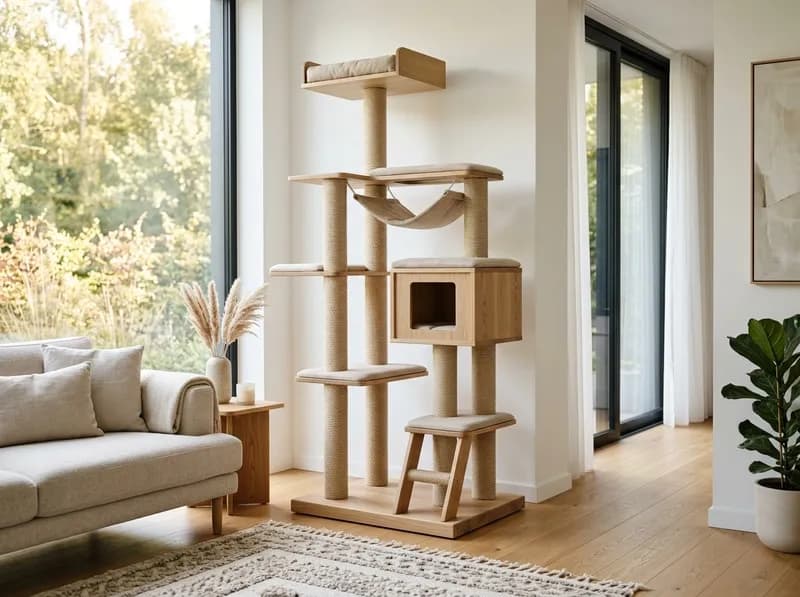
The best cat tree is not necessarily the tallest, heaviest, or most expensive model. It is the one that provides a stable climbing structure, enough room for your cat to rest comfortably, and a layout that works in your home.
That matters because cats do more than sit on cat trees. They jump onto elevated platforms, shift their weight while scratching, turn around in sleeping baskets, and sometimes chase one another up and down the structure. A tall tower with a narrow base or poorly positioned platforms can be a disappointing purchase even if it looks impressive in product photos.
For this guide, the priorities are stability first, usable space second, and appearance third. The recommendations draw on published product specifications, manufacturer documentation, retailer listings, and owner feedback. No physical testing was conducted for this article, so these picks should be treated as promising options based on available evidence—not as the winners of a comparative stability or tip-over test.
Quick Picks: The Best Cat Trees at a Glance
Prices below are approximate U.S. prices based on accessible listings reviewed in October 2026. Availability and promotional pricing can change, so check the current listing before ordering.
1. New Cat Condos Deluxe 69-Inch Cat Tower
Best for large cats and stability-conscious buyers
Approximate price: $159 on sale; $229.99 MSRP
Height: 69 inches
Base: 24 × 20 inches
Bed: 17 inches in diameter
Materials: Manufacturer-described solid wood, carpet, and natural sisal rope
The New Cat Condos Deluxe is worth considering if you want a substantial tower from a manufacturer that explicitly describes its construction as solid wood. Its 24 × 20-inch base and large-cat positioning make it a candidate for households that have enough floor space for a full-size structure.
Main trade-off: It takes up more room than a compact tree, and the manufacturer lists a limited 30-day warranty against defects. Check the warranty terms and anchoring guidance before buying.
2. Feandrea 67-Inch Multi-Level Cat Tree
Best value for large-cat owners on a budget
Approximate price: $70–$85 on sale
Height: 67 inches
Features: Two condos, multiple perches, sisal-wrapped posts, and removable, washable cushion covers
The Feandrea 67-inch tree offers plenty of features for the price. It appears frequently in owner discussions and mainstream buying guides, making it a sensible starting point for shoppers who want a tall, multi-level cat tree without spending several hundred dollars.
For larger cats, the actual dimensions of the resting surfaces matter more than the number of platforms. Owner feedback suggests that some upper cradle-style perches may feel cramped, while the top perch and wider lower platform are more useful for full-size cats.
Main trade-off: Published dimensions and weight-capacity claims vary between listings. Confirm the exact model and current manufacturer specifications rather than relying on figures repeated by third-party roundups.
3. Frisco 65-Inch XXL Heavy Duty Cat Tree
Best value for large cats and active households
Approximate price: $113
Height: 65.5 inches
Baseboard: 23.5 × 23.5 inches
Top perch: 23.5 × 23.5 inches
The Frisco XXL stands out for its relatively generous top perch and square base. Chewy lists thousands of customer ratings, and many owners praise the available space and perceived sturdiness.
Its layout is worth examining before purchase, however. A large platform is useful only if your cat can reach it comfortably and move between levels without awkward jumps.
Main trade-off: Chewy states that replacement parts are not currently available for Frisco cat trees. That may make repairs less practical if a major component wears out or breaks.
4. Yaheetech 63-Inch Multi-Level Sisal Cat Tree
Best budget multi-level cat tree
Approximate price: $64–$71
Height: 62.2 inches
Base: 24 × 19.5 inches
Features: Multiple resting areas, sisal-covered posts, and an anti-toppling strip
The Yaheetech tower provides several places to climb, scratch, and rest at a relatively low price. It is worth considering for buyers who want a tall cat tree without moving into the premium furniture category.
Main trade-off: Its base is relatively compact for its height. Careful assembly, placement on a level surface, and installation of the supplied anti-tip attachment are particularly important.
5. Mau Lua Cat Tree
Best design-focused option
Height: 48.25 inches
Overall footprint: 23.75 × 23.75 inches
Materials: Solid-oak base, metal frame, synthetic-rattan spheres, and washable cushions
Manufacturer's stated cat-weight guidance: Up to 20 lb per cat
The Mau Lua is aimed at owners who want a cat tree that looks more like a piece of home furniture. Its sculptural structure and rounded resting spaces offer a different aesthetic from conventional carpet-covered towers.
Main trade-off: The distinctive layout is not a substitute for broad, conventional platforms. Consider your cat's size, jumping style, and preferred sleeping position before paying a premium for its design.
6. Mau Reiya Cat Tree
Best for natural-looking materials and replaceable components
Overall dimensions: 31 × 23 × 54 inches
Materials: Solid oak, synthetic rattan, washable cushions, and sisal
Manufacturer's stated cat-weight guidance: Up to 23 lb per cat
The Mau Reiya combines a furniture-style appearance with baskets, cushions, and replaceable scratching components. It may suit homes where the cat tree will be a prominent part of the living space.
Main trade-off: It costs more than a conventional plush tower, and basket-style resting areas will not suit every cat. Check the dimensions of the actual resting surfaces before ordering.
7. Frisco 28-Inch Faux Fur Cat Tree & Condo
Best for kittens, smaller cats, and compact rooms
Approximate price: $45
Height: 28 inches
Baseboard: 18 × 13 inches
Perches: Two, each measuring 11.25 × 11.25 inches
This compact tree provides a perch, scratching surface, and enclosed resting area without taking up much floor space. Its modest height also makes it worth considering for cats that no longer enjoy climbing high.
Main trade-off: The perches and condo are small for many adult cats, especially large breeds. Chewy also states that replacement parts are not available for this product line.
Cat Tree Comparison
Cat tree | Best for | Height | Base or footprint | Main material notes | Approx. price |
|---|---|---|---|---|---|
New Cat Condos Deluxe | Large cats; stability-conscious buyers | 69 in | 24 × 20 in | Manufacturer-described solid wood, carpet, natural sisal | $159 sale |
Feandrea 67-Inch | Value-minded large-cat owners | 67 in | Listings vary; approximately 23.6 × 19.7–23.6 in | Particleboard frame, plush covering, sisal posts | $70–$85 |
Frisco 65-Inch XXL | Large cats; multi-cat homes | 65.5 in | 23.5 × 23.5 in | Engineered wood, plush covering, sisal posts | About $113 |
Yaheetech 63-Inch | Budget multi-level setup | 62.2 in | 24 × 19.5 in | Particleboard, soft fabric, sisal | $64–$71 |
Mau Lua | Design-focused homes | 48.25 in | 23.75 × 23.75 in overall | Solid-oak base, metal frame, synthetic rattan | Check current listing |
Mau Reiya | Design-focused homes; replaceable components | 54 in | 31 × 23 in overall | Solid oak, synthetic rattan, washable cushions | Check current listing |
Frisco 28-Inch | Kittens, smaller cats, small rooms | 28 in | 18 × 13 in | Engineered wood, plush fabric, sisal | About $45 |
The measurements above come from the relevant product listings or manufacturer descriptions. The Feandrea footprint is shown as a range because third-party listings disagree about its exact base dimensions. Where a usable platform measurement or material detail was not verified, it has been left unspecified rather than estimated.
One important distinction: No single dimension proves that a cat tree is stable. Base geometry, total mass, center of mass, structural connections, platform placement, floor conditions, assembly, and the cat's movements all matter. These recommendations identify candidates worth considering; they are not certified safety rankings.
Why Cat Tree Weight-Capacity Numbers Often Conflict
Weight capacity is one of the least useful figures to compare when listings do not explain what the number means.
A capacity might refer to an individual platform, the entire structure, or a recommended maximum cat weight. Listings also rarely explain whether the figure reflects a static load or accounts for the forces created when a cat jumps onto a perch.
Third-party buying guides can make the confusion worse when they repeat figures from different listings or mistake one type of capacity for another.
The Feandrea example
The Feandrea 67-inch cat tree illustrates the problem. English-language listings and roundups reviewed for this guide included at least five different descriptions of its capacity:
Source type | Reported figure | Possible interpretation |
|---|---|---|
Listing A | 33 lb total | Whole-tree load |
Listing B | 33 lb per perch | Individual platform limit |
Roundup C | 55 lb per platform | Individual platform limit |
Roundup D | 66 lb | Unit or measurement basis unspecified |
Roundup E | 15.4 lb per cat | Recommended cat weight rather than structural capacity |
These figures are not necessarily measuring the same thing. Some may refer to different models or versions; others may be transcription errors. The important point is that the claims conflict, and the manufacturer's own tested figure could not be established from the sources reviewed for this article.
Similar inconsistencies can occur with dimensions, platform sizes, and the number of scratching posts.
How to interpret capacity claims
Check the exact model's official listing. If two listings disagree, ask the manufacturer rather than assuming the higher figure is correct.
Look for the unit and scope. A total capacity is not the same as a per-platform rating.
Distinguish structural capacity from recommended cat weight. A manufacturer's recommended cat size may account for more than whether a stationary load can be supported.
Remember that cats move. Landing and pushing sideways can impose forces that a static weight figure does not describe.
Do not treat a high capacity as proof of stability. A structure may support a substantial stationary load yet wobble when a cat lands near the edge of an elevated platform.
Large-cat owners sometimes use a rule of thumb that the stated per-platform capacity should be at least twice the cat's weight. This can be a conservative screening preference, but it is not a validated engineering standard, and it cannot compensate for unclear specifications or poor construction.
How to Evaluate Claims That a Cat Tree Was Tested
Many cat-tree roundups describe their recommendations as tested or hands-on. Some provide useful first-hand observations; others offer little information that allows a reader to understand what was actually tested.
Look for the following warning signs.
No clear testing method. A credible hands-on review should explain how long the product was used, what animals were involved, and what the reviewer assessed. Saying that a tree was tested and felt sturdy does not explain the test.
Precise scores without a disclosed basis. A rating such as 4.6 out of 5 or 88 out of 100 is difficult to interpret unless the site explains what it measured and how the score was calculated.
Product specifications that contradict the manufacturer. If a roundup lists the wrong dimensions or capacity, its factual foundation deserves closer scrutiny.
Unverifiable testing claims. A site that provides no photographs, observations, or methodology makes it difficult to distinguish genuine testing from a summary of product listings.
Nearly identical reviews across different sites. Repeated wording and template-like impressions may indicate that the material has been recycled rather than independently evaluated.
This does not mean owner communities are unreliable. Long-running discussions can provide useful information about wobbling, wear, platform usability, and how a tree performs after months of ordinary use. The limitation is that owner reports are accumulated anecdotes, not controlled comparative tests.
For that reason, this guide distinguishes published specifications from owner feedback and does not claim physical testing that was not conducted.
What Makes a Cat Tree Stable?
A cat tree can support a cat sitting still and still move when that cat jumps onto an upper platform or pushes sideways while scratching. Stability depends on the entire structure, not simply its weight limit or material.
Base width and depth
The base is the foundation of a freestanding cat tree. A wider support area can make a structure less vulnerable to tipping, but the base's shape and orientation matter.
For example, a 24 × 20-inch base does not offer identical support in every direction. A sideways landing toward the narrower edge can create a different tipping demand from a landing toward the wider edge. The base's own mass and the placement of the upper platforms also influence how the tree responds.
One screening heuristic sometimes used in tall-furniture buying guides is that the shorter side of the base should be at least one-third of the overall height. This is a rough geometry check, not an established cat-tree safety standard.
Applying it to the models in this guide gives the following results:
Cat tree | Height | Shorter base dimension | Ratio | Practical interpretation |
|---|---|---|---|---|
New Cat Condos Deluxe | 69 in | 20 in | 29% | Below the heuristic; consider anchoring |
Frisco 65-Inch XXL | 65.5 in | 23.5 in | 36% | Meets the heuristic, but stability is not guaranteed |
Feandrea 67-Inch | 67 in | 19.7–23.6 in, depending on listing | 29–35% | Verify exact dimensions; consider anchoring |
Yaheetech 63-Inch | 62.2 in | 19.5 in | 31% | Near the heuristic; anchoring is prudent |
Frisco 28-Inch | 28 in | 13 in | 46% | Meets the heuristic, but still requires inspection |
The ratio says nothing about base mass, connection quality, or platform placement. Passing the test does not override the manufacturer's anchoring instructions.
For a tall cat tree, installing the supplied anti-tip strap is a sensible precaution when the manufacturer recommends it. Use a fixing appropriate for the actual wall construction and follow the installation instructions.
Height and center of mass
A taller tree creates more leverage when a cat lands or pushes against a high platform. The center of mass also matters: a structure with more of its weight near the top may behave differently from one with a substantial base.
A heavy base can help, but it does not automatically compensate for weak connections or an awkward layout.
This is why "shorter is always safer" is not a reliable rule. A well-designed tall tree can be more stable than a poorly designed short one. Consider the base, frame, weight distribution, and installation requirements together.
Frame construction and connections
When a cat lands on a platform, the force travels through the platform supports, posts, connecting panels, fasteners, and base. The quality of these connections can matter as much as the material itself.
Solid wood: Can provide robust structural components, but performance still depends on the wood species, thickness, joints, and fasteners.
Plywood: Can be strong for its weight, depending on its grade, thickness, and construction.
MDF and particleboard: Common in budget furniture. Their performance depends on panel thickness, support spacing, fastener design, moisture exposure, and assembly quality.
Metal frames: Can provide rigid support, but the joints and mounting points still need to be properly designed.
Do not assume a cat tree is solid wood because its surface has a wood-grain finish. The New Cat Condos manufacturer describes the Deluxe tower as solid wood, while Chewy identifies the Frisco 28-inch tree as engineered wood. For other products, rely on the documentation for the exact model.
Platform placement and climbing routes
A cat tree is more than a stack of shelves. Its layout affects how easily a cat can climb, descend, turn around, and settle into a resting position.
Look for:
Platforms large enough for your cat's body and preferred sleeping position.
Staggered steps that create a practical climbing route.
Supports that adequately support the platforms rather than leaving large, unsupported overhangs.
Resting spots at different heights.
A descent route that does not require an awkward jump over a narrow intermediate shelf.
Owner feedback about the Frisco XXL illustrates why layout matters alongside stability. Many buyers praise its large top perch, while some report difficulty with particular routes between levels. These reports identify a potential usability issue, not proof that every cat will have the same experience.
Floor surface and wall anchoring
A cat tree may behave differently on carpet, hardwood, tile, or an uneven floor. If one corner is not firmly supported, do not simply leave the structure rocking.
Follow the manufacturer's assembly and anchoring instructions. If a wall strap is included or anchoring is recommended, the correct fixing depends on the wall itself. Hardware suitable for a solid wood stud may not be appropriate for hollow drywall or masonry.
Avoid improvising with arbitrary screws or brackets. If you are unsure which fixing is suitable, contact the manufacturer or a qualified installer.
Fasteners and assembly quality
Even a well-designed cat tree can become unstable if fasteners loosen or structural panels are damaged. Assembly and maintenance are part of the safety equation.
Inspect the tree periodically for:
Posts that rotate or loosen.
Platforms that shift at their joints.
Cracked panels or split wood.
Stripped fastener holes.
Torn coverings that expose or loosen structural components.
A base that lifts or rocks during ordinary use.
A loose connection that the manual allows you to retighten is different from a cracked panel or stripped connection that can no longer hold securely. If the structure has serious damage or remains unstable after correct assembly and inspection, stop using it until the problem is resolved.
How to Assess a Cat Tree Before Buying
You cannot fully establish dynamic stability from a product page, but you can screen out some questionable choices before ordering.
Cat-tree shopping checklist
The listing gives the exact assembled height, width, and depth.
Base dimensions are listed separately from overall dimensions.
Product photos show the base, post connections, and platform supports.
Structural materials are identified rather than described only as premium or natural.
Assembly instructions and anchoring guidance are available.
Any weight limit explains whether it applies to an individual platform or the whole tree.
The manufacturer provides a way to report missing parts or structural problems.
Independent owner reviews refer to the exact model and describe real use.
Replacement components, return terms, and warranty conditions are clear.
How to read customer reviews
A review saying "very sturdy" is a useful first impression, but it leaves important questions unanswered. More informative reviews explain the cat's approximate size, how the cat uses the tree, whether it moves during jumping, and how long the owner has used it.
The Frisco XXL has thousands of ratings on Chewy, with many positive reports about its space and stability. Its product Q&A also indicates that replacement parts are not currently available. Those are separate considerations: a popular product can still be difficult to repair economically.
Look for patterns across multiple buyers instead of treating one complaint as proof of a widespread defect. At the same time, high ratings cannot replace clear specifications and appropriate installation.
Do not perform risky tip tests with your cat on the tree. Use documented dimensions, the manufacturer's instructions, and careful inspection instead.
Best Cat Trees for Large Cats and Heavy Cats
For large cats, prioritize usable platform dimensions and the structure's layout—not simply the biggest number in a product description.
A Maine Coon, Ragdoll, or large domestic shorthair may need enough room to turn around, stretch out, and settle without hanging over the edge. Breed names are only a starting point because individual cats differ considerably in size and behavior.
A large cat that climbs slowly can place different demands on a tree from a similarly sized cat that leaps forcefully between levels.
What to look for
A roomy base. A larger base may provide a more forgiving support area, although the complete design determines stability. Use the base-to-height ratio as a preliminary check, not a guarantee.
Usable resting platforms. Measure the surface on which your cat can actually lie down. The outside dimensions of a raised bed or the full width of a hammock may include attachments that do not provide usable sleeping space. For cats over about 15 lb, a platform around 12–16 inches across is a useful initial screening target, but there is no universal minimum. Compare the dimensions with your cat's actual curled sleeping position.
Adequate scratching posts. Cats need enough vertical space to stretch while scratching. Post diameter, rope quality, and attachment also influence durability. Posts with a thicker core may be worth considering for large or vigorous scratchers, but diameter alone does not guarantee a longer lifespan.
Accessible routes. Small openings, closely spaced platforms, and narrow steps can make a tree difficult for a large cat to use.
Useful resting areas. A broad open perch may be more practical than a small enclosed condo.
Appropriate anchoring. Follow the installation guidance for the exact model rather than assuming that a heavy tree does not need to be secured.
The strongest candidates under $150
The New Cat Condos Deluxe 69-Inch Cat Tower is a good starting point if you want a manufacturer-described solid-wood structure with a 24 × 20-inch base and a 17-inch-diameter bed. Its large-cat positioning is relevant, but you should still compare the actual bed dimensions with your cat's preferred sleeping position.
The Feandrea 67-inch is a value-oriented choice that appears frequently in owner recommendations. It may suit some large cats, but its conflicting published capacity figures make it particularly important to verify the exact listing. The upper cradle perches may be less useful for very large cats than the top perch and wider lower platform.
The Frisco 65-Inch XXL Heavy Duty Cat Tree is another strong value candidate. Its 23.5-inch-square baseboard and equally wide top perch provide useful dimensions for comparison. Owner feedback often praises the available space, although some reviews identify concerns about how particular cats navigate the layout.
For buyers with a budget below $100, the Feandrea 67-inch and Yaheetech 63-inch are worth comparing. Both offer multiple levels at relatively low prices, and both use engineered materials. Long-term performance will depend on construction, assembly, anchoring, and how vigorously the tree is used.
Owner reports suggest that some budget plush towers show wobble or wear after sustained use, especially with large, active cats. The time to failure varies, however, so claims about a universal one-to-three-year lifespan should not be treated as established product-life data.
When to move up to a heavy-duty cat tree
If your cat weighs more than about 20 lb, two large cats will share the same tree, or your cats scratch aggressively, a conventional budget tower may not offer the combination of platform space and structural durability you want.
Several upgrade paths are worth investigating.
Reinforced plush towers, around $150: Globlazer's heavy-duty range, including models such as the 70-inch F70 Pro and 72-inch S72, is frequently discussed by owners shopping for larger cats. Check the exact model's dimensions, connections, capacity guidance, and anchoring requirements because listings may differ.
Engineered-wood towers, around $250: The Armarkat X7001 is often cited as a more substantial alternative, with features described as thicker panels, a double-layered base, and thick sisal posts. Confirm these details on the current listing before comparing it with other models.
Solid-wood towers, around $300: Prestige Cat Trees is a name that recurs in large-breed owner discussions. The brand's offerings are worth examining if you want solid-wood structural components and a more furniture-like build. The New Cat Condos Deluxe is another option in this general category, particularly at its sale price.
These prices are broad budget tiers, not guaranteed current prices for every model.
One caution applies across the category: "Heavy Duty" and "XXL" are marketing labels, not standardized size or safety classes. A model with one large perch is not necessarily equivalent to an oversized structure with reinforced connections and a substantial base.
The Mau Reiya is an alternative for buyers who value appearance and replaceable components. Mau states that it is intended for cats up to 23 lb each and lists overall dimensions of 31 × 23 × 54 inches. Its baskets and cushions provide a different resting experience from the broad platforms on conventional towers.
Owners of especially large cats should be cautious about any design whose usable platform sizes, condo openings, or capacity guidance are not clearly disclosed. A tall structure is not automatically suitable for a heavy cat.
Best Cat Trees for Multi-Cat Homes
A multi-cat household needs more than a tall perch or a high number of shelves. Cats vary in how much they share space, and some need to avoid one another rather than rest side by side.
A useful cat tree provides several resting places, practical climbing routes, and enough room that one cat cannot easily control every favored spot.
What matters most
Multiple resting places. Separate beds, baskets, hammocks, and platforms give cats options. Cats that enjoy resting together may share a perch; cats that prefer distance may need separate spots.
Count usable elevated resting places rather than total platforms. For three cats, three elevated spots they can occupy at the same time are a reasonable starting point, but some households will need more depending on how the cats interact.
More than one practical route. A tree can have many levels and still create a bottleneck if every cat must pass through the same narrow opening. Look for layouts that allow cats to move between levels without repeatedly confronting one another.
Room for simultaneous use. Six small platforms do not necessarily provide more useful resting space than three larger ones. Check whether adult cats can actually lie down comfortably on the surfaces.
Enough scratching access. Several scratching posts or surfaces may help reduce competition for a preferred spot.
Easy cleaning and repair. Multiple cats usually mean more fur and more wear. Removable, washable cushions and replaceable scratching components can make maintenance easier.
Which models are worth considering?
The Frisco XXL offers a large top perch, a condo, and additional resting areas at a relatively accessible price. The Feandrea 67-inch and some larger Feandrea towers are also popular options for households with average-weight cats, but verify the per-cat guidance on the exact listing.
The Yaheetech 63-inch offers several platforms and resting areas. Its relatively compact base makes correct assembly and placement particularly important.
For multiple large cats, the New Cat Condos Deluxe is worth considering if the price and floor space work for your household. Its manufacturer markets it for large and multi-cat homes, which indicates intended use rather than independent proof that every group of cats will share it comfortably.
A large cat tree cannot, by itself, resolve tension between cats. If one cat guards a resource or blocks access to another, provide additional resting and climbing options elsewhere in the home instead of expecting a single structure to solve the problem.
Best Cat Trees for Senior Cats and Cats With Arthritis
Most tall cat trees are designed around climbing and jumping. Senior cats often benefit from the opposite approach: easier access, shorter steps, and a stable resting place.
Arthritis and reduced mobility can make familiar jumps difficult. If your cat hesitates before jumping to a favorite perch, stops using a previously popular tower, or starts sleeping on the floor instead, consider whether the setup has become difficult to access.
What to look for
Shorter platform gaps: Spacing around 12–18 inches can be a useful starting point, although the right distance depends on the cat's mobility.
Ramps or broad steps: These reduce the need for vertical jumps.
Modest overall height: A two-to-four-foot structure may provide enough elevation without requiring difficult climbs.
Wide resting platforms: Broad surfaces and modest raised edges may help a cat settle comfortably.
Supportive cushioning: Removable pads can make resting areas more comfortable.
Ground-level access: A favorite hideout should not require a difficult jump to enter.
Horizontal scratching surfaces: Floor-level scratchers can be easier for some cats with limited mobility.
A stable base: Movement that a young cat ignores may discourage a hesitant senior from using the tree.
Practical advice
If your senior cat still enjoys an existing tall tree, you do not necessarily need to remove it. Add an accessible alternative nearby and let your cat choose.
Place the lower tree near a favored window or resting spot so it remains appealing. For a cat with diagnosed arthritis or significant mobility changes, ask your veterinarian about an appropriate setup for its individual needs.
The Frisco 28-inch Faux Fur Cat Tree & Condo may work for a smaller senior cat that needs a modest perch and scratching surface. Its small platforms make it less suitable for many large adult cats, so check the measurements carefully.
Best Cat Trees for Small Apartments and Limited Floor Space
In a small home, a cat tree needs to justify the space it occupies. A compact design can provide a perch and scratching surface without dominating the room, but a narrow base is not automatically a good compromise for a tall tower.
Compact freestanding cat trees
The Frisco 28-inch Faux Fur Cat Tree & Condo is a practical option for kittens, smaller cats, and rooms where a large tower would be intrusive. Its listed baseboard measures 18 × 13 inches, and its two perches are 11.25 × 11.25 inches.
The compromise is clear: these resting surfaces may be too small for many adult cats. Measure your cat rather than relying on the product's overall height.
A short tree can also suit senior cats or cats that no longer enjoy climbing high. The goal is a useful, accessible perch—not maximum height.
Tall, narrow designs
A tall tower makes use of vertical space, but it still needs an appropriate base and a practical climbing route.
The Yaheetech 63-inch tower, for example, stands 62.2 inches tall and has a 24 × 19.5-inch base. Its listing includes an anti-toppling strip, which should be installed according to the manufacturer's directions.
Do not choose a tall, narrow tree simply because it fits between two pieces of furniture. Check the clearance needed for climbing, the location of the top perch, and whether the structure can be anchored as instructed.
Wall-mounted cat shelves versus freestanding trees
Wall-mounted shelves can free up floor space and create elevated routes around a room. They are not automatically the better option: installation quality, wall construction, and your cat's mobility all matter.
Factor | Freestanding cat tree | Wall-mounted shelf system |
|---|---|---|
Floor space | Usually needs a footprint and clearance | Uses wall space instead |
Installation | Assembly; anchoring may be required | Usually requires drilling into suitable structural supports |
Scratching | Often includes sisal posts | Scratching surfaces may need to be purchased separately |
Portability | Easier to move | More permanent; moving may require patching |
Approximate starting cost | $45–$160 for the models in this guide | Roughly $100–$270 for a functional setup, plus installation time |
Choose a wall-mounted system if floor space is genuinely scarce, your wall can support the installation, and your lease permits drilling. Choose a freestanding tree if you rent without modification rights, want integrated scratching surfaces, or need something you can move.
A shelf anchored only to drywall is not a safe substitute for a properly supported cat platform just because its advertised weight limit looks high. Follow the mounting system's specifications and use appropriate structural fixings.
For senior cats, wall shelves may also create repeated jumps that are harder to manage than a low tree with ramps or broad steps.
A window perch can be useful for watching the outdoors, but it does not replace a full cat tree for every cat. Check the cat's weight, the attachment method, the window structure, and the manufacturer's limitations.
Cat tree placement tips
Keep doorways, walkways, and emergency exits clear.
Leave room around the base so you can inspect connections and tighten fasteners.
Check whether nearby furniture creates an awkward or excessive jump.
Keep hanging toys away from places where people frequently walk.
Follow anchoring instructions, especially for tall freestanding trees.
Choose a location where the cat can use the tree without being forced into a busy or uncomfortable part of the home.
Cat Tree Materials: Solid Wood, Plywood, MDF, and Particleboard
Materials influence weight, repairability, moisture sensitivity, and how a cat tree can be assembled. However, no material name alone establishes that a product is stable, durable, or safe.
Solid wood
Solid wood can provide sturdy structural components and may be easier to repair than some engineered-board furniture. Its performance still depends on the wood species, dimensions, joinery, fasteners, and design of the base and platforms.
The manufacturer specifically describes the New Cat Condos Deluxe as solid wood. That is more informative than a generic claim that a tree is wooden, but it does not eliminate the need to check platform dimensions, connections, and installation instructions.
Plywood
Plywood consists of layers of wood veneer bonded together. Depending on its grade, thickness, adhesive system, and construction, it can provide strong, dimensionally stable components.
A well-designed plywood platform may be more suitable than a poorly supported solid-wood component. Compare the complete construction instead of assuming one material is always superior.
MDF and particleboard
MDF is made from wood fibers bonded into panels, while particleboard is made from bonded wood particles. Both are widely used in furniture, including budget cat trees.
Their mechanical properties and resistance to moisture vary. A properly supported panel may perform adequately in an indoor structure, but damaged edges, moisture, poorly placed fasteners, and repeated movement can cause problems. The material also matters when a fastener must be tightened repeatedly or a component needs replacing.
Chewy identifies the Frisco 28-inch tree as engineered wood and describes its baseboards as particleboard in the product Q&A. Yaheetech identifies particleboard as a material in its 63-inch tower.
These disclosures help buyers understand construction. They do not, by themselves, establish a product's formaldehyde emissions or overall safety.
Posts, coverings, and scratching surfaces
The visible covering is not necessarily the structural material underneath it.
Sisal rope: Provides a textured surface for vertical scratching. Its lifespan depends on the rope, attachment, post dimensions, and how vigorously the cat scratches.
Sisal fabric: Provides a broader scratching surface and may work well on flat panels.
Carpet: Offers traction and a familiar texture, but can collect fur and show wear.
Plush fabric: Makes resting surfaces soft but may collect hair and be harder to clean than a removable cushion.
Jute and other natural fibers: Offer scratching textures, although durability and replacement options vary.
Before buying, check whether the manufacturer sells replacement posts, cushions, or coverings. Replacing a worn scratching component can be more economical than replacing the whole tree, provided the part fits and the underlying structure remains sound.
Formaldehyde, CARB Phase 2, TSCA Title VI, and FSC: What Cat Owners Should Know
Claims about composite wood, low-emission materials, sustainable sourcing, and "non-toxic" finishes can be confusing because they do not all mean the same thing.
The goal is not to assume that engineered wood is dangerous. It is to understand what a particular claim actually covers and whether the supporting documentation is available.
Why formaldehyde may matter
Certain composite wood products can emit formaldehyde, including some types of hardwood plywood, MDF, and particleboard. Emissions depend on the material, resin system, manufacturing process, finishing, and other conditions.
That does not mean every cat tree made with engineered wood emits formaldehyde at a harmful level. The material category alone cannot establish the concentration in a specific product or the exposure in a particular room.
Smell is not a quantitative test. A strong odor may be a reason to ventilate the room, stop using the product if you are concerned, or contact the manufacturer. It cannot establish a formaldehyde concentration or prove that formaldehyde is responsible for the odor.
What CARB Phase 2 means
CARB Phase 2 refers to California Air Resources Board requirements under its formaldehyde-emissions rules for covered composite wood products. The rules establish emissions limits and related requirements for specified material categories.
A listing that says "CARB compliant" should not be interpreted as an all-purpose safety certificate for the entire cat tree. Check which material or finished product the claim covers and whether the manufacturer can provide relevant documentation.
What TSCA Title VI means
TSCA Title VI is the U.S. federal framework governing formaldehyde emissions from covered composite wood products. The U.S. Environmental Protection Agency identifies hardwood plywood, MDF, and particleboard among the covered materials, along with applicable finished goods containing them.
The federal rule has required compliance labeling for regulated composite wood products and covered finished goods manufactured or imported after March 22, 2019. EPA also describes third-party certification and recordkeeping requirements.
These are regulatory requirements for covered products, not a general ranking of furniture quality. Compliance does not mean a product is formaldehyde-free, nor does it establish that a cat tree is structurally stable.
CARB Phase 2 and TSCA Title VI have aligned emissions standards, although the federal rule includes additional requirements. EPA's consumer FAQ explains how the two frameworks relate.
What FSC certification means—and does not mean
FSC certification concerns responsible forest management and the tracking of eligible forest-based materials through the supply chain. Its chain-of-custody system is intended to verify that certified materials are identified and tracked through relevant stages of production and distribution.
FSC certification is not a formaldehyde-emissions certification. On its own, it does not show that a cat tree has low formaldehyde emissions, is chemical-free, or is automatically safer for cats.
When comparing material claims, look for the exact certification or compliance statement, the product or material it covers, and documentation that can be verified. Avoid treating broad phrases such as "eco-friendly," "natural," or "non-toxic" as substitutes for specific evidence.
Related GuidesMore →
Best Dog Ramps for Cars and Beds: Top Picks and How to Choose
Choosing the best dog ramp starts with measuring your vehicle's cargo-floor height or your bed's surface, then matching the ramp length to a manageable incline. This guide compares popular dog ramps for cars, SUVs, trucks, couches, and beds, including options from PetSafe, WeatherTech, HerCcreta, Pet Gear, and DoggoRamps. Learn how to compare slope, traction, width, stability, storage, and weight capacity before buying.
Dog Crate End Table Dimensions: A Buying Guide to Size, Design, and Cost
Furniture-style dog crates can double as end tables or living-room furniture, but their usable space, door openings, materials, and prices vary considerably. This guide compares seven popular dog crate furniture models from New Age Pet, Fable, Diggs, Casual Home, and Unipaws. It examines interior dimensions, space efficiency, price per square foot, and practical design differences to help you find a crate that fits both your dog and your home.
Litter-Robot Models Compared: EVO, 4, 5, and 5 Pro
The current Litter-Robot lineup includes the EVO, Litter-Robot 4, Litter-Robot 5, and 5 Pro, but the differences go beyond price. This guide compares cat and weight limits, capacity, sensing, WasteID, cameras, accessories, ownership costs, and long-term serviceability to help you choose the right model for your cats and decide whether the 5 Pro is worth the extra $100.