Litter-Robot 4 vs PETKIT PuraMax 2: What’s the Difference?
The Litter-Robot 4 and PETKIT PuraMax 2 automate litter cleaning but target very different budgets and household needs. This comparison looks at price, cleaning performance, odor control, noise, cat size, multi-cat support, app features, litter compatibility, warranty coverage and three-year ownership costs to help cat owners decide which automatic litter box fits their home.
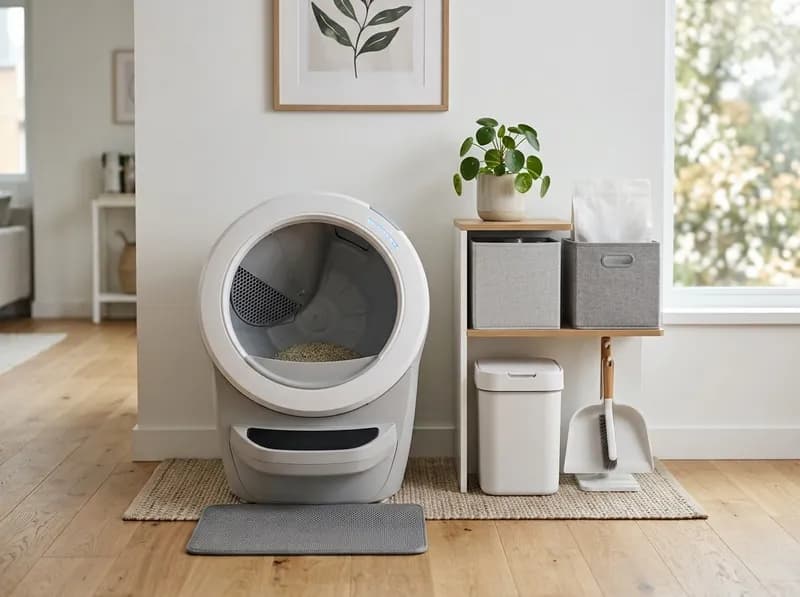
If you're comparing the Litter-Robot 4 vs PETKIT PuraMax 2, the biggest difference is the price. The Litter-Robot 4 costs around $699 new, while the PETKIT PuraMax 2 has recently been selling for about $300 in the US.
Both are automatic self-cleaning litter boxes. Both remove waste after your cat uses the box, track visits and weight through an app, and require clumping litter. Neither eliminates regular cleaning.
The choice becomes more specific once you look at your cats, available space, litter preferences and how much you want to spend on the machine and its consumables.
Quick Answer
If you... | Consider | Why |
|---|---|---|
Want the lowest upfront price | PuraMax 2 | Around $300 at current street prices versus $699 for the LR4 |
Have three or more cats | Litter-Robot 4 | Rated for up to four cats, with individual weight profiles |
Have a large cat | Litter-Robot 4, with a caveat | Higher weight limit and larger opening, although the interior is not especially large |
Have a kitten or senior cat | PuraMax 2 | Its 7.87-inch entry is much lower |
Want quiet operation | PuraMax 2 on paper; fairly close in practice | PETKIT quotes 35 dB; independent LR4 measurements vary by test |
Want more detailed app tracking | Litter-Robot 4 | More mature tracking and cat identification, although some features require Whisker+ |
Want a longer standard warranty | PuraMax 2 | Two years for qualifying US purchases made from January 1, 2025 |
Want established parts and support | Litter-Robot 4 | Large installed base, established replacement parts and a 90-day in-home trial |
For most one- or two-cat households, the PuraMax 2 is the less expensive way to automate litter cleaning. The Litter-Robot 4 makes more sense when you have several cats, want more developed individual-cat tracking, or place more value on Whisker's support and parts ecosystem.
Litter-Robot 4 vs PuraMax 2: Key Differences
Category | Litter-Robot 4 | PETKIT PuraMax 2 |
|---|---|---|
Cleaning mechanism | Rotating globe with internal sifting screen | Rotating cylinder with interchangeable sifters |
Cat weight | 3–25 lb | 3.3–22 lb |
Recommended cats | Up to 4 | Best suited to 1–2 cats |
Entry | Higher globe opening | 7.87-inch low entry |
Odor control | Sealed drawer, carbon filter, optional OdorTrap | Sealed bin, N50 2.0 deodorizing system |
Claimed noise | QuietSift system | About 35 dB |
Waste capacity | Up to 8 days for one cat, according to Whisker | Up to 15 days for one cat under PETKIT's test conditions |
Litter | Clumping clay | Most clumping litters |
App | Whisker app | PETKIT app |
Subscription | Whisker+ optional | Care+ optional |
Wi-Fi | 2.4 GHz | 2.4 GHz |
Dimensions | 29.5 × 22 × 27 in | 24.4 × 21.2 × 21.7 in |
US list price | $699 | $399.99 |
Typical recent street price | $699 new; reconditioned from $599 | About $299.99 |
Warranty | 1 year, extendable to 3 | 2 years on qualifying 2025+ US purchases |
One important difference is the shape of the litter chamber. The LR4's globe gives it a more open interior, while the PuraMax 2 uses a cylindrical enclosed chamber. That can matter more for a large or long-bodied cat than the published weight limit suggests.
Price: The PuraMax 2 Is Much Cheaper
At current US prices, these two boxes are not really in the same price class.
The Litter-Robot 4 has a $699 list price. Reconditioned units start around $599, and Whisker periodically discounts bundles and refurbished machines.
The PETKIT PuraMax 2 lists at $399.99 but has been selling for around $299.99 at Amazon for much of the recent period, with occasional prices around $284.99.
That puts the normal street-price difference at roughly $400.
It's worth checking the price immediately before buying because both companies change promotions, and the gap can narrow during sales.
There's also another Whisker model to consider. The Litter-Robot EVO is positioned below the LR4 at around $599, while the Litter-Robot 5 starts around $799 and the 5 Pro around $899. If your budget is between $500 and $700, the current Whisker lineup changes the calculation considerably.
How the Cleaning Systems Work
The Litter-Robot 4 uses a rotating globe. Once the cat leaves, the globe rotates and separates clumps from clean litter. Clean litter falls back into the litter bed while waste drops into the sealed drawer underneath.
Whisker's OmniSense system uses weight and laser-based sensing to detect when the cat has entered and left and when the machine can safely run a cleaning cycle.
The PuraMax 2 uses a rotating cylinder and PETKIT's ShieldBase design. It comes with interchangeable sifters designed for different litter particle sizes. Waste falls into a sealed 7-liter container.
Both systems do the same basic job well enough that the differences are less obvious during everyday operation than they are during maintenance.
The more interesting distinction is deep cleaning.
Cats.com's hands-on testing found the LR4 effective at separating clumps, with removable components that make periodic cleaning relatively straightforward. The PuraMax 2 also handled routine waste removal effectively, but the same testing found its deeper cleaning more cumbersome.
That doesn't mean the PuraMax 2 needs constant cleaning. It means that an automatic litter box still needs occasional manual maintenance, and the physical design determines how annoying that job is.
Odor Control
The LR4 uses a sealed waste drawer, carbon filtration and an optional OdorTrap system.
The PuraMax 2 uses a sealed waste container and PETKIT's N50 2.0 deodorizing system.
Both are designed to keep waste enclosed as soon as the cleaning cycle finishes. Cats.com's testing found good odor control from both machines, although neither completely eliminates smell.
The biggest factors are still the litter, the amount of waste in the drawer, how often the container is emptied and the ventilation in the room.
In other words, don't choose between these two solely because one company uses more aggressive odor-control language in its marketing.
Noise
PETKIT quotes approximately 35 dB for the PuraMax 2.
Independent measurements of the Litter-Robot 4 have produced results roughly in the 25–40 dB range depending on the testing conditions. Some of the noise comes from litter moving through the machine rather than simply from the motor.
A UK side-by-side test found the PuraMax 2 quieter, but that comparison used a smartphone measurement rather than calibrated laboratory equipment.
The useful conclusion is simpler: both machines are relatively quiet, and neither should normally be a problem in a bedroom or living area. If the litter box sits directly beside your bed, small differences in operating noise may matter more.
Cat Size and Entry Height
This is one area where the specifications don't tell the whole story.
The LR4 supports cats from 3 to 25 pounds and has a relatively high opening. The PuraMax 2 supports cats from approximately 3.3 to 22 pounds, but its entry is only 7.87 inches high.
That lower entrance is useful for kittens, older cats and cats with mobility problems.
The trade-off is interior space.
Cats.com's testing found that some cats over 10 pounds were less willing to use the PuraMax 2. The enclosed cylindrical chamber can feel restrictive to larger cats even when they are technically within the supported weight range.
The LR4 has a larger opening, but its litter bed is only around 14 inches in diameter. Very large cats may still find it cramped.
If your cat weighs more than about 12–15 pounds, don't stop at the advertised maximum weight. Check the internal dimensions and consider how your cat behaves around enclosed litter boxes.
A cat that already refuses covered litter boxes may simply dislike either machine. In that situation, an open design such as the Neakasa M1 is worth considering instead.
Multi-Cat Homes
The Litter-Robot 4 is officially rated for up to four cats.
Its weight-based identification is particularly useful in a multi-cat household because the app can associate visits with individual cats and show changes in their usage patterns.
That doesn't turn the machine into a medical device, but it can make unusual changes easier to notice.
The PuraMax 2 is better suited to one or two cats. Its 7-liter waste container will fill faster as the number of cats increases.
For one cat, this difference may not matter much. With two cats, either machine can work. With three or more, the LR4's larger capacity and individual-cat tracking become more useful.
If you have four or five cats, it's also worth looking at the Litter-Robot 5, which is designed for a larger multi-cat household.
Regardless of which automatic box you buy, the usual veterinary recommendation of providing enough litter boxes for the household still matters. An automatic box doesn't remove the need to consider access and territory between cats.
App Features and Subscriptions
The apps are another area where the two products have moved beyond simple remote controls.
The Whisker app tracks visits, weight and device status and can identify individual cats based on weight. Longer-term history and additional insights are available through Whisker+, which costs roughly $8 per month or $80 per year.
Without the subscription, basic information remains available, but the free history is more limited.
The PETKIT app provides remote controls, usage information and weight-related data. Some of the more advanced health-monitoring features are tied to Care+.
Both machines connect to 2.4 GHz Wi-Fi, which can cause setup problems if your home network is configured only for 5 GHz or handles the two bands in an unusual way.
Neither subscription is required for the basic litter-cleaning function.
That's important when calculating the real price. If you don't care about long-term health data, you may never pay either subscription. If you do want those features, include the recurring cost when comparing the two machines.
And weight tracking should be treated as useful household information, not a veterinary diagnosis. A significant change in a cat's weight or bathroom habits is something to discuss with a veterinarian.
Litter Compatibility
The Litter-Robot 4 is designed primarily for clumping clay litter.
Whisker warns that some crystal litters can interfere with the litter-level or drawer-full sensors, while non-clumping litter, paper litter and wood pellets are not suitable for normal operation.
The PuraMax 2 works with most clumping litters and includes two sifter sizes.
PETKIT's claim that it works with 99% of clumping litter is useful as a general indication, but automatic litter boxes are sensitive to the details. Clumping speed, dust and particle size can all affect the cleaning cycle.
If you already have a litter brand your cat likes, check its compatibility before buying rather than assuming every clumping litter will behave the same way.
Three-Year Ownership Cost
The purchase price is only part of the cost.
A rough three-year comparison looks like this:
Cost | Litter-Robot 4 | PuraMax 2 |
|---|---|---|
Machine | $599 refurb–$699 new | About $300 street |
Waste bags/liners | ~$40–60/year | ~$30–50/year |
Filters/deodorizer | ~$40–60/year, with OdorTrap optional | ~$100–130/year for N50 refills |
Subscription | Optional Whisker+, ~$80/year | Optional Care+ |
Approx. 3-year total without subscription | ~$800–940 | ~$520–580 |
These are estimates rather than fixed ownership costs. A household with multiple cats will use more litter, bags and deodorizing supplies.
The PuraMax 2 remains substantially cheaper even after consumables. The higher recurring cost of its deodorizing refills doesn't come close to eliminating the initial $300–400 machine-price difference.
For the LR4, the bigger question is whether you'll actually pay for Whisker+. If not, the ownership calculation is relatively straightforward. If you will, add that recurring expense to the premium.
Reliability and Common Problems
Neither automatic litter box is completely maintenance-free.
For the Litter-Robot 4, recurring owner complaints include false drawer-full warnings, weight-sensor problems on carpet, incomplete cycles after changing litter and 2.4 GHz Wi-Fi issues.
Some of these problems have relatively simple fixes. Sensor areas can collect litter dust, and Whisker sells a carpet tray for situations where carpet affects weight readings. Firmware updates have also addressed some issues over time.
The LR4 has another advantage here: replacement parts are relatively easy to find, and Whisker's established product ecosystem means a faulty component doesn't necessarily mean replacing the entire machine.
For the PuraMax 2, testing has highlighted the more involved deep-cleaning process and the possibility that larger cats won't like the enclosed interior. Owner reports also include sensor and automatic-cleaning problems.
The original PuraMax had reported leakage issues. The PuraMax 2 uses the sealed ShieldBase design, so make sure you're actually buying the second-generation PuraMax 2 rather than an older model.
Warranty and Trial Period
The warranty terms are quite different.
Whisker provides one year of WhiskerCare with the Litter-Robot 4 and offers an extension to three years. The company also provides a 90-day in-home trial, which is useful if you're not sure whether your cat will accept the machine.
PETKIT's current US policy provides two years of limited warranty coverage for qualifying PuraMax 2 purchases made on or after January 1, 2025 through PETKIT or authorized US distributors.
Older retailer pages may still show different warranty periods, so check the warranty attached to the exact listing you're buying from.
The longer standard warranty makes the PuraMax 2 interesting on paper, while Whisker's trial period and parts ecosystem address a different concern: what happens if your cat simply refuses to use the machine?
Litter-Robot 4 vs PuraMax 2: Which One Fits Your Home?
Choose the Litter-Robot 4 if you have three or more cats, want individual-cat tracking, prefer Whisker's established parts and support ecosystem, or have a medium-to-large cat that is comfortable with an enclosed litter box. The $699 price is significant, but the extra capacity and software become more useful as the household gets larger.
Choose the PuraMax 2 if you have one or two cats and want to spend around $300 rather than $700. The low entry is particularly useful for kittens, senior cats and cats with mobility limitations, and its litter compatibility is broader than the LR4's.
Look at the Litter-Robot EVO if you're already comfortable spending around $600. It sits below the LR4 in Whisker's current lineup and can make the comparison less straightforward for buyers who want the Whisker ecosystem without paying the full LR4 price.
Consider neither if your cat refuses enclosed litter boxes, is under the supported weight range, or you expect an automatic litter box to require no manual maintenance. Every automatic litter box still needs periodic cleaning and consumable replacements.
Pros and Cons
Litter-Robot 4 | PETKIT PuraMax 2 | |
|---|---|---|
Pros | Strong cleaning performance; supports up to four cats; individual-cat tracking; large waste drawer; good odor containment; 90-day trial; established parts ecosystem | Around $300 street price; smaller footprint; low 7.87-inch entry; good odor control; two sifter sizes; two-year warranty on qualifying 2025+ US purchases |
Cons | Around $400 more at current prices; relatively large; some app features require Whisker+; one-year standard warranty; litter bed can still feel small for very large cats | Deep cleaning takes more work; enclosed chamber may not suit larger cats; smaller waste bin; advanced app features require Care+ |
FAQ
Is the Litter-Robot 4 worth the extra $400 over the PuraMax 2?
It depends heavily on the household.
For three or more cats, the LR4's capacity and individual-cat tracking are more useful. The 90-day trial and established parts ecosystem also reduce some of the risk associated with buying an expensive automatic litter box.
For one small-to-medium cat, the PuraMax 2 provides the same basic automation for much less money.
Is the PuraMax 2 worth buying?
At around $300, it offers most of the basic automatic litter-cleaning functions buyers are looking for without the LR4's price premium.
Its main compromises are the enclosed interior, more involved deep cleaning and smaller waste capacity.
Which is quieter?
PETKIT quotes around 35 dB for the PuraMax 2. Independent measurements of the LR4 vary from roughly 25–40 dB depending on the setup.
Because the testing methods are different, those numbers shouldn't be treated as a controlled head-to-head result. Both are reasonably quiet for normal household use.
Which is better for large cats?
The LR4 has the higher advertised weight limit and a larger entrance, so it is the safer starting point for a larger cat.
But the interior dimensions matter. A large cat may find either machine cramped, and Cats.com's testing found some cats over 10 pounds were less willing to use the PuraMax 2.
If possible, compare the internal litter-bed dimensions with your cat's current litter box before buying.
Do I need a subscription?
No.
Both machines perform their basic automatic cleaning functions without a subscription.
Whisker+ adds longer-term history and additional insights to the Whisker app. PETKIT's Care+ adds more health-monitoring features.
If those features aren't important to you, you can use the machines without adding a monthly or annual software cost.
How often do I need to empty them?
Whisker says the LR4 can hold up to about eight days of waste for one cat.
PETKIT claims up to 15 days for one cat under its test conditions.
Actual intervals depend heavily on the number of cats, their size, how often they use the box and how much litter is carried out of the machine. For one cat, weekly emptying is a more useful expectation than treating either manufacturer's maximum as a normal schedule.
What litter can I use?
The LR4 is designed for clumping clay litter. Some crystal products may work, but Whisker warns that they can interfere with sensors.
The PuraMax 2 supports most clumping litters and provides two sifter options.
Check the manufacturer's current compatibility list if you're planning to use a specific litter.
Can kittens use these automatic litter boxes?
Both machines have minimum weight requirements.
The LR4 supports cats from 3 pounds, while the PuraMax 2 starts at about 3.3 pounds.
Very small kittens should not be placed into automatic cycling based solely on age. Until they meet the manufacturer's weight and sensing requirements, a conventional litter box is safer.
What are the most common Litter-Robot 4 problems?
Common owner-reported issues include false drawer-full alerts, weight-sensor problems on carpet, incomplete cycles after changing litter and 2.4 GHz Wi-Fi setup problems.
Many have documented troubleshooting steps, and the LR4's replaceable parts make repairs more practical than replacing the entire machine.
Should I buy the Litter-Robot EVO instead?
If you're already willing to spend around $600, the EVO deserves a look.
It sits below the LR4 in Whisker's current lineup and may make more sense for a one- or two-cat household that wants Whisker's ecosystem without paying the full LR4 price.
Bottom Line
The Litter-Robot 4 and PETKIT PuraMax 2 solve the same basic problem, but they're aimed at different budgets and households.
At around $300, the PuraMax 2 is the straightforward choice for a one- or two-cat home where keeping the purchase price down matters. Its low entry also gives it an advantage for cats that struggle with a taller opening.
The Litter-Robot 4 costs substantially more, but the price buys more than a larger machine. Its multi-cat support, individual weight tracking, established replacement-parts ecosystem and 90-day trial are the features that matter most when you're relying on the box every day.
For a single cat, the price difference is hard to ignore. For a larger multi-cat household, the extra capacity and tracking become easier to justify.
The cat itself may be the deciding factor. Before comparing features, consider whether your cat is comfortable with enclosed litter boxes, whether the interior is large enough, and whether the entry height works for the way your cat moves.
Related GuidesMore →
Best Dog Ramps for Cars and Beds: Top Picks and How to Choose
Choosing the best dog ramp starts with measuring your vehicle's cargo-floor height or your bed's surface, then matching the ramp length to a manageable incline. This guide compares popular dog ramps for cars, SUVs, trucks, couches, and beds, including options from PetSafe, WeatherTech, HerCcreta, Pet Gear, and DoggoRamps. Learn how to compare slope, traction, width, stability, storage, and weight capacity before buying.
Best Cat Trees: Stable Picks for Large Cats, Multi-Cat Homes, and Small Spaces
A tall cat tree is not necessarily a stable one. This buying guide compares popular models from New Cat Condos, Feandrea, Frisco, Yaheetech, and Mau, using published specifications and owner feedback rather than claiming hands-on testing. Learn how base geometry, construction, platform layout, and wall anchoring affect your choice, along with the trade-offs between budget towers and premium designs.
Dog Crate End Table Dimensions: A Buying Guide to Size, Design, and Cost
Furniture-style dog crates can double as end tables or living-room furniture, but their usable space, door openings, materials, and prices vary considerably. This guide compares seven popular dog crate furniture models from New Age Pet, Fable, Diggs, Casual Home, and Unipaws. It examines interior dimensions, space efficiency, price per square foot, and practical design differences to help you find a crate that fits both your dog and your home.