Which HARIO V60 Should You Buy? Every Dripper and Accessory Compared (2026)
Choosing a HARIO V60 can be surprisingly complicated, with multiple sizes, materials and brewing styles available. This guide explains the differences between plastic, ceramic, glass and metal drippers, compares the V60 with the NEO, Switch, MUGEN and Suiren, and examines independent testing on temperature, extraction and drawdown time. It also offers practical recommendations for beginners and experienced home brewers.
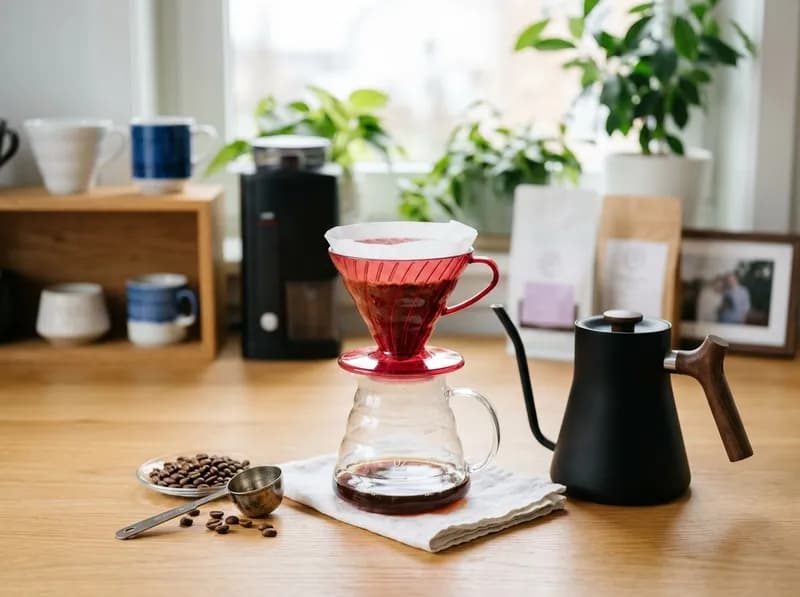
HARIO makes far more than the familiar plastic V60. Its pour-over lineup includes five main dripper materials, the redesigned V60 NEO, the MUGEN, the immersion-capable Switch, the modular Suiren, and the premium W60. Add paper filters, servers, Buono kettles, hand grinders, scales and starter kits, and choosing a setup becomes less straightforward than it first appears.
The good news is that you don't need to spend much to make excellent pour-over coffee. For most people, a plastic V60-02 is still the best place to start. The more interesting question is where spending extra actually makes a difference — and where HARIO's competitors offer better value.
Several developments in 2026 help answer that question. Blind tasting has put some numbers behind the debate over dripper materials. Coffee writer Scott Rao has published a V60 recipe that specifies the plastic model, while HARIO UK's own blog recommends its least expensive dripper over a much pricier stainless-steel version. The V60 NEO has also received a full independent review, and CoffeeGeek's first look at the Suiren produced a result that challenges the assumption that its open-air design makes brewing faster.
This guide looks at HARIO's U.S. lineup alongside independent reviews, measured comparisons, price history and owner feedback. It also covers a less obvious detail: HARIO USA's warranty for non-electric products is only 90 days.
No new product testing was conducted for this guide. Measurements and test results are attributed to the reviewers or organizations that produced them.
Quick Verdict: The Best HARIO Gear for Most People
Category | Recommendation | Why |
|---|---|---|
Best V60 for most people | V60 Plastic Size 02 | Inexpensive, easy to preheat and supported by a deep collection of recipes |
Best design-focused dripper | V60 NEO | Redesigned geometry, two 2026 design awards and compatibility with the Switch base |
Best versatile brewer | V60 Switch | Combines immersion and percolation in one brewer |
Best restricted-flow option | MUGEN | Simplifies pouring for people who prefer a repeatable recipe |
Best modular brewer | Suiren | Interesting for experimentation, but not a faster alternative to the V60 |
Best HARIO travel grinder | Mini-Slim+ | Compact and practical, although grind consistency trails some competitors |
Best HARIO grinder on paper | Smart G Pro | Stainless-steel burrs and double-bearing construction, but limited independent testing |
Best stovetop kettle | Buono | Excellent basic gooseneck design at a reasonable street price |
Best temperature-controlled kettle | Fellow Stagg EKG | More precise temperature control and a longer warranty |
Best HARIO scale | Polaris | Useful brewing functions, though its interface has some shortcomings |
Best alternative to the Drip Scale | Timemore Black Mirror | A stronger choice at a similar price |
A few recommendations deserve particular attention:
The plastic V60-02 is the sensible default. Scott Rao's published recipe specifies it, and HARIO UK's own blog recommends its inexpensive plastic model. CamelCamelCamel price history shows the red Size 02 has dropped as low as $5.93.
The NEO is a meaningful alternative, not an automatic replacement. It produces a rounder, fuller cup according to Barista Magazine, but that comes with less emphasis on the high-clarity floral notes associated with a classic V60.
The Switch is the most flexible HARIO brewer. It can make conventional pour-over coffee or hold water for immersion, although some drinkers find its immersion-style cups less distinct.
Think twice before buying the Skerton Pro at full price. Independent assessments point to inconsistent grind quality, coarse adjustment steps and durability concerns. Timemore and 1Zpresso offer stronger alternatives in a similar price range.
The Buono electric is not temperature-controlled. If you want precise temperature settings, the Fellow Stagg EKG is a more capable choice.
The Drip Scale is not an obvious $60 purchase. Its large owner-review base is positive overall, but independent reports describe display lag, inconsistent readings and other usability problems.
Three findings also challenge common assumptions about HARIO gear:
The Suiren is not faster simply because it is open-air. CoffeeGeek measured a 4:15 brew compared with 4:10 for a closed V60 under matched conditions.
HARIO USA's non-electric warranty is 90 days. Glass damage is excluded, so check a retailer's return policy before buying.
The W60 mesh filter can be slower than paper. Kurasu's test recorded a drawdown exceeding five minutes.
Understanding the HARIO Lineup
HARIO's catalog makes more sense when you separate brewing method from brewing style.
The classic V60 is a percolation dripper: water passes through the coffee bed continuously. The Switch adds a valve that can stop the flow, allowing immersion brewing. The MUGEN restricts the outlet and simplifies the pouring process. The Suiren uses an open, modular structure, while the W60 combines a dripper with a metal mesh filter.
Beyond drippers, HARIO sells servers and flasks, Buono kettles, hand grinders, coffee scales, paper filters and accessories such as the Drip-Assist.
Brewing approach | HARIO products | What it changes | Best suited to |
|---|---|---|---|
Percolation | V60, NEO | Pouring, grind size and agitation control the extraction | People who enjoy adjusting recipes |
Restricted percolation | MUGEN, Drip-Assist | Reduces the number of pouring decisions | Beginners and consistency-focused brewers |
Hybrid immersion | Switch | Allows immersion, percolation or a combination | People who want body and flexibility |
Open-air modular brewing | Suiren | Changes airflow and brewer configuration | Coffee enthusiasts who enjoy experimenting |
Two catalog details can cause confusion.
First, HARIO's U.S. and Japanese product descriptions are not always consistent. The MUGEN is listed as a 1–2 cup brewer in HARIO's global catalog, while some U.S. ceramic listings describe it as a 1–4 cup model. The underlying geometry is the same. The difference largely reflects how cup capacity is presented.
Second, the W60 occupies a niche position. Developed in collaboration with Pete Licata, it is one of HARIO's more specialized brewers. However, Kurasu's testing found that its metal mesh attachment could take longer to drain than paper filters. That makes it an interesting product for experimentation rather than an obvious upgrade for everyday brewing.
What Makes the HARIO V60 Different?
The V60's design is simple but gives the brewer considerable control over extraction:
A cone-shaped body with a 60-degree angle.
Spiral ribs along the inside wall.
One large opening at the bottom.
The steep cone helps water move through the coffee bed. The large opening means the dripper itself does relatively little to restrict flow, leaving grind size and pouring technique to determine much of the drawdown time. The ribs help prevent the filter from sealing against the wall and preserve an air channel.
This design is why the V60 has become a reference point for specialty coffee brewing. It is also why two people can use the same beans and equipment yet produce noticeably different cups.
A Kalita Wave or Clever Dripper tends to be more forgiving. The V60 offers more room to adjust extraction, but it also gives you more ways to get it wrong.
How V60 brewing variables interact
Variable | What happens | Possible adjustment |
|---|---|---|
Finer grind | Slower drawdown | Pour more gently or use fewer pulses |
Faster pouring | More agitation and fines migration | Grind slightly coarser or pour from a lower height |
Larger dose | Deeper coffee bed and longer contact time | Adjust grind size or divide the pour differently |
Cooler water | Lower extraction | Grind finer or increase contact time |
More agitation | Potentially higher extraction and more muddiness | Reduce turbulence elsewhere in the recipe |
This is the real answer to whether the V60 is beginner-friendly: it is not the easiest dripper to master, but it is one of the most adaptable. The MUGEN, Switch and Drip-Assist exist partly to make that learning process less demanding.
V60 Plastic vs Ceramic vs Glass vs Metal: Does Material Affect Taste?
The material debate has been around almost as long as the V60 itself. Plastic, ceramic, glass and stainless steel all have loyal supporters. In 2026, however, there is more independent evidence to work with than simply personal preference.
What blind testing found
japanesecoffeegear conducted triangle tests with trained tasters, comparing V60 drippers made from different materials. The results suggest that some differences are detectable, but they are smaller than many coffee enthusiasts assume.
Plastic vs. ceramic: Tasters identified the difference roughly 60% of the time, above chance but not by a large margin.
Plastic vs. glass: Results were around 45%, effectively chance.
Glass vs. ceramic: Results were around 50%, also effectively chance.
TDS measurements: Refractometer readings across the tested materials varied by less than 0.05 percentage points.
The same analysis compared the thermal mass of the drippers. The plastic V60 was estimated at roughly 200 J/°C, compared with approximately 492 J/°C for the porcelain model.
That difference matters when brewing. A cold ceramic dripper absorbs more heat from the slurry, while the plastic model warms up quickly. The ceramic V60 also showed slower and more variable drawdown in the same source's testing. The analysis attributed some of that variation to differences in ceramic manufacturing and filter seating.
In other words, material can influence brewing conditions, but the practical advantage of one material over another is not as dramatic as the price differences suggest.
Why coffee professionals often choose plastic
Two recommendations are particularly notable.
Scott Rao's published V60 recipe specifies the plastic dripper, citing heat retention as a reason for the choice.
HARIO UK's own blog also recommends its £9 plastic V60 as the starting point, despite selling a stainless-steel version for around £45.
That is a useful reminder that the most expensive dripper is not necessarily the best-performing one. The plastic V60 is inexpensive, easy to preheat and has a huge collection of established recipes built around it.
Why some people still prefer ceramic
Not everyone wants a plastic brewer. Some buyers prefer the weight and appearance of ceramic, while others avoid plastic for environmental or personal reasons.
The blind-test results do not make those preferences unreasonable. They simply suggest that the taste difference is modest rather than transformative.
If you prefer ceramic, preheat it thoroughly before brewing. If you are buying ceramic because you expect a clearly superior flavor compared with glass, the available blind-test evidence does not support that expectation.
V60 material comparison
Material | Approx. U.S. price | Thermal behavior | Durability | Verdict |
|---|---|---|---|---|
Plastic (AS resin) | $9–13 for Size 02 | Low thermal mass; heats quickly | Highly resistant to breakage; BPA-free resin rated for boiling water | Best overall value |
Ceramic | $24–27 | Higher thermal mass; needs thorough preheating | Heavy; can break if dropped on a hard surface | Choose for appearance and feel |
Glass | $21–24 | Moderate thermal mass; lets you see the coffee bed | Fragile | Best for visual appeal |
Stainless steel | $40+ | Heats quickly but can lose heat through the walls | Very durable | Aesthetic or travel-oriented choice |
Copper | Availability varies | High thermal conductivity | Durable; develops a patina | A premium design purchase |
There is no compelling blind-test evidence that the more expensive materials produce better coffee. Buy them because you prefer the material, not because you expect a major improvement in extraction.
What V60 price history tells us
The plastic V60-02 is cheap enough that timing your purchase can save a meaningful percentage.
CamelCamelCamel records the red VD-02R at an all-time low of $5.93, an average of $10.55 and a high of $19.23. The current listing used for this guide was around $13.
The white plastic Size 01 has a recorded low of $4.44 and an average of $10.06.
For a plastic V60, roughly $10 is a reasonable reference price. If you see one below $7, it is a good time to buy. Paying close to $19 makes little sense unless availability is limited.
V60 NEO: Is HARIO's New Dripper Worth Buying?
The V60 NEO is one of HARIO's most significant dripper updates in years. It arrived in the U.S. in January 2026 at approximately $26, with a redesigned rib structure and a different internal geometry.
HARIO's global website lists both an iF Design Award 2026 and a Red Dot Design Award 2026 for the NEO. The design is more contemporary than the classic V60, but its value depends on what kind of coffee you prefer.
What independent reviews found
Barista Magazine's test drive described the NEO's coffee as rounder, fuller and sweeter than a classic V60. That character is appealing if you prefer more body, but it comes with a trade-off: the high-clarity floral notes associated with washed Ethiopian coffees can seem less pronounced.
The review also identified a few practical differences:
The bloom drains faster than with a classic V60, so recipes that rely on a long bloom may need adjustment.
The paper seam needs to be folded carefully to avoid uneven flow.
Barista Magazine's suggested total brew time is approximately 2:30–3:00.
Basic Barista initially questioned whether the NEO was simply a marketing exercise. After using it for two months, the reviewer documented a change of opinion and adopted it for regular brewing. That is useful context because the NEO has attracted skepticism from people who see little reason to redesign a dripper as established as the V60.
Gear Patrol's coverage also noted that the coffee community remains divided over whether the redesign was necessary. The classic V60's geometry has been copied extensively, so a new version naturally invites comparison.
The Switch-base compatibility advantage
One practical detail makes the NEO more interesting: it fits the Switch base.
That means you can use the NEO in the Switch's immersion-and-percolation system rather than limiting it to conventional pour-over brewing.
For someone buying a new HARIO dripper in 2026, this compatibility adds flexibility. The NEO is a good choice if you want a fuller cup and a more modern design. If washed-coffee florals and a sharper flavor profile are your priority, the classic V60 remains the safer choice.
At the time of writing, the NEO had approximately 4.8 stars across around 500 Amazon ratings. That is encouraging for a relatively new product, although its review history is much shorter than the classic V60's.
V60-01 vs. V60-02 vs. V60-03: Which Size Should You Buy?
The size of a V60 affects more than how much coffee you can brew. It also changes the depth of the coffee bed and the way a recipe behaves.
Size | Practical dose range | Best use | Notes |
|---|---|---|---|
01 | 10–16 g | One small serving | Works well for approximately 200–300 ml |
02 | 15–30 g | One or two servings | The most versatile size for most households |
03 | 25–45 g or more | Larger batches | Better suited to sharing |
For most U.S. buyers, Size 02 is the best choice. It handles approximately 250–500 ml comfortably and leaves room to experiment with different doses.
Size 01 is useful if you nearly always brew one small cup. Size 03 makes sense if you regularly prepare coffee for several people.
One source of confusion is HARIO's use of Japanese cup measurements. Japanese cup counts often assume approximately 120 ml per cup, not a typical 8–12 oz Western mug. A brewer described as suitable for four cups may therefore produce much less coffee than a U.S. buyer expects.
A historical note: sources place the V60's launch in either 2004 or October 2005. Barista Magazine uses the earlier date, while other accounts emphasize the later commercial release. The distinction does not affect buying decisions, but it helps explain why the V60's design has such a long-established recipe ecosystem.
V60 vs. MUGEN vs. Switch vs. Suiren
These brewers share HARIO's approach to coffee, but they suit different habits.
HARIO MUGEN: A simpler way to brew
MUGEN means "infinity" in Japanese. Its design uses a restricted outlet and a pouring structure intended to reduce the number of decisions involved in brewing.
HARIO's official Tetsu Kasuya recipe uses:
25 g of coffee
300 g of water
Water temperature of 93°C
A single 15-second pour
Approximately 90 seconds of drawdown
The appeal is obvious: instead of managing several pours, you follow one straightforward recipe.
However, MUGEN is not completely foolproof. Kurasu's hands-on coverage found that the final cup still depends heavily on pour speed. Pour too quickly and the restricted outlet can still be overwhelmed.
honestcoffeereviews also raised concerns about weak cups when the recommended recipe is ignored, particularly with light-roasted coffee.
The brewer is listed as 1–2 cups in HARIO's global catalog, although some U.S. ceramic listings use a 1–4 cup description. For typical Western servings, the smaller capacity estimate is more useful.
Who should buy it: People who want a repeatable morning routine and would rather follow one established recipe than manage several pouring variables.
HARIO Switch: Immersion and pour-over in one brewer
The Switch combines a V60-style dripper with a valve in its base. Open the valve and it behaves like a conventional percolation brewer. Close it and water stays in contact with the coffee for immersion brewing.
You can also combine the two methods in a single recipe.
That flexibility is the Switch's main advantage. It is not necessarily a better V60, but it gives you more ways to adjust the cup without buying a second brewer.
The independent record is broadly positive, although not unanimous.
What users and reviewers like:
Amazon ratings are approximately 4.7 stars across around 2,500 reviews.
coffeexplore's 90-day test documented the flexibility of the system.
HARIO UK's official recipe uses 15 g of coffee and 250 g of water at 92–94°C, with a two-minute immersion.
A commonly used beginner variation uses 15 g of coffee and 240 g of water with the same two-minute steep.
The coffeexplore test also measured an 8–10°C drop in slurry temperature during a two-minute immersion in the glass brewer. If temperature is important to your recipe, preheating the Switch base is worth doing.
Why some people prefer a plain V60:
Not everyone enjoys immersion-style coffee. In an April 2026 r/pourover discussion, one user, u/Bach_Chemist, described Switch immersion cups as "muted and dull" compared with pure percolation.
That is a subjective assessment, but it reflects a genuine difference in brewing style. Immersion can produce a fuller cup, while some drinkers prefer the separation and clarity they get from a conventional pour-over.
Comparisons with the Clever Dripper show a similar distinction. The Clever is often associated with a fuller-bodied immersion cup, while the Switch offers more control over how much of the brew is immersion versus percolation.
Who should buy it: People who find their V60 results inconsistent, enjoy experimenting with different extraction styles or want one brewer that can cover several preferences.
If your priority is a very clear, tea-like cup, a plain V60 may be the better choice.
The Switch typically sells for around $31 on Amazon, although third-party sellers can affect the price. The Switch & Match configuration, which includes a dripper and server, is often a more economical way to buy into the system.
HARIO Suiren: Modular design, not faster brewing
The Suiren is an open-frame dripper built from separate modules. Its unusual appearance and open structure make it appealing to people who like experimenting with brewing equipment.
The marketing idea behind an open-air brewer is easy to understand: more airflow should mean faster brewing. CoffeeGeek's first look, however, measured the opposite.
Under matched conditions:
The Suiren took approximately 4:15.
A closed V60 took approximately 4:10.
Refractometer readings were effectively identical at 1.32–1.34% TDS.
The reviewer described the Suiren's cup as less sharp.
The proposed explanation was heat loss. The open structure allows more heat to escape from the slurry, with condensation visible on the ribs. That can slow the brewing process rather than accelerate it.
Serious Eats' review reaches a compatible conclusion about the Suiren's appeal: its value is in the modular design, not a measurable speed advantage.
Who should buy it: Coffee enthusiasts who enjoy changing configurations and experimenting with equipment. It is not the right purchase if your main goal is a faster drawdown.
V60 variant comparison
Brewer | Brewing method | Recipe dependence | Independent assessment | Approx. price |
|---|---|---|---|---|
Classic V60 | Pure percolation | High | Extensive history of recipes and reviews | $9–40, depending on material |
V60 NEO | Redesigned percolation cone | High, with faster-draining bloom | Barista Magazine review; two 2026 design awards | ~$26 |
MUGEN | Restricted percolation | Medium | Kurasu and honestcoffeereviews | ~$20–30 |
Switch | Immersion and percolation | Low to medium | 90-day test; positive owner ratings and some dissent | ~$31 |
Suiren | Open-air modular brewing | Medium | CoffeeGeek measured slower drawdown than V60 | ~$30–40 |
HARIO Paper Filters: White vs. Brown, Japan vs. Netherlands
Paper filters are easy to overlook, but they are part of the V60's brewing system. Changing filters can alter drawdown time, even when the coffee and pouring recipe stay the same.
White vs. brown HARIO filters
The difference between white and brown filters is smaller than many buyers expect.
The main practical consideration is whether you rinse the filter before brewing. Unrinsed brown filters can contribute a noticeable papery taste. Some users also detect a paper note from unrinsed white filters.
The 1997 Journal of Food Science leaching study cited in this debate found that oxygen bleaching does not create the chlorinated-residue concern sometimes associated with older bleaching methods. The environmental impact of filter manufacturing is a separate question from what ends up in the cup.
For everyday brewing, rinse either color thoroughly. This removes much of the paper taste and preheats the dripper at the same time.
Japanese-made vs. Netherlands-made filters
HARIO filters are manufactured in both Japan and the Netherlands. The two versions are not necessarily identical.
Feature | Japan-made filters | Netherlands-made filters |
|---|---|---|
Paper thickness | Thinner | Slightly thicker |
Flow | Generally faster | Generally slower |
Tab | No tab | Tab included |
Brewing impact | May produce shorter drawdown | May produce longer drawdown |
Neither version is inherently better. The important point is consistency.
If you have developed a V60 recipe around a particular filter, changing the manufacturing origin may alter the drawdown. Check the packaging when repeatability matters.
Are genuine HARIO filters worth buying?
A flow-rate comparison from flypresso, using a 15 g coffee-to-250 g water recipe, recorded approximately:
HARIO white filter: 2:45 drawdown
Generic budget filter: 3:30 drawdown
That is a difference of roughly 45 seconds under the test conditions.
The result does not mean every generic filter will behave the same way, but it illustrates why paper choice matters. A V60 recipe is built around a particular flow profile, and changing the filter can change the result.
Metal and cloth alternatives
Reusable cloth and metal filters generally trade some of the clarity associated with paper for a fuller-bodied cup. They also require cleaning and maintenance that some owners find inconvenient.
The W60's mesh attachment is a useful cautionary example: Kurasu's test recorded a brew time exceeding five minutes, slower than paper.
Cafec and other specialty filter brands are also worth considering. Some offer papers designed for faster or slower flow, making them useful for recipe adjustment. For a standard V60, however, HARIO white paper remains a sensible baseline because many published recipes assume its flow characteristics.
HARIO Servers and Carafes
HARIO's servers are among the simplest products in its catalog. The main choices are borosilicate glass Range servers, insulated stainless-steel models and other glass formats.
The Range line is available in several capacities, including 360 ml, 600 ml and 800 ml.
Two details are worth considering before buying.
Glass makes brewing easier to monitor. A transparent server lets you see the coffee level and color, which can be useful when developing a recipe. Insulated stainless-steel servers retain heat but hide the coffee.
Choose capacity based on actual serving size. A 600 ml server works well for roughly two smaller servings, while the 800 ml version is more comfortable for larger batches or two full mugs.
There is little reason to spend heavily on a server unless you specifically want insulation or a particular design. A basic borosilicate Range server is sufficient for most V60 setups.
HARIO Kettles: Buono vs. Fellow Stagg EKG
HARIO's Buono line includes stovetop, electric and copper versions. They share the familiar gooseneck shape, but they differ significantly in temperature control.
HARIO Buono kettle comparison
Kettle | Heat source | Temperature control | Approx. U.S. price | Main advantage |
|---|---|---|---|---|
Buono stovetop | Stove | None; use a separate thermometer | $65 list; $40–54 street | Classic gooseneck pouring |
Buono electric | Electric | No variable temperature setting | ~$65–75 | Electric convenience |
Buono copper | Stove | None | Premium; availability varies | Distinctive appearance |
The most important distinction is that the Buono electric does not offer variable temperature control.
That is a surprising limitation in a product family aimed at pour-over brewing, where recipes often specify temperatures between 92°C and 97°C.
Buono vs. Fellow Stagg EKG
The Fellow Stagg EKG is a more advanced kettle, particularly for people who want to control water temperature precisely.
In one set of head-to-head comparisons, the Buono stovetop scored 7.9 overall against 7.5 for the Stagg EKG. However, the temperature-accuracy sub-scores went the other way: 4.2 for the Buono and 8.8 for the Stagg.
The Stagg EKG lists at $199.95, with street prices around $150 on Amazon. It offers degree-level temperature control, a 60-minute hold function and a two-year warranty. HARIO USA's non-electric coverage is considerably shorter.
The choice depends on how you brew:
Buono stovetop + thermometer ($40–54): Best value if you are comfortable heating water on the stove and checking the temperature yourself.
Buono electric ($65–75): Convenient, but difficult to recommend when it lacks variable temperature control.
Fellow Stagg EKG (around $150 street): Better for repeatable recipes and people who regularly adjust temperature for different coffees.
Do you actually need temperature control?
Not necessarily.
The main recipes discussed in this guide can all be made with water heated close to boiling. Scott Rao's recipe uses 97°C, which is essentially off-boil, while other recipes use a brief resting period after boiling.
Temperature control becomes more useful when you brew several different coffees and want to repeat specific settings. For a beginner making one or two cups a day, it is a convenience rather than a requirement.
HARIO Grinders: Where You Should Consider Other Brands
HARIO's drippers and filters are easy to recommend. Its grinders are a more complicated story.
The company makes several hand grinders, including the Skerton Pro, Mini-Slim+, Smart G, Smart G Pro, Prism and Zebrang. Independent testing suggests that some are reasonable travel options, but the strongest value in this category often comes from Timemore or 1Zpresso.
HARIO Skerton Pro: Why it is hard to recommend at full price
The Skerton Pro is one of HARIO's best-known hand grinders. It is also one of the least convincing purchases in its current price range.
Coffee Grinder Index gave it an overall score of 6.5/10, with a grind-quality score of 5.8. The assessment highlighted coarse-end fines, noticeable static and an adjustment system that requires disassembly from the top for meaningful changes.
The adjustment steps are another limitation. At roughly 60 microns per click, the grinder offers relatively coarse adjustment compared with the finer increments preferred for espresso. Community espresso-suitability ratings are around 2/5.
For pour-over, the limitations are less severe, but adjustment precision still matters. Light roasts can be particularly sensitive to grind settings.
Long-term reports collected by VeriReview also describe wear to plastic components after roughly eight months of regular use, with resulting changes in grind consistency.
At approximately $40–50, the Skerton Pro faces strong competition from the Timemore C2/C3 and 1Zpresso Q2. These grinders are frequently recommended for their more consistent grinding and adjustment mechanisms.
The Skerton Pro still has two possible advantages: it can be heavily discounted, and its glass catch jar is pleasant to use. Neither changes the underlying grind-quality comparison.
HARIO Mini-Slim+: A reasonable travel grinder
The Mini-Slim+ performs better as a compact grinder.
In comparisons with the Timemore Chestnut C2, it scored slightly higher overall in one review framework: 6.5 versus 6.3. However, the C2 scored better for grind consistency, at 7.0 compared with 6.5.
That makes the Mini-Slim+ a reasonable choice for travel and occasional filter coffee. If you are buying one grinder for daily use, the Timemore alternatives remain more attractive.
Smart G and Smart G Pro: Interesting specifications, limited evidence
The Smart G Pro stands out because it uses stainless-steel burrs and a double-bearing construction. It weighs around 360 g and stores its handle in the outer band.
On paper, that makes it HARIO's most interesting answer to the Timemore competition.
The problem is the limited independent review record. Its approximately 4.5-star rating comes from only around six reviews, which is too small a sample to establish long-term performance with much confidence.
HARIO UK's own grinder guidance also steers filter-coffee buyers toward other options.
The Smart G Pro is worth watching, but it is difficult to rank confidently without more independent testing.
Prism and Zebrang
The Prism uses ceramic burrs and a body designed to store the handle. The Zebrang uses steel burrs and is positioned toward outdoor coffee preparation.
Neither has a substantial independent English-language testing record.
The Zebrang's steel burrs make it more interesting on specifications alone, while its outdoor positioning gives it a clearer use case. The Prism is harder to justify without stronger evidence of its grinding performance.
HARIO grinder comparison
Grinder | Burr material | Adjustment | Independent evidence | Verdict |
|---|---|---|---|---|
Skerton Pro | Ceramic | Stepped; roughly 60 μm; top disassembly | 6.5/10 overall, 5.8 grind quality | Skip at full price |
Mini-Slim+ | Ceramic | Stepped | 6.5 vs. C2's 6.3 overall; lower consistency score | Travel option |
Smart G Pro | Stainless steel | Stepped; double bearings | Limited review base, around 4.5★ from 6 reviews | Interesting but unproven |
Prism | Ceramic | Stepped | No substantial independent record found | Hard to recommend |
Zebrang | Steel | Stepped | No substantial independent record found | Outdoor niche |
For most buyers, the more sensible grinder shortlist is:
Timemore C2 or C3: Strong value for everyday filter coffee.
1Zpresso Q2: Another compact hand-grinder option worth considering.
HARIO Mini-Slim+: A reasonable travel choice.
HARIO Smart G Pro: Worth considering if you specifically want a HARIO grinder, but the evidence is limited.
HARIO Skerton Pro: Buy only when heavily discounted.
None of these HARIO consumer grinders should be treated as a dedicated espresso grinder. If espresso is your main brewing method, look at a grinder designed for that level of adjustment.
HARIO Scales and Accessories
V60 Drip Scale: A clever design with practical shortcomings
The HARIO V60 Drip Scale was developed with input from James Hoffmann's recommendations for reducing unnecessary cost. Its weighing resolution changes by range: 0.1 g below 100 g and 1 g above that point.
The idea is sensible, but owner reports and independent assessments identify several issues:
A display lag of approximately 1–2 seconds.
Re-weigh variation of around 0.2–0.3 g on the same object.
No backlight.
No water resistance.
Reports of touchpad wear over time.
One documented failure in which the display appeared to read backward during pouring.
A lab-style roundup also failed the scale, citing a dim display, inconsistent behavior with 100 g calibration weights and its use of AAA batteries.
That is not the entire story. Amazon ratings are approximately 4.6 stars across more than 3,000 reviews, suggesting that many owners are satisfied with it.
The issue is value. At around $60, the Timemore Black Mirror is a safer purchase in many comparisons, with a faster display refresh, backlighting and a stronger consistency record.
HARIO Polaris: Useful brewing features, some interface compromises
The Polaris is designed around pour structure and includes built-in timer segments.
Side-by-side testing found that it could hit target water ratios within approximately 1–2%, which is a good result.
Its shortcomings are more about usability:
The timer counts up rather than down.
Some units use 1 g resolution.
The beeper is annoying enough that some users disable it.
Its review base is also much smaller than the Drip Scale's, so confidence in long-term reliability is limited.
Drip-Assist: A simple way to improve consistency
The Drip-Assist is a plastic plate that sits on a standard V60 and helps distribute water in a controlled pattern.
It applies some of the MUGEN's simplified-pouring philosophy to a conventional V60. For beginners who find pouring technique difficult, it is one of HARIO's more useful low-cost accessories.
HARIO Starter Set
The V60 Starter Set typically costs around $28.50 and includes:
Plastic V60-02 dripper.
Range server.
Filter holder.
Paper filters.
It is a sensible gift or entry-level purchase. The included plastic Size 02 dripper is not a compromise in brewing performance; it is the model that makes the most sense for many experienced brewers as well.
Essential HARIO accessory comparison
Accessory | Approx. price | Verdict |
|---|---|---|
HARIO white filters, Size 02 | $9–12 per 100 | Worth buying; consistent flow is part of the recipe |
Drip-Assist | $15–20 | Useful for beginners who want more controlled pouring |
Range server, 600/800 ml | $20–30 | Good basic glass server |
V60 Drip Scale | ~$60 | Better bought on sale |
Polaris | $50–60 | Good ratio accuracy, but some interface limitations |
Plastic V60-02 + filters + existing carafe | ~$19.50 | Best minimalist starting setup |
V60 Recipes: Hoffmann, Kasuya and Rao
The V60's flexibility is a major advantage, but it can make the brewing process confusing. A reliable published recipe is a better starting point than changing several variables at once.
Three well-known approaches cover most brewing preferences.
James Hoffmann's Ultimate V60
A good starting point for most home brewers.
Coffee: 30 g
Water: 500 g
Grind: Medium-fine
Target brew time: Approximately 3:30
Hoffmann's method uses a structured pouring approach with controlled agitation. It is a useful baseline for anyone with a V60 and a scale.
Tetsu Kasuya's 4:6 Method
Best for people who want to adjust sweetness and brightness.
Coffee: 20 g
Water: 300 g
Grind: Coarse
Pouring: Five equal pours
The first 40% of the water, delivered in two pours, is used to adjust the balance between sweetness and brightness. The remaining 60%, delivered in three pours, controls strength.
The method is useful because it gives brewers a relatively clear way to adjust flavor without changing every part of the recipe.
Kasuya's approach also appears in HARIO's official MUGEN recipe, which uses 25 g of coffee, 300 g of water at 93°C, a 15-second pour and a 90-second drawdown.
Scott Rao's Spin Technique
A useful option for light roasts and people looking for higher extraction.
Coffee: 20 g
Water: 330 g
Temperature: 97°C
Target brew time: 4:00–4:30
Rao's method includes a signature rotation to flatten the coffee bed and reduce channeling. His published recipe specifies the plastic V60, which reinforces the earlier point that a more expensive dripper is not necessarily required.
Switch recipes
The Switch offers a different approach because it can hold water in contact with the coffee.
Recipe | Coffee | Water | Temperature | Immersion |
|---|---|---|---|---|
HARIO UK official recipe | 15 g | 250 g | 92–94°C | 2 minutes |
Common beginner variation | 15 g | 240 g | Adjust to taste | 2 minutes |
The two-minute immersion is a useful starting point. If you want to maintain temperature more closely, preheat the glass base before brewing. coffeexplore's 90-day test measured an 8–10°C temperature drop during a two-minute steep.
Complete HARIO Setups: What Should You Buy First?
You do not need to buy the entire HARIO catalog to make good coffee. A basic V60 setup can cost less than a typical specialty coffee subscription.
1. Minimalist setup: approximately $19.50
Plastic V60-02: $10–13
HARIO white filters: approximately $9–12 per 100
Any heatproof carafe or mug you already own
Use a kettle you already have and start with Hoffmann's recipe. You can make excellent coffee without buying a dedicated server, scale or grinder immediately.
2. HARIO Starter Set: approximately $28.50
The official Starter Set adds a server, filter holder and filters to the plastic dripper.
It is a good gift option and a convenient way to get the basic equipment in one purchase.
3. Setup with a grinder: approximately $68.50
Add a Timemore C2 or 1Zpresso Q2, typically around $50–60 at street prices.
This is a better use of money than adding a Skerton Pro at $40–50. Freshly ground coffee and a more consistent grinder are likely to make a more noticeable difference than upgrading the dripper material.
4. Immersion-hybrid setup: approximately $75–85
HARIO Switch: around $31
Paper filters
600 ml Range server
Optional Timemore C2 or 1Zpresso Q2
The Switch gives you both immersion and percolation brewing. If you want one brewer that can produce different cup styles, it is one of HARIO's strongest options.
5. Recipe-focused upgrade setup
For someone who has already developed a regular brewing routine:
Plastic V60-02
Timemore C2/C3 or 1Zpresso Q2
Fellow Stagg EKG
Timemore Black Mirror scale
This setup includes only a few HARIO products, but that is a reasonable conclusion from the comparisons above. HARIO remains particularly strong in drippers and filters. For grinders, scales and temperature-controlled kettles, other brands often make more compelling products.
HARIO vs. Fellow, Kalita, Origami, Timemore, Cafec and Chemex
HARIO is not the only brand worth considering. The alternatives are useful because they often solve a specific problem better than the V60.
HARIO vs. Fellow
Fellow's Stagg EKG is the stronger choice if you want precise temperature control. Its kettles are more expensive, but they offer features the Buono electric lacks.
For drippers, Fellow's Stagg X/Y products target a similar specialty-coffee audience, although they have a smaller independent review history than the classic V60.
Choose HARIO for: Affordable drippers and filters.
Choose Fellow for: Temperature-controlled kettles and selected premium brewing accessories.
HARIO vs. Kalita Wave
The Kalita Wave uses a flat-bottom design with three small holes. Compared with the V60, it reduces some of the influence of pouring technique and can produce more consistent results from less experienced brewers.
The Wave 185 is the size most buyers should consider. It typically costs two to three times as much as a plastic V60 and can be harder to find in the U.S.
Choose the V60 for: More control and a large collection of recipes.
Choose the Kalita Wave for: A more forgiving brewing process.
HARIO vs. Origami
The Origami dripper is known for its folded, ridged design. It can accept both conical and flat-bottom filters, giving it more flexibility in filter choice.
That makes it attractive to people who want to experiment with different extraction styles without buying multiple brewers.
The trade-offs are its greater fragility compared with a plastic V60 and the need for a suitable holder.
Choose Origami for: Dual-filter flexibility.
Choose HARIO for: Lower cost, durability and a much larger established recipe ecosystem.
HARIO vs. Timemore
The two brands now occupy different positions in the market.
HARIO's V60 remains one of the reference designs for pour-over brewing, while Timemore has become a stronger option for affordable hand grinders and scales.
The practical combination: HARIO dripper and filters, Timemore grinder and scale.
HARIO vs. Cafec
Cafec competes through specialty paper filters designed to influence flow rate, along with its Flower dripper.
Its papers are useful for V60 owners who want to adjust drawdown time without changing the brewer itself.
Choose Cafec for: Filter experimentation and alternative flow profiles.
Choose HARIO for: The standard V60 setup and its established recipe base.
HARIO vs. Chemex
The Chemex is a larger-format glass brewer with a distinctive appearance and thick paper filters.
Its filters retain more oils and fine particles, producing a cleaner cup with a different body and mouthfeel. It is particularly useful when brewing larger batches for several people.
The V60 and Range server can cover much of the same everyday brewing need at a lower cost. The Chemex is more appealing if you want a larger table-side brewer or value its distinctive design.
Which brand should you choose?
What matters most | HARIO option | Alternative worth considering |
|---|---|---|
Cheapest excellent dripper | Plastic V60-02 | None needed |
More consistent brewing with less technique | MUGEN or Drip-Assist | Clever Dripper |
Immersion and percolation in one brewer | Switch | Origami for dual-filter flexibility |
Everyday hand grinder | No clear HARIO winner | Timemore C2/C3, 1Zpresso Q2 |
Coffee scale | Polaris or Drip Scale | Timemore Black Mirror |
Temperature-controlled kettle | No direct Buono equivalent | Fellow Stagg EKG |
Different paper-filter flow profiles | V60 with Cafec papers | Cafec Flower dripper |
Which HARIO Should You Buy? 15 Common Buyer Situations
The right setup depends on how much coffee you make, how much control you want and how much you are prepared to spend.
Buyer situation | Recommended setup | Why |
|---|---|---|
1. Absolute beginner with $20 | Plastic V60-02 + filters | Low-cost entry point; start with Hoffmann's recipe |
2. Beginner with $50 | Plastic V60-02 + Timemore C2 | A better grinder is a more useful upgrade than a premium dripper |
3. Buying a gift | HARIO Starter Set | Includes the basic equipment in one package |
4. Distracted morning brewer | MUGEN or Drip-Assist + plastic V60 | Reduces pouring decisions |
5. Light-roast enthusiast | Plastic V60-02 + Rao's recipe | High brewing temperature and controlled agitation |
6. Washed-Ethiopian clarity enthusiast | Classic V60 + Kasuya 4:6 | Preserves the classic V60's sharper profile |
7. Fuller-bodied coffee drinker | Switch | Immersion brewing offers more body |
8. Office worker | Mini-Slim+ + plastic V60-01 | Compact and easy to transport |
9. Camper | Zebrang or plastic V60-01 | Outdoor-oriented grinder or lightweight brewer |
10. Two-person household | Plastic V60-02 + 800 ml Range server | More room for larger batches |
11. Recipe experimenter | Switch + scale + plastic V60 | Covers several brewing approaches |
12. Design-focused buyer | V60 NEO + Buono copper | Distinctive appearance and award-winning design |
13. Espresso-curious buyer | Timemore or 1Zpresso grinder | HARIO's consumer grinders are not ideal for espresso |
14. Buyer avoiding plastic | Ceramic V60-02 | A reasonable choice if you preheat it thoroughly |
15. Buyer who wants one simple recommendation | Plastic V60-02 + filters + server + Timemore C2 + Buono stovetop | A balanced setup without overspending on the wrong components |
For most people, the best starting point is still the plastic V60-02. If you enjoy experimenting, add the Switch. If you want a better daily grinder, spend the extra money on Timemore or 1Zpresso rather than moving up to a more expensive HARIO hand grinder.
Final Verdict: Which HARIO Products Are Worth Buying?
HARIO's lineup is strongest where the brand has built its reputation: drippers and paper filters. The plastic V60-02 remains an excellent brewer, the NEO offers a different cup profile, and the Switch is one of the most versatile options in the catalog.
The material debate is less dramatic than it might seem. Blind testing suggests that plastic and ceramic can be distinguished under some conditions, but the difference is modest. Preheating and brewing technique matter more than buying an expensive dripper.
The NEO is worth considering if you prefer fuller-bodied coffee and want a modern design. The Switch makes sense if you want to alternate between immersion and percolation. The Suiren is an interesting modular brewer, but its open structure does not make it faster.
The accessories require more selective buying. Timemore and 1Zpresso offer stronger grinder choices for most budgets. The Timemore Black Mirror is a safer scale purchase at the Drip Scale's price, and the Fellow Stagg EKG is the better option if precise temperature control matters.
A practical shopping list for most home brewers looks like this:
Dripper: HARIO V60 Plastic-02.
Filters: HARIO white Size 02.
Server: HARIO Range 600 ml or 800 ml.
Grinder: Timemore C2/C3 or 1Zpresso Q2.
Kettle: Buono stovetop for value; Fellow Stagg EKG for temperature control.
Scale: Timemore Black Mirror.
You do not need to buy everything at once. Start with the V60, filters and a kettle. Add a grinder when you are ready to grind fresh coffee, then decide whether a scale or a more specialized brewer would improve your routine.
Frequently Asked Questions
Is the plastic HARIO V60 safe?
Yes. The plastic V60 is made from AS resin, is BPA-free and is rated for use with boiling water. It is also the model specified in Scott Rao's published V60 recipe and recommended in HARIO UK's own buying guidance.
Does V60 dripper material actually affect taste?
It can, but the measured differences are relatively small. In japanesecoffeegear's triangle tests, trained tasters identified plastic versus ceramic around 60% of the time, above chance but not by a large margin. Plastic versus glass and glass versus ceramic were effectively at chance.
TDS readings varied by less than 0.05 percentage points across the tested materials. Preheating the dripper is more important than paying extra for a different material.
Should I buy a V60-01, V60-02 or V60-03?
For most people, buy the V60-02. It handles approximately 15–30 g of coffee and 250–500 ml of water.
Choose the 01 for smaller single servings and the 03 for larger batches. Remember that Japanese cup measurements often assume approximately 120 ml per cup, not a full Western mug.
Is the HARIO Switch worth buying over a regular V60?
The Switch is worth considering if you want both immersion and conventional pour-over brewing. It has a strong owner-review base, with approximately 4.7 stars across 2,500 Amazon ratings, and a 90-day independent testing record from coffeexplore.
However, some coffee drinkers find immersion-style cups less distinct. If you prefer high clarity and a tea-like profile, a plain V60 may be a better fit.
Is the V60 NEO better than the classic V60?
Not necessarily. It produces a different cup.
Barista Magazine described the NEO as rounder, fuller and sweeter, but noted that its profile can soften the high-clarity floral notes associated with the classic V60.
The NEO launched in the U.S. in January 2026 at around $26 and received both iF Design Award and Red Dot Design Award recognition for 2026. Its compatibility with the Switch base is another advantage.
Choose the NEO if you prefer more body and a redesigned brewer. Choose the classic V60 if floral clarity is your priority.
Is the HARIO MUGEN foolproof?
No. It simplifies the pouring process, but it does not eliminate the need for a suitable recipe.
Kurasu's testing found that pour speed still affects the result. Some reviews also report a risk of weak extraction, particularly with light roasts, when the recommended brewing approach is ignored.
HARIO's official Kasuya recipe uses 25 g of coffee, 300 g of water at 93°C, a 15-second pour and approximately 90 seconds of drawdown.
Are white or brown HARIO filters better?
After rinsing, the practical difference is small. The 1997 Journal of Food Science leaching study cited in this discussion found no chlorinated-residue concern from oxygen-bleached filters.
Rinse either type before brewing. It helps remove paper taste and preheats the dripper.
Do I need a gooseneck kettle for the V60?
A gooseneck kettle is strongly recommended because it makes pouring easier to control. Temperature control is optional.
The Buono stovetop kettle is a good value choice at around $40–54 street price. If you want precise temperature settings and a hold function, the Fellow Stagg EKG is the stronger option.
Is the HARIO Skerton Pro good enough for pour-over?
It can make pour-over coffee, but it is difficult to recommend at its full $40–50 price.
Coffee Grinder Index scored it 6.5/10 overall and 5.8 for grind quality. Its adjustment steps are around 60 microns, and long-term reports describe wear to plastic components after roughly eight months of regular use.
The Timemore C2/C3 and 1Zpresso Q2 are generally better purchases at similar prices.
Which HARIO grinder should I actually buy?
The Mini-Slim+ is the most straightforward HARIO choice for travel. The Smart G Pro has interesting stainless-steel burr specifications, but its independent review base is too small for a confident recommendation.
For everyday grinding, Timemore and 1Zpresso are stronger options. None of HARIO's consumer hand grinders is an obvious choice for espresso.
Is the HARIO V60 Drip Scale worth $60?
It is difficult to recommend at full price.
Reports describe a 1–2 second display lag, 0.2–0.3 g re-weigh variation, no backlight and no water resistance. One independent roundup also failed it in testing.
Its Amazon rating is still around 4.6 stars across more than 3,000 reviews, so many owners are satisfied. However, the Timemore Black Mirror is a safer alternative at a similar price.
What warranty does HARIO offer in the U.S.?
According to HARIO USA's published policy:
Returns: 30 days.
Electric products: One-year limited warranty.
Non-electric products: 90-day warranty.
Glass damage: Excluded from warranty coverage.
Shipping damage: Must be reported within three days.
Policies differ by region. HARIO Asia, for example, lists a one-year warranty. If you are buying a glass server or dripper, check the retailer's own return policy before placing the order.
Is the HARIO Suiren faster because it is open-air?
No. CoffeeGeek measured a 4:15 brew with the Suiren compared with 4:10 for a closed V60 under matched conditions.
The proposed explanation is that the open structure allows more heat to escape from the coffee slurry. TDS readings were effectively identical at 1.32–1.34%, while the reviewer described the Suiren's cup as less sharp.
Buy the Suiren for its modular design, not for faster brewing.
How much does a complete beginner HARIO setup cost?
A basic setup can be inexpensive:
Minimalist setup: Approximately $19.50 for a plastic V60-02, filters and an existing carafe.
HARIO Starter Set: Approximately $28.50.
Setup with a grinder: Approximately $68.50, using a Timemore C2 or 1Zpresso Q2 rather than the Skerton Pro.
You can start with the dripper and filters, then add equipment as your brewing routine develops.
How long do HARIO filters take to drain compared with generic filters?
In the flypresso flow comparison, a HARIO white filter took approximately 2:45 to draw down, compared with around 3:30 for a generic filter using the same 15 g coffee and 250 g water recipe.
The exact difference depends on the filter and brewing conditions, but genuine HARIO filters are part of the V60's intended flow characteristics.
Which HARIO products should I skip?
Based on the available independent evidence, these are the products to approach cautiously:
Skerton Pro at full price: Timemore and 1Zpresso offer stronger grinder alternatives.
Buono electric: It lacks variable temperature control, making the stovetop Buono or Fellow Stagg EKG more compelling.
V60 Drip Scale at full price: The Timemore Black Mirror has a stronger case at a similar price.
W60 mesh attachment: Kurasu's testing found a drawdown exceeding five minutes, slower than paper.
That does not make these products unusable. It means their prices and limitations deserve more attention before you buy.
Related GuidesMore →
Which Breville Smart Oven Should You Buy? Every Model Compared (2026)
Shopping for a Breville Smart Oven in 2026? This complete buying guide compares every major U.S. model, from the compact BOV450 and BOV680 to the large-capacity BOV900 and connected Joule BOV950. Explore cooking functions, interior capacity, prices, warranties, independent lab results, and key differences to find the right countertop oven for your kitchen.
KitchenAid Stand Mixer Buying Guide 2026: Which Model Should You Buy?
Choosing a KitchenAid stand mixer in 2026 means comparing more than bowl size and price. This guide covers the Classic, Deluxe, Artisan, Artisan Mini, Artisan Plus, Luminaire, and bowl-lift models, with current U.S. pricing, capacity limits, and practical differences. Learn which mixer fits everyday baking, small batches, or heavy dough, and how independent testing, warranty terms, and repairability can help you make a more informed purchase.
Best Baratza Coffee Grinder for 2026: A Complete Buying Guide
Which Baratza grinder should you buy for home espresso or everyday filter coffee? This 2026 buying guide compares the Encore, Encore ESP, ESP Pro, Virtuoso+, Sette 270, and higher-end models using official specifications, independent testing, and owner feedback. Learn why the least expensive option can be the smartest choice for brewed coffee, when stepless adjustment matters, and which models have notable trade-offs in noise, reliability, or dosing accuracy.