Best Breville Espresso Machine in 2026: Every Series Explained and How to Choose
Breville's espresso machine lineup ranges from compact entry-level models to premium automated systems, but the differences go beyond price and appearance. This buying guide compares the Bambino, Barista Express, Barista Pro, Touch Impress, and Oracle Jet to help you decide which features are worth paying for. You'll also find practical trade-offs, warranty information, pricing context, and alternatives to discontinued models such as the Dual Boiler BES920 and Oracle Touch BES990.
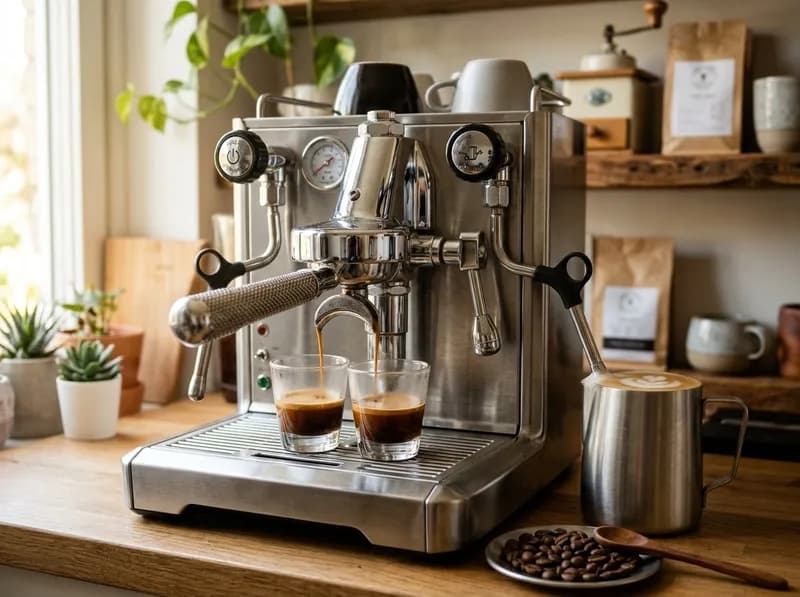
Breville makes home espresso machines for a wide range of budgets and skill levels. The Bambino series keeps things compact and leaves grinding to you. The Barista Express and Barista Pro combine a grinder and espresso machine in one unit. The Barista Touch models add touchscreen guidance and automatic milk texturing, while the Oracle series handles more of the preparation for you.
The best Breville espresso machine depends on how much work you want to do before each cup. If you enjoy adjusting grind size, dosing coffee, and learning to steam milk, a simpler machine may be all you need. If you make several lattes every morning, assisted tamping and automatic milk preparation can save time and make the routine more consistent.
Three questions will help narrow down the choices:
How much control do you want? Manual preparation gives you more opportunities to adjust the shot, but it takes practice.
Do you want a built-in grinder? An all-in-one machine saves counter space and simplifies shopping, although its grinder may be harder to upgrade independently.
What do you drink most often? Espresso, cappuccinos, lattes, and regular brewed coffee call for different equipment.
There is also a reason to check model numbers carefully in 2026. Several machines that still appear in older buying guides, including the Dual Boiler BES920 and Oracle Touch BES990, have been discontinued in the U.S. They can remain worthwhile purchases at the right price, but availability, warranty coverage, and replacement parts deserve more attention than they would for a current model.
This guide focuses on Breville's U.S. lineup and distinguishes manufacturer-listed prices from retail deals and historical sale prices. Prices and inventory can change, so check the current listing before buying.
How This Guide Evaluates Breville Espresso Machines
The comparisons draw on Breville's U.S. product information and manuals, independent reviews, and owner reports about everyday use. Manufacturer specifications are treated separately from reviewer observations and longer-term reliability complaints. That distinction matters: a machine can offer an impressive feature list without necessarily being the easiest one to live with.
Model availability is another consideration. Some machines remain visible on support pages after leaving the retail lineup, and an old product page does not guarantee that a model is still manufactured or readily available. Where a model's status affects the recommendation, it is identified separately.
Prices below reflect the U.S. market information available for this guide as of October 23, 2026. Historical Black Friday prices are included where relevant, but they are not promises of future discounts.
Quick Picks: Which Breville Espresso Machine Should You Buy?
These recommendations are a starting point for comparing the machines, rather than a ranking based on price alone.
Buyer or use case | Recommended model | Why it makes sense | Main drawback |
|---|---|---|---|
First home espresso machine | Bambino | Compact, straightforward, and quick to heat | Requires a separate grinder |
Small kitchen | Bambino | Narrow footprint of about 7.7 inches | Milk steaming is manual |
Best all-in-one starting point | Barista Express | Integrated grinder and espresso machine; often discounted | Older heating system and limited grinder refinement |
Faster daily workflow | Barista Pro | ThermoJet heating, LCD, and integrated grinder | Manual dosing and tamping |
Easier puck preparation | Barista Express Impress | Assisted dosing and tamping | Assistance does not guarantee better extraction |
Touchscreen convenience | Barista Touch | Guided drink selection and automatic milk texturing | No Impress-assisted tamping system |
Guided preparation and milk automation | Barista Touch Impress | Touchscreen, assisted puck prep, and plant-milk settings | Higher list price |
Premium automated espresso | Oracle Jet | Automated grinding, dosing, tamping, and milk texturing | Workflow and grinder limitations remain |
Premium dual-boiler automation | Oracle Dual Boiler (BES995) | Dual-boiler design with extensive automation | Expensive and less hands-on than the older BES920 |
Regular brewed coffee | Precision Brewer | Designed for batch brewing rather than espresso | Cannot replace an espresso machine |
One recommendation needs context: the older Dual Boiler BES920 was a popular choice among enthusiasts who wanted to control espresso preparation themselves. Breville has discontinued it in the U.S. The current Oracle Dual Boiler BES995 is a premium alternative, but it takes a different approach by automating more of the workflow. Buyers who specifically want the BES920's manual experience may need to consider remaining retail stock, used equipment, or another brand.
Relevant current models include the Bambino BES450, Barista Express BES870, Barista Pro BES878, Barista Express Impress BES876, Barista Touch BES880, Barista Touch Impress BES881, Oracle Jet BES985, and Oracle Dual Boiler BES995. Check the model number on Breville's U.S. website before purchasing.
One regional naming detail can complicate research: Breville machines are sold under the Sage brand in the UK and much of Europe. The same model may therefore appear under different brand names in reviews from different markets.
Understanding the Breville Espresso Machine Lineup
The easiest way to compare Breville coffee machines is to look at what each series automates and what you still have to do yourself.
Bambino and Bambino Plus: Compact Espresso Machines
Both Bambino models require a separate grinder. You grind the beans, prepare the portafilter, extract the shot, and decide how to steam the milk.
The standard Bambino is the more affordable option and uses a manual steam wand. The Bambino Plus adds automatic milk texturing and a larger water tank, making it more appealing for households that regularly prepare lattes and cappuccinos.
Barista Express and Barista Pro: Espresso Machines With Built-In Grinders
These machines combine grinding and brewing in one appliance. Beans go into the hopper, and the grinder feeds coffee into the portafilter.
You still control puck preparation, extraction, and milk steaming. The Barista Express is the established entry-level all-in-one choice, while the Barista Pro adds a faster ThermoJet heating system, an LCD, and more grind settings.
Barista Express Impress and Barista Touch Impress: Assisted Preparation
The Impress system helps with dosing and tamping, reducing some of the variation that beginners encounter when preparing a coffee puck.
The Barista Express Impress keeps the workflow relatively traditional. The Barista Touch Impress adds touchscreen guidance and automatic milk texturing, along with settings designed for different plant-based milks. It is better suited to buyers who want help with several stages of preparation rather than tamping alone.
Barista Touch: Touchscreen Convenience
The Barista Touch combines an integrated grinder, touchscreen drink selection, and automatic milk texturing. It simplifies the routine, but it does not include the Impress system's assisted puck preparation.
That distinction is important when comparing the Touch with the Touch Impress. Both offer a touchscreen and automatic milk, but the more expensive model adds assistance with dosing and tamping and uses a different grinder configuration.
Oracle: More Automation and a Premium Price
The Oracle series automates more of the process, including grinding, dosing, and tamping. The Oracle Jet and Oracle Dual Boiler are the principal current U.S. models covered here.
They are designed for buyers who want espresso with fewer manual preparation steps. However, automatic preparation does not eliminate every limitation. Grinder retention, cleaning requirements, and the sequence of brewing and steaming can still affect daily use.
What If You Mostly Drink Regular Coffee?
Breville also sells the Precision Brewer, a batch coffee maker designed for larger servings of brewed coffee. Depending on the version, its listed price is roughly $279.95 to $329.95.
If your usual morning drink is a full mug of drip coffee, the Precision Brewer is a more appropriate starting point than an espresso machine. The two types of equipment serve different needs.
Breville Espresso Machines Compared
The following table compares the main models by grinder, portafilter, milk preparation, listed U.S. price, and warranty. Listed prices are manufacturer pricing references, not guaranteed current checkout prices.
Model | Machine type | Built-in grinder | Portafilter | Milk preparation | Listed U.S. price | Warranty* |
|---|---|---|---|---|---|---|
Bambino (BES450) | Semi-automatic | No | 54 mm / 18 g | Manual steam wand | $299.95 | 1 year |
Bambino Plus (BES500) | Semi-automatic | No | 54 mm / 18 g | Automatic texturing | $499.95 | 2 years |
Barista Express (BES870) | All-in-one semi-automatic | Yes, 16 settings | 54 mm / 18 g | Manual steam wand | $699.95 | 1 year |
Barista Pro (BES878) | All-in-one semi-automatic | Yes, 30 settings | 54 mm / 18 g | Manual steam wand | $849.95 | Verify current terms |
Barista Express Impress (BES876) | Assisted semi-automatic | Yes | 54 mm / 18 g | Manual steam wand | $799.95 | 2 years |
Barista Touch (BES880) | Touchscreen all-in-one | Yes | 54 mm / 18 g | Automatic texturing | $999.95 | 2 years |
Barista Touch Impress (BES881) | Assisted touchscreen all-in-one | Yes, Baratza burrs, 30 settings | 54 mm / 18 g | Automatic texturing and plant-milk presets | $1,499.95 | 2 years |
Oracle Jet (BES985) | Automated espresso system | Yes, Baratza, 45 settings | 58 mm | Automatic Milk IQ texturing | $1,999.95 | 2 years |
Oracle Dual Boiler (BES995) | Premium automated dual-boiler system | Yes, Baratza, 45 settings | 58 mm / 22 g | Auto MilQ and manual modes | $2,999.95 | 2 years |
Dual Boiler (BES920) | Manual dual-boiler machine | No | 58 mm | Manual steam wand | Discontinued | — |
Oracle (BES980) / Oracle Touch (BES990) | Automated espresso systems | Yes | 58 mm | Automated | Discontinued | — |
*Warranty terms should be confirmed for the exact model, purchase channel, and region. Published warranty information can differ across product pages and documentation.
Availability note: Breville's support catalog may still contain documentation for older machines such as the Infuser BES840 and Duo-Temp Pro BES810. That does not establish that either model remains in production or is available through normal retail channels. Before buying an older unit, confirm its condition, warranty, return policy, and access to replacement parts.
Discontinued Breville Espresso Machines: What Should You Buy Instead?
Older Breville machines still appear in search results, comparison articles, and retailer listings. Their performance may remain competitive, but their current status changes the buying decision.
Breville Dual Boiler BES920: Still Worth Buying?
The Dual Boiler BES920 has been discontinued in the U.S. Its former listed price was $1,599.95, and availability has varied between official listings and individual retailers.
The reason enthusiasts continue to recommend it is straightforward. The BES920 was built for buyers who wanted more control over espresso extraction rather than a heavily automated workflow. Its features included dual stainless-steel boilers, PID temperature control, adjustable pre-infusion, and the ability to brew espresso while steaming milk.
Those features can still make it an attractive used or clearance purchase. Discontinuation does not automatically make a machine obsolete.
There are three sensible routes in 2026:
Buy remaining stock at a meaningful discount. Check that the unit is new or accurately described, that the seller provides a valid warranty, and that service and replacement parts remain available.
Choose the Oracle Dual Boiler BES995. This is the current premium alternative for buyers who want a dual-boiler system, but it costs substantially more and automates much of the preparation. It is not a direct replacement for the BES920's hands-on workflow.
Consider another brand. If manual control, repairability, and long-term ownership matter more than automation, compare machines that offer a conventional dual-boiler setup and a separate grinder.
For enthusiasts who value manual espresso preparation, the BES920 may still make sense at the right price. Paying close to its former retail price for aging inventory is harder to justify when serviceability and warranty coverage are uncertain.
Breville Oracle Touch BES990 and Oracle BES980
The Oracle Touch BES990 and original Oracle BES980 have also left Breville's U.S. lineup.
Clearance listings for the Oracle Touch have appeared around $2,301, depending on the finish and seller. A discount can make the machine more appealing, but the purchase deserves a closer inspection than a current model would.
Before buying, check the warranty, seller reputation, return window, and availability of service parts. Owner and review reports have raised concerns about issues such as grinder failures and boiler leaks, although individual reports do not establish a failure rate for every unit.
The Oracle Touch's automated workflow remains useful for buyers who want to reduce manual preparation. Its age and discontinued status, however, should be part of the price calculation. Avoid paying close to the original list price simply for a premium finish or touchscreen.
Is There a Breville Barista Express Plus?
Some online buying guides refer to a model called the Barista Express Plus, sometimes assigning it a price of $650 to $750 and a high review score. Its identity and specifications could not be verified in Breville's U.S. catalog for this guide.
Do not assume that a listing is accurate because it uses a familiar Breville name. Check the model number, product photographs, included accessories, and manufacturer documentation before ordering. Regional variants may exist, but a seller's title alone is not enough to establish that a machine is an official U.S. model.
Bambino vs. Bambino Plus: Is the Upgrade Worth It?
The Bambino and Bambino Plus are compact espresso machines for people who want to choose their own grinder rather than buy an all-in-one appliance.
The standard Bambino costs $299.95 at the listed U.S. price. It has a 54 mm portafilter, supports an 18 g dose, and uses Breville's ThermoJet heating system, which the manufacturer advertises as reaching operating temperature in three seconds. Its manual steam wand gives you direct control over milk texture, and the BES450 manual documents a dedicated hot-water function.
The Bambino Plus costs $499.95. It retains the compact format but adds automatic milk texturing with adjustable temperature and texture settings, as well as a larger water tank.
One detail deserves verification before purchase: hot-water functionality is described inconsistently across some secondary sources. The standard Bambino's manual confirms its dedicated hot-water function. If you want the same feature on the Plus, check the current BES500 documentation rather than relying on a retailer's comparison chart.
Feature | Bambino | Bambino Plus |
|---|---|---|
Grinder | Separate | Separate |
Espresso preparation | Manual | Manual |
Milk texturing | Manual | Automatic |
Learning to steam milk | Necessary for manual control | Optional |
Counter space | Very compact, about 7.7 inches wide | Compact, slightly larger |
Listed warranty | 1 year | 2 years |
Best suited to | Espresso drinkers and budget-conscious beginners | Frequent latte and cappuccino drinkers |
The upgrade decision comes down to milk preparation. If you drink espresso straight or enjoy learning to steam milk, the standard Bambino leaves more money for a capable grinder. If you make several milk drinks a day and want repeatable results with less practice, the Bambino Plus is easier to live with.
Neither machine includes a grinder, so remember to budget for one. A reasonable starting allowance is around $200 for a capable espresso grinder, although prices vary and more demanding light-roast coffee may call for a more precise model.
The choice of grinder also explains many disappointing beginner experiences. A good espresso machine cannot compensate for coffee that is ground too coarsely or inconsistently. The Bambino's dual-wall pressurized baskets make it more forgiving when used with pre-ground coffee, but they can also conceal some of the improvements that come from a better grinder and freshly ground beans.
Barista Express vs. Barista Pro: Is the Pro Worth More?
The Barista Express and Barista Pro both combine an espresso machine with a built-in grinder. Neither automates the full puck-preparation process, and both require you to steam milk manually.
The Barista Express uses a thermocoil heating system, a pressure gauge, and a grinder with 16 settings. The Barista Pro uses ThermoJet heating, has an LCD, and offers 30 grind settings. Breville advertises a three-second heat-up for the Pro's ThermoJet system.
In everyday use, the Pro's main advantage is a faster, more modern workflow. The Express remains appealing when it is heavily discounted and you want an all-in-one machine without moving into the more expensive assisted models.
Owner discussions and independent reviews have raised concerns about the Express's grinder retention and temperature consistency across repeated shots. These reports are worth considering, particularly if you plan to make several drinks in quick succession, but they should not be treated as proof that every unit will have the same problems.
At a historical Black Friday price around $499.95, the Express can be a cost-effective entry into espresso. At its $699.95 listed price, the case for buying it becomes less compelling unless you find the newer models significantly more expensive.
The Pro's listed price is $849.95, a $150 premium over the Express. That extra money buys faster heating, more grinder settings, and a clearer display rather than an entirely different level of automation.
Choose the Barista Express if price is the priority and you are comfortable with manual preparation. Choose the Barista Pro if you value quicker transitions and a more informative interface, especially when making several drinks in a row.
If your biggest frustration is inconsistent dosing or tamping, however, the Express Impress may be a better match than the Pro. It addresses a different part of the workflow.
Barista Express vs. Barista Express Impress
The standard Barista Express leaves dosing and tamping to you. The Barista Express Impress adds Breville's Impress Puck System, which assists with dosing and uses a guided tamping mechanism to make puck preparation more repeatable.
The listed U.S. prices are $699.95 for the Express and $799.95 for the Express Impress, a $100 difference. Promotional prices can narrow that gap considerably. A reported October 2026 offer placed the Impress at $649.95, while a price around $599.95 has been discussed as a possible Black Friday target. Neither price should be assumed available without checking the retailer.
The Impress system is most useful for beginners who struggle to prepare consistent coffee doses or want to reduce mess on the counter. It can make the daily routine less frustrating, but it does not choose the ideal grind setting for every bean or guarantee a balanced shot.
Its dose correction relies on puck depth rather than directly measuring the dose by weight. Frequent bean changes and some light-roast coffees may therefore require extra adjustment.
The practical choice is simple:
Buy the Barista Express if you want to learn dosing and tamping yourself, or if it is substantially cheaper.
Buy the Barista Express Impress if repeatable puck preparation matters more than having complete manual control over that step.
The Impress is an upgrade in convenience and consistency, not a guarantee of better espresso. Coffee quality, grinder adjustment, dose, and extraction still matter.
Barista Touch vs. Barista Touch Impress
The Barista Touch and Barista Touch Impress both combine an integrated grinder, touchscreen controls, and automatic milk texturing. The Touch Impress adds assisted puck preparation and a more extensive set of grinder and milk options.
Feature | Barista Touch | Barista Touch Impress |
|---|---|---|
Listed U.S. price | $999.95 | $1,499.95 |
Touchscreen drink selection | Yes | Yes |
Integrated grinder | Yes | Yes, Baratza burrs, 30 settings |
Assisted dosing and tamping | No | Yes |
Automatic milk texturing | Yes | Yes, including plant-milk presets |
Cold-drink options | More limited | Includes dedicated cold-extraction presets |
The standard Touch is the more economical choice if you want guided drink selection and automatic milk without paying extra for assisted tamping. Its reported retail price has remained close to the $999.95 list price, although promotions vary.
The Touch Impress costs $500 more at list price. Its additional features include the Impress puck system, a Baratza-designed grinder with European precision burrs, Auto MilQ settings for oat, almond, and soy milk, and presets for cold drinks.
Independent reviews have praised the Touch Impress for its combination of guidance and automation. Common reservations include the high list price and milk texture that can be slightly more bubbly than carefully hand-steamed milk. Touchscreen responsiveness has also been raised in owner reports across some Breville touchscreen machines.
The extra cost is easier to justify if you will use several of the added features: assisted puck preparation, different plant-milk settings, the upgraded grinder, and cold-drink presets. If you already know how to dose and tamp, mainly drink dairy-based lattes, and do not need the cold-drink functions, the standard Touch delivers much of the same convenience for less.
Breville Oracle Jet: An Honest Assessment
The Oracle Jet is a premium automated espresso machine listed at $1,999.95 in the U.S. It automates grinding, dosing, tamping, and milk texturing, while retaining a portafilter-based espresso workflow.
Its appeal is clear: you get much of the convenience of a guided coffee system without giving up the espresso-making format used by traditional home machines. The more important question is whether the remaining limitations matter at this price.
What the Oracle Jet Does Well
Cold drinks: Dedicated cold-extraction options provide more variety than a conventional espresso machine.
Automatic milk texturing: The Milk IQ system helps control milk temperature and texture, including for alternative milks.
Guided setup: On-screen assistance helps beginners adjust the machine toward a usable espresso recipe.
Fast heating: ThermoJet technology reduces the wait before brewing.
58 mm portafilter: The larger format is familiar to many espresso enthusiasts and offers a different accessory ecosystem from Breville's 54 mm machines.
Oracle Jet Limitations to Consider
It cannot brew and steam simultaneously. The Jet uses a single ThermoJet heating system. It can guide you through the milk step, but it cannot extract espresso and steam milk at the same time in the way a suitable dual-boiler machine can. This matters when preparing several milk drinks in succession.
The grinder retains some coffee. Owner reports describe grounds collecting in the chute and around the tamping mechanism. That can be inconvenient if you regularly switch between beans or want to single-dose small amounts.
Fine adjustments may take patience. The grinder offers 45 settings, but the number of settings alone does not establish how precisely it can dial in every coffee. Some owners report wanting finer adjustment between clicks.
Very oily beans can cause trouble. Dark, oily roasts may be less suitable for the grinder path, so buyers who prefer those beans should take this limitation into account.
The drip tray needs attention. The machine purges water after milk steaming, and some owners report that the resulting tray fill requires frequent emptying. The practical impact depends on how many drinks you prepare.
The construction and software deserve scrutiny. Reviews, including Wirecutter's reporting on the machine, have raised questions about plastic components in the brewing path, touchscreen freezes following software updates, cloud-related cleaning-record uploads, and filter-replacement reminders controlled by the software. These concerns do not establish that every machine will experience a fault, but they are relevant when assessing a premium appliance that depends on electronics and automated routines.
The Oracle Jet is best suited to buyers who value guided preparation, automatic milk, and a wide range of drinks more than complete manual control. If you routinely prepare several lattes at once, want to adjust every stage of extraction yourself, or frequently switch between different beans, compare its workflow carefully with the Oracle Dual Boiler and less automated machines before spending $2,000.
Related GuidesMore →
OXO 8-Cup vs. 12-Cup Coffee Maker: Which Is Better for You in 2026?
The OXO 8-Cup and 12-Cup Coffee Makers share SCA certification and pod-free brewing, but they suit different routines. This comparison examines coffee taste, brew speed, capacity, single-serve performance, programming, and carafe design to help you choose. Learn why the compact 8-Cup is better suited to smaller households, while the 12-Cup offers more capacity, a thermal carafe, and scheduling features for people who regularly brew full pots.
2026 Air Fryer Features: What's Actually Worth Paying For?
Air fryer brands continue to introduce new features, but not every upgrade improves cooking results. This 2026 buying guide compares dual-basket designs, steam-assisted cooking, glass containers, integrated temperature probes, viewing windows, smart controls, and multifunction countertop ovens. Learn which features are worth paying for, which suit specific cooking habits, and which are mostly marketing. Model comparisons and U.S. price snapshots help you choose an air fryer that fits your kitchen and budget.