2026 Air Fryer Features: What's Actually Worth Paying For?
Air fryer brands continue to introduce new features, but not every upgrade improves cooking results. This 2026 buying guide compares dual-basket designs, steam-assisted cooking, glass containers, integrated temperature probes, viewing windows, smart controls, and multifunction countertop ovens. Learn which features are worth paying for, which suit specific cooking habits, and which are mostly marketing. Model comparisons and U.S. price snapshots help you choose an air fryer that fits your kitchen and budget.
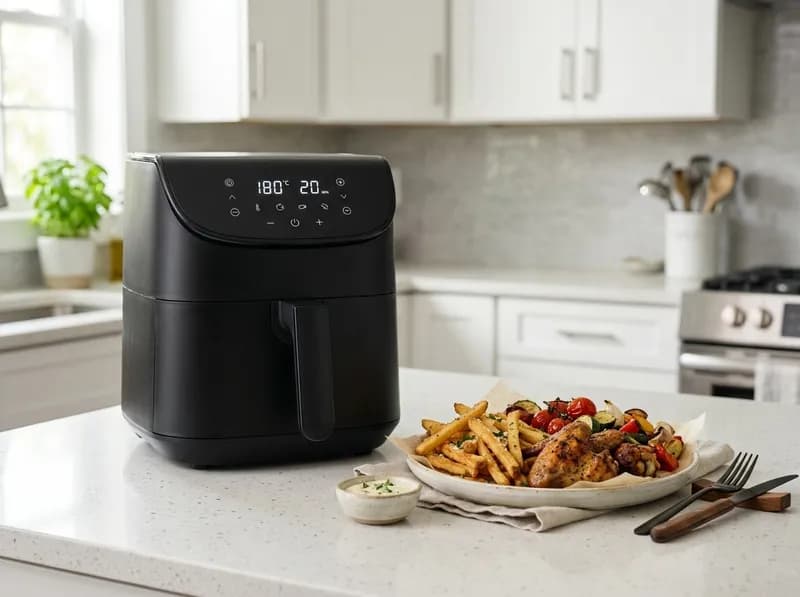
Not every new air fryer feature makes dinner better. In 2026, the upgrades most likely to justify the extra cost are dual-zone cooking, integrated food probes, more usable cooking space, easier cleaning, and, for certain households, steam-assisted cooking or glass cooking containers. Extra presets, app connectivity, higher maximum temperatures, and vague AI claims are much harder to justify on their own.
The best air fryer for your kitchen depends less on how many features it advertises than on what you cook, how much food you prepare at once, and which limitations you encounter with your current appliance.
That distinction matters when comparing the best air fryers of 2026. Different testing outlets favor different designs, from conventional baskets to multifunction cookers. There is no single feature set that makes one model the best choice for everyone. A family cooking two dishes at different temperatures has different needs from someone who mainly reheats leftovers or makes frozen fries.
This guide looks at the air fryer features worth paying for, the improvements that are useful only in certain kitchens, and the marketing claims that deserve closer scrutiny.
2026 Air Fryer Features: Quick Verdict
Feature | What it changes | Worth paying for? | Best for |
|---|---|---|---|
Dual-zone or dual-basket cooking | Cooks two foods independently and coordinates finishing times | Yes, if you regularly cook two dishes at once | Families, meal prep, busy weeknight cooking |
Stacked dual-basket design | Provides two cooking zones in a narrower footprint | Yes, if counter width is limited | Small kitchens and apartments |
Integrated food-temperature probe | Measures internal food temperature and can stop cooking at a target | Yes, for frequent meat and fish cooks | Anyone who wants more consistent doneness |
Larger usable cooking area | Reduces the need to cook in multiple batches | Yes, when batch size is a recurring problem | Families and bulk cooking |
Easier cleaning and replacement parts | Reduces maintenance and extends practical ownership | Yes, for frequent users | Anyone using an air fryer several times a week |
Steam-assisted cooking | Adds moist-heat cooking and steam-then-crisp programs | Useful for some | Vegetable and fish cooks, leftover reheating |
Glass cooking containers | Adds visibility and convenient serving or storage | Useful for some | People who prefer glass over coated baskets |
Viewing window and interior light | Lets you check browning without opening the appliance | A useful extra | People who frequently monitor food |
Multifunction countertop oven | Combines air frying with baking, toasting, roasting, and other functions | Useful if it replaces appliances you use | Households that bake and toast regularly |
Wi-Fi and app control | Adds guided recipes, notifications, and remote monitoring | Usually optional | Beginners and probe-based cooking |
Ceramic or PFAS-free coating claims | Changes the cooking surface and its care requirements | Not a reason to upgrade by itself | Buyers with specific material preferences |
More presets | Adds options to the control menu | Rarely worth paying extra for alone | People who rely on guided programs |
Higher maximum temperature | Raises the available temperature ceiling | Not a reason to upgrade by itself | Buyers with a specific recipe requirement |
Faster or more energy-efficient claims | Promises shorter cooking times or lower electricity use | Only with comparable test data | Buyers comparing measured performance |
AI or camera-based recognition | Promises automated food identification and cooking | Not without a clearly demonstrated function | Buyers evaluating emerging smart features |
These are general buying judgments, not guarantees that every model with a particular feature performs equally well. Airflow, heating design, basket dimensions, temperature control, and cooking consistency still matter. Two air fryers with similar specifications can produce noticeably different results.
What's Actually New in Air Fryers in 2026?
Several features receiving attention this year have been around for a while. The more meaningful developments are changes to how manufacturers combine them and fit them into different kitchen layouts.
Dual-zone cooking is becoming more flexible. Side-by-side dual-basket designs are established products. Newer layouts, including the Ninja DoubleStack and flexible-divider designs, address different space and capacity problems. A stacked unit saves counter width, while a removable divider lets one appliance switch between two smaller zones and a larger cooking area.
Steam-assisted cooking is reaching more U.S. kitchens. The Philips 5000 Series dual-basket steam models combine dedicated steam and air-fry functions, while the Ninja Speedi uses steam and hot air together for one-pot meals. These are useful additions for people who cook vegetables, fish, and reheated meals regularly, but they do not make every air-fried food better.
Glass-container air fryers are expanding beyond a single format. Ninja's Crispi family now includes portable, family-size, and dual-zone designs. The appeal is straightforward: you can see the food, serve it in the cooking container, and store leftovers in compatible glassware. The compromises include weight, handling, and model-specific accessories.
Integrated food probes are gaining visibility. Wireless temperature probes have become a selling point in models such as the Typhur Sync. The technology itself is not new, but integrating it with an air fryer can simplify cooking and help prevent overcooking.
Multifunction countertop ovens remain an alternative to basket models. Appliances such as the Breville Smart Oven Air Fryer Pro combine air frying with other cooking functions. They can replace several appliances, but their larger footprint makes sense only if you will use those additional functions.
The important point is that a new model does not automatically produce crispier fries, healthier meals, or lower electricity bills. A feature is an upgrade only when it solves a problem you actually have.
What a Conventional Air Fryer Already Does Well
An air fryer is essentially a compact convection cooker. A heating element warms the air, and a fan circulates it around the food. As moisture evaporates from the surface, the moving hot air helps the exterior brown and crisp.
It does not deep-fry food. Its results depend on several factors:
Airflow: Overcrowding blocks circulation and can leave some areas soggy.
Cooking surface: The space available to spread food out often matters more than the advertised quart capacity.
Surface moisture: Wet food generally needs more time to dry before it browns properly.
Temperature and time: Different foods need different combinations.
Food size and starting temperature: A thick, cold chicken breast cooks differently from a small portion of frozen fries.
Most modern air fryers already offer adjustable temperature settings, removable baskets, presets, and some combination of roasting and reheating. Many also include shake reminders and dishwasher-safe components.
That is the baseline. A $300 air fryer will not necessarily cook frozen fries better than a $100 model simply because it has more presets, app connectivity, or a higher maximum temperature. Before paying for a newer feature, identify what your current appliance cannot do well.
1. Dual-Basket and Dual-Zone Cooking
Dual-basket air fryers solve a specific problem: cooking two foods that need different temperatures or cooking times.
Each basket can run independently, while synchronization features such as Smart Finish coordinate the end time. Match Cook-style functions copy the same settings to both baskets when you want to prepare a larger quantity of one food.
For households that regularly cook a main dish and a side at the same time, this can be more useful than almost any other air fryer feature.
Side-by-side, stacked, or flexible divider?
The term dual basket covers several layouts with different advantages.
Consideration | Side-by-side dual basket | Stacked dual basket | Flexible-divider basket | Large single basket |
|---|---|---|---|---|
Two foods with different settings | Excellent | Excellent | Good | Requires sequential cooking |
One large roast or whole food | Limited by individual basket size | Limited by individual basket size | Best when the divider is removed | Often a good fit |
Counter space | Wide | Narrower but taller | Generally wide | Usually compact |
Cleaning | Two drawers and crisper plates | Two drawers, plates, and potentially extra racks | Divider adds another component | Usually the fewest parts |
Cooking flexibility | Two independent zones | Two zones, with additional rack options on some models | Two zones or one larger area | One continuous area |
The Ninja DoubleStack XL (SL401) illustrates the stacked approach. It has two 5-quart baskets for 10 quarts of combined capacity, with stacked meal racks that can expand the number of foods cooked at once. Ninja lists it at $249.99, with discounts sometimes bringing it closer to $210.
Its principal advantage is the vertical layout: it provides dual-zone cooking without the width of a conventional side-by-side unit. The trade-off is height. At roughly 17.7 inches, the SL401 needs sufficient cabinet clearance, including room to open the upper drawer. It is also heavy, and differences in cooking speed between the upper and lower baskets may require extra attention.
If counter width is your main constraint, a stacked design is worth considering. If you regularly cook a large item that does not fit comfortably in either individual basket, a flexible-divider model such as the Ninja Foodi FlexBasket may be a better fit. Removing its divider creates a single 7-quart MegaZone.
Dual-basket air fryer vs. large single basket
Consideration | Dual-basket model | Large single-basket model |
|---|---|---|
Two foods needing different temperatures | Excellent | Usually requires separate batches |
Finishing two dishes together | Supported by synchronization features | Requires manual timing |
Large whole foods | Depends on individual basket dimensions | Often easier to accommodate |
One large batch of fries or wings | Food must be divided between baskets | More continuous cooking area |
Cleaning | More components | Usually fewer components |
Counter footprint | Wide, or tall if stacked | Often more compact |
Verdict: Dual-zone cooking is worth paying for if you regularly prepare two foods at once. Families, meal-prep users, and people cooking busy weeknight dinners are the clearest beneficiaries.
If you mostly cook one portion of vegetables, frozen fries, or chicken wings at a time, a well-designed single basket is usually better value. The second basket adds cost, takes up space, and creates more parts to wash.
2. Steam and Steam-Air-Fry Combinations
Steam and hot air perform different jobs. Steam transfers heat through moist air and helps limit surface drying. Circulating hot air promotes browning and crisping.
Combining them gives an appliance more flexibility, but it does not automatically improve every recipe.
When does steam help?
Steam-assisted cooking is most useful for:
Vegetables and fish: Moist heat can help cook delicate foods without drying them out as quickly.
Meat and other proteins: Steam-assisted programs may help retain moisture, depending on the food and cooking sequence.
Leftovers: Reheating with moisture can reduce the dryness that sometimes develops with hot air alone.
Steam-then-crisp recipes: Cooking with steam first and finishing with hot air can help balance a moist interior with a browned exterior.
Philips 5000 Series vs. Ninja Speedi
Two products illustrate different approaches to steam cooking.
Philips 5000 Series dual-basket steam air fryer
The NA555/00 specification lists 9.6 quarts of combined capacity, divided between a 6.3-quart drawer and a 3.2-quart drawer. Its features include dedicated steam, air-fry, and combined modes, synchronized finishing, and a steam-clean function.
U.S. shoppers should verify the exact model number before comparing specifications. Philips uses different naming and configurations across regions, and NA551/NA555 variants have appeared in U.S. retail. Pricing has been around $350, depending on the model and retailer.
Ninja Speedi (SF301)
The Speedi is a more accessible entry into steam-assisted cooking, with a listed price of $199.99. Its 6-quart pot combines steam and hot air in a single cooking chamber. Speedi Meals programs are designed to prepare a complete meal in as little as 15 minutes, while SmartSwitch selects between rapid-cooker and air-fry modes.
It is a different format from a conventional basket air fryer, but that is part of its appeal: it can handle one-pot meals as well as crisping tasks. Reviewed has also recognized the Speedi in its air fryer coverage.
The trade-offs of steam cooking
Steam adds maintenance. You may need to refill a water reservoir, clean water-contact components, and manage mineral buildup. Steam can also work against the goal of a very dry, crisp exterior.
If you mainly cook frozen fries, breaded snacks, and wings, you may rarely use the steam functions. If vegetables, fish, and reheated meals are regular parts of your routine, they may be worth the extra complexity.
Verdict: Steam is useful for some households, not a universal upgrade. The Ninja Speedi is a lower-cost way to explore steam-and-crisp cooking. A dedicated steam air fryer makes more sense if you want separate steam functions and dual-basket flexibility.
3. Glass Cooking Containers: Is the Ninja Crispi Worth It?
Most conventional air fryers use metal baskets with a nonstick coating. Glass-container models place the food in a glass vessel beneath a separate heating unit.
The Ninja Crispi family has helped bring this format into the mainstream. Its three models serve different needs, and their accessories are not universally interchangeable.
Ninja Crispi models compared
The following prices reflect the official U.S. pricing snapshot dated October 20, 2026. Retail prices and promotions can change.
Model | Listed price | Capacity and glassware | Main functions | Best suited to |
|---|---|---|---|---|
Ninja Crispi 4-in-1 (FN101) | $179.99 | 4-quart container plus 6-cup container | Max Crisp, Air Fry, Bake, Recrisp | Small households and portable storage |
Ninja Crispi Pro (AS101) | $299.99 | 6-quart and 2.5-quart containers | Six functions, including Roast and Dehydrate | Family-size glass cooking |
Ninja Crispi DualZone (DD101) | $379.99 | Two 4-quart containers, 8 quarts combined | DualZone, Smart Finish, Match Cook, and other cooking modes | Two-dish cooking in glass containers |
The original Crispi uses a PowerPod that can be stored separately, allowing the containers to nest when the appliance is not in use. Ninja lists the Pro as suitable for larger family meals, with capacity for a 7.5-pound chicken. The DualZone adds two independently controlled glass cooking zones.
Three details are worth checking before buying.
First, glassware compatibility depends on the exact model. The FN101, AS101, and DD101 use different combinations of containers. An accessory that fits one Crispi model may not fit another. Check the model number before ordering replacement containers or lids.
Second, glass is not automatically lighter or easier to handle. These containers are substantial, especially when full or hot, and may be awkward to wash in a small sink.
Third, prices can move. The DualZone was initially announced at a lower price before appearing at a higher listed price. Check the current official listing and retailer offers rather than assuming the launch price still applies.
What does glass change?
Glass offers three practical benefits:
You can see the food without opening the container.
The cooking vessel can double as a serving and storage container when used according to the manufacturer's instructions.
You avoid a coated metal cooking surface in the glass container itself.
However, glass does not automatically produce more even cooking. Airflow, heating design, food placement, and batch size still determine the result.
Capacity is another consideration. A glass model may be less space-efficient than a conventional basket at a similar price, and the vessel's shape may limit how much food you can spread out in a single layer.
Verdict: Glass is worth considering if visibility, serving convenience, and avoiding coated cooking surfaces matter to you. The Crispi Pro is the family-size option, while the DualZone is the model to consider if you specifically want two glass cooking zones. If maximum cooking capacity per dollar is your priority, conventional basket models remain strong alternatives.
A glass cooking vessel is not automatically a completely chemical-free appliance. The container material is only one part of the product's construction, and any materials claim should be checked against the relevant components.
4. Viewing Windows and Interior Lights
A viewing window lets you monitor browning without opening the basket. That sounds like a small convenience, but opening an air fryer releases heat and can extend cooking time.
The Instant Vortex Plus 6QT ClearCook is a useful example. Its official listed price is $139.99, while the ClearCook version with OdorErase is listed at $159.99. Retail prices often fall below $130.
The ClearCook model includes six cooking functions, a transparent window, an interior light, and dishwasher-safe basket components. Food Network has selected it in its 2026 air fryer coverage.
There are two limitations to keep in mind. Windows can fog from steam and become obscured by grease, especially when cooking wet or fatty foods. An odor filter is also a consumable component, and its performance may not justify paying a substantial premium.
For dry foods such as fries and wings, a window can be genuinely useful. For steam-heavy recipes, it may offer a less reliable view.
Oven-style air fryers provide another option. Models such as the Cuisinart TOA-60 have a glass door, allowing you to monitor food across a larger cooking chamber.
Verdict: A viewing window is a useful extra, but it should not outweigh cooking consistency, capacity, or cleaning. At around $139.99, the ClearCook offers the feature without moving into premium pricing.
5. Integrated Temperature Probes
An integrated food-temperature probe is one of the more meaningful air fryer upgrades because it can change the cooking result rather than simply making the controls more convenient.
A preset uses programmed time and temperature settings. A probe measures the internal temperature of the food and, in compatible modes, allows the appliance to adjust or stop cooking when the target is reached.
The difference is simple: a timer estimates when food should be done; a probe measures its temperature at the point where the probe is placed.
Typhur Sync: Probe-based cooking in an air fryer
The Typhur Sync (AF14) combines an 8-quart air fryer with a wireless food probe. Its listed price was $159 as of October 2026, against a stated list price of $199.99.
The five-point wireless probe is specified at ±0.5°F accuracy, with the manufacturer describing its accuracy as NIST-verified. The appliance can monitor internal temperature and automatically stop cooking at the selected target. Its cooking area is listed at 124 square inches, with room for a 6-pound whole chicken.
The app lets you monitor food temperature remotely, which is particularly useful for larger pieces of meat. The main limitations are physical size and day-to-day convenience: the unit is about 18 inches deep, so measure your counter, and it does not include a shake reminder for foods such as fries.
Typhur Dome 2: A different approach to browning
The Typhur Dome 2 focuses on a wide, shallow cooking area rather than an integrated probe. It has a 5.6-quart basket and a 1,750-watt heating system, with geometry designed for foods that benefit from a broad, relatively flat surface.
WIRED rated it 8/10 and highlighted its speed when cooking chicken wings. The listed price is $499, although discounts have brought it into the $330–$400 range.
The wide shape can be useful for wings, flat proteins, and foods that benefit from even surface exposure. It is less convenient for tall or irregular items, and the price is high for a specialized design.
What a temperature probe can and cannot do
A probe can reduce the risk of overcooking, but placement matters. One reading does not necessarily identify the coldest part of a large or irregular piece of food. You still need to insert it correctly, select an appropriate target, and follow food-safety guidance.
The USDA's recommended minimum internal temperatures include:
Poultry: 165°F
Ground meat: 160°F
Whole cuts of beef, pork, veal, and lamb: 145°F, followed by a three-minute rest
Fish: 145°F
Use authoritative food-safety guidance rather than relying on a preset or a doneness label alone.
Verdict: An integrated probe is worth paying for if you cook meat or fish regularly and want more consistent doneness. At its listed $159 price, the Typhur Sync makes integrated probe cooking more accessible. If you mainly cook frozen snacks and vegetables, an inexpensive instant-read thermometer may be all you need.
6. Ceramic, Teflon, and PFAS-Free Air Fryer Coatings
Air fryer coating claims can be confusing because manufacturers use several different terms to describe different materials.
A conventional nonstick basket is often made from aluminum with a PTFE-based coating. Teflon is a well-known brand of PTFE coating. A product described as having a ceramic coating generally uses a metal surface with a sol-gel ceramic coating; it is not necessarily made from solid ceramic. Glass-container air fryers use a different construction.
Is a PTFE-coated air fryer safe?
PTFE is generally considered chemically stable at normal cooking temperatures. Intact, undamaged PTFE used as intended presents a low risk under typical cooking conditions, according to mainstream safety assessments.
Overheating is a different matter. PTFE can begin to degrade at very high temperatures, and safety guidance commonly warns against exposing it to extreme heat. The temperature at the basket surface may also differ from the displayed air temperature. Overheated PTFE fumes are particularly dangerous to pet birds.
Practical precautions are straightforward:
Avoid heating an empty nonstick basket at the highest setting for an extended period.
Use utensils that will not scratch the coating.
Follow the manufacturer's temperature and cleaning instructions.
Replace a basket if its coating is visibly scratched, peeling, or flaking.
Keep air fryers with PTFE components away from situations where pet birds could be exposed to overheating fumes.
A worn coating is not something to ignore simply because the appliance still works.
What does “PFOA-free” actually mean?
PFOA is one chemical in the broader PFAS family. A PFOA-free claim does not mean a product is PFAS-free, and it does not mean the product contains no PTFE.
If PFAS-free materials are a priority, check the exact claim and the component it covers. The COSORI TurboBlaze and Ninja AF101 specify ceramic-coated baskets in their product information. The Ninja Crispi range uses glass cooking containers and is marketed as free of PFAS and PTFE in the relevant cooking surfaces.
A claim that does not identify the component or material it refers to is difficult to evaluate.
Are ceramic coatings more durable?
Ceramic-coated baskets can release food well when new and can be easy to clean. However, consumer reviews and owner reports often describe declining nonstick performance as ceramic coatings wear. The actual lifespan depends on the coating, frequency of use, utensils, cleaning methods, and storage.
Some owners report needing to replace heavily used ceramic-coated baskets after a few years, but there is no universal lifespan that applies to every model.
Before buying either type, check whether replacement baskets are available and how much they cost. A coating that suits your material preferences may be a reasonable trade-off even if it needs more careful handling or earlier replacement.
Verdict: A coating label alone is not a reason to upgrade. If avoiding particular materials is a priority, choose a model whose official specifications clearly identify the relevant cooking surface. If your current air fryer has an intact, serviceable basket and cooks well, switching purely for a label is unlikely to improve your cooking results.
7. Smart Air Fryers, Wi-Fi, and App Control
Connected air fryers can offer guided recipes, saved settings, cooking notifications, and remote monitoring. The important question is whether the app does something useful that the appliance's controls cannot do.
App features are most helpful when they provide step-by-step instructions, monitor a temperature probe from another room, or remind you to check or shake food. They are less useful when they simply mirror a timer that is already visible on the appliance.
Before paying extra for Wi-Fi, check five things:
Can the app change cooking settings, or does it only display information?
Does the model support remote starting? If so, under what safety conditions?
Can you use the main cooking functions without Wi-Fi?
Is an account or subscription required?
Are the notifications useful enough to change how you cook?
The COSORI TurboBlaze is an example of a model whose smart features are better treated as conveniences than as the main reason to buy it. The Typhur Sync has a stronger case for app use because remote temperature monitoring supports its central feature.
Verdict: App control is useful for beginners and people who want guided cooking, but rarely justifies replacing a working air fryer on its own. If the app merely duplicates the physical controls, spend the money on capacity, cleaning, or cooking performance instead.
8. Air Fryer Capacity: How Much Space Do You Really Need?
Capacity is one of the most misunderstood air fryer specifications. Quart figures measure volume, but good results often depend on the amount of food you can spread out without blocking airflow.
The right size also depends on the shape of the food. A tall roast, a whole chicken, and a wide batch of wings place different demands on the cooking chamber.
Household or cooking pattern | Layout to consider | Why it fits |
|---|---|---|
One person, occasional snacks | Compact 3–4-quart single basket | Lower cost and easier storage |
One or two people cooking regular meals | 4–6-quart single basket | Enough flexibility without unnecessary bulk |
Two to four people, everyday dinners | 6-quart single basket | A useful balance of cooking space and footprint |
Family cooking two dishes at once | Dual-basket model | Independent temperatures and synchronized finishing |
Large batches of one food | Wide single basket or suitably sized dual-basket model | More usable surface or room for separate batches |
Whole chicken or large roast | Check dimensions; consider a flexible-divider design | Shape and clearance matter more than the headline capacity |
Small kitchen with limited counter width | Compact single basket or stacked dual basket | Makes better use of available space |
Frequent baking, toasting, and multi-rack cooking | Air fryer toaster oven | Offers racks and trays for different cooking tasks |
As a starting point, a 4-quart model often suits one or two people, a 6-quart model is a practical size for many families of four, and an 8–10-quart dual-basket model suits households that regularly cook two dishes at once.
There is an important catch: a 10-quart dual-basket model usually has two 5-quart drawers, not one continuous 10-quart cooking space. Likewise, a stacked model with meal racks may provide more cooking levels than its quart figure suggests.
If you routinely need two or three batches to prepare dinner, more usable cooking area can make a real difference. If you normally cook one or two portions, a large dual-zone machine may add more washing and storage work than value.
Verdict: Pay for capacity when your current cooking space is a genuine bottleneck. Choose the layout around the food you prepare most often, not the largest number on the product box.
9. Cleaning, Maintenance, and Long-Term Ownership
An air fryer that is easy to clean can be more valuable over a year than one with another cooking mode.
Look for removable baskets and crisper plates, accessible interiors, clear cleaning instructions, and replacement parts that are actually available. Check dishwasher compatibility for each component: a claim that the basket is dishwasher-safe does not mean the entire appliance can go in the dishwasher.
Replacement-part availability deserves particular attention. Baskets and crisper plates experience regular wear, and the ability to buy a replacement can extend the useful life of the appliance. Compare the cost of replacement parts before committing to a model.
Steam-clean functions, such as those offered on some Philips steam air fryers, can help loosen residue but do not eliminate the need to remove grease. Glass containers can be convenient for serving and storing food but cumbersome to wash in a small sink. Some multifunction machines also have more racks, trays, and accessories to maintain.
Verdict: Easier cleaning is worth paying for if you use your air fryer several times a week. Accessible parts, practical care instructions, and available replacements matter more over time than a long list of cleaning claims.
10. Air Fryer Energy Use and Cooking Speed
Air fryers can be convenient for small meals because they heat a compact chamber rather than an entire conventional oven. Whether they use less electricity depends on the food, quantity, cooking time, and appliance being compared.
UK consumer group Which? has reported controlled kitchen tests in which roasting a whole chicken used about 0.54 kWh in an air fryer, compared with 1.157 kWh in a conventional oven. That is roughly half the energy for that particular task. These are UK test results, not a U.S. electricity-cost comparison.
The underlying reason is straightforward: a smaller cooking chamber generally needs less time to heat, and many small air-frying tasks require little or no preheating. However, the advantage can narrow when a large air fryer runs for a long time or when a full-size oven cooks a much larger quantity in one batch.
Calculate your own air fryer electricity cost
You can estimate energy use using the appliance's wattage and your actual cooking time:
Energy used (kWh) = watts × hours ÷ 1,000
Cost = energy used (kWh) × your electricity rate per kWh
For example, a 1,700-watt air fryer running for 20 minutes uses approximately 0.57 kWh. At an electricity rate of $0.17 per kWh, that works out to about 10 cents per use.
This is an estimate based on rated wattage and runtime. Actual energy consumption depends on how the heating element cycles during cooking.
Claims that an air fryer cooks faster deserve the same scrutiny. A compact chamber and strong airflow can speed up small portions, but a meaningful comparison must use the same food, weight, starting temperature, and final doneness. Headline cooking times without those conditions are not a reliable basis for choosing a model.
Verdict: Energy savings and speed are useful benefits, but rarely reasons to replace a working air fryer on their own. If you cook small portions frequently, avoiding a full oven's preheating time can be convenient. For larger meals, compare the actual cooking capacity and runtime of the appliances you would otherwise use.
11. Which Air Fryer Features Are Mostly Marketing?
Marketing claims are not necessarily false, but they need evidence. Look for demonstrated benefits rather than adjectives or the number of functions printed on the box.
Marketing claim | What would substantiate it? | What buyers should check |
|---|---|---|
“Cooks faster” | Matched tests using the same food, weight, starting temperature, and doneness | Compare total cooking time, including preheating |
“Crispier results” | Side-by-side cooking tests using a consistent method | Look for actual food results, not descriptive language |
“More even cooking” | Results across basket positions and multiple batches | Check whether less shaking or turning is needed |
“Uses less energy” | Metered electricity use against a defined alternative | Wattage alone does not establish energy savings |
“Healthier cooking” | A clearly defined nutritional comparison | Less added oil does not automatically mean a healthier overall diet |
“Smart cooking” | Features that improve control, consistency, or monitoring | An app that mirrors a timer adds little |
“AI-powered” | A clearly described, verifiable automated function | Identify what the AI actually does |
“More cooking modes” | Demonstrated performance across those modes | More presets do not guarantee better results |
“Extra-large capacity” | Usable cooking area, dimensions, and realistic loading examples | Compare the layout, not just quart figures |
“Premium nonstick coating” | Specific material claims, care instructions, and durability information | Marketing labels do not establish lifespan |
“Steam-assisted crisping” | Tests using the foods and cooking sequences you prepare | Steam can help some recipes and hinder others |
“All-in-one appliance” | Evidence that it can replace appliances you already use | Versatility comes with footprint and complexity |
An expensive appliance can be worth the money when it solves a recurring problem. Synchronized dual-zone cooking can make weeknight dinners easier even if it does not improve the crispness of frozen fries. A temperature probe can help prevent overcooking without changing any other aspect of the appliance.
The goal is not to buy the fewest features. It is to buy the features you will use.
12. The 2026 Air Fryer Models Worth Comparing
The following models illustrate the main design choices discussed in this guide. Prices are the U.S. pricing snapshot for October 20, 2026, based on the stated official listings and observed promotions. Retail prices change, and availability may vary by retailer.
Product and exact model | Design | Capacity | Main selling point | Main limitation | Price snapshot |
|---|---|---|---|---|---|
COSORI TurboBlaze | Single basket | 6 qt | Ceramic-coated basket, high-speed fan, value-oriented feature set | No dual zones or viewing window | $119.99; street price around $100 |
Instant Vortex Plus 6QT ClearCook | Single basket | 6 qt | Viewing window, interior light, six functions | Standard nonstick basket; OdorErase is an extra consumable | $139.99; $159.99 with OdorErase |
Ninja Speedi (SF301) | Steam-and-air-fry pot | 6 qt | Steam-and-crisp cooking and one-pot meal programs | Different cooking format from a conventional basket | $199.99 |
Typhur Sync (AF14) | Single basket with wireless probe | 8 qt; 124 sq in cooking area | Probe-based temperature monitoring and automatic shutoff | Deep footprint; no shake reminder | $159; list price $199.99 |
Typhur Dome 2 | Wide, shallow basket | 5.6 qt | Wide cooking surface designed for browning | Specialized shape and premium price | $499 list; promotions around $330–$400 |
Ninja DoubleStack XL (SL401) | Stacked dual basket | 10 qt, two 5-qt baskets | Dual-zone cooking in a narrower footprint, with stacked meal racks | Tall and heavy; upper basket may cook faster | $249.99; promotions around $210 |
Ninja Crispi 4-in-1 (FN101) | Portable glass-container design | 4 qt plus 6-cup container | Compact storage and glass cooking vessel | Smaller capacity and fewer controls | $179.99 |
Ninja Crispi Pro (AS101) | Glass-container design | 6 qt plus 2.5-qt container | Family-size glass cooking and precision dial | Heavy glassware and model-specific accessories | $299.99 |
Ninja Crispi DualZone (DD101) | Dual glass containers | 8 qt, two 4-qt containers | Two glass cooking zones with synchronized finishing | Highest price in the Crispi family; accessory compatibility matters | $379.99 |
Philips 5000 Series dual-basket steam (NA555/00 specification) | Dual basket with steam | 9.6 qt, 6.3-qt and 3.2-qt drawers | Steam, air fry, combined modes, and steam-clean | Verify exact U.S. model and price | Around $350; check current listing |
Breville Smart Oven Air Fryer Pro (BOV900) | Countertop oven | 1 cu. ft. oven | 13 functions and convection cooking | Large footprint, about 21.4 × 17.3 × 12.7 in | $399.95 list; promotions around $319.95 |
Ninja Foodi FlexBasket | Dual basket with removable divider | 7 qt, two 3.5-qt zones or one 7-qt area | Switches between two zones and one larger cavity | Less total capacity than some 10-qt dual-basket models | Check current official listing |
The most important comparison is how each model fits your cooking habits. A $120 TurboBlaze may be a better choice than a $300 multifunction appliance if you mainly cook one dish at a time. The DoubleStack makes more sense when coordinating two dishes is a regular frustration. The Breville BOV900 is easier to justify if you will also use it for baking, toasting, and roasting.
For current specifications, warranty details, and replacement parts, check the official product pages from COSORI, Instant, Ninja, Typhur, Philips, and Breville. Independent testing from outlets such as TechGearLab, RTINGS, and Consumer Reports can help assess model-level performance, but their test methods and scoring systems differ.
13. Are Expensive Air Fryers Worth the Extra Money?
Higher prices tend to buy different kinds of benefits rather than a simple improvement in cooking quality.
Around $100–$140: A good conventional air fryer
Models such as the COSORI TurboBlaze and Instant Vortex Plus ClearCook cover the needs of many households. They offer everyday cooking capacity and useful controls without requiring a premium budget. The ClearCook adds a window and interior light, while the TurboBlaze emphasizes its fan and cooking configuration.
The Ninja AF101 is another established budget option, with a 4-quart capacity and ceramic-coated basket. Its simpler design may suit smaller households.
If a $120 model already cooks the foods you like well, the additional cost of a premium appliance needs a specific justification.
Around $160–$250: Features that solve particular problems
This is where you start paying for functions that can change your routine:
The Typhur Sync integrates a wireless probe for more precise doneness control.
The Ninja Speedi combines steam-assisted cooking with air frying.
The Ninja DoubleStack provides dual-zone capacity in a stacked design.
These features are worth considering when they address a problem you encounter regularly, rather than a task you might try once.
Around $300–$400 and above: Different cooking formats
The Ninja Crispi Pro and Crispi DualZone offer glass cooking containers, while the Breville BOV900 is a multifunction countertop oven. These are format purchases. They make sense when you want glass vessels or need an appliance that can also handle baking and toasting.
They are not automatically better at cooking basic frozen fries.
A useful way to assess value is to ask how often you will use the feature that defines the appliance. Synchronized cooking can save a separate batch several nights a week. A temperature probe may help you cook chicken more consistently every Sunday. A steam mode that you use twice a year is unlikely to justify a large premium.
14. Which Air Fryer Features Are Worth It for Your Household?
First-time air fryer buyers
Start with a straightforward single basket that offers enough cooking space, reliable controls, and removable parts that are easy to clean. The TurboBlaze and ClearCook represent the kind of mid-priced single-basket models worth comparing.
You do not need dual zones, steam, or Wi-Fi before you know how you will use the appliance.
Owners of an older air fryer
Replace it when you have a recurring limitation, such as a damaged coating, insufficient capacity, or the difficulty of cooking two foods at once.
Match the replacement to that problem:
Choose a dual-zone model if two-dish cooking is the issue.
Consider a probe-equipped model if you frequently overcook meat.
Choose a larger usable cooking area if multiple batches are slowing down dinner.
Check replacement baskets before discarding an appliance that otherwise works well.
Owners of a 2025 air fryer
A working air fryer that is only a year old is not obsolete. The fundamentals of air frying have not changed enough to make routine replacement necessary.
Consider upgrading if a newer feature would materially change your cooking routine, such as independently cooking two foods at different temperatures or using a probe to manage doneness automatically.
Families and meal-prep users
Dual-zone cooking is one of the most useful features to consider. Choose the layout based on your kitchen:
Side-by-side baskets are the conventional choice.
A DoubleStack can suit a narrow counter, provided you have enough vertical clearance.
A FlexBasket can be more convenient when you alternate between two smaller foods and one large item.
Small households and small kitchens
A compact single basket is often sufficient for one or two people. If you regularly cook two foods but have little counter width, a stacked design may be worth considering.
A large side-by-side model can be excessive if most meals are single portions.
Health-conscious cooks
Air frying can reduce the amount of added oil needed compared with deep frying. That is a useful difference, but portion size and overall dietary habits still matter.
Steam functions may be useful if you cook vegetables and fish frequently. There is no need to buy a premium air fryer simply because its packaging emphasizes health.
Buyers who want minimal maintenance
Prioritize a conventional basket with accessible parts, clear cleaning instructions, and available replacements. Steam reservoirs, complex stacked systems, and app-dependent functions can add maintenance without necessarily improving your everyday cooking.
15. AI and Camera-Based Air Fryers: What's Real in 2026?
“AI-powered” is appearing more frequently in appliance marketing, but the label can describe very different functions.
Some forms of automation are well established. Temperature probes can track the internal temperature of food, and sensor-based controls can adjust heating behavior. Guided presets and app-based cooking instructions can also simplify the process.
Camera-based food recognition is a separate claim. It suggests that an appliance can identify the food placed inside and adjust cooking automatically based on what it sees.
In the mainstream U.S. models covered in this guide, there is not enough independently validated evidence to treat camera-based food recognition as a standard, proven air fryer feature. A product described as “AI Smart” may rely on probe control, programmed settings, or app guidance rather than a camera that identifies food.
Before paying extra for AI, look for a specific description of what the system detects, how it changes cooking, which foods it recognizes, and whether independent tests confirm the results.
If the feature is automatic doneness control based on a probe, that is a real function with a clear purpose. If the manufacturer does not explain what the AI does, the label alone is not a reason to buy.
16. How to Evaluate an Air Fryer Before Buying
A useful air fryer review should test the food, not just compare specifications. When reading reviews or testing models yourself, consider:
Cooking evenness: Do foods cook consistently across different basket positions?
Crispness: Does the appliance produce good results with realistic portions, not just a small test batch?
Shaking and turning: How often does food need manual attention?
Batch performance: Does cooking a larger quantity reduce consistency?
Total cooking time: How long does the appliance take, including preheating?
Noise: How loud is it during ordinary use?
Cleaning: Can the parts be removed, washed, and dried without hassle?
Footprint: Will it fit on your counter and under your cabinets?
Temperature control: Are the controls straightforward, and does the appliance maintain the selected settings?
Special features: Do the advertised functions work as described?
Long-term ownership: Are replacement parts available, and what does the warranty cover?
One successful recipe does not establish that an air fryer is better than its competitors. Independent testing is useful because models with similar specifications can differ in cooking consistency, speed, capacity, and ease of use.
Food-safety presets also should not be treated as guarantees that every piece of food has reached a safe temperature. Use a food thermometer and follow USDA guidance for minimum internal temperatures.
Final Verdict: Which 2026 Air Fryer Features Are Worth Buying?
The best air fryer features are the ones that make a recurring cooking task easier, more consistent, or less wasteful.
Worth paying for
Dual-zone cooking: If you regularly prepare two foods with different cooking requirements, compare side-by-side, stacked, and flexible-divider designs.
Integrated temperature probes: A strong option for people who cook meat or fish frequently and want better control over doneness.
More usable cooking space: Worth the money when your current air fryer forces you to prepare dinner in several batches.
Easier cleaning and replacement parts: Particularly valuable for households that use their air fryer several times a week.
Useful for some households
Steam-assisted cooking: The Ninja Speedi is an accessible entry point; dedicated steam models offer more specialized functions.
Glass cooking containers: Consider the Ninja Crispi range if you value visibility and glass vessels, but check model-specific accessory compatibility.
Viewing windows: Useful for monitoring browning; the Instant Vortex Plus ClearCook is a reasonable option at its listed price.
Wi-Fi and app control: Helpful for guided cooking and probe monitoring, but not essential for most users.
Multifunction countertop ovens: Worth considering if you will use the baking, toasting, and roasting functions as well as air frying.
Not a reason to upgrade on its own
More presets
A higher maximum temperature
Coating labels without clear material specifications
Faster or more energy-efficient claims without comparable test results
AI claims that do not identify a verifiable function
For most first-time buyers, a well-designed single-basket air fryer remains the sensible choice. If you already own a working 2025 model, keeping it is usually the better financial decision unless a specific limitation is affecting your cooking.
The best air fryer of 2026 is not necessarily the newest or most expensive. It is the one with the right cooking layout, capacity, controls, and maintenance requirements for the meals you actually prepare.
Frequently Asked Questions
Are dual-basket air fryers worth it?
Yes, if you regularly cook a main dish and a side that need different temperatures or cooking times. Independent zones and synchronized finishing can simplify meal preparation. If you mostly cook one food at a time, a single basket is usually better value.
What's the difference between the Ninja DoubleStack and a regular DualZone air fryer?
Conventional DualZone models generally place two baskets side by side. The Ninja DoubleStack stacks two 5-quart baskets vertically, providing 10 quarts of combined capacity in a narrower footprint. Its meal racks can add cooking levels for preparing more foods at once. Because the unit is roughly 17.7 inches tall, check cabinet clearance before buying.
Should I upgrade my air fryer in 2026?
Only if your current model has a recurring limitation, such as insufficient capacity, a damaged coating, or difficulty cooking two dishes at once. A working one-year-old appliance is not automatically obsolete, and there is no universal rule that air fryers need replacing every two or three years.
Is a steam air fryer worth it, or is it a gimmick?
Steam cooking is a real feature, but it is most useful for particular foods and cooking methods. It can help with vegetables, fish, reheating, and steam-then-crisp recipes. It also adds water-system maintenance and may not suit foods that need a very dry exterior. The Ninja Speedi is a relatively accessible way to try steam-and-crisp cooking.
Do air fryers really use less electricity than ovens?
Often, particularly for small or medium portions. A compact cooking chamber generally requires less preheating, but the result depends on the amount of food and the appliance being compared. UK metered tests have found lower energy use for certain air-fried meals, including a roast chicken. For a U.S. estimate, multiply the appliance's wattage by its runtime in hours, divide by 1,000, and multiply by your electricity rate per kWh.
What size air fryer do I need?
As a starting point, consider 4 quarts for one or two people, 6 quarts for many households of four, and an 8–10-quart dual-basket model for families that regularly cook two dishes at once. Check usable cooking area and basket dimensions as well as volume: a 10-quart dual-zone model usually has two 5-quart drawers rather than one continuous 10-quart basket.
Is the Ninja Crispi worth it, and which model should I choose?
The Crispi range is worth considering if you value glass cooking containers, visibility, and the convenience of compatible serving and storage vessels. The FN101 is the portable, smaller-capacity option; the Crispi Pro offers a larger family-size format; and the DualZone is designed for cooking two dishes in separate glass containers. Check accessory compatibility before buying additional glassware.
Are ceramic or PFAS-free air fryer coatings actually safer?
Intact PTFE coatings used at normal cooking temperatures are generally considered low-risk, but overheating and damaged coatings should be avoided. “PFOA-free” does not mean “PFAS-free.” If particular materials are a priority, check the manufacturer's specifications for the actual cooking surface rather than relying on a broad label. A coating preference does not necessarily mean better cooking performance.
Is an air fryer with a temperature probe worth it compared with a separate thermometer?
For people who cook meat frequently, an integrated probe can be convenient because it combines temperature monitoring with compatible automatic shutoff functions. The Typhur Sync is one example. If you mainly cook frozen snacks and vegetables, an inexpensive instant-read thermometer may provide all the temperature information you need.
Is Wi-Fi useful on an air fryer?
It can help with guided recipes, notifications, and remote temperature monitoring. It adds less value if the app simply duplicates the timer on the appliance. Check whether the main controls work without Wi-Fi and whether an account or subscription is required.
Basket air fryer or air fryer toaster oven: which should I buy?
A basket air fryer is usually the simpler choice for everyday portions, frozen foods, wings, and straightforward cleanup. An air fryer toaster oven is better suited to toast, baking pans, flat foods, multiple racks, and replacing some conventional oven tasks. If you mainly air-fry, a basket is often sufficient; if you also bake and toast regularly, a countertop oven may offer more value.
Do air fryer viewing windows fog up?
They can. Steam condensation and grease may obscure the window during cooking, particularly with wet or fatty foods. Windows tend to be more useful for dry foods such as fries and wings. An interior light also helps, and the Instant Vortex Plus ClearCook is one option to compare.
Are expensive air fryers worth the extra money?
It depends on what the extra money buys. Around $100–$140 can cover a capable conventional air fryer. Roughly $160–$250 opens up features such as integrated probes, steam cooking, and dual-zone layouts. At $300 and above, you are more likely to be paying for a different cooking format, such as glass containers or a multifunction countertop oven. Buy the feature that solves a recurring problem, not the highest price tier.
Which air fryer features are just marketing?
Preset count, maximum temperature, vague “faster” or “more efficient” claims, premium coating labels, and AI terminology without a clearly described function are not sufficient reasons to choose one model over another. Dual-zone synchronization, integrated food probes, usable cooking capacity, and genuinely accessible cleaning are easier to evaluate because they address specific cooking needs.
Related GuidesMore →
OXO 8-Cup vs. 12-Cup Coffee Maker: Which Is Better for You in 2026?
The OXO 8-Cup and 12-Cup Coffee Makers share SCA certification and pod-free brewing, but they suit different routines. This comparison examines coffee taste, brew speed, capacity, single-serve performance, programming, and carafe design to help you choose. Learn why the compact 8-Cup is better suited to smaller households, while the 12-Cup offers more capacity, a thermal carafe, and scheduling features for people who regularly brew full pots.
Best Breville Espresso Machine in 2026: Every Series Explained and How to Choose
Breville's espresso machine lineup ranges from compact entry-level models to premium automated systems, but the differences go beyond price and appearance. This buying guide compares the Bambino, Barista Express, Barista Pro, Touch Impress, and Oracle Jet to help you decide which features are worth paying for. You'll also find practical trade-offs, warranty information, pricing context, and alternatives to discontinued models such as the Dual Boiler BES920 and Oracle Touch BES990.