Best Welding Helmets in 2026: Top Picks for TIG, MIG, and Everyday Use
Choosing the best welding helmet means balancing optical clarity, low-amp TIG performance, viewing area, weight, and comfort. This 2026 buying guide compares the Lincoln Electric VIKING 3350, Miller Digital Infinity, ESAB Sentinel A60, Optrel crystal2.0, Hobart Inventor, and YESWELDER LYG-M800H. It explains which specifications are documented, where manufacturer claims differ from independent verification, and what to check before choosing a helmet for your welding setup.
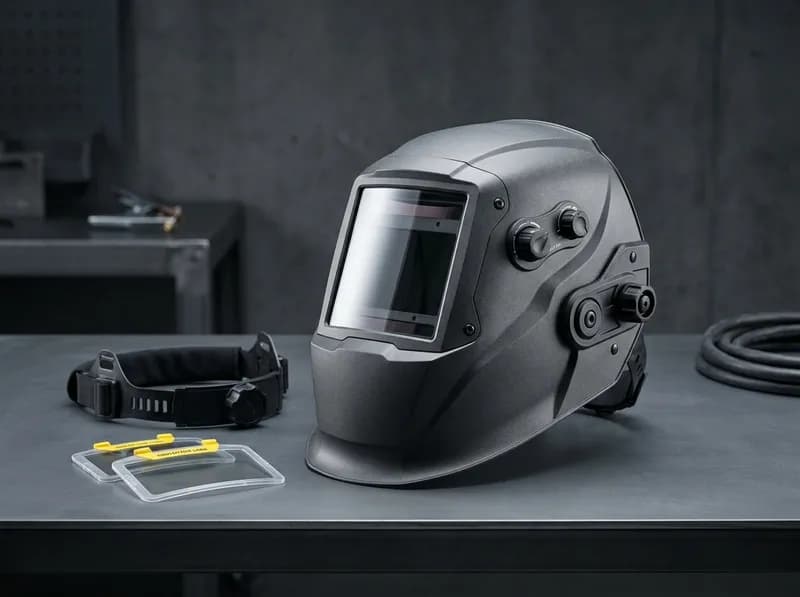
The best welding helmet is not necessarily the one with the largest viewing window, the fastest advertised switching time, or the longest feature list. What matters is whether it provides dependable protection, a clear view of the work, reliable arc detection, and a comfortable fit for the welding you actually do.
For mixed-process welding, the Lincoln Electric VIKING 3350, Miller Digital Infinity, and ESAB Sentinel A60 are strong models to compare. The Lincoln stands out for its documented 2 A TIG capability, while the Miller offers a large viewing field and extensive electronic controls. The ESAB combines a 1/1/1/1 EN optical classification with a wide, 118 × 71 mm viewing window. For a brighter view before the arc starts, the Optrel crystal2.0 takes a different approach.
Budget-conscious buyers may also want to consider the Hobart Inventor 770890 and YESWELDER LYG-M800H. Both offer useful features, but their published specifications leave some questions unanswered, particularly for low-current TIG welding.
One distinction matters more than many product descriptions suggest: a helmet advertised as “low-amp TIG rated” is not necessarily documented to work at a specific current. If you regularly weld below 20 amps, look for a model-specific minimum-current rating rather than relying on a general TIG label or a high-sensitivity setting.
This guide compares the available manufacturer specifications, explains the differences that affect buying decisions, and identifies where the published evidence is incomplete. It is a research-based comparison, not a claim that all six helmets were physically tested side by side.
Quick picks: best welding helmets for different needs
Best documented low-current TIG capability: Lincoln Electric VIKING 3350 Series. Lincoln's Series 4 documentation lists a 2 A TIG rating, alongside a 1/1/1/1 EN 379 optical classification.
Best for a large view and extensive controls: Miller Digital Infinity ClearLight 4x. It offers a 13.4-square-inch viewing field, four arc sensors, memory, and X-Mode. Miller labels it low-amp TIG rated but does not publish a minimum current in the cited U.S. listing.
Best for a wide window and adjustable settings: ESAB Sentinel A60. Its 118 × 71 mm viewing window, 1/1/1/1 EN classification, and saved settings make it worth considering for fabrication work.
Best candidate for a bright light-state view: Optrel crystal2.0. Its light-state shade of 2.0 is a key differentiator, although its documented optical classification is 1/1/1/2 rather than 1/1/1/1.
Best for straightforward home-shop use: Hobart Inventor 770890. It has analog controls and an explicit low-amp TIG designation, but the cited listing does not specify the minimum current.
Best budget large-view candidate: YESWELDER LYG-M800H. It offers a broad feature set at a lower listed price, but independent verification and some important specifications are limited.
These recommendations reflect documented features and the needs they may suit. They should not be read as results from controlled optical, comfort, or arc-detection testing.
What matters when choosing a welding helmet?
Three factors deserve attention before features such as memory presets, touchscreen controls, or automatic power-on.
Buying decision | What to check | Why it matters |
|---|---|---|
Optical performance | Formal optical classification, light-state visibility, and filter condition | Helps you see the joint, torch position, edges, and weld pool |
Low-current TIG | Published minimum current, sensitivity range, and sensor placement | Helps establish whether the filter is suitable for weak or difficult-to-detect arcs |
Viewing area and weight | Window dimensions, stated viewing area, total weight, and headgear balance | Affects visibility, clearance, and comfort over long sessions |
Switching speed, shade range, grind mode, battery design, replacement parts, and warranty coverage also matter. But these features cannot compensate for a helmet that does not suit the welding process or provide the protection required for the job.
A larger window is not automatically better. A faster advertised switching time does not prove more reliable low-current arc detection. And a premium price does not guarantee that the headgear will fit comfortably.
What does a 1/1/1/1 welding helmet rating mean?
The familiar four-number optical rating comes from EN 379, the European standard historically used for automatic welding filters. The numbers describe separate aspects of optical performance; they are not four interchangeable scores for overall image quality.
The four categories cover:
Optical class: Image geometry and distortion. This concerns whether the viewed image remains geometrically accurate, helping you judge the position of the joint, torch, filler rod, and weld pool.
Diffusion of light: Light scattering through the filter. Excessive scattering can make fine details and joint boundaries appear less sharp.
Luminous-transmittance variation, or homogeneity: Consistency in light transmission across the filter. Uneven transmission can make one part of the viewing window appear brighter or darker than another.
Angle dependence: Changes in light transmission when the filter is viewed from an angle rather than straight on. This matters when you look toward the edges of a wide window.
Under the historical EN 379 classification, Class 1 is the best result in each category. A 1/1/1/1 filter achieves Class 1 in all four. A 1/1/1/2 filter has the same first three results but a lower classification for angle dependence.
That difference is meaningful, but it does not settle every buying decision. The rating does not directly measure color rendition, light-state brightness, switching reliability, viewing-window dimensions, comfort, or minimum TIG current.
Is a 1/1/1/1 helmet always better than a 1/1/1/2 helmet?
Not necessarily for every welder or task. All else being equal, 1/1/1/1 is the stronger result under this classification. But a 1/1/1/2 helmet may still be the better purchase if it fits better, weighs less, costs less, or better matches the user's documented requirements.
The Optrel crystal2.0, for example, is listed as 1/1/1/2 and emphasizes a bright light-state view and adjustable sensitivity. Those features may appeal to a particular user, but they should be evaluated separately from the formal optical rating.
Optical classification is not the same as U.S. safety compliance
An EN optical rating does not, by itself, establish compliance with every applicable U.S. workplace requirement. ANSI/ISEA Z87.1 addresses protective eyewear and face protection, while OSHA requirements may refer to particular standards or editions.
Before buying, check the exact model's documentation for applicable safety markings and stated compliance. Do not rely on a retailer's use of terms such as “industrial,” “professional,” or “ANSI compliant” without product-specific evidence. Employers should also verify the requirements applicable to their workplace.
Why welding helmet specifications sometimes conflict
The same welding helmet can appear with different specifications across retailer pages and third-party articles. In the material reviewed for this guide, several discrepancies stood out:
The Lincoln VIKING 3350 was described as both 1/1/1/1 and 1/1/1/2.
The ESAB Sentinel A60 appeared with switching-speed claims of 0.04 ms and 0.08 ms.
The YESWELDER LYG-M800H's viewing area was listed as both 3.94 and approximately 14.4 square inches.
Some third-party content described the Sentinel A60 as 2 A TIG rated, although that minimum-current figure was not present on the cited ESAB product page.
These discrepancies do not necessarily indicate deliberate misrepresentation. Product listings can be copied between sites, specifications can be mixed across generations, and dimensions can be mistaken for areas. The practical problem is that a number on a store page may not describe the model in the box.
A simple way to evaluate conflicting specifications
Use three levels of evidence.
Tier 1: Formal manufacturer documentation. Technical manuals, specification sheets, and official product pages for the exact model are the strongest starting point.
Tier 2: Manufacturer marketing claims. Terms such as “4C lens,” “ClearLight,” “True Color,” and “OpTCS” describe manufacturer-promoted features. They may be useful, but they are not automatically equivalent to standardized test results.
Tier 3: Retailer listings and third-party reviews. These can help with price, availability, package contents, and user impressions. When a retailer's numerical specification conflicts with the manufacturer's documentation, the manufacturer document should take priority. If a number cannot be confirmed, treat it as unverified.
The LYG-M800H viewing-area discrepancy illustrates why this matters. Its stated dimensions of 100 × 93 mm produce a geometric rectangular area of 9,300 mm², or roughly 14.4 square inches. That calculation does not prove that the entire rectangle is usable viewing area. Conversely, 3.94 inches is approximately the window's height in inches, not its area.
The Sentinel A60's switching-speed figures require similar care. The cited ESAB page lists 0.04 ms, so that is the figure used here. A different number on a third-party page should not be assumed to describe the same generation or measurement conditions.
The general rule is straightforward: an undisclosed specification is better left undisclosed than filled in with a guess.
Best welding helmets in 2026: comparison table
The following comparison focuses on six helmets with different strengths. Specifications are based on the manufacturer information identified in the research for this guide. Confirm the exact model, generation, and package before purchasing.
Welding helmet | Best for | Optical rating | Low-current TIG evidence | Viewing window | Main trade-off |
|---|---|---|---|---|---|
Lincoln Electric VIKING 3350 Series | Broad view and mixed processes | 1/1/1/1 EN 379 | 2 A listed in Series 4 documentation | 95 × 85 mm; also marketed as 12.5 sq. in. | Large shell and meaningful weight |
Miller Digital Infinity ClearLight 4x | Large view and extensive controls | Four-part EN rating not verified in the cited U.S. listing | “Low Amp TIG Rated”; minimum current not stated | 13.4 sq. in. | Feature-rich; verify exact low-current capability |
ESAB Sentinel A60 | Wide window and fine adjustments | 1/1/1/1 EN classification | TIG listed; minimum current not published in the cited specification | 118 × 71 mm | Wide, feature-rich design; minimum TIG current remains unverified |
Optrel crystal2.0 | Bright light-state view | 1/1/1/2 EN 379 | “Super High” sensitivity; no documented minimum current found | 50 × 100 mm | Light-state emphasis, but not a 1/1/1/1 rating |
Hobart Inventor 770890 | General home-shop use | Four-part EN rating not verified in the cited listing | “Low Amp TIG Rated”; minimum current not stated | 9.3 sq. in. | Simpler controls and a smaller stated viewing field |
YESWELDER LYG-M800H | Budget large-view option | Manufacturer claims 1/1/1/1 | TIG listed; minimum current not stated | 100 × 93 mm | Less independent verification; weight not stated in the cited listing |
Weight figures also vary by source and version. The Lincoln manual lists 595 g for one black version; Miller lists 21.4 oz for the cited version; ESAB lists 644 g; Optrel documentation includes both 482 g and 460 g figures for different versions or documents; and Hobart lists 19.7 oz. The cited YESWELDER listing does not provide a complete helmet weight.
These numbers are useful for screening, not a definitive comfort ranking. Check whether the weight includes the shell, filter, headgear, battery, and accessories.
The cited manufacturer sources include Lincoln's technical documentation, Miller's U.S. product specifications, ESAB's Sentinel A60 page, Optrel's product and technical documents, Hobart's Inventor listing, and YESWELDER's U.S. listing. Current pricing, availability, and specifications should be confirmed with the seller or manufacturer.
Lincoln Electric VIKING 3350 Series: best candidate for a wide, clear view
The VIKING 3350 Series is worth comparing if you move between MIG, flux-core, stick, and TIG and want a large viewing window without stepping into a specialized powered-respirator system.
Lincoln's Series 4 documentation lists a 1/1/1/1 EN 379 optical classification, four sensors, variable shades, and a switching time of 1/25,000 second. It also documents a 2 A low-TIG-current rating. Confirm that these specifications apply to the exact U.S. model and generation you intend to buy.
Who should consider it: Mixed-process welders who value a broad view and want a helmet with a specific, published low-current TIG figure.
Optical performance: The 1/1/1/1 classification is a useful formal benchmark. Lincoln also promotes its 4C lens technology, but that marketing claim should be considered separately from the standardized optical classification. The rating does not establish that every user will prefer the lens's color rendition to every competitor.
Low-current TIG: The documented 2 A rating is the clearest numerical minimum-current claim among the main models in this comparison. It is stronger evidence than a general “low-amp TIG” label, but it is not a guarantee under every torch position, sensitivity setting, lighting condition, or arc setup.
Viewing area and weight: Lincoln lists a 95 × 85 mm filter viewing area and markets a 12.5-square-inch viewing area. These figures may use different definitions, so do not assume they are directly interchangeable. A technical manual lists 595 g for one black version; verify the exact configuration before comparing it with other helmets.
Controls and ownership: Series 4 materials describe an external grind control and X6 headgear designed to distribute weight and improve balance. Lincoln lists a five-year standard warranty for the cited Series 4 family, but buyers should confirm the applicable U.S. warranty terms and eligible model number.
Main drawback: The broad viewing area comes with a larger shell and non-trivial weight. If you frequently weld overhead or in confined spaces, fit and clearance deserve particular attention.
Verdict: A strong candidate if you want a documented optical classification, a broad view, and a published 2 A TIG rating. It is less compelling if a compact shell or minimal weight is your main priority.
Miller Digital Infinity ClearLight 4x: best for extensive controls and mixed-process use
The Miller Digital Infinity ClearLight 4x is designed for welders who want a large viewing field and a broad set of electronic controls. Its cited U.S. listing specifies a 13.4-square-inch viewing area, four arc sensors, sensitivity and delay adjustments, grind mode, memory, and a switching time of 1/25,000 second. Miller also explicitly describes it as low-amp TIG rated.
Who should consider it: Welders who regularly switch between TIG, MIG, and stick and expect to use the different settings rather than leave the helmet on one configuration.
Optical performance: Miller promotes ClearLight and HDV technology. The cited U.S. listing does not establish a four-part EN 379 classification, so those features should not be treated as a substitute for a formal optical rating.
Low-current TIG: The “Low Amp TIG Rated” designation is useful, but the cited listing does not specify a minimum current. It therefore cannot establish reliable operation at a particular figure, such as 5 A or 10 A. If your work regularly falls below 20 A, ask Miller or an authorized dealer for model-specific documentation.
Viewing area and weight: The 13.4-square-inch field is among the largest stated areas in this comparison. Miller lists a weight of 21.4 oz, or approximately 1.34 lb, for the cited version. Confirm the weight convention and package contents for the exact product.
Controls and everyday use: The listed features include Weld, Cut, and Grind modes, X-Mode, sensitivity and delay adjustment, memory, and automatic-on functionality. X-Mode is intended to help with arc detection in situations where conventional light sensors may be affected by sunlight or obstruction. It should not be taken as a guarantee of perfect detection in every environment.
Main drawback: The feature set adds complexity, and the published low-current designation lacks a numerical threshold in the cited listing. Current U.S. pricing should also be checked before purchase.
Verdict: Worth considering if you want a large view and expect to use its advanced controls. If you mainly need a straightforward helmet, you may not get enough value from the additional electronics to justify a higher price.
ESAB Sentinel A60: best for a wide viewing window and fine adjustments
The ESAB Sentinel A60 combines a 118 × 71 mm viewing window with a 1/1/1/1 EN optical classification and adjustable digital controls. ESAB lists four sensors, sensitivity and delay controls, memory for up to nine settings, half-shade adjustments, an external grind button, and a replaceable CR2450 battery with solar assistance.
Who should consider it: Fabricators who work across larger assemblies, want a wide view, and regularly switch between processes or settings.
Optical performance: ESAB documents the 1/1/1/1 EN classification and promotes its OpTCS True Color technology. The classification provides a standardized point of comparison; the color-viewing claims are a separate manufacturer description.
Low-current TIG: TIG is listed as a supported process, and sensitivity is adjustable. However, the cited ESAB specification does not publish a minimum TIG current. A third-party claim of a 2 A rating should not be repeated as fact without model-specific manufacturer evidence.
Viewing area and weight: ESAB lists a 4.65 × 2.80-inch viewing window and a weight of 644 g, or about 1.4 lb. Its rounded, low-profile shell is intended to improve clearance, but the fit still needs to work with your posture, workpiece, and fixtures.
Controls and ownership: Half-shade increments allow more precise shade adjustment, while nine saved profiles may help users who change processes frequently. Replacement cover lenses and accessories are also worth checking if the helmet will see regular use.
Main drawback: The wide window and extensive controls may be more than an occasional home user needs. For TIG work below 20 A, the absence of a published minimum current is a meaningful evidence gap.
Verdict: A strong option if viewing area, a formal optical classification, and adjustable controls are priorities. If low-current TIG is the deciding factor, obtain a specific answer from ESAB before buying.
Optrel crystal2.0: best candidate for a bright light-state view
The Optrel crystal2.0 takes a different approach by emphasizing visibility when the filter is inactive. The cited manufacturer documentation lists a light-state shade of 2.0, a manual dark-shade range of 4–12, adjustable sensitivity including a “Super High” range, three sensors, and an EN 379 classification of 1/1/1/2.
Who should consider it: Welders who place a high value on seeing the workpiece before striking the arc and want a helmet built around a bright light-state view.
Optical performance: Its 1/1/1/2 classification differs from the 1/1/1/1 results documented for the Lincoln and ESAB models. The difference is in the fourth category, angle dependence. The light-state view and color-rendering characteristics should be evaluated separately from that rating.
Low-current TIG: The manufacturer documents a high-sensitivity range, but the cited technical documents do not establish a minimum TIG current. Three sensors and a high-sensitivity setting do not, on their own, prove reliable detection below 20 A.
Viewing area and weight: Optrel lists a 50 × 100 mm viewing field. Published weights differ: one technical sheet gives 482 g, while another listing gives 460 g. Check the exact version rather than selecting the product based on the lowest number.
Controls and ownership: Documentation describes adjustable sensitivity, a sensor slider, grind mode, replaceable CR2032 batteries, and a gradual opening-delay feature. These controls can help adapt the helmet to a workflow, but they do not remove the need to choose the correct shade and maintain the filter.
Main drawback: Its fourth optical class is 2, and the cited information does not give a specific minimum TIG current. Its light-state advantages may also be unnecessary for casual users who mostly weld MIG or stick.
Verdict: Worth considering if a bright inactive view is a high priority. For precision TIG below 20 A, seek model-specific confirmation rather than assuming the high-sensitivity setting guarantees reliable detection.
Hobart Inventor 770890: a simpler option for the home shop
The Hobart Inventor 770890 uses analog controls and provides a stated 9.3-square-inch viewing field. Hobart lists four independent arc sensors, sensitivity and delay adjustments, grind mode, a switching time of 1/25,000 second, and low-amp TIG capability. The cited U.S. listing gives a weight of 19.7 oz.
Who should consider it: Home fabricators and general-purpose welders who want straightforward controls and a useful viewing area without paying for a more elaborate digital interface.
Optical performance: Hobart promotes its PureColor lens technology. The cited listing does not provide a four-part EN optical classification, so a direct numerical comparison with helmets documented as 1/1/1/1 would be unsupported.
Low-current TIG: Hobart explicitly labels the model low-amp TIG rated, but the cited page does not identify the minimum current. If your work regularly involves TIG below 20 A, request model-specific documentation.
Viewing area and weight: The stated 9.3-square-inch field is smaller than the 13.4-square-inch field listed for the Miller Digital Infinity. These area figures are not necessarily comparable with rectangular window dimensions from other manufacturers. The listed weight is useful for screening, but comfort also depends on headgear balance.
Controls and ownership: Analog controls are relatively simple to understand. The listing identifies an owner's manual and replacement parts, but buyers should confirm warranty coverage for the helmet itself and the seller's terms.
Main drawback: It has a smaller stated viewing field than the largest options and fewer advanced controls. The low-amp TIG designation also lacks a published minimum-current figure in the cited listing.
Verdict: A sensible candidate for general workshop use if you prefer simplicity. Verify the minimum-current capability before choosing it specifically for precision, low-current TIG work.
YESWELDER LYG-M800H: best budget large-view candidate
The YESWELDER LYG-M800H is positioned as a lower-cost option with a broad viewing area and a substantial feature list. At the time of the research, the manufacturer's U.S. store listed the classic black version at $82, with other designs priced higher. Prices can change.
The cited product page lists a 100 × 93 mm viewing area, a claimed 1/1/1/1 optical rating, four sensors, a DIN 4 light state, dark shades of DIN 5–9 and 9–13, solar assistance, a replaceable battery, and a claimed switching time below 1/30,000 second.
Who should consider it: Hobbyists and budget-conscious home fabricators who want a large viewing window and multiple features without paying premium-brand prices.
Optical performance: YESWELDER advertises 1/1/1/1 optical clarity. That claim should be checked against the documentation supplied with the exact model and market version. The manufacturer's listing is not an independent laboratory result.
Low-current TIG: TIG is listed as a supported process, and the helmet has four sensors. However, the cited U.S. listing does not specify a minimum TIG current. Neither the sensor count nor the general TIG designation establishes reliable operation below 20 A.
Viewing area and weight: The 100 × 93 mm dimensions indicate a large window on paper. The cited listing does not provide the complete helmet weight, so a reliable weight comparison is not possible.
Controls and ownership: The product page lists automatic power-on, a low-voltage indicator, an ADF self-check, and replacement lenses and a battery in the package. Before buying for frequent use, check warranty terms, replacement-filter availability, and service arrangements.
Main drawback: The price is attractive, but the available evidence provides less independent confirmation of optical performance and long-term serviceability than buyers may want for professional use. Minimum TIG current and complete helmet weight are also missing from the cited U.S. listing.
Verdict: A plausible value choice for general hobby welding if the seller supplies appropriate safety documentation. For precision low-current TIG or all-day professional use, do not treat the feature list as a substitute for product-specific verification.
Low-amperage TIG: what to check below 20 A
At low current, the arc can be more difficult for an auto-darkening filter to detect consistently. This matters for thin materials, precision work, and setups where the arc is small or the filter's sensors have a restricted view.
Twenty amps is a useful scenario to investigate, not a universal boundary between suitable and unsuitable helmets. Actual performance depends on the filter, sensitivity settings, sensor placement, torch and workpiece geometry, ambient lighting, and operating conditions.
Which welding helmets publish a minimum TIG current?
Helmet or product family | Minimum TIG current in the cited documentation | How to interpret it |
|---|---|---|
Lincoln VIKING 3350 Series 4 | 2 A | Specific figure in manufacturer documentation |
Jackson Safety Insight, variable-shade models | 5 A | Manufacturer product literature; verify the exact model |
Miller Digital Infinity | Not stated | “Low Amp TIG Rated” label only |
Hobart Inventor 770890 | Not stated | “Low Amp TIG Rated” label only |
ESAB Sentinel A60 | Not stated | No minimum published in the cited specification |
Optrel crystal2.0 | Not stated | “Super High” sensitivity is not a minimum-current rating |
YESWELDER LYG-M800H | Not stated | No minimum published in the cited listing |
3M Speedglas 9100 series and G5-02 | Varies by model | Verify the exact model with 3M |
A published minimum current is stronger evidence than a general label. A label is more informative than no statement at all. Neither guarantees reliable detection under every welding condition.
Sensitivity, arc detection, and delay are different
These terms are often grouped together in product descriptions, but they address different aspects of filter behavior.
Sensitivity determines how readily the filter responds to an arc. Higher sensitivity may help with weaker arcs, but it can also increase unwanted triggering under some conditions.
Arc detection concerns whether the filter recognizes the arc when welding starts and continues responding appropriately. Initial switching and stable detection throughout a weld are related but separate issues.
Delay controls how long the filter stays dark after the arc stops. The right setting depends on the work and the manufacturer's instructions.
Sensor placement and line of sight matter because the torch, workpiece, or surrounding geometry can obstruct a sensor's view of the arc.
Environmental interference can affect some designs. Nearby arcs and bright sunlight may present challenges, and features such as Miller's X-Mode are intended to address particular detection problems. No feature should be treated as a guarantee under every condition.
A helmet's optical classification, advertised switching time, and low-current capability should therefore be evaluated separately. One does not establish the others.
Low-current TIG buying checklist
Before purchasing, ask the manufacturer or an authorized dealer:
Does the exact model publish a minimum TIG current? Does the figure apply to AC, DC, or both?
What sensitivity range and operating modes are available?
How many sensors are present, and where are they positioned?
Does the manual identify limitations involving low-current TIG or sensor obstruction?
What shade, sensitivity, and delay settings does the manufacturer recommend for your application?
Does the exact model have the safety markings and documentation required for your work?
Do not test a questionable helmet by striking an inadequately protected arc or deliberately exposing your eyes to see whether the filter darkens. Follow the manual and applicable welding-safety guidance. If the filter behaves unexpectedly, stop welding and resolve the issue before continuing.
Viewing area versus weight: bigger is not always better
A large welding helmet viewing window can make it easier to follow a long joint, see the surrounding material, and keep track of the torch and filler rod without repeatedly shifting your head.
The trade-off is that a larger window often requires a larger filter or shell. That can increase bulk and affect balance, although the relationship depends on the helmet's construction.
The models in this comparison illustrate the differences:
Lincoln VIKING 3350: A broad conventional window, listed as 95 × 85 mm and marketed as 12.5 square inches. Worth considering for longer joints and larger assemblies.
Miller Digital Infinity: A stated 13.4-square-inch viewing field, with a listed weight of 21.4 oz. The large view may be useful, but headgear fit and balance still matter.
ESAB Sentinel A60: A 118 × 71 mm window and a listed weight of 644 g. Its low-profile shell is intended to improve clearance, though actual fit depends on the working position and surrounding fixtures.
Do not compare a window's width and height with another manufacturer's stated viewing area as if they were the same measurement. Multiplying width by height gives a geometric rectangle, not necessarily the usable area of the filter. Frame design, filter geometry, and each manufacturer's definition can affect the result.
What is a good weight for a welding helmet?
There is no single weight threshold that guarantees comfort. A helmet that feels fine during a short MIG weld may become tiring during hours of overhead work. A slightly heavier helmet may feel better if its headgear distributes the load more effectively.
Use weight as an initial screening measure, then consider:
Whether the figure includes the shell, filter, headgear, battery, and accessories.
Whether the helmet stays in position when raised and lowered.
Whether the headband creates pressure points on your forehead.
Whether the shell clears your chest, shoulders, and nearby fixtures.
Whether the helmet remains balanced when you look down or tilt your head.
For overhead welding, confined spaces, and frequent head movement, compact dimensions and balance may be more useful than the largest possible window. For broad fabrication work, the extra viewing area may be worth the added size.
Other welding helmet specifications worth checking
Auto-darkening versus passive welding helmets
A passive welding helmet uses a fixed-shade filter. It is simple and can be economical, but the welder must raise or reposition it to inspect the work before welding.
An auto-darkening filter (ADF) changes from its light state to a selected dark shade when it detects the arc. This makes it easier to position the torch and inspect the joint without repeatedly moving the entire helmet.
Auto-darkening does not eliminate the need for the correct shade, proper helmet positioning, a functioning filter, and any other required personal protective equipment. If the filter behaves unexpectedly, stop and follow the manufacturer's troubleshooting instructions.
Switching speed
Switching speed describes the stated time required for the filter to change from its light state to its dark state. Manufacturers may express it in seconds or fractions of a second, and the figure may depend on temperature or other test conditions.
A faster advertised number is not, by itself, proof that a helmet will detect a weak TIG arc more reliably. For low-current work, look for documented minimum-current capability and guidance on sensor positioning and sensitivity, rather than choosing solely by the smallest switching-time figure.
Shade range
The appropriate dark shade depends on the welding process, current, and working conditions. A wide adjustment range can make a helmet more versatile, but having more settings does not automatically make it safer or better.
Choose a shade in accordance with the manufacturer's guidance and applicable welding-safety recommendations. Do not assume that one setting is suitable for every process or current.
Sensors and sensitivity controls
More sensors can help maintain arc detection when some sensors have a restricted view, but sensor count alone does not establish real-world performance. Sensor placement, line of sight, sensitivity settings, and the conditions around the arc all matter.
Likewise, a “high sensitivity” or “super high” setting should not be treated as a published minimum-current rating. If the helmet will be used for low-current TIG, seek a specific answer for the exact model.
Grind mode, batteries, and replacement parts
Grind mode is useful when switching between welding and grinding, but confirm how it is activated and how clearly its status is indicated. Accidental use of the wrong mode can create a serious safety risk.
Battery design is another ownership consideration. Check whether the helmet uses replaceable batteries, solar assistance, or both, and whether replacement batteries are readily available. For regular professional use, also check the availability and cost of cover lenses, replacement filters, headgear, and other wear parts.
A helmet that is inexpensive to buy may be less attractive if replacement components are difficult to obtain.
Where 3M Speedglas and Jackson Safety fit
Two additional names deserve consideration, particularly for professional use and low-current TIG: 3M Speedglas and Jackson Safety.
3M Speedglas
The Speedglas 9100 series and G5-02 are established options in professional fabrication. The range includes model-specific optical documentation and configurations that can integrate with the Adflo powered-air respiratory system.
That respiratory integration can be relevant when fume exposure is a major concern, but it is a different purchasing decision from choosing a standalone welding helmet. Pricing, configuration, viewing dimensions, and specifications vary across the range.
If you are considering Speedglas for precision TIG, check the exact model's optical classification and minimum-current documentation with 3M. If respiratory protection is also required, evaluate the complete system against the requirements of your work rather than comparing helmet-only prices.
Jackson Safety Insight
The variable-shade Jackson Safety Insight models are worth investigating because manufacturer literature lists a 5 A TIG rating for relevant models. That provides a specific comparison point for buyers who need documented low-current capability.
However, the Insight range includes different models and filter generations. Confirm the exact model number and check its viewing area, sensor count, switching speed, optical documentation, and current TIG rating before purchasing.
Neither brand should be compared as a single uniform product: specifications and configurations must be checked model by model.
Which welding helmet should you buy?
The right choice depends on the work you do most often, not simply the number of features on the box.
For TIG below 20 A: Start with helmets that publish a specific minimum-current figure. The Lincoln VIKING 3350 Series 4 documents 2 A capability, while relevant Jackson Safety Insight models list 5 A. Confirm the exact model and operating conditions.
For mixed-process welding and a large viewing field: Compare the Lincoln VIKING 3350 and Miller Digital Infinity. The Lincoln has more specific published low-current evidence; the Miller offers extensive controls and a large stated viewing area.
For a wide window and saved settings: The ESAB Sentinel A60 is a strong candidate, but its cited specification does not establish a minimum TIG current.
For a bright light-state view: Consider the Optrel crystal2.0, taking its 1/1/1/2 classification and lack of a published minimum-current figure into account.
For a straightforward home shop: The Hobart Inventor 770890 offers simpler controls and a useful feature set. Verify its minimum TIG current if that is central to your work.
For a tighter budget: The YESWELDER LYG-M800H offers a large stated window and a broad feature list for less money. Before buying, check the safety documentation, warranty, replacement parts, and low-current limitations.
For professional use, also consider serviceability, replacement-filter availability, warranty terms, and the requirements of your workplace. A helmet is not a good value if it lacks the documentation or fit your work requires.
Frequently asked questions
What is the best welding helmet in 2026?
There is no single best welding helmet for every application. The Lincoln Electric VIKING 3350 Series is a strong candidate for buyers who want a broad view, a 1/1/1/1 EN 379 classification, and a documented 2 A TIG rating. The Miller Digital Infinity is worth comparing for its large viewing field and extensive controls, while the ESAB Sentinel A60 suits buyers who prioritize a wide window and adjustable settings.
Is a 1/1/1/1 welding helmet better than a 1/1/1/2 helmet?
Under the historical EN 379 classification, 1/1/1/1 is the stronger result because all four categories are Class 1. A 1/1/1/2 filter has a lower classification for angle dependence. However, the rating does not measure every feature that affects a purchase, including light-state brightness, comfort, and low-current arc detection.
What is the best welding helmet for low-amp TIG?
Look for a documented minimum TIG current rather than relying only on a general low-amp label. In the evidence reviewed for this guide, the Lincoln VIKING 3350 Series 4 lists 2 A, and relevant Jackson Safety Insight models list 5 A. Other manufacturers may have additional documentation, so verify the exact model before making a final decision.
Is a faster auto-darkening switching time always better?
No. Switching speed is one specification, but it does not establish reliable detection of weak arcs. For low-current TIG, minimum-current documentation, sensor placement, sensitivity settings, and the manufacturer's operating guidance are also important.
Does a larger welding helmet viewing area improve weld quality?
A larger window can make it easier to see a joint, torch position, and surrounding material. It does not automatically improve weld quality. Optical performance, fit, working position, and the welder's technique all matter, and a larger window may come with additional bulk or weight.
Is a lightweight welding helmet always more comfortable?
No. Weight matters, but balance and headgear design can be just as important. A slightly heavier helmet may feel more comfortable if the load is distributed well. If possible, try the helmet in your normal working position before committing to it.
Can I use any auto-darkening welding helmet for TIG?
Do not assume every auto-darkening helmet is suitable for every TIG setup. Check that TIG is listed as a supported process, review the manufacturer's guidance for the current range and settings, and verify minimum-current capability if you work at low amperage.
Should I choose a premium welding helmet over a budget model?
A premium model may offer better-documented specifications, more adjustment options, established replacement-part support, or features that matter for frequent professional use. A budget model may be sufficient for occasional home-shop work, provided its safety documentation and capabilities meet your needs. Price and feature count alone do not establish performance.
Final recommendation
When comparing the best welding helmets in 2026, start with the requirements that are hardest to compromise on: suitable protection, dependable auto-darkening behavior, a usable view, and a fit that works for your welding position.
For low-current TIG, give greater weight to a published minimum-current rating than to phrases such as “high sensitivity” or “low-amp TIG rated.” For mixed-process welding, compare the viewing window, optical documentation, controls, weight, and replacement-part support. For occasional home use, a simpler helmet may be all you need, provided its specifications are adequately documented.
The most useful buying decision is not the helmet with the longest feature list. It is the one whose documented capabilities match your work, with no important safety or performance assumptions left unchecked.
Related GuidesMore →

How to Choose a Water Softener in 2026: Sizing, Salt Efficiency, and Cost
Choosing a water softener starts with your water test, not the grain rating on the box. This guide explains how to calculate your household’s hardness load, size a system, and compare usable capacity at different salt doses. It also compares five salt-based water softeners, including Rheem, Whirlpool, Pentair Fleck, and SpringWell options, while covering installation costs, ongoing salt use, regeneration water, and key operating limits.
Best Beginner Welders: MIG vs. Flux-Core vs. Stick vs. TIG
Buying your first welder means balancing power requirements, welding processes, duty cycle, and total setup cost—not just maximum amperage. This guide compares seven welders for beginners and home use, including MIG, flux-core, stick, and DC TIG options from Forney, Hobart, Lincoln, ESAB, and Miller. Learn which machines suit occasional repairs, garage fabrication, outdoor work, and longer welding sessions, plus what to check before plugging a welder into a household circuit.