Detailed Review
The TRUTHEAR HEXA remains one of the most interesting choices in the budget IEM market because it takes a relatively neutral, reference-oriented approach instead of chasing exaggerated bass or an immediately exciting V-shaped sound. Priced around $90, the HEXA uses a hybrid 1DD+3BA configuration and focuses on clean mids, controlled bass, strong treble detail, and relatively accurate overall tonality. Its biggest strength is sound quality for the money, particularly if you prefer clarity and balance over warmth and bass impact. Its biggest weakness is that the low end can feel restrained, while the upper treble may sound a little too energetic for treble-sensitive listeners. The shell is also not exceptionally small, so fit can vary between ears. For listeners looking for an affordable, technically capable IEM with a neutral presentation, the HEXA remains worth considering. Bass-heavy listeners, however, may find it too restrained.
Positioning and Market Context
TRUTHEAR HEXA is an entry-level audiophile IEM designed around a hybrid four-driver configuration: one dynamic driver handles the low frequencies while three balanced-armature drivers cover the rest of the spectrum. The official specification lists a 10mm dynamic driver with a PU+LCP composite diaphragm, three balanced-armature drivers, a 20.5Ω impedance, and 120dB/Vrms sensitivity. Its current official listed price is $89.99.
The important thing about the HEXA is not simply that it has four drivers. At this price, driver count is not a meaningful shortcut for determining sound quality. The more relevant point is that TRUTHEAR designed the HEXA around a controlled, relatively neutral tuning rather than trying to create maximum bass or maximum excitement.
That gives the HEXA a very different identity from many inexpensive IEMs that emphasize a large bass shelf and prominent upper mids. It is aimed more toward listeners who want a clean and balanced presentation that can work across a wide range of music.
The HEXA became particularly notable because its overall tonal direction resembles considerably more expensive reference-oriented IEMs. Later competitors have narrowed the price-performance gap considerably, but reviews in recent years have continued to regard the HEXA as a strong sub-$100 option.
Specifications and Hardware
Specification | TRUTHEAR HEXA |
|---|---|
Type | Wired in-ear monitor |
Driver configuration | 1DD + 3BA hybrid |
Dynamic driver | 10mm PU+LCP composite diaphragm |
Impedance | 20.5Ω ±15% @ 1kHz |
Sensitivity | 120dB/Vrms @ 1kHz |
Frequency response | 8Hz–40kHz |
Effective frequency response | 20Hz–20kHz |
Connector | 0.78mm 2-pin |
Cable | Four-strand silver-plated cable |
Shell | DLP 3D-printed medical-grade resin |
Faceplate | CNC-machined aluminum alloy |
Cable replacement | Yes |
Listed price | $89.99 |
The official specifications should be distinguished from subjective listening impressions. The frequency-response specification, for example, does not tell you how spacious or dynamic the HEXA sounds. Likewise, the four-driver architecture does not automatically mean it will outperform every single-driver competitor.
The HEXA's real strength is the combination of its hardware implementation and tuning philosophy. TRUTHEAR uses an acoustic waveguide and calculated crossover arrangement to integrate the four drivers, while the shell itself is produced using DLP 3D-printing technology.
Build Quality and Design
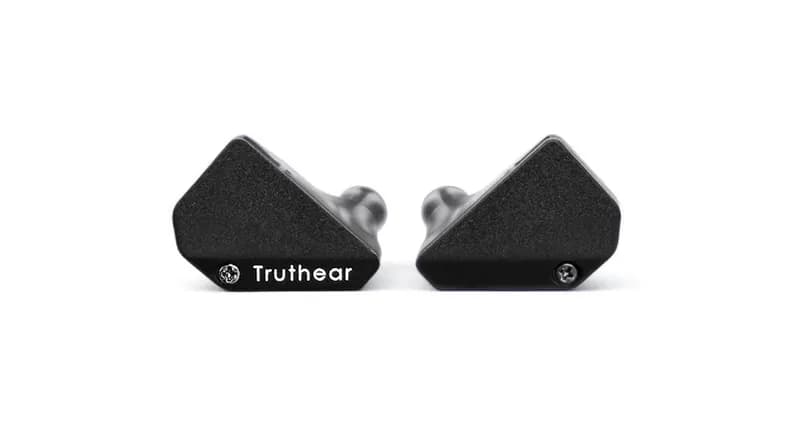
The HEXA has a deliberately understated appearance. Instead of a colorful or highly decorative shell, it uses a dark, minimalist design with a metal faceplate and visible screws.
The shell is made using a medical-grade resin process, while the faceplate uses aluminum alloy. TRUTHEAR also describes the shell as being designed to keep the overall volume relatively compact while maintaining wearing stability.
In practical terms, the HEXA feels more like a functional audio product than a fashion accessory. The design is unlikely to appeal to someone looking for an elaborate or luxurious appearance, but the understated styling also means it does not look particularly dated.
The removable 0.78mm 2-pin cable is a useful feature. If the cable eventually fails, it can be replaced without replacing the entire IEM.
The main limitation is that the construction does not completely escape the compromises of the price category. The HEXA feels solid enough for normal use, but it should not be treated like a premium custom IEM. Long-term durability will also depend heavily on how carefully the cable connectors and shell are handled.
Fit and Comfort
Fit is one of the more complicated aspects of the HEXA.
The shell is shaped for a conventional over-ear IEM fit, and its relatively smooth resin construction can work well once the correct ear tips are selected. However, it is not an especially tiny design, and some listeners may find that the shell sits more prominently in the ear than smaller competitors.
This matters particularly for people with small ears. A shell that is perfectly comfortable for one listener can create pressure points for another.
For average-sized ears, the HEXA can generally provide a stable fit suitable for extended listening. The over-ear cable arrangement also helps reduce movement and keeps the IEM secure.
Isolation is reasonable for a passive IEM, although it depends heavily on ear-tip selection and the individual ear canal. There is no active noise cancellation, so it should not be compared with modern ANC earbuds for commuting.
Based on the shell design and reported user experiences, the HEXA can work for several hours of continuous listening for many users, but it is not possible to guarantee a universal 2–4 hour comfort level because ear anatomy varies significantly. Some users have specifically reported that the shell protrudes more than they would prefer.
Cable, Ear Tips and Accessories
The included cable is one of the more practical parts of the package. It is a four-strand silver-plated design with a standard detachable connector. The important advantage is not the material name itself, but the fact that the cable is replaceable and reasonably appropriate for an entry-level IEM.
The package includes three pairs of thick silicone tips, three pairs of thin silicone tips, and one pair of foam tips.
That is enough variety for most users to find a workable combination.
There is little reason to immediately purchase an expensive replacement cable. A cable upgrade may change handling, comfort, or appearance, but it should not be treated as a necessary sound-quality upgrade.
Sound Quality
Sound is where the HEXA makes its strongest case.
Its overall presentation is relatively balanced and neutral, with controlled bass, clear mids, and a detailed upper range. It does not attempt to create an oversized low-end response, so the first impression can be surprisingly restrained if you are accustomed to bass-heavy consumer earphones.
That restraint is both its biggest strength and one of its biggest weaknesses.
Bass
The HEXA's bass is controlled rather than dominant.
Sub-bass extension is respectable, but the overall quantity is relatively modest. You can hear the low-end foundation in electronic music and cinematic recordings, but the emphasis is on cleanliness rather than physical impact.
Bass lines tend to remain separated from the midrange instead of creating a large warm bass-to-mid transition. This helps keep vocals and instruments clear.
The downside is obvious: listeners who expect strong mid-bass punch may find the HEXA dry or lightweight. Several comparative reviews have specifically criticized its limited bass impact and note weight.
For acoustic bass, controlled drums, and detailed arrangements, this can be an advantage. For hip-hop, EDM, modern pop, and bass-heavy rock, it may feel less satisfying than warmer competitors.
Midrange
The midrange is one of the HEXA's strongest areas.
Vocals are relatively clear and forward without becoming excessively thick. Male vocals benefit from the clean lower-mid presentation, while female vocals receive good presence and intelligibility.
The HEXA is particularly effective when a recording contains multiple instruments competing for attention. Its restrained bass prevents the lower frequencies from covering up vocals or guitars.
The trade-off is note weight. Compared with warmer IEMs, the HEXA can sound somewhat lean. A singer may be very easy to hear, but the presentation does not necessarily have the richness or body associated with a warm tuning.
This is why the HEXA can be attractive to listeners who prioritize clarity, while listeners who prefer thick and emotionally warm vocals may want something else.
Treble
Treble is detailed and relatively energetic.
The HEXA provides good perceived resolution for its price, particularly with cymbals, guitar textures, background instruments, and subtle recording details.
However, the upper treble is not universally smooth. Recent comparative measurements and reviews have noted an upper-treble peak, while also emphasizing that high-frequency measurements are particularly sensitive to ear anatomy and ear tips.
In practical listening, this means the HEXA can sound crisp and open with suitable silicone tips, but some recordings may become more aggressive than intended.
Listeners who are sensitive to treble peaks should pay attention to this characteristic. Foam tips can also alter the perceived high-frequency balance; TRUTHEAR itself notes that different tips can produce noticeably different high-frequency behavior.
Soundstage and Imaging
The HEXA provides a reasonably spacious presentation for its class, although it does not create the kind of enormous soundstage associated with high-end open-back headphones.
Its biggest strength is separation rather than sheer width.
Instruments are generally easy to distinguish, and the relatively clean bass helps prevent congestion. This works well for layered pop productions, acoustic recordings, and game soundtracks.
Several comparative evaluations have found the HEXA's staging above average for its price, while also noting that it is not exceptional in absolute terms.
For gaming, its imaging and clean mid/high presentation can be useful for positional information and environmental details. It is not a specialized competitive gaming IEM, however, and soundstage width alone should not be confused with imaging accuracy.
Dynamics and Transients
The HEXA is technically competent but not overwhelmingly dynamic.
Drums have reasonable definition, and individual attacks are easy to follow. The restrained bass also prevents low-frequency energy from masking percussion.
However, compared with more energetic or bass-emphasized IEMs, the HEXA can feel somewhat restrained.
This is an important distinction between resolution and dynamics. The HEXA can reveal small details without necessarily producing a huge sense of physical impact.
For listeners who want analytical clarity, this is acceptable. For listeners who want visceral kick drums and highly explosive transitions, a warmer or more energetic alternative may be more satisfying.
Tuning and Frequency Response
The HEXA can broadly be described as a neutral-to-balanced IEM with restrained bass, clean mids, and elevated upper-frequency energy.
Its tuning is one of the reasons the product became so influential in the budget IEM segment. The goal is not simply to make everything flat; instead, the tuning aims to provide a natural overall tonal balance while maintaining enough high-frequency energy for clarity.
Frequency-response measurements can explain some of the HEXA's characteristics, particularly its restrained low end and energetic treble.
They cannot, however, fully predict perceived dynamics, staging, texture, or comfort. Ear anatomy, insertion depth, ear tips, recording quality, and listening volume can all affect the experience.
Music Compatibility
Music Type | Performance | Suitability | Reason |
|---|---|---|---|
Pop | Clean and controlled | High | Clear vocals and separation |
Chinese Pop | Clear and neutral | High | Strong vocal intelligibility |
Rock | Detailed but restrained | Medium-High | Good guitars, less bass impact |
Electronic | Clean but light | Medium | Sub-bass is present but not dominant |
Classical | Balanced and detailed | High | Separation and tonal neutrality |
Jazz | Clean and articulate | High | Good instrument definition |
Folk | Natural and clear | High | Strong vocal and acoustic presentation |
Female Vocals | Detailed and forward | High | Good upper-mid clarity |
Games/OST | Precise and separated | High | Useful imaging and detail |
Film Soundtracks | Clear but not cinematic | Medium-High | Good separation, limited low-end weight |
The HEXA's versatility is one of its strongest qualities. It does not have an extremely specialized tuning, so it can work across many genres.
Its main weakness appears when music depends heavily on bass impact.
Who Is the HEXA For?
Bass lovers: Only moderately suitable. The bass is clean and controlled, but not particularly powerful.
Vocal listeners: Very suitable if you prefer clear, relatively neutral vocals rather than thick and warm vocals.
Detail-oriented listeners: Suitable. The HEXA delivers strong perceived detail for its price.
Treble-sensitive listeners: Potentially problematic. The upper treble can become energetic with certain recordings and tips.
Classical listeners: A good match because its balance and separation work well with complex arrangements.
Gamers: Suitable for players who value clarity, positioning, and separation. It is not specifically designed around exaggerated positional effects.
Driving Requirements
The HEXA is easy to drive.
Its official impedance is 20.5Ω and sensitivity is rated at 120dB/Vrms, meaning it does not require a powerful desktop amplifier simply to reach normal listening levels.
A modern smartphone with a suitable headphone output, laptop, or basic USB dongle can provide enough volume.
A better dongle DAC can still be useful for convenience, output quality, or eliminating noise from a poor source, but there is little justification for pairing the HEXA with a large desktop amplifier purely to unlock its potential.
The source should be viewed as a compatibility and noise consideration rather than an automatic sound-quality upgrade.
Source Pairing
A phone or basic dongle is sufficient for most users.
A decent USB-C dongle can be a practical upgrade if the phone lacks a headphone jack. A mid-range dongle may offer cleaner output or better volume control, but the improvement should not be exaggerated.
A desktop DAC/amp is unnecessary unless it is already part of your setup.
The HEXA is also sensitive enough that users should pay attention to source noise. Poor-quality or unusually noisy outputs can potentially make sensitive IEMs more revealing of background hiss.
HEXA vs Other Budget IEMs
The HEXA's closest alternatives have changed considerably since its launch, but several comparisons illustrate its character.
Against bassier competitors, the HEXA generally favors balance, clarity, and treble detail over physical low-end impact.
Against warmer IEMs, it sounds cleaner and leaner, while those alternatives can deliver more satisfying vocals and bass weight.
Against newer neutral competitors, the HEXA remains competitive because its overall tuning is coherent and technically capable, but newer products may offer smoother treble or more natural note weight.
Its position is therefore not about being universally superior. The HEXA makes more sense for someone who specifically values a restrained, clean presentation.
Pros and Cons
Pros
Balanced and relatively neutral tuning
Excellent clarity for the price
Strong vocal intelligibility
Good separation and imaging
Detailed treble presentation
Detachable 0.78mm 2-pin cable
Easy to drive
Multiple ear-tip options
Lightweight resin shell construction
Cons
Bass quantity may be insufficient for bass lovers
Note weight can sound somewhat thin
Upper treble can be energetic on certain recordings
Fit is not ideal for every ear shape
Sound can feel slightly dry compared with warmer competitors
Build and accessories are functional rather than luxurious
Rating
Category | Weight | Assessment |
|---|---|---|
Sound Quality | 35% | 4.5/5 |
Tuning | 15% | 4.5/5 |
Comfort | 15% | 4.0/5 |
Build & Design | 10% | 4.0/5 |
Driveability & Compatibility | 10% | 4.5/5 |
Cable & Accessories | 5% | 4.0/5 |
Value | 10% | 4.5/5 |
Overall Score: 4.5/5.0
The value score naturally depends on the actual purchase price. At around its official $89.99 positioning, the HEXA remains competitive, although the budget IEM market is now much more crowded than when it first appeared.
Who Should Buy the TRUTHEAR HEXA?
The HEXA is a strong fit for listeners who want their first serious wired IEM and prefer a relatively neutral sound. It is particularly attractive if you listen to vocals, acoustic music, classical, jazz, pop, or detailed game soundtracks and do not need powerful bass.
It is also a good choice for someone who wants to explore Hi-Fi without immediately investing in a dedicated amplifier.
On the other hand, it is not the obvious choice for listeners who define good sound primarily through bass impact. If you mainly listen to bass-heavy electronic music, hip-hop, or modern pop and want physical low-end weight, a warmer alternative may be more satisfying.
Treble-sensitive listeners should also approach it carefully.
Buying Advice
The HEXA makes the most sense when its price remains close to the budget-IEM segment. At a substantial discount, its balanced tuning and technical performance become particularly compelling.
If you have a slightly larger budget, newer IEMs can offer more refined treble, stronger bass, or improved technical performance. But spending more does not automatically mean getting a sound you will prefer.
If your budget is lower, there are also plenty of capable single-driver IEMs that can provide enjoyable sound for less money. The HEXA's reason for existing is not simply that it has more drivers; its appeal comes from how those drivers are integrated into a coherent tuning.
Final Verdict
The TRUTHEAR HEXA is best understood as a budget IEM for people who value balance and clarity more than excitement. Its controlled bass, clean midrange, detailed treble, and good separation make it an unusually mature-sounding product for its price category.
Its main limitation is also obvious: the same restrained tuning that makes it attractive to neutral-sound listeners can make it feel thin or dry to people who want warmth and bass impact. The upper treble can also be more energetic than some listeners prefer, and the shell fit is not guaranteed to work equally well for every ear.
The HEXA is therefore not a universal recommendation. If you want a clean, relatively neutral IEM for vocals, acoustic music, classical, jazz, pop, gaming, and general everyday listening, it remains a compelling option. If you prioritize powerful bass, thick note weight, or a softer treble presentation, another IEM may suit you better.
The key reason to buy the HEXA is simple: it offers a carefully balanced, technically capable sound at a relatively accessible price, without requiring expensive amplification. For the listener who values that particular balance, that remains the HEXA's strongest argument.