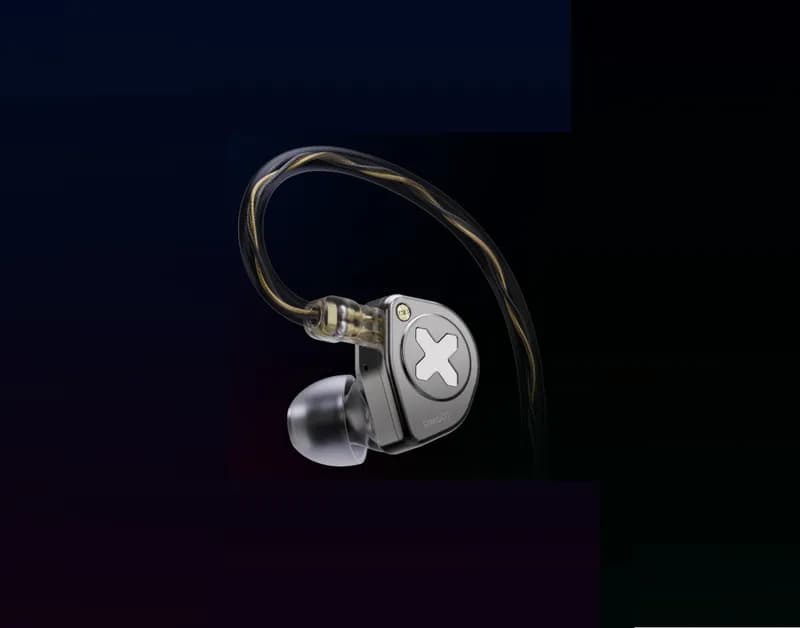
Detailed Review
The SIMGOT EW300 is a tribrid in-ear monitor that takes an unusually ambitious approach for its price class. Instead of relying on a single dynamic driver, it combines a 10mm dynamic driver, a 6mm micro-planar driver, and a piezoelectric driver, while also providing interchangeable tuning nozzles. The result is an IEM that aims to combine bass impact, vocal clarity, treble extension, and technical performance without becoming difficult to drive or excessively expensive.
Its strongest characteristic is versatility. The standard silver nozzle delivers a lively, relatively balanced presentation with punchy bass, clear vocals, good detail retrieval, and energetic treble. The alternative gold nozzle shifts the presentation toward a warmer and smoother balance, giving listeners a practical way to adapt the sound to different preferences.
The EW300 is also unusually well built for its price, with a compact metal shell and a distinctive polished finish. Its main limitations are not related to the number of drivers or basic technical performance. Instead, the shorter nozzle can make fit somewhat tip-dependent, the glossy shell attracts fingerprints, and listeners who strongly prefer a completely neutral or relaxed presentation may find the upper frequencies somewhat energetic.
For listeners looking for an affordable everyday IEM that can handle pop, rock, electronic music, vocals, gaming, and general multimedia, the EW300 remains a particularly flexible option.
Positioning and Market Role
The EW300 sits in the budget-to-lower-midrange IEM segment, competing primarily with other models around and below the $100 price bracket.
Its most important selling point is not simply its tribrid configuration. Driver count alone does not guarantee better sound. What makes the EW300 interesting is how SIMGOT uses the three drivers to divide the frequency range: the 10mm dynamic driver handles the low frequencies and much of the midrange, while the micro-planar and piezoelectric drivers contribute to the upper frequencies. This arrangement helps maintain a relatively coherent presentation while allowing the smaller drivers to contribute additional treble detail and extension.
The EW300 was also offered in several versions, including the standard model, a USB-C DSP version, and an HBB-tuned edition. This means buyers should pay attention to the exact version being purchased because the cable, electronics, and tuning can differ.
The standard EW300 is the most straightforward choice for someone who already owns a DAC or dongle and wants maximum flexibility through the detachable cable and interchangeable nozzles.
In practical terms, the EW300 is trying to solve a simple problem:
How much versatility, technical ability, and physical quality can an IEM provide without moving far beyond the budget category?
That is where the EW300 is particularly convincing.
Specifications and Hardware
Specification | SIMGOT EW300 |
|---|---|
Type | Wired in-ear monitor |
Driver configuration | Tribrid |
Dynamic driver | 10mm |
Micro-planar driver | 6mm |
Piezoelectric driver | 1 |
Driver arrangement | Dynamic + micro-planar + piezoelectric |
Connector | 0.78mm 2-pin |
Standard plug | 3.5mm |
Housing | CNC-machined metal alloy |
Tuning | Interchangeable nozzles |
Standard tuning nozzles | Silver and gold |
Cable | Detachable |
Microphone | No |
DSP version | Available as a separate variant |
Approximate price class | Around $70–$100, depending on version and market |
The exact specifications can vary slightly between versions, so buyers should verify the listing before purchasing, particularly when comparing the standard, DSP, and HBB editions.
The most important hardware feature is obviously the three-driver configuration. However, it should not be interpreted as automatically superior to a good single-dynamic IEM. The actual result depends on crossover design, driver integration, tuning, distortion, and acoustic implementation.
In the EW300, the arrangement generally works well enough to produce a technically capable and coherent presentation for its price.
Build Quality and Shell Design
Build quality is one of the EW300's strongest points.
The shell uses a CNC-machined metal construction with a polished finish. It feels considerably more substantial than many inexpensive resin IEMs, and the compact shell manages to accommodate three different driver technologies without becoming unusually large. Multiple reviews have specifically noted the solid construction and premium feel relative to the price.
The faceplates use a distinctive geometric design, giving the EW300 a recognizable appearance without relying on excessive decoration.
The main downside is the polished surface.
It looks attractive when clean, but it is also a fingerprint magnet. Regular handling quickly leaves visible marks, and users who frequently place their IEMs on desks or carry them without the case may notice scratches over time.
The 0.78mm 2-pin connection is practical and widely compatible with replacement cables. The connectors are recessed into the housing, helping maintain a clean overall appearance.
The replaceable nozzle system is also useful from a practical perspective. Besides changing the tuning, removable nozzles make it easier to clean the acoustic path and replace filters if necessary.
Comfort and Fit
The EW300 is relatively compact for a metal IEM, and its basic shell shape is derived from the ergonomic design used in other models in the EW series.
For many users, the fit is comfortable enough for several hours of continuous listening. Multiple long-term users have reported being able to wear the EW300 for extended sessions without significant discomfort.
However, the nozzle is somewhat shorter than average.
This is the main fit issue to keep in mind.
A short nozzle can work extremely well with some ears but may make it harder for others to achieve a deep and consistent seal. The solution is often simple: experiment with ear-tip sizes and shapes rather than assuming the shell itself is uncomfortable. Reviews have similarly noted that tip selection can have a meaningful effect on the final fit.
For small ears, the compact shell can actually be an advantage. Several user reports describe the EW300 as comfortable for smaller ears, although ear anatomy varies enough that this should not be treated as a universal guarantee.
For average-sized ears, two to four hours of continuous use should generally be realistic with the right tips.
Isolation is adequate rather than exceptional. A good seal provides reasonable passive isolation for commuting and everyday use, but the EW300 is not designed specifically as a maximum-isolation monitor.
Cable, Ear Tips, and Accessories
The standard EW300 comes with a detachable cable using 0.78mm 2-pin connectors and a 3.5mm plug.
The cable is perfectly usable for normal listening and does not create a strong reason for an immediate upgrade.
This is important because inexpensive IEMs often encourage unnecessary accessory spending. With the EW300, changing the cable is mainly justified if you need a different connector, such as 4.4mm balanced, rather than because the stock cable is fundamentally inadequate.
The included ear tips are sufficient to get started, although tip rolling can be useful because the relatively short nozzle makes seal quality particularly important.
Some reviewers have found alternative tips capable of changing bass definition or soundstage perception, but these differences should not be exaggerated. A correct seal is much more important than chasing expensive aftermarket tips.
The tuning nozzles are the more meaningful accessory.
Instead of buying another IEM to obtain a different tonal balance, the user can switch between the supplied nozzles and obtain a noticeable change in presentation.
Sound Quality
The EW300's sound is best described as fun, energetic, relatively balanced, and versatile.
The standard silver nozzle has a lively presentation with punchy bass, clear vocals, and energetic upper frequencies. The gold nozzle provides a somewhat warmer and smoother alternative.
This makes the EW300 more flexible than many budget IEMs that commit strongly to one tuning philosophy.
Bass
Bass is one of the EW300's most successful areas.
The 10mm dynamic driver provides convincing sub-bass extension and good mid-bass impact. It does not simply produce a large amount of bass; the more important characteristic is that the low end generally remains controlled enough to avoid overwhelming the midrange.
Kick drums have good physical impact, while electronic bass lines can produce a satisfying sense of rumble.
The bass is therefore closer to punchy and controlled than soft or bloated.
The standard silver nozzle provides a more energetic balance, while the alternative gold nozzle can make the overall presentation feel warmer and fuller.
This gives the EW300 a useful advantage for listeners who do not want to choose between a neutral IEM and a bass-heavy IEM.
However, listeners who want an extremely tight, reference-style low end may still notice some coloration. The EW300 is designed to be enjoyable rather than strictly neutral.
Midrange
The midrange is arguably the most important part of the EW300's tuning.
Vocals are generally clear and reasonably present, while the bass provides enough foundation to prevent the overall presentation from becoming excessively thin.
Male vocals benefit from the additional low-frequency body, while female vocals gain clarity from the upper-midrange tuning.
Acoustic guitar, piano, and many pop recordings also benefit from the relatively clean separation between the low and mid frequencies.
The silver nozzle tends to bring vocals slightly more forward, while the gold nozzle creates a somewhat warmer and smoother balance. This distinction is noticeable enough to make the interchangeable nozzles genuinely useful rather than purely decorative.
The main limitation is timbre.
Although the EW300 generally sounds coherent, some listeners may detect a slightly less natural character in certain upper-frequency instruments because of the micro-planar and piezoelectric drivers. This is not necessarily obvious on every recording, but listeners who prioritize completely natural acoustic timbre may prefer a simpler single-dynamic-driver design.
Treble
Treble is one of the areas where the EW300 distinguishes itself from many inexpensive IEMs.
The micro-planar and piezoelectric drivers provide plenty of upper-frequency information and help create a sense of air and clarity.
Importantly, the EW300 does not simply boost treble to create the impression of detail.
The standard tuning can sound energetic, but several reviews have found it relatively smooth and free from the aggressive sharpness that some hybrid IEMs can exhibit.
The gold nozzle reduces some of that energy and produces a smoother presentation.
For listeners who are sensitive to brightness, the gold nozzle is therefore worth trying before rejecting the EW300 entirely.
For listeners who enjoy crisp percussion, cymbal energy, vocal articulation, and a more open presentation, the silver nozzle is likely the more attractive choice.
The important caveat is that treble perception is highly dependent on ear tips, insertion depth, volume, and individual hearing. A listener who is particularly sensitive to upper-midrange or treble energy may still find the silver configuration tiring at high volume.
Soundstage and Imaging
The EW300 offers a good sense of width for its price.
The stage is not speaker-like, but instruments can occupy clearly differentiated positions across the stereo field. Height is also respectable, while depth is somewhat less impressive than the horizontal presentation.
Imaging is one of the EW300's stronger technical characteristics.
The combination of driver separation, upper-frequency clarity, and controlled bass allows individual sounds to remain distinguishable without making the presentation excessively analytical.
This is particularly useful for games and spatial recordings.
In busy orchestral or heavily layered electronic tracks, however, the EW300 does not completely eliminate congestion. More expensive IEMs can provide more precise layering when many instruments compete for the same space.
Still, within its price range, the EW300 provides a convincing spatial presentation.
Dynamics and Transients
The EW300 delivers good dynamic contrast, although this is not necessarily its strongest technical area.
The dynamic driver provides convincing impact on drums and bass, while the upper drivers allow percussion and smaller transient details to remain distinct.
Kick drums have a reasonably quick attack, and electronic percussion generally sounds lively.
However, the EW300 is not the kind of IEM that makes every transient feel extremely sharp or immediate.
Its tuning prioritizes a balance between musicality and technical performance rather than extreme transient speed.
That distinction is important.
The EW300 can sound detailed without becoming aggressively analytical.
Tuning and Frequency Response
The EW300's tuning changes depending on the nozzle.
The silver nozzle generally provides a more energetic and vocal-focused balance, while the gold nozzle shifts the presentation toward greater warmth and smoother upper frequencies. Independent frequency-response databases show that the two configurations are related but not identical.
The overall tuning can be described as a mild-to-moderate V-shaped or energetic balanced presentation rather than a neutral reference tuning.
The elevated bass provides physicality, while the upper-midrange and treble provide clarity.
A frequency-response graph can explain much of this tonal balance, but it cannot completely predict perceived timbre, imaging, dynamics, or comfort.
The nozzle, ear-tip seal, insertion depth, and individual ear anatomy can all affect the final result.
This is particularly relevant to the EW300 because its short nozzle makes ear-tip selection more important than it might be with a deeper-fitting IEM.
Music Compatibility
Music Type | Performance | Suitability | Reason |
|---|---|---|---|
Pop | Punchy and clear | Excellent | Strong bass impact with clear vocals |
Chinese Pop | Vocal-focused | Excellent | Good vocal presence and bass balance |
Rock | Energetic | Excellent | Strong drums and guitar separation |
Electronic | Powerful and extended | Excellent | Good sub-bass rumble and treble energy |
Classical | Spacious and detailed | Very Good | Good imaging and instrument separation |
Jazz | Clear and lively | Very Good | Good bass texture and instrumental definition |
Acoustic/Folk | Natural enough | Very Good | Clear guitars and vocals |
Female Vocals | Detailed and energetic | Excellent | Strong upper-midrange clarity |
Gaming/OST | Spacious and precise | Excellent | Good imaging and positional cues |
Film Scores | Immersive | Very Good | Bass impact and spatial separation |
The EW300 is particularly versatile with pop, rock, electronic music, vocal recordings, J-Pop, gaming, and movie soundtracks.
It is less ideal for listeners seeking a strictly neutral reference presentation for classical or acoustic monitoring.
That does not mean it performs poorly with classical music. Its imaging and separation are good enough to make orchestral recordings enjoyable. The difference is that the EW300 adds its own tonal character instead of disappearing into the recording.
Who Is the EW300 For?
Bass Lovers
Yes, with some qualification.
The EW300 provides meaningful sub-bass extension and punch without becoming excessively bloated. It is suitable for listeners who want bass to be physically present but still want reasonably clear vocals.
Dedicated bassheads may still want something with an even stronger low-end emphasis.
Vocal Listeners
Very good match.
The silver nozzle provides good vocal presence, while the bass adds enough warmth and body to avoid an overly thin presentation.
The gold nozzle is useful if you prefer vocals in a slightly warmer and smoother environment.
Detail-Oriented Listeners
Good match.
The upper-frequency drivers provide plenty of perceived detail and separation for the price.
However, the EW300 should not be mistaken for a hyper-analytical monitor. Its objective is to remain musical while still sounding technically capable.
Listeners Who Prefer Smooth Sound
Moderate match.
The gold nozzle helps substantially, but the EW300 remains more energetic than genuinely relaxed IEMs.
If you are extremely sensitive to upper-midrange or treble energy, a darker or warmer IEM may be easier to enjoy for long sessions.
Classical Listeners
Good, but not reference-neutral.
The soundstage and imaging are useful for orchestral music, but the tonal balance has more personality than a neutral monitoring IEM.
Gamers
Very good match.
The EW300 provides clear positional information, useful separation, and enough bass to make explosions and environmental effects engaging.
Both nozzle options can work, with the smoother gold configuration potentially being preferable for long competitive sessions.
Does the SIMGOT EW300 Need an Amp?
No.
The EW300 is designed to work well with ordinary portable sources.
A phone, laptop, or basic USB dongle can provide enough power for normal listening. A more powerful amplifier may change the presentation slightly depending on its output characteristics, but the EW300 does not require a desktop amplifier to perform properly.
This is particularly important in this price category.
Spending another $100 or more on amplification does not make much sense if the goal is simply to make the EW300 louder.
A clean source is more important than a powerful source.
Source and DAC Pairing
Phone:
A phone with a suitable USB-C or Lightning dongle is sufficient.
Basic Dongle DAC:
This is the most sensible upgrade if your phone lacks a headphone output. A clean dongle provides enough power and keeps the system portable.
Midrange Dongle DAC:
Useful if you already own one, but there is no strong reason to buy an expensive dongle specifically for the EW300.
Desktop DAC/amp:
Optional.
The additional power is not necessary. A desktop setup may provide a different output character or additional connectivity, but the EW300 does not require it.
The most meaningful upgrade is therefore not maximum power. It is a clean, low-noise output and a good seal.
Noise and Compatibility
The EW300 is generally easy to use with modern devices.
Android, Windows, macOS, and iPhone systems can all be used with the appropriate USB DAC or adapter.
Because IEM sensitivity and source noise interact, an extremely noisy output can potentially produce audible hiss, although this is more dependent on the specific source than on the EW300 itself.
A modern, well-designed USB dongle is the safest choice.
There is also no reason to worry about amplifier impedance in the same way one might with a difficult full-size headphone. The EW300 is fundamentally a portable-friendly IEM.
How It Compares With Similar IEMs
The EW300 operates in one of the most competitive sections of the IEM market, so the comparison is more useful when viewed through different priorities.
Against the Truthear Hexa, the EW300 is the more energetic and bass-oriented option. The Hexa is more restrained and reference-oriented, while the EW300 provides more physicality and a more immediately engaging presentation.
Against the Truthear Nova, the comparison becomes more complicated. The Nova offers a multi-driver design and strong technical performance, while the EW300 provides a smaller, simpler package with the unusual advantage of interchangeable tuning nozzles. Buyers who want flexibility and a more dynamic presentation may prefer the EW300, while those seeking a different technical/tuning balance may find the Nova more appropriate.
Against the LETSHUOER S12 Pro, the EW300 offers a different interpretation of technical sound. The S12 Pro's planar driver produces a characteristically fast and energetic presentation, while the EW300 combines dynamic-driver bass with micro-planar and piezoelectric upper-frequency drivers. The EW300 can therefore sound fuller and more versatile, while planar enthusiasts may prefer the more immediate character of the S12 Pro.
Against the SIMGOT EW200, the EW300 is the more ambitious design. It adds two additional driver technologies and interchangeable nozzles while maintaining a similarly compact physical concept. The EW200 remains attractive if its simpler configuration and lower price are enough, but the EW300 provides a broader range of tuning possibilities.
Against the SIMGOT EA500 LM, the choice is more about tuning than a simple upgrade path. The EA500 LM has its own strong technical and energetic character, while the EW300 emphasizes versatility, bass fullness, and multiple tuning options.
The EW300 therefore does not need to be the objectively best model in this group. Its advantage is that it gives the user several different ways to approach the same IEM.
Pros and Cons
Pros
Excellent versatility for the price
Three-driver tribrid configuration
Strong sub-bass extension and punch
Clear and engaging vocals
Good treble detail and air
Two useful tuning nozzles
Solid CNC-machined metal construction
Compact shell
Good imaging and soundstage width
Easy to drive
Suitable for music, gaming, and movies
Detachable 0.78mm 2-pin cable
Cons
Glossy metal shell attracts fingerprints and can show scratches
Short nozzle can make tip selection important
Treble may be energetic for highly sensitive listeners
Some recordings can reveal slight timbral coloration
Accessories are functional rather than especially luxurious
The differences between tuning nozzles are useful but not dramatic
Strong competition in the same price range
Rating
Category | Weight | Score |
|---|---|---|
Sound Quality | 35% | 4.5/5 |
Tuning | 15% | 4.5/5 |
Comfort | 15% | 4.5/5 |
Build & Design | 10% | 4.5/5 |
Driveability & Compatibility | 10% | 4.5/5 |
Cable & Accessories | 5% | 4.0/5 |
Value | 10% | 4.5/5 |
Overall Score: 4.5/5.0
The value score is particularly dependent on the actual selling price. At around the original sub-$100 positioning, the EW300 offers a strong combination of hardware, tuning flexibility, build quality, and sound quality. At a significantly higher price, its value proposition becomes less distinctive because the IEM market becomes considerably more competitive.
Who Should Buy the SIMGOT EW300?
Recommended for
Listeners buying their first serious Hi-Fi IEM
People who want an energetic all-rounder
Listeners who enjoy punchy bass without completely sacrificing vocal clarity
Pop, rock, electronic, J-Pop, and vocal-music listeners
Gamers who want good positional imaging
Users who appreciate tuning flexibility
People who want a metal IEM with a premium feel
Portable listeners who do not want to invest in a powerful amplifier
Not Recommended for
Listeners who want completely neutral monitoring
People who are extremely sensitive to treble or upper-midrange energy
Listeners seeking maximum sub-bass quantity
Buyers who strongly prioritize natural acoustic timbre above everything else
Users who dislike experimenting with ear tips
People looking for a luxurious accessory package rather than a functional one
Buying Advice
At its typical budget-market pricing, the EW300 is easiest to justify when its combination of sound flexibility and technical performance is what you actually want.
The biggest reason to buy it is not simply that it contains three drivers.
It is the combination of a capable dynamic bass driver, clear upper-frequency reproduction, interchangeable tuning, compact metal construction, and good everyday usability.
If you want one IEM that can cover pop during the day, gaming at night, and electronic or rock music on the weekend, the EW300 makes a strong case for itself.
If you already own an IEM with a similar energetic V-shaped tuning, however, the EW300 may not provide enough of a tonal change to justify another purchase.
Likewise, if your priority is a strictly neutral sound, you should look elsewhere rather than trying to force the EW300 into a role it was not designed for.
The best buying opportunity is generally when the standard model is available at or below its normal budget positioning. If the price approaches significantly more expensive competitors, its value advantage becomes less obvious.
SIMGOT EW300: Quick Answers
Who is the SIMGOT EW300 for?
The EW300 is best suited to listeners who want an energetic, versatile IEM with punchy bass, clear vocals, good treble detail, and useful tuning flexibility.
What does the SIMGOT EW300 sound like?
The standard configuration has a lively, slightly V-shaped character with punchy bass, clear upper-midrange energy, and extended treble. The alternative nozzle provides a warmer and smoother presentation.
What music is the EW300 best for?
It is particularly well suited to pop, rock, electronic music, J-Pop, vocal recordings, game soundtracks, and movies. It can also handle classical and jazz well, although it is not a strictly neutral monitor.
Does the SIMGOT EW300 need an amp?
No. It is designed to be driven easily from portable sources. A clean dongle DAC is more than sufficient for most users.
Can a phone drive the EW300?
Yes. A modern phone paired with an appropriate USB-C or Lightning DAC can drive it comfortably.
Is the EW300 comfortable?
Generally yes. The shell is relatively compact and many users report good long-term comfort. The shorter nozzle means that ear-tip selection can be important for achieving a reliable seal.
What is the EW300's biggest weakness?
Its main limitations are the somewhat energetic upper frequencies, potential timbral coloration, and short nozzle. The glossy metal shell also attracts fingerprints and may show scratches.
Are the tuning nozzles actually useful?
Yes, although the difference is not dramatic. The silver and gold configurations shift the balance enough to give the user a meaningful choice between a more energetic and a smoother presentation.
Is the SIMGOT EW300 worth buying?
At its typical budget price, it is worth considering for listeners who value versatility, punchy bass, clear vocals, good technical performance, and tuning flexibility. It is less compelling for listeners who specifically want a neutral or very relaxed presentation.
Final Verdict
The SIMGOT EW300 is an example of a budget IEM that tries to provide more than one clearly defined sound signature.
Its three-driver configuration is interesting, but the real achievement is how many practical strengths SIMGOT has combined into one relatively affordable package. The 10mm dynamic driver gives the EW300 satisfying bass, while the micro-planar and piezoelectric drivers provide additional clarity and treble extension. The interchangeable nozzles then allow the listener to adjust the overall character rather than being locked into a single tuning.
The result is an IEM that is particularly easy to recommend to someone who wants one versatile earphone for music, gaming, movies, and everyday listening.
Its weaknesses are relatively straightforward. The short nozzle can make fit dependent on ear tips, the polished metal shell requires frequent cleaning, and the upper frequencies may be too energetic for particularly sensitive listeners. It also does not deliver the completely natural timbre or neutral balance that some listeners prioritize.
If you value punchy bass, clear vocals, energetic detail, good imaging, solid build quality, and the ability to change the tuning, the EW300 has a strong reason to exist.
If you prefer strict neutrality, maximum acoustic naturalness, or a very relaxed treble presentation, there are other IEMs that may better match those priorities.
The EW300's biggest strength is therefore not any single specification. It is the overall balance between sound quality, tuning flexibility, build quality, comfort, and price. That combination makes it a particularly practical choice for listeners who want to enter the Hi-Fi IEM market without immediately moving into a much more expensive price bracket.