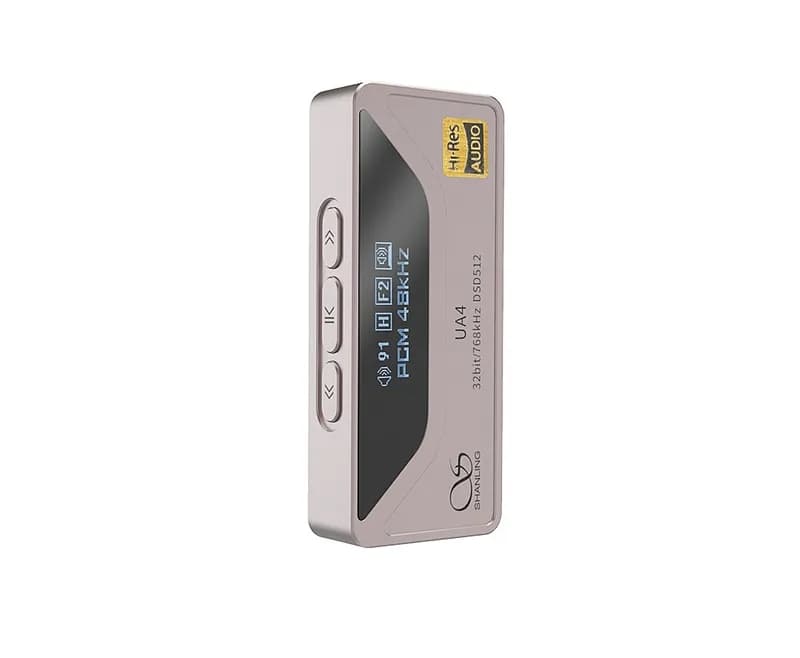
Detailed Review
The Shanling UA4 is a compact USB DAC/amp designed for listeners who want more than a basic dongle. Its combination of an ESS ES9069Q DAC, dual Ricore RT6863 amplifier stages, 3.5mm and 4.4mm outputs, hardware controls, and a small display makes it unusually feature-rich for a $99 dongle DAC. Shanling rates the balanced output at up to 211mW at 32Ω, while third-party measurements and reviews have reported slightly higher figures depending on the test method.
The most interesting part of the UA4 is its tuning. Despite using an ESS DAC, it does not aim for an aggressively analytical presentation. Independent listening tests describe it as warm, smooth and full-bodied, with a spacious presentation and good instrument separation. That makes it particularly appealing for IEM users who want a more relaxed and musical presentation rather than maximum treble emphasis.
Its biggest advantages are the excellent feature set, compact metal construction, low output impedance, dual headphone outputs, physical controls and efficient power consumption. The main limitations are that the 4.4mm output can produce a slight hiss with some extremely sensitive IEMs, while users looking to drive demanding full-size headphones may still want a more powerful dedicated amplifier.
Overall rating: 4.5/5
For IEM users and mobile Hi-Fi listeners, the UA4 is one of the more complete dongle DACs in its price range. Its value comes less from having the biggest numbers and more from combining sound quality, usability and features in a very small device.
Shanling UA4 Specifications
Specification | Shanling UA4 |
|---|---|
DAC | ESS ES9069Q |
Amplification | Dual Ricore RT6863 |
3.5mm output | 137mW @ 32Ω |
4.4mm output | 211mW+ @ 32Ω, depending on measurement |
Output impedance | 0.4Ω / 0.8Ω |
PCM | Up to 32-bit/768kHz |
DSD | Up to DSD512 |
Outputs | 3.5mm single-ended, 4.4mm balanced |
Gain | Low / High |
Display | 0.87-inch monochrome display |
Controls | Three multifunction buttons |
USB | USB-C |
Weight | Approx. 20.8g |
Dimensions | 60 × 25 × 11mm |
iOS | Supported with appropriate connection cable |
Reference price | $99 |
Shanling officially specifies 211mW at 32Ω for the balanced output, while Headfonia measured 227mW under its testing conditions. The difference illustrates why output-power figures should always be considered alongside the measurement conditions rather than treated as a universal number.
What Makes the Shanling UA4 Different?
The UA4 is not simply another ESS-based dongle DAC.
Its ES9069Q DAC is paired with two Ricore RT6863 amplifier chips, while Shanling also uses low-noise regulation and six Kemet tantalum capacitors in the audio circuit. More importantly for everyday use, the UA4 includes a small 0.87-inch display and three physical buttons. These can be configured for hardware volume, software volume, playback control, or a combination of functions depending on the connected device.
This makes the UA4 feel closer to a miniature DAC/amp component than a simple USB adapter.
It also supports both UAC 1.0 and UAC 2.0 modes. UAC 1.0 allows compatibility with devices such as the Nintendo Switch and some older USB audio hardware.
For a device costing around $99, that combination of controls, display and connectivity is a meaningful advantage.
How Does the Shanling UA4 Sound?
The UA4's sound is arguably its strongest reason to buy it.
Although the ES9069Q is an ESS DAC, the UA4 does not produce the stereotypical bright or clinical presentation sometimes associated with ESS-based equipment. Independent listening impressions describe the UA4 as warmer than neutral, with a fuller low end, richer lower mids and a smooth overall presentation.
That does not mean the UA4 is dark or lacking detail. Instead, Shanling appears to have used the amplification and analog stage to create a more relaxed tonal balance.
Bass
The bass has good weight and texture without becoming excessively dominant.
Mid-bass adds some warmth to the presentation, while sub-bass remains reasonably controlled. The result is a fuller sound that works well with vocals, pop, electronic music and many acoustic recordings.
Listeners looking for an extremely tight, dry or reference-oriented bass presentation may prefer a more neutral dongle. The UA4 is better suited to those who want some additional body without turning the sound excessively warm.
Midrange
The midrange is one of the UA4's most attractive characteristics.
Vocals and instruments have a relatively dense and textured presentation. Rather than pushing vocals aggressively forward, the UA4 creates a smooth and slightly rich presentation.
This can be particularly useful with bright or thinner-sounding IEMs. Instead of adding more upper-mid energy, the UA4 gives the presentation additional body.
Treble
Treble is relatively smooth rather than aggressively energetic.
Independent reviews describe the upper treble as somewhat relaxed while retaining useful detail and extension.
That makes the UA4 easier to listen to for long periods, especially with IEMs that already have strong treble energy.
The trade-off is that listeners who specifically want maximum sparkle, air and analytical contrast may find it less exciting than a more neutral or bright dongle.
Soundstage and Imaging
The UA4 performs particularly well in spatial presentation.
Third-party listening tests describe a medium-sized soundstage with good depth, positioning and instrument separation. Another review specifically found the UA4's stage wider and taller than the iBasso DC06 in its comparison.
This is important because the UA4's spacious presentation helps compensate for its smoother tonal balance. It does not simply make everything thicker and warmer; there is still enough separation to prevent complex recordings from becoming congested too quickly.
Is the Shanling UA4 Powerful Enough?
For IEMs, yes.
The official specification lists up to 211mW at 32Ω through the balanced output, while third-party testing has measured around 227mW under specific conditions. The 3.5mm output is rated at 137mW at 32Ω.
That is considerably more than most ordinary smartphone headphone outputs and is sufficient for the overwhelming majority of efficient IEMs.
However, power should not be judged by wattage alone.
A demanding planar headphone or high-impedance full-size headphone can require substantially more voltage and current than an efficient IEM. The UA4 can drive some headphones, but it should not be treated as a replacement for a powerful desktop headphone amplifier.
For this reason, the UA4 is best viewed as an IEM-first dongle DAC with enough additional power for many portable headphones, rather than a miniature desktop amplifier.
What About Output Impedance and Noise?
The UA4 has a low output impedance, officially specified around 0.4Ω on 3.5mm and 0.8Ω on 4.4mm according to third-party specification data.
That is useful for low-impedance IEMs because a low output impedance reduces the likelihood of the DAC/amp significantly changing the frequency response of multi-driver earphones.
However, there is an important caveat.
One independent review reported slight hiss from the 4.4mm output with an extremely sensitive 8Ω IEM, while the 3.5mm output did not exhibit the same issue.
This does not mean the UA4 is generally noisy. Rather, users with exceptionally sensitive IEMs should test the combination instead of assuming that a low output impedance automatically guarantees a completely silent background.
Phone and Computer Compatibility
The UA4 is designed to work across Android, Windows, macOS and iOS. Shanling officially lists compatibility with these platforms and also supports UAC 1.0 for devices such as the Nintendo Switch.
Android is arguably the most straightforward environment because USB Audio applications can interact directly with the external DAC.
On Windows and macOS, the UA4 can function as a USB audio device without turning the setup into a complicated desktop configuration.
For Lightning-based iPhones and iPads, Shanling specifies the need for an appropriate Lightning cable. USB-C iPhones are considerably simpler because the UA4 uses USB-C connectivity.
Shanling has also continued firmware development for the UA4. Its current download page lists firmware V1.0.5, with improvements specifically addressing iOS 18 compatibility and iOS volume control.
Power Consumption and Heat
Power efficiency is another area where the UA4 performs well.
Shanling claims its power-optimization system reduces standby consumption by 65% and playback consumption by 40% compared with its previous approach. A third-party reviewer also reported no excessive battery drain during use and described the UA4 as running cool.
Actual smartphone battery consumption will still vary depending on the phone, operating system, volume level and output used.
The important point is that the UA4 does not behave like an unnecessarily power-hungry portable amplifier. For people who regularly connect a dongle DAC to a phone, this is a meaningful practical advantage.
Build Quality and Portability
At roughly 20.8g and 60 × 25 × 11mm, the UA4 is small enough to carry with a phone without becoming a major burden.
Its machined aluminum chassis gives it a more substantial feel than inexpensive plastic dongles. The three physical buttons are also more useful than they might initially appear because they allow volume and playback-related controls without relying entirely on the phone's touchscreen.
The biggest ergonomic advantage is the combination of the display and physical controls.
The display can show playback information and configuration settings, while the buttons allow access to functions that would otherwise require a companion app.
For a pocket-sized DAC, that is a practical rather than merely cosmetic feature.
Gaming and Video Use
The UA4 is not specifically a gaming DAC, but its UAC 1.0 compatibility gives it some flexibility for gaming hardware.
For music, its spacious presentation and clean instrument separation can be useful for positional audio and complex soundtracks. However, soundstage width should not automatically be interpreted as superior competitive-gaming performance.
For FPS games, factors such as the game's own audio engine, headphone tuning, imaging capability and player preference remain more important than simply choosing a more expensive DAC.
The UA4 therefore makes sense as a general-purpose music and gaming USB DAC, rather than as a dedicated competitive gaming solution.
Shanling UA4 Pros and Cons
Pros
ESS ES9069Q DAC with a well-controlled, musical tuning
3.5mm and 4.4mm outputs
Strong output for IEMs
Low output impedance
Excellent soundstage and separation
Physical volume and playback controls
Useful monochrome display
UAC 1.0 and UAC 2.0 support
Compact aluminum construction
Relatively efficient and cool-running design
Around $99 official pricing
Cons
Extremely sensitive IEMs may reveal slight hiss from the 4.4mm output
Not powerful enough to replace a serious desktop headphone amplifier
Smooth tuning may not satisfy listeners seeking an aggressively analytical presentation
Some advanced settings are more convenient through Android than iOS because of Apple's system limitations
The display and controls increase functionality but also make the device slightly more complicated than a basic dongle
Shanling UA4 vs Similar Dongle DACs
The UA4 sits in a competitive segment that includes products such as the iBasso DC06, FiiO KA13 and other dual-output USB DACs.
Product | General Strength | Output / Focus | Sound Direction | Best Suited For |
|---|---|---|---|---|
Shanling UA4 | Features + tuning | 3.5mm / 4.4mm | Warm, smooth, spacious | IEMs and mobile Hi-Fi |
iBasso DC06 | Power and technical performance | 3.5mm / 4.4mm | More neutral / direct | Users wanting more output |
FiiO KA13 | Compact power | 3.5mm / 4.4mm | Clean, energetic | Portable users needing extra power |
Shanling UA3 | Simpler Shanling experience | 3.5mm / 4.4mm | Smooth and musical | Users wanting a straightforward setup |
The important difference is not simply which device has the largest output number.
The UA4's combination of physical controls, display, low output impedance, power efficiency and smooth sound gives it a distinct use case. Third-party comparisons have also found that the UA4 can produce a wider and taller presentation than some technically powerful alternatives.
Shanling UA4 Ratings
Category | Rating | Comment |
|---|---|---|
Build Quality | 4.5/5 | Compact aluminum construction and solid controls |
Sound Quality | 4.5/5 | Smooth, rich and spacious presentation |
Driving Power | 4.5/5 | More than enough for most IEMs |
Noise Performance | 4/5 | Generally clean, but sensitive IEMs may expose hiss on 4.4mm |
Soundstage | 4.5/5 | One of its stronger characteristics |
Software & Controls | 4.5/5 | Display, buttons and Eddict support add flexibility |
Connectivity | 4.5/5 | USB-C, iOS, Android, Windows, macOS and UAC 1.0/2.0 |
Portability | 5/5 | Small and lightweight |
Power Efficiency | 4.5/5 | Good battery behavior and relatively low heat |
Value | 4.5/5 | Strong feature set around the $99 price |
Overall | 4.5/5 | A highly complete IEM-focused dongle DAC |
The score reflects the UA4's balance rather than simply its specifications. It loses some points for the possibility of hiss with extremely sensitive IEMs and for its limited suitability as a serious high-power headphone amplifier.
Who Should Buy the Shanling UA4?
The UA4 makes the most sense for:
Smartphone users who want a substantial step beyond basic built-in audio
IEM owners who want both 3.5mm and 4.4mm outputs
Listeners who prefer a smooth, slightly warm presentation
Users who value physical volume controls
People who want a display without moving to a full portable music player
Users who regularly switch between Android, Windows, macOS and other USB audio devices
Listeners who want enough power for most IEMs without carrying a larger amplifier
It is less suitable for:
Users who primarily own difficult-to-drive planar headphones
People who require desktop-level amplification
Extremely sensitive IEM users who are particularly intolerant of even slight background hiss
Listeners who strongly prefer a highly analytical or aggressively bright presentation
People who already own a high-quality portable DAC/amp and do not need its additional controls or outputs
Is the Shanling UA4 Worth Buying?
The Shanling UA4 is a good example of why dongle DACs should not be judged solely by DAC chip, maximum power or theoretical decoding specifications.
Its real strength is the combination of several practical features: a capable ES9069Q implementation, dual amplification, low output impedance, 3.5mm and 4.4mm outputs, physical controls, a display, UAC compatibility and efficient power consumption. Shanling currently lists it at $99, making this feature set particularly relevant at its price.
For high-sensitivity IEM users, the low output impedance and generally clean output are attractive, although the small possibility of 4.4mm hiss with exceptionally sensitive earphones should be considered.
For users who want more driving power, the balanced output provides plenty for most IEMs and many portable headphones, but it should not be mistaken for a desktop-class amplifier.
For users who primarily listen from a smartphone, the UA4 is especially compelling because its small size, physical controls, display and relatively low power consumption make it practical for everyday use.
For users who already own a capable desktop DAC/amp, the value proposition is different. The UA4 is not necessarily an upgrade in absolute amplification capability. Its advantage is portability and convenience.
Overall, the Shanling UA4 is best understood as a feature-rich, smooth-sounding portable DAC/amp rather than a specification-chasing powerhouse. Its combination of soundstage, musical tuning, controls and portability makes it particularly well suited to IEM-focused listeners.
FAQ
Is the Shanling UA4 worth buying?
Yes, particularly if you want a compact DAC with both 3.5mm and 4.4mm outputs, physical controls and a smooth sound signature. Its $99 official price puts it in a competitive part of the dongle DAC market.
How does the Shanling UA4 sound?
It has a relatively warm, rich and smooth presentation rather than an aggressively analytical ESS sound. The bass and lower mids have good body, while the treble remains controlled.
Is the Shanling UA4 powerful enough?
For most IEMs, yes. Its balanced output provides over 200mW at 32Ω according to official and third-party specifications. More demanding full-size headphones may still benefit from a dedicated amplifier.
Does the Shanling UA4 have background hiss?
It is generally designed for low-noise operation, but an independent review reported slight hiss through the 4.4mm output with an extremely sensitive 8Ω IEM. The same issue was not observed through 3.5mm in that test.
Does the Shanling UA4 work with phones?
Yes. Shanling lists compatibility with Android and iOS. Lightning iPhones require an appropriate Lightning cable, while USB-C devices can use the USB-C connection directly.
Does the UA4 work with Windows and Mac?
Yes. It supports Windows and macOS as USB audio sources. Shanling also provides firmware updates and USB-related support through its official download section.
Is the 4.4mm output necessary?
Not necessarily. The 4.4mm output provides higher available power and is useful if your IEM or headphone uses a balanced cable. If you only use 3.5mm IEMs, the single-ended output remains perfectly usable.
Is the Shanling UA4 good for beginners?
Yes, provided the buyer understands that the main benefit is not simply “better sound from an expensive DAC chip.” The UA4 is particularly attractive to beginners who want a compact device with straightforward physical controls and room to move into 4.4mm balanced headphones or IEMs later.