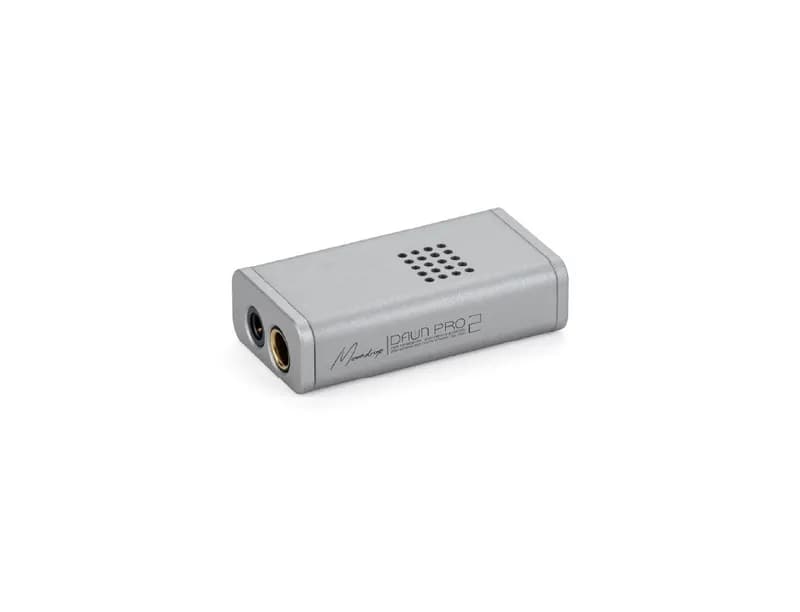
Detailed Review
The MOONDROP Dawn Pro 2 is a compact USB DAC/amp designed primarily for IEM users who want a cleaner headphone output, 4.4mm balanced connectivity, precise volume control, and much more software customization than a typical dongle DAC. It uses dual Cirrus Logic CS43198 DAC chips, supports PCM up to 32-bit/384kHz and DSD256, and provides both 3.5mm single-ended and 4.4mm balanced outputs. MOONDROP specifies up to 124mW + 124mW at 16Ω and 4.1Vrms output, making it powerful enough for most IEMs and efficient headphones, but not a replacement for a serious desktop amplifier.
Its biggest advantage is not simply the dual DAC architecture. The more meaningful upgrade is the built-in second-generation interactive DSP system, which adds parametric EQ, filter adjustment, gain control, Q adjustment, and profile sharing through MOONDROP's software ecosystem. The 100-step independent volume control is also genuinely useful for sensitive IEMs.
The main limitations are equally practical: there is no Bluetooth or internal battery, output power is still modest compared with stronger dongles such as the FiiO KA13, and third-party testing and user reports indicate that the physical volume-button design can be a weak point. Headfonia also found that the Dawn Pro 2 is much better suited to IEMs than demanding planar or high-impedance headphones.
At around $59.99 in the current U.S. market, the Dawn Pro 2 sits in a competitive price range. For someone mainly using IEMs with a phone, tablet, or computer, it offers a particularly strong combination of low noise, balanced output, precise volume control, and DSP customization.
MOONDROP Dawn Pro 2 Specifications
Specification | MOONDROP Dawn Pro 2 |
|---|---|
DAC | Dual Cirrus Logic CS43198 |
PCM | Up to 32-bit / 384kHz |
DSD | Up to DSD256 |
Outputs | 3.5mm single-ended + 4.4mm balanced |
Output voltage | 4.1Vrms @ 0dBFS |
Output power | 124mW + 124mW @ 16Ω, THD+N <1% |
Dynamic range | 132dB A-weighted @ 1kHz |
THD+N | 0.00014% @ 1kHz |
Input | USB-C |
Volume | 100-step independent volume control |
Bluetooth | No |
Battery | No |
Dimensions | 42.5 × 23.2 × 11.4mm |
Current reference price | Around $59.99 |
The core specifications come from MOONDROP's official product information. The product is powered through USB rather than an internal battery, so its operating time is ultimately tied to the connected phone, tablet, or computer.
One important point is that the 124mW + 124mW figure is specified at 16Ω. It should not be interpreted as meaning that the Dawn Pro 2 can deliver the same power to every headphone. Voltage and current requirements change with impedance and sensitivity, which is why a dongle can be excellent with IEMs but considerably less convincing with difficult-to-drive planar headphones.
What Actually Matters With a Dongle DAC?
The DAC chip is not the whole story
The Dawn Pro 2 uses two CS43198 DAC chips, accompanied by MOONDROP's TYPE-UA01 audio control chip and independent power regulation. MOONDROP also specifies three independent LDO power chips in its design.
That sounds impressive on paper, but the practical question is whether the entire DAC/amp implementation produces low noise and sufficient output. The answer is more useful than simply saying that the CS43198 is a high-end DAC chip.
The Dawn Pro 2 measures well on paper, and independent listening and measurement reports describe a very clean output with a low noise floor. Reference Audio Analyzer measured an output impedance of around 0.29Ω on the single-ended output, while Headfonia reported essentially no audible hiss even with highly sensitive IEMs.
For IEM users, this is more important than the DAC chip name itself.
Is the output power enough?
For most IEMs, yes.
For difficult full-size headphones, not necessarily.
This distinction is important. A device can produce sufficient volume without having enough voltage or current headroom to control a demanding headphone properly.
Headfonia found the Dawn Pro 2 excellent with IEMs but limited with demanding planar headphones, including the FiiO FT7 used in its testing.
So the Dawn Pro 2 should primarily be viewed as a high-quality IEM-oriented portable DAC/amp, rather than a miniature replacement for a desktop headphone amplifier.
How Does the Dawn Pro 2 Sound?
The most consistent description from third-party listening reports is neutral, clean, and relatively transparent.
Headfonia described it as neutral and uncolored, with tight bass, clear mids, extended treble, and a generally unexaggerated presentation. Another independent user report found its frequency response, noise floor, and distortion essentially indistinguishable from the measurements expected from a transparent DAC/amp implementation.
This means the Dawn Pro 2 is unlikely to radically change the character of your IEM.
That is an advantage if you already like your earphones.
Bass
The bass is better described as controlled and clean rather than boosted.
With IEMs, kick drums can sound quick and well defined without excessive mid-bass bloom. Headfonia specifically noted tight, controlled bass with the Sennheiser IE600.
If you are moving from a noticeably warmer source, however, the Dawn Pro 2 may initially sound slightly leaner. That is not necessarily a deficiency; it is simply a less colored presentation.
The important distinction is that the Dawn Pro 2 generally does not try to create additional bass weight through its basic tuning.
Midrange
The midrange is one of the reasons the Dawn Pro 2 works well as a general-purpose IEM source.
Vocals are presented clearly without obvious added warmth. Instruments retain their own tonal character rather than being pushed toward a particular house sound.
This makes it useful for listeners who own several IEMs with different tuning philosophies.
Treble
Treble is relatively clean and extended, with good detail retrieval.
The Dawn Pro 2 is therefore more appropriate for listeners who want their IEM's existing treble character preserved rather than softened through a deliberately warm source.
However, this also means that a bright or aggressively tuned IEM will not necessarily become smoother simply because it is connected to the Dawn Pro 2.
This is where the built-in DSP becomes important.
Soundstage, imaging and detail
The Dawn Pro 2 provides good stereo separation and positional precision for a dongle in this class. Headfonia described its stereo image as wide with good instrument positioning, although depth was less impressive than width.
The more useful conclusion is that the Dawn Pro 2 does not create an artificial "huge soundstage." Instead, it provides a relatively clean and controlled presentation that allows the IEM itself to determine much of the final soundstage.
The Real Feature: DSP and Parametric EQ
This is where the Dawn Pro 2 2 separates itself from many inexpensive USB DACs.
Its second-generation interactive DSP supports adjustable EQ parameters including frequency, gain, Q and filter type. MOONDROP also provides an ecosystem for sharing and downloading tuning profiles. The system can be controlled through the company's software and web-based interface.
For enthusiasts, this is considerably more useful than another small improvement in DAC specifications.
For example, if you like an IEM but find its upper-midrange slightly aggressive, you can reduce that region without changing headphones. If an otherwise good IEM lacks some sub-bass, you can add a controlled low-frequency shelf.
This effectively turns the Dawn Pro 2 into a portable DAC plus customizable DSP platform, rather than just a USB-to-headphone adapter.
There is one caveat: software and physical controls become part of the ownership experience. If you simply want to plug a dongle in and never touch settings, much of the Dawn Pro 2's extra functionality will be irrelevant.
100-Step Independent Volume Control
The 100-step volume system is one of the Dawn Pro 2's most practical features.
Sensitive IEMs often make normal phone volume controls frustrating because one volume step can be too quiet while the next is already too loud. The Dawn Pro 2 gives you a much finer adjustment range.
This is especially useful with high-sensitivity multi-driver IEMs.
However, user reports also show that the interaction between the DAC's independent volume control and certain phones can occasionally be inconvenient. One recent iPhone user, for example, reported that balanced-output volume could become difficult to control at very low levels.
So the 100-step system is useful, but the exact experience can depend on the host device and the sensitivity of the earphones.
Which Headphones Pair Best With It?
High-sensitivity IEMs
This is the Dawn Pro 2's strongest use case.
The low noise floor and low output impedance make it a sensible pairing for sensitive IEMs, including multi-driver designs.
Headfonia reported no audible hiss even with very sensitive IEMs during testing.
Low-impedance IEMs
Also a strong match.
The low output impedance is useful because some multi-driver IEMs can change frequency response when paired with a source having relatively high output impedance.
The Dawn Pro 2 avoids that concern to a large extent.
Planar headphones
This is where expectations need to be controlled.
Some efficient planar headphones can work, but demanding planar headphones are not the Dawn Pro 2's natural territory. Headfonia specifically found its available power limiting with demanding planar models.
If you own a difficult planar headphone, a stronger portable amplifier or desktop DAC/amp is generally more appropriate.
High-impedance headphones
The situation depends heavily on sensitivity, not impedance alone.
A 300Ω headphone with high sensitivity can be easier to drive than a low-impedance but inefficient planar headphone.
The Dawn Pro 2 can therefore work with some higher-impedance headphones, but buyers should evaluate the headphone's sensitivity and required voltage rather than simply looking at its impedance rating.
Phone and Computer Compatibility
The Dawn Pro 2 is designed around USB-C and does not include Bluetooth.
It is therefore a straightforward wired solution for Android phones, USB-C iPhones and iPads, Windows PCs and Macs, assuming the host supports USB audio.
MOONDROP describes it as compatible with PC, Android and iOS devices, and the package includes a USB-C cable and USB-A adapter.
The absence of a battery has both advantages and disadvantages.
There is no separate battery to charge or eventually replace, but the device draws power from the host. With a phone, that means using a USB DAC inevitably consumes some additional battery power.
If battery life is your highest priority, a Bluetooth DAC/amp with its own battery may make more sense.
Heat and Portability
The Dawn Pro 2 uses a compact aluminum body with a heat-dissipation-oriented design. Its dimensions are approximately 42.5 × 23.2 × 11.4mm, making it small enough to travel with a phone without becoming a major burden.
Third-party reports generally describe the body as becoming warm during extended operation rather than dangerously hot. Because there is no internal battery, however, thermal behavior is tied closely to the amount of processing, output level and host power available.
The compact metal chassis is one of the product's strengths, although the physical buttons deserve more attention.
Headfonia criticized the volume-button assembly for being wobbly and noted concerns because similar buttons on the original Dawn Pro had reportedly caused reliability complaints.
That is one of the more meaningful weaknesses of the Dawn Pro 2.
Dawn Pro 2 for Gaming and Video
The Dawn Pro 2 can work very well as a wired gaming audio device, especially with IEMs.
Its strengths are low noise, clean separation and accurate positioning rather than any dedicated gaming virtualization.
For competitive FPS gaming, the quality of the IEM and its tuning will usually matter more than the DAC itself once the source is already transparent and powerful enough.
For movies and video, the clean presentation and 4.4mm support are useful, but there is no need to buy the Dawn Pro 2 solely for gaming if your existing USB audio output is already clean and sufficiently powerful.
MOONDROP Dawn Pro 2 Pros and Cons
Pros
Very low noise floor with sensitive IEMs
3.5mm and 4.4mm outputs
Dual CS43198 architecture
100-step independent volume control
Useful parametric EQ and interactive DSP
Low output impedance
Compact aluminum construction
Good value at around $60
Excellent fit for IEM-focused portable listening
Cons
Not powerful enough to replace a serious desktop amp for demanding headphones
No Bluetooth
No internal battery
USB power comes from the connected device
Physical volume buttons have received criticism
DSP/software adds complexity for users who prefer simple plug-and-play operation
The audible improvement depends heavily on the headphones or IEMs being used
Dawn Pro 2 vs Other Dongle DACs
Product | Main strength | Output | Best suited to | Main limitation | Reference price |
|---|---|---|---|---|---|
MOONDROP Dawn Pro 2 | DSP + low noise + balanced output | 3.5 / 4.4mm | IEM users and EQ enthusiasts | Limited for demanding headphones | ~$59.99 |
MOONDROP Dawn Pro | Compact transparent DAC/amp | 3.5 / 4.4mm | IEM users wanting simple performance | Less DSP functionality | ~$59.99 |
FiiO KA13 | Much higher output power | 3.5 / 4.4mm | IEMs + harder-to-drive headphones | Larger/heavier and higher power draw potential | Varies |
Fosi Audio DS3 | Higher-format support and gaming features | 3.5 / 4.4mm | General portable use and gaming | Different software/feature priorities | ~$99 list |
The comparison with the FiiO KA13 is particularly interesting. The KA13 can deliver up to 550mW at 32Ω through its 4.4mm output in Desktop Mode, compared with the Dawn Pro 2's specified 124mW + 124mW at 16Ω. FiiO also provides a detachable cable, physical controls and Android app connectivity.
This does not mean the KA13 automatically sounds better. It means it belongs to a different part of the portable DAC/amp spectrum: power is its selling point, while the Dawn Pro 2 puts more emphasis on low-noise IEM performance, DSP customization and fine volume control.
The original Dawn Pro remains relevant because the Dawn Pro 2 is not a radical change in basic sound philosophy. The newer model keeps the dual-output concept but adds a much more sophisticated DSP system. MOONDROP's original Dawn Pro specification also lists 3.5mm and 4.4mm outputs, 4Vrms balanced output and very low noise figures.
Who Should Buy the Dawn Pro 2?
The Dawn Pro 2 makes the most sense for:
IEM users who want a clean portable source
Phone users who want 4.4mm balanced output
Listeners who want parametric EQ
Hi-Fi beginners moving beyond basic phone audio
Users with sensitive multi-driver IEMs
Listeners who prefer a neutral, low-coloration source
People who want precise volume adjustment
Users who value compact size
It is less suitable for:
Owners of difficult-to-drive planar headphones
Users who need very high output power
People who want Bluetooth
Users who want a self-powered DAC/amp
People who already own a good desktop DAC/amp and mainly use demanding headphones
Listeners who have no interest in EQ or software customization
MOONDROP Dawn Pro 2 Rating
Because a dongle DAC is used differently from a conventional headphone, the score should emphasize IEM performance, noise, usability and portability rather than simply rewarding maximum output power.
Category | Score |
|---|---|
Sound quality | 4.5/5 |
IEM performance | 4.8/5 |
Driving power | 3.8/5 |
Noise / background | 4.8/5 |
Volume control | 4.5/5 |
DSP / EQ | 4.8/5 |
Connectivity | 4.0/5 |
Build quality | 4.2/5 |
Portability | 4.7/5 |
Value | 4.6/5 |
Overall | 4.5/5 |
The relatively lower power score is intentional. The Dawn Pro 2 is not designed to compete directly with high-output portable amplifiers. Its strongest area is the combination of clean IEM performance, balanced output, precise volume control and DSP flexibility.
Is the MOONDROP Dawn Pro 2 Worth Buying?
For IEM users, the answer is generally yes, particularly around its current ~$60 price range. The combination of dual CS43198 DACs, very low noise, low output impedance, 3.5mm/4.4mm outputs, 100-step volume control and interactive parametric EQ gives it a broader feature set than many conventional dongle DACs at this price.
The important qualification is that the Dawn Pro 2 is not primarily a high-power headphone amplifier.
If your priority is driving a difficult planar or high-impedance full-size headphone, a higher-output device such as the FiiO KA13 is more relevant. If your priority is getting a clean, compact source for IEMs and being able to customize their sound, the Dawn Pro 2 makes considerably more sense.
FAQ
Is the MOONDROP Dawn Pro 2 worth buying?
It is particularly compelling for IEM users who want low noise, 4.4mm balanced output and built-in parametric EQ. It is less compelling if you already have a capable DAC/amp or need substantial power for difficult headphones.
How does the Dawn Pro 2 sound?
It is generally described as neutral, clean and relatively transparent, with controlled bass, clear mids and extended treble. The connected IEM still has a much greater influence on the final sound than the DAC's own tonal character.
Is the Dawn Pro 2 powerful enough?
For most IEMs, yes. It can handle many efficient headphones as well, but demanding planar and high-impedance headphones can expose its power limitations.
Does the Dawn Pro 2 have hiss?
Independent listening reports indicate a very low noise floor, with Headfonia reporting no audible hiss even with highly sensitive IEMs.
Does the Dawn Pro 2 work with phones?
Yes. It is designed for USB-connected Android and iOS devices as well as computers. It has no Bluetooth and no internal battery.
Is the 4.4mm output necessary?
No. A 4.4mm balanced connection is useful when your headphones or IEMs already have a compatible cable and you want to use the Dawn Pro 2's balanced output. You should not buy a new cable simply because "balanced" automatically means better sound.
Does the Dawn Pro 2 get hot?
It can become warm during extended use because it is powered directly through USB and uses a compact metal chassis. Its heat-dissipation design is intended to manage this, but exact temperature depends on output level and usage conditions.
Is the Dawn Pro 2 good for gaming?
Yes, especially with efficient IEMs. Its low noise and clean positional presentation are useful for gaming, but it does not turn an ordinary IEM into a gaming headset. The headphone itself remains the dominant factor.
Should beginners buy the Dawn Pro 2?
It can be a good first serious dongle DAC if the user has wired IEMs and wants room to experiment with EQ. If the user simply wants a basic headphone output and does not need 4.4mm or DSP, a cheaper dongle may be sufficient.
Final Verdict: Who Is the Dawn Pro 2 For?
If you mainly use sensitive IEMs → the Dawn Pro 2 is a strong match because of its low noise and low output impedance.
If you want 4.4mm balanced output → it offers both 4.4mm and 3.5mm connections in a very small chassis.
If you like EQ and sound customization → this is one of the Dawn Pro 2's strongest reasons to buy it. The interactive DSP gives it functionality that many simple dongle DACs lack.
If you need maximum driving power → look beyond the Dawn Pro 2. Its output is sufficient for most IEMs but is not designed to replace a powerful headphone amplifier.
If you mainly use a phone → it is a practical wired solution, but remember that it draws power from the phone because there is no internal battery.
If you want the smallest possible dongle → there are simpler and lighter options, but few combine this level of DSP functionality with dual 3.5mm/4.4mm outputs at a similar price.
If you already own a good desktop DAC/amp → the Dawn Pro 2 is unlikely to replace it for demanding headphones. Its value is portability, IEM compatibility and DSP rather than absolute amplifier power.
Overall, the MOONDROP Dawn Pro 2 is best understood as an IEM-focused portable DAC/amp with unusually strong software customization, rather than simply another dongle competing on DAC-chip specifications. Its clean sound, very low noise and useful DSP make it particularly attractive around the $60 price point, while its modest amplifier output and physical-button concerns are the main reasons not to buy it blindly.