Detailed Review
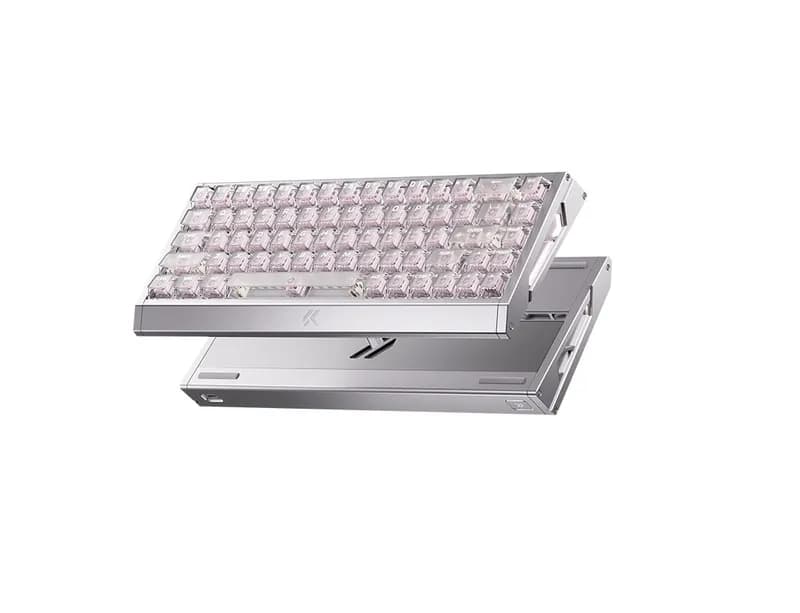
The MCHOSE Ace 68 Turbo is a 65% Hall Effect gaming keyboard built around three main ideas: adjustable actuation, Rapid Trigger, and a full aluminum chassis. The Mount Tai GT version supports up to 16K polling, 0.1–3.4 mm adjustable actuation, and Rapid Trigger adjustment down to 0.001 mm.
The most important thing to understand is that 16K polling is not the main reason to buy this keyboard. Going from 8K to 16K reduces the theoretical polling interval from 0.125 ms to 0.0625 ms, a difference that is extremely difficult to notice in real-world gaming. Independent reviews have similarly found little practical difference between the two modes.
What makes the Ace 68 Turbo interesting is the combination of Hall Effect gaming features, a solid CNC aluminum body, a compact 65% layout, and a price of around $139 in the U.S.
For competitive FPS players, that combination is considerably more meaningful than the 16K number on the box.
What Is the MCHOSE Ace 68 Turbo?
The Ace 68 Turbo is a 65% / 68-key wired Hall Effect gaming keyboard designed primarily for competitive gaming.
It keeps dedicated arrow keys while removing the function row and several navigation keys. This gives players more room for mouse movement without going all the way down to a compact 60% layout.
The Mount Tai GT version reviewed by major outlets uses a full aluminum chassis, Cherry-profile keycaps, RGB lighting, onboard profiles, USB-C wired connectivity, and Hall Effect magnetic switches. The keyboard weighs approximately 1.36 kg and measures 324 × 119 × 38 mm.
Feature | MCHOSE Ace 68 Turbo |
|---|---|
Layout | 65% / 68 keys |
Switch | Mount Tai GT Hall Effect |
Connection | Wired USB-C |
Polling rate | Up to 16KHz |
Actuation | 0.1–3.4 mm |
Rapid Trigger | Up to 0.001 mm adjustment |
Case | CNC aluminum |
Weight | About 1.36 kg |
RGB | Yes |
Software | MCHOSE Hub / Web Driver |
U.S. price | Around $139 |
MCHOSE also sells other Ace 68 variants, so buyers should check the exact switch and hardware configuration before ordering.
Typing Feel: Smooth and More Refined Than Expected
The Mount Tai GT Hall Effect switches are one of the strongest parts of the keyboard.
Because Hall Effect switches detect key movement magnetically rather than through traditional mechanical contacts, they can provide both smooth linear movement and software-adjustable actuation.
PC Gamer described the switches as extremely smooth, with no obvious roughness or bump around the actuation point.
This is important because the Ace 68 Turbo is not purely a competitive gaming tool. It can also be used for everyday typing.
However, there is a distinction between being good for typing and being optimized for typing.
Rapid Trigger keyboards are designed around fast input rather than traditional typing comfort. PC Gamer specifically found the board better suited to quick reactions than extensive writing.
The 65% layout can also create some adjustment for users who frequently use function keys or navigation keys.
For everyday typing, the switches are smooth enough. For serious productivity work, however, a 75% or TKL keyboard may be more convenient.
Gaming Performance: Rapid Trigger Matters More Than 16K
The Ace 68 Turbo is most convincing when used for FPS gaming.
The Hall Effect switches allow the actuation point to be adjusted, while Rapid Trigger can respond to changes in key position without requiring the key to travel back to a traditional reset point.
This is particularly useful for movement keys in games such as Counter-Strike 2 and VALORANT.
You can configure WASD differently from other keys and create separate Rapid Trigger profiles. The keyboard also includes a dedicated physical button for switching RT profiles, which is a surprisingly useful feature during actual use.
For example, you could have one configuration optimized for aggressive FPS movement and another with less sensitive settings for general gaming or typing.
This is where the Ace 68 Turbo's Hall Effect hardware provides a meaningful advantage over a conventional mechanical keyboard.
Does 16K Polling Actually Matter?
This is the most important question surrounding the Ace 68 Turbo.
At 8K polling, the keyboard reports input every:
0.125 ms
At 16K:
0.0625 ms
The theoretical improvement is therefore only:
0.0625 ms
That is an extremely small difference.
XSReviews tested the keyboard extensively and reported no noticeable gaming improvement when moving from lower polling rates to 16K. The reviewer actually used 2KHz for much of the testing because it was already more than fast enough for gaming.
DeskForged reached a similar conclusion after comparing the keyboard with an 8K Wooting board in CS2 and VALORANT.
So the conclusion is straightforward:
Buy the Ace 68 Turbo for Hall Effect switches and Rapid Trigger. Don't buy it specifically for 16K polling.
The 16K specification is impressive engineering, but its practical gaming benefit is much smaller than the marketing number suggests.
Sound and Acoustics
The Ace 68 Turbo is not designed to be a silent office keyboard.
It uses multiple layers of internal damping to control resonance, and third-party reviews generally describe its sound as relatively dense and controlled for an aluminum gaming keyboard.
The full aluminum chassis also gives the keyboard a heavier acoustic character than a typical plastic gaming board.
The result is a more substantial typing sound rather than a thin or hollow sound.
However, users who work in quiet offices should still consider the noise level. This is a mechanical gaming keyboard, not a silent productivity keyboard.
Build Quality: One of Its Biggest Advantages
The full aluminum chassis may actually be more important than the 16K polling rate.
At around 1.36 kg, the Ace 68 Turbo is a very substantial 65% keyboard.
The CNC aluminum construction gives it a solid feel and helps prevent the board from moving around during intense gaming sessions.
This also changes how the keyboard feels compared with lightweight plastic gaming keyboards. It feels more like an enthusiast mechanical keyboard than a conventional mass-market gaming peripheral.
The downside is obvious:
It is heavy.
This is a keyboard designed to stay on your desk. If you regularly carry your keyboard between home, school, work, and gaming setups, the 1.3 kg-plus weight becomes a genuine disadvantage.
Software and Customization
The MCHOSE software provides a fairly complete set of Hall Effect controls.
Depending on the configuration, users can adjust:
Actuation distance
Rapid Trigger
RT sensitivity
SOCD
DKS
Macros
RGB
Polling rate
Onboard profiles
The keyboard can also store multiple configurations, allowing users to switch between different setups without constantly changing settings.
The web-based interface is actually one of the better aspects of the software experience once everything is installed.
The problem is the initial setup.
Several reviews have noted that firmware updates, drivers, and setup instructions can be more complicated than those from established Western competitors. PC Gamer specifically criticized the complexity of the setup and the need for translation in some parts of the documentation.
This is an area where MCHOSE still has room to improve.
Connectivity: The Biggest Limitation
The Ace 68 Turbo is wired only.
There is no Bluetooth and no 2.4GHz wireless mode.
For a dedicated gaming PC, this is not necessarily a problem. In fact, wired connectivity eliminates another potential source of wireless latency.
But for users who switch between a desktop, laptop, tablet, and other devices, wireless connectivity is considerably more convenient.
MCHOSE does offer other keyboards with wireless functionality, but the Turbo is clearly designed around maximum wired performance.
So this is not a hidden weakness. It is simply an intentional trade-off.
Who Is the Ace 68 Turbo For?
Best For
FPS players
This is the most obvious target audience. Rapid Trigger and adjustable actuation are genuinely useful for competitive movement.
Competitive gamers
Players who enjoy tuning input settings and creating different profiles will get much more from this keyboard than casual users.
Users who want a premium aluminum keyboard
The full CNC aluminum chassis gives the Ace 68 Turbo a much more substantial feel than typical gaming keyboards.
Small-desk setups
The 65% layout provides dedicated arrow keys while leaving more room for a mouse.
Hall Effect enthusiasts
If you specifically want adjustable actuation, Rapid Trigger, SOCD, and other analog-keyboard features, the Ace 68 Turbo offers a lot of functionality for its price.
Who Should Skip It?
Users Who Need Wireless
If Bluetooth or 2.4GHz is a requirement, the Turbo is immediately the wrong configuration.
Heavy Productivity Users
Programmers, writers, and office users who frequently rely on function keys and navigation keys may prefer a 75% or TKL layout.
Users Who Don't Need Rapid Trigger
If you mostly play RPGs, strategy games, casual games, or simply type documents, much of the Ace 68 Turbo's advanced hardware will have limited practical value.
People Who Travel With Their Keyboard
The approximately 1.36 kg weight makes this a desk-focused keyboard rather than a portable one.
MCHOSE Ace 68 Turbo vs. Other Keyboards
The biggest mistake when comparing the Ace 68 Turbo with competing gaming keyboards is to focus entirely on polling rate.
Instead, compare:
Feature | Importance |
|---|---|
Hall Effect switches | ★★★★★ |
Rapid Trigger | ★★★★★ |
Adjustable actuation | ★★★★★ |
Actual street price | ★★★★★ |
Layout | ★★★★☆ |
Software | ★★★★☆ |
Build quality | ★★★★☆ |
Wireless connectivity | ★★★★☆ |
Switch feel | ★★★★☆ |
Polling rate | ★★☆☆☆ |
RGB | ★★☆☆☆ |
At around $139, the Ace 68 Turbo's main proposition is premium physical construction combined with advanced Hall Effect gaming features.
That's more meaningful than simply saying it has twice the polling rate of an 8K keyboard.
For example, Wooting has a more mature software ecosystem, while the Ace 68 Turbo puts more emphasis on hardware value and aluminum construction. Mainstream gaming brands may also offer stronger wireless ecosystems or broader software integration.
The right comparison therefore depends on whether you prioritize Rapid Trigger, build quality, software maturity, wireless connectivity, or layout.
Pros and Cons
Pros
Full CNC aluminum chassis
Smooth Mount Tai GT Hall Effect switches
Adjustable actuation
Highly configurable Rapid Trigger
65% layout with dedicated arrow keys
Physical RT profile button
Extensive gaming customization
Strong hardware value around $139
Good acoustic performance for an aluminum gaming keyboard
Cons
No Bluetooth or 2.4GHz wireless
16K polling provides very limited practical benefit over 8K
Initial software and firmware setup can be complicated
Heavy at roughly 1.36 kg
65% layout may not suit productivity-heavy users
Advanced features can be unnecessary for casual gamers
MCHOSE Ace 68 Turbo Rating
Category | Score |
|---|---|
Build Quality | 4.7/5 |
Typing Feel | 4.4/5 |
Gaming Performance | 4.8/5 |
Sound | 4.2/5 |
Software | 4.0/5 |
Connectivity | 3.5/5 |
Customization | 4.5/5 |
Value | 4.5/5 |
Overall | 4.4/5 |
The overall score reflects the keyboard as a complete product rather than its 16K specification alone. Its strongest areas are gaming performance, build quality, and Hall Effect customization. Its biggest deductions come from wired-only connectivity and software/setup maturity.
Is the MCHOSE Ace 68 Turbo Worth Buying?
At around $139 in the U.S., the MCHOSE Ace 68 Turbo makes a strong case for itself if you specifically want a 65% Hall Effect gaming keyboard with a full aluminum body and Rapid Trigger. Independent reviews have generally agreed that the hardware itself is impressive for the price.
The important qualification is that the 16K polling rate should not be treated as the main reason to buy it.
The difference between 8K and 16K is tiny in practical terms. Rapid Trigger, adjustable actuation, switch feel, layout, and build quality are much more important.
For an FPS-focused player who wants a compact aluminum keyboard and enjoys tuning magnetic-switch settings, the Ace 68 Turbo offers a compelling package at its U.S. price.
For someone who simply wants a comfortable everyday keyboard, wireless connectivity, or a more productivity-friendly layout, its specialized gaming features are less valuable.
In short: the Ace 68 Turbo is a good Hall Effect gaming keyboard that happens to have 16K polling—not a keyboard that becomes good because it has 16K polling.
FAQ
Is the MCHOSE Ace 68 Turbo worth buying?
At around $139, it is worth considering if you want a full-aluminum 65% Hall Effect keyboard with Rapid Trigger. Its value is much less compelling if you do not need magnetic-switch gaming features.
Is the Ace 68 Turbo good for FPS games?
Yes. Adjustable actuation and Rapid Trigger are particularly relevant to games such as CS2 and VALORANT, where fast movement and repeated inputs matter.
Does 16K polling make a noticeable difference?
Probably not for most players. The theoretical difference between 8K and 16K is only 0.0625 ms, and independent testing has found little or no perceptible gaming benefit.
Is the Ace 68 Turbo good for typing?
The magnetic switches are smooth and capable of handling everyday typing, but the keyboard is primarily designed around gaming. Users who do extensive writing or productivity work may prefer a larger layout.
Does the Ace 68 Turbo support wireless?
No. The Turbo version uses wired USB-C connectivity and does not offer Bluetooth or 2.4GHz wireless.
What is the biggest disadvantage of the Ace 68 Turbo?
The biggest practical limitations are its wired-only design, relatively heavy weight, and more complicated software setup compared with mature ecosystems such as Wooting.
Who should buy the Ace 68 Turbo?
It is best suited to FPS players, competitive gamers, and Hall Effect keyboard enthusiasts who want Rapid Trigger, adjustable actuation, a compact 65% layout, and a premium aluminum chassis.