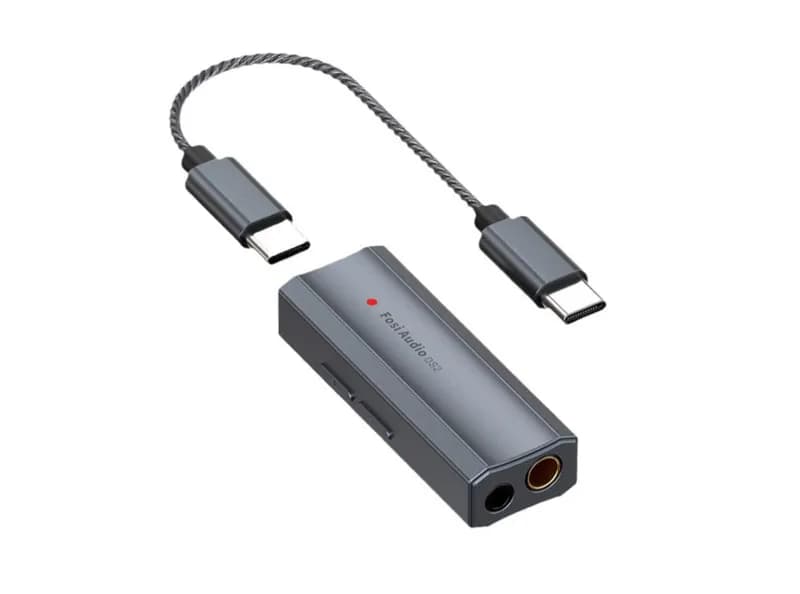
Detailed Review
The Fosi Audio DS2 is a small USB DAC/headphone amplifier designed for users who want substantially more output capability than a typical phone dongle without carrying a separate desktop amplifier. The current version uses dual Cirrus Logic CS43131 DAC chips, supports PCM up to 32-bit/384kHz and DSD256, and provides both 3.5mm single-ended and 4.4mm balanced outputs. Fosi rates it for up to 130mW at 32Ω from the 3.5mm output and up to 510mW at 32Ω from the balanced output, depending on the specification/version being referenced.
The DS2's biggest strength is therefore not simply its DAC chip. It is the combination of compact size, physical volume controls, dual outputs and unusually strong balanced output capability for its class. With efficient IEMs, the 3.5mm output is already more than sufficient; the 4.4mm connection becomes more interesting when using planar IEMs or less sensitive full-size headphones.
Its main compromises are equally practical. It draws power from the phone or computer, can become warm during operation, and does not offer the display, extensive menu system or software controls found on some more expensive dongles. Fosi itself notes that temperature increases during use are normal and that actual power consumption depends on the connected device and operating conditions.
Overall rating: 4.4/5
For users who primarily use IEMs, the DS2's extra power is not necessarily a reason to upgrade by itself. But if you want a compact dongle that can also handle more demanding headphones, has both 3.5mm and 4.4mm outputs, and offers physical volume buttons, the DS2 remains a particularly practical design.
Fosi Audio DS2 Specifications
Specification | Fosi Audio DS2 |
|---|---|
DAC | Dual CS43131 |
PCM | Up to 32-bit/384kHz |
DSD | Up to DSD256 |
3.5mm output | Single-ended |
4.4mm output | Balanced |
Output power | Up to 128/130mW @ 32Ω SE; up to 510mW @ 32Ω BAL, depending on specification |
SNR | Up to 130dB |
THD+N | Up to 0.0002% in current Fosi documentation |
Output impedance | Very low; third-party measurement reports around 0.65Ω on SE |
USB | USB-C |
Supported systems | Android, iOS, Windows, macOS |
Weight | About 15g |
Headphone impedance | Fosi recommends 16–300Ω |
Price | Around $59.99 official price |
Fosi's current product documentation identifies the DS2 as a dual-CS43131 design supporting 32-bit/384kHz PCM and DSD256. The official product page currently lists the DS2 at $59.99.
There is an important specification caveat: older DS2 documentation refers to dual ESS ES9018K2M chips, with lower published output figures and support extending to DSD512. That is a different hardware version and should not be mixed with the current CS43131 model when comparing products.
What Actually Matters With the DS2?
The DAC Chip Is Not the Whole Story
The current DS2 uses two CS43131 chips, but the chip itself does not determine the complete sound of a dongle DAC.
The analogue output stage, amplifier implementation, power supply, output impedance and gain structure all influence the final result. This is why comparing dongles solely by DAC model can be misleading.
The more interesting part of the DS2 is how Fosi combines the DAC section with a relatively powerful headphone amplifier in a device weighing only around 15g.
For a typical IEM, the DS2 does not need anywhere near its maximum output. What the extra headroom provides is flexibility: the same device can move from sensitive IEMs to more demanding headphones without immediately running out of voltage or current.
How Much Power Does the Fosi Audio DS2 Really Have?
This is one of the DS2's strongest selling points, but it needs some context.
Fosi's current documentation specifies approximately 128mW at 32Ω through the single-ended output and 510mW at 32Ω through balanced output for the current version, while other documentation and reviews have reported somewhat different figures depending on the measurement or version.
That distinction matters.
A sensitive 16–32Ω IEM may already reach very high listening levels from the 3.5mm output. Using the 4.4mm output does not automatically make the sound better simply because its power rating is higher.
The additional power becomes more useful with:
planar IEMs
inefficient headphones
higher-volume listening
headphones requiring greater current delivery
users who want more dynamic headroom
Third-party measurements also indicate that the DS2's low output impedance is suitable for low-impedance IEMs. One Reference Audio Analyzer report measured approximately 0.65Ω from the single-ended output.
So the practical conclusion is straightforward:
The DS2 has far more output capability than most users need for ordinary IEMs, but that reserve makes it unusually versatile for a small dongle.
Does the DS2 Have Enough Power for Your Headphones?
High-Sensitivity IEMs
For sensitive IEMs, power is rarely the limiting factor.
The more important questions are background noise and volume control.
The DS2's low output impedance is useful for multi-driver IEMs because it reduces the likelihood that the source will significantly alter the earphone's frequency response.
With extremely sensitive IEMs, however, having a lot of amplifier power is not inherently beneficial. The volume range and noise floor matter more.
Low-Impedance IEMs
This is an easy workload for the DS2.
The combination of low output impedance and substantial available power makes it a good match for conventional dynamic and hybrid IEMs.
In many cases, the 3.5mm output is already enough. The 4.4mm output is better viewed as additional flexibility rather than something every IEM owner needs.
Planar IEMs
This is where the DS2 becomes more interesting.
Some planar IEMs have relatively low impedance but demand more current than their impedance number might suggest. A dongle with a stronger amplifier stage can therefore provide greater headroom.
The DS2 has been reported to handle demanding planar IEMs successfully through its balanced output, although actual results still depend on the particular headphone's sensitivity.
High-Impedance Headphones
The DS2 can work with headphones in Fosi's stated 16–300Ω range, but impedance alone is not enough to determine whether a headphone will be properly driven. Sensitivity and required voltage also matter.
A 300Ω headphone with relatively high sensitivity can be much easier to drive than a low-impedance planar headphone with poor sensitivity.
So I would not describe the DS2 as a replacement for a powerful desktop amplifier. It is better understood as a very capable portable DAC/amp that can cover a surprisingly broad range of headphones.
Fosi Audio DS2 Sound Quality
The DS2 is generally better described as clean, neutral to slightly warm and relatively controlled rather than strongly colored.
That is important because some dongle DACs deliberately introduce a noticeable tonal character. The DS2 tends to stay closer to the character of the connected headphone.
Independent reviews have similarly described the current/earlier DS2 family as neutral with a mild warmth, with controlled bass and good overall dynamics.
Bass
Bass is not excessively boosted.
The DS2 tends to deliver a controlled low end with enough weight to avoid sounding thin. Kick drums have reasonable impact, while sub-bass can retain its rumble when the recording and headphones provide it.
The stronger balanced output can also give demanding headphones more headroom, which can indirectly improve the sense of bass control.
However, it would be misleading to say that the DS2 fundamentally transforms the bass response of every headphone. Your IEM's own tuning remains much more important.
Midrange
The midrange is relatively clean and straightforward.
Vocals do not appear artificially pushed forward, and instruments retain reasonable separation without the presentation becoming overly clinical.
This makes the DS2 easy to pair with a wide range of IEMs.
If your headphones are already bright or extremely analytical, the DS2 is unlikely to dramatically soften them. Likewise, if your IEM is heavily warm, the DS2 will not suddenly turn it into a neutral monitor.
That relative neutrality is one of its strengths.
Treble
The treble presentation is generally clean and extended without an obvious artificial emphasis.
The DS2 can reveal fine details reasonably well, but it does not rely on exaggerated upper treble to create the impression of high resolution.
That is important for long listening sessions. A dongle that simply increases upper-frequency energy can initially sound more detailed while becoming fatiguing later.
The DS2's presentation is more restrained.
Soundstage and Separation
The DS2 provides good channel separation and positional information for a device in this class.
However, expectations should remain realistic.
A dongle DAC cannot magically turn a closed-back headphone into a large open soundstage. Headphone design, recording and mastering remain dominant factors.
What the DS2 does well is maintain a clean presentation when the music becomes busy.
Is the Fosi Audio DS2 Good for Music?
Yes, particularly if you prefer a relatively neutral presentation.
It works well with:
rock
pop
electronic music
acoustic recordings
vocals
classical
jazz
game soundtracks
The DS2 does not impose such a strong signature that it becomes specialized for one genre.
Its main advantage is versatility rather than a distinctive “house sound.”
Phone and Computer Compatibility
The DS2 uses USB-C and supports Android, iOS, Windows and macOS according to Fosi's documentation.
Android
Android phones are generally straightforward, although some devices may require OTG to be enabled. Fosi also notes that exclusive USB audio modes can introduce compatibility or volume-control issues on certain phones and apps.
iPhone and iPad
USB-C iPhones and iPads can connect directly using an appropriate USB-C cable.
Lightning devices require a Lightning-to-USB-C OTG connection, and Fosi notes that this cable may not be included.
Windows and macOS
The DS2 is designed for plug-and-play USB audio operation. For ordinary music playback, it does not require the kind of complicated setup associated with some desktop DAC systems.
Power Consumption and Heat
This is one area where expectations need to be realistic.
The DS2 has no internal battery. It draws power from the connected phone, tablet or computer.
That means battery consumption will vary according to:
output level
connected headphone
playback format
phone hardware
operating system
amplifier operating mode
Fosi also states that the DS2 normally becomes warm during operation, with its FAQ describing a temperature rise of around 15°C as normal.
So the DS2 is not the ideal choice if your highest priority is minimizing smartphone battery consumption.
Build Quality and Portability
At roughly 15g, the DS2 is genuinely pocket-friendly.
The compact metal body feels more like a miniature piece of audio equipment than a generic USB adapter.
The layout is practical:
USB-C input
3.5mm output
4.4mm balanced output
physical volume buttons
status LED
The physical buttons are particularly useful for phone users. You do not have to unlock the phone every time you want to make a small volume adjustment.
The absence of a screen is not necessarily a disadvantage. A screen would make the unit more informative, but it would also add complexity and potentially power consumption.
Fosi Audio DS2 for Gaming and Movies
The DS2 can work well for gaming because of its clean output, channel separation and ability to provide enough volume and headroom for many headphones.
For competitive FPS games, however, it is important not to exaggerate the effect.
The DS2 does not automatically create better positional audio. The headphone, game mix and software settings remain more important.
For movies and streaming, its neutral presentation works well because dialogue remains clear without imposing a strong tonal coloration.
Fosi Audio DS2 Pros and Cons
Pros
Very compact and lightweight
3.5mm and 4.4mm outputs
Strong balanced output capability
Low output impedance
Physical volume buttons
Dual CS43131 DAC configuration
PCM 384kHz and DSD256 support
Broad Android, iOS, Windows and macOS compatibility
Competitive price
Cons
Draws power from the connected device
Gets warm during use
High output power is unnecessary for many sensitive IEMs
No display
No sophisticated onboard menu system
Current and older DS2 versions have significantly different specifications, which can cause confusion when shopping
Fosi Audio DS2 vs Other Dongle DACs
Model | DAC | 3.5mm | 4.4mm | Approx. Output | Main Character |
|---|---|---|---|---|---|
Fosi Audio DS2 | Dual CS43131 | ✓ | ✓ | Up to 510mW @ 32Ω BAL* | Neutral / slightly warm |
FiiO KA13 | Dual CS43131 | ✓ | ✓ | Up to 550mW+550mW @ 32Ω BAL* | Powerful, feature-rich |
Shanling UA4 | ES9069Q | ✓ | ✓ | Up to 211mW @ 32Ω | Clean, controlled |
iFi GO link Max | Dual ES9219 | ✓ | ✓ | 241mW @ 32Ω BAL | Dynamic / feature-oriented |
*Output figures are manufacturer specifications under stated conditions and should not be treated as directly interchangeable measurements.
The FiiO KA13 is particularly relevant because it also uses dual CS43131 DACs and provides both 3.5mm and 4.4mm outputs. Its desktop mode is designed to push output substantially higher, with FiiO specifying up to 550mW+550mW at 32Ω through balanced output.
The Shanling UA4 takes a different approach, combining an ES9069Q DAC, hardware controls and a small display with a maximum specified balanced output of 211mW at 32Ω. It is therefore particularly interesting for users who care about on-device controls and information display.
The iFi GO link Max emphasizes a compact dual-ESS architecture, 4.4mm balanced output and hardware-based volume control. Its published output is 241mW at 32Ω balanced and 100mW at 32Ω through 3.5mm.
Rather than asking which one is universally better, the more useful question is what you actually need. The DS2 makes the most sense when power, simplicity, physical volume controls and compact size are more important than having a display or extensive software features.
Who Should Buy the Fosi Audio DS2?
The DS2 is a good fit for:
IEM users who want both 3.5mm and 4.4mm
Users upgrading from a basic phone adapter
Listeners using planar IEMs
Portable headphone users
People who want physical volume buttons
Users who want a compact DAC/amp rather than a desktop setup
Listeners looking for strong output without moving to a larger portable amplifier
It makes less sense for:
Users who only use extremely sensitive IEMs and do not need extra output
People who prioritize minimum smartphone battery consumption
Owners of a good desktop DAC/amp who rarely listen away from a desk
Users who specifically want a display and extensive onboard controls
Headphone owners who require a genuinely powerful desktop amplifier
Fosi Audio DS2 Rating
Category | Rating |
|---|---|
Sound quality | 4.5/5 |
Output power | 4.8/5 |
IEM compatibility | 4.5/5 |
Headphone driving ability | 4.4/5 |
Build quality | 4.4/5 |
Portability | 4.8/5 |
Features | 4.1/5 |
Power efficiency | 3.8/5 |
Value | 4.6/5 |
Overall | 4.4/5 |
Fosi Audio DS2: Is It Worth Buying?
Yes, if you need a compact DAC/amp with more power and flexibility than a basic USB dongle.
The DS2's strongest argument is not that its CS43131 DAC is inherently superior to every competing chip. Its appeal comes from the complete package: small size, low output impedance, physical controls, dual headphone outputs and substantial balanced output capability.
If you mainly use efficient IEMs, you may not hear a dramatic improvement simply because the DS2 has more power. In that situation, a cheaper dongle can already provide sufficient volume.
But if you regularly switch between IEMs, planar IEMs and full-size headphones, the DS2's extra headroom becomes much more useful.
It is also worth checking which DS2 version you are buying. The older ES9018K2M model and current CS43131 model have substantially different specifications, so product listings that simply say “DS2” should not automatically be treated as identical.
At around $59.99, the current DS2 occupies a competitive part of the dongle-DAC market.
Bottom line: the Fosi Audio DS2 is best viewed as a powerful, uncomplicated and highly portable DAC/amp, rather than a feature-heavy audiophile gadget. Its biggest advantage is versatility: it can remain useful even after you move beyond basic IEMs.
FAQ
Is the Fosi Audio DS2 worth buying?
For users who want strong output, 3.5mm and 4.4mm connections, physical volume buttons and a compact design, it offers a compelling feature set at its current official price.
How does the Fosi Audio DS2 sound?
The current DS2 is best described as clean and relatively neutral, with a slight warmth reported in listening impressions rather than an aggressively colored presentation.
Is the DS2 powerful enough?
For most IEMs, yes, and it has substantial additional headroom through its balanced output. Actual headphone compatibility still depends on sensitivity as well as impedance.
Does the DS2 have background hiss?
Its low output impedance and low-noise design make it suitable for many sensitive IEMs, but hiss perception can vary significantly between extremely sensitive earphones and individual units.
Does the DS2 get hot?
It can become warm during operation. Fosi states that temperature rise during use is normal.
Can the DS2 work with a phone?
Yes. Fosi lists Android and iOS among its supported platforms, although some Android devices may require OTG activation and Lightning devices require an appropriate OTG connection.
Do I need the 4.4mm balanced output?
Not necessarily. Efficient IEMs generally do not require it. Its main practical advantage is additional output capability for harder-to-drive headphones and compatible IEMs.
Is the Fosi Audio DS2 suitable for beginners?
Yes. Its operation is relatively straightforward, and the physical volume buttons make it easy to use with a phone or computer. The main thing beginners should understand is that more output power does not automatically mean better sound.