Detailed Review
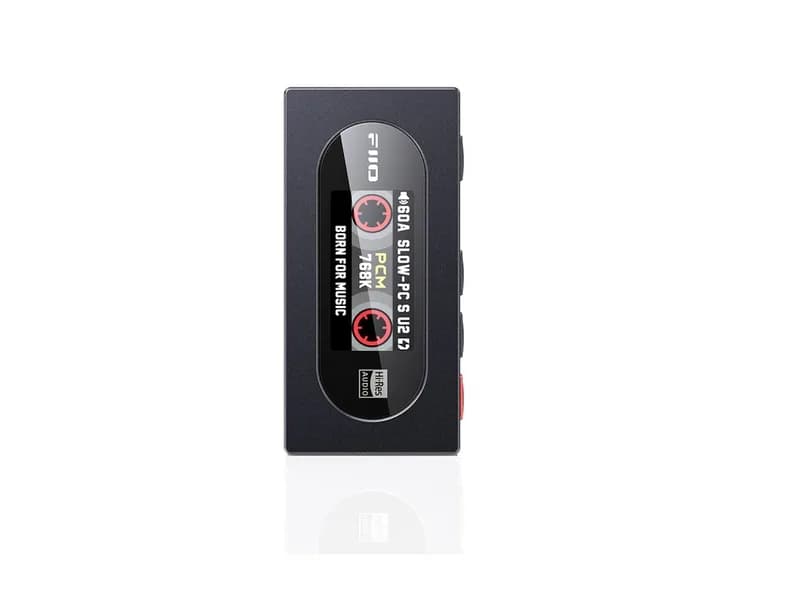
The FiiO KA15 is a feature-rich USB DAC dongle designed for listeners who want considerably more than a basic phone-to-headphone adapter. It combines dual CS43198 DAC chips, dual SGM8262 amplifiers, 3.5mm single-ended and 4.4mm balanced outputs, a color display, physical controls, PEQ support, and a high-power desktop mode in a compact 21g body.
Its biggest strength is not simply the choice of DAC chip. The more important advantage is the combination of output power, connectivity, software control, and portability. FiiO rates the KA15's desktop mode at up to 560mW + 560mW into 32Ω through the 4.4mm balanced output, giving it substantially more headroom than many basic dongle DACs.
The KA15 is particularly attractive for IEM users who also want the flexibility to drive portable headphones or moderately demanding full-size headphones. However, users with extremely easy-to-drive IEMs may never need its maximum power, while those who prioritize the smallest possible size or the lowest possible smartphone power consumption may prefer a simpler dongle.
Overall Rating: 4.5/5
FiiO KA15 Specifications
Specification | FiiO KA15 |
|---|---|
DAC | 2 × Cirrus Logic CS43198 |
Amplifier | 2 × SGM8262 |
USB Controller | SPV5048Pro |
PCM | Up to 768kHz / 32-bit |
DSD | Up to DSD256 |
3.5mm | Single-ended / S/PDIF |
4.4mm | Balanced |
3.5mm Output | Up to 180mW + 180mW @ 32Ω in desktop mode |
4.4mm Output | Up to 560mW + 560mW @ 32Ω in desktop mode |
Output Impedance | <0.8Ω / <1.2Ω |
Display | 0.96-inch LCD |
Connection | USB Type-C |
Weight | Approx. 21g |
Dimensions | Approx. 52 × 25 × 11mm |
Output figures depend on the output, operating mode, load and test conditions, so maximum rated power should not be interpreted as the power available in every real-world situation.
What Really Matters About the KA15?
Does the dual-CS43198 design guarantee better sound?
No. The use of two CS43198 DAC chips is an important part of the KA15's hardware design, but the DAC chip alone does not determine sound quality.
The analog output stage, amplifier section, power supply, output impedance, gain structure and tuning all contribute to the final result. This is why simply comparing DAC chip numbers can be misleading.
The KA15's more meaningful advantage is that FiiO has built a complete DAC and headphone amplifier around those chips, rather than treating the DAC section as the entire product.
Is the KA15's 560mW output actually useful?
This is one of the KA15's most important specifications, but it needs some context.
The 4.4mm balanced output can reach 560mW + 560mW at 32Ω in desktop mode, while the 3.5mm output is rated at 180mW + 180mW at the same load.
That does not mean every headphone needs this amount of power.
There is a major difference between:
Producing sound
Reaching a sufficient volume
Providing enough electrical headroom for demanding headphones
Most sensitive IEMs need very little power. For them, the KA15's high output is mostly reserve capacity.
The advantage becomes more obvious with less sensitive IEMs, planar headphones and some portable full-size headphones.
For higher-impedance headphones, the situation is different. FiiO rates the 4.4mm output at 78mW + 78mW into 300Ω, so buyers should consider headphone sensitivity and voltage requirements rather than looking only at the 32Ω number.
How Does the FiiO KA15 Sound?
The KA15 has a generally clean, controlled and detailed presentation rather than an obviously warm or heavily colored sound.
That description should not be treated as an absolute characteristic of every headphone pairing. The connected IEM or headphone remains a major part of the final sound.
Bass
Bass reproduction is more about control and definition than added quantity.
Kick drums and bass lines tend to have clear outlines, while complex passages remain relatively well organized. The KA15 does not appear designed to artificially inflate bass quantity.
This makes it a useful pairing for headphones that already have sufficient low-end energy but could benefit from additional control.
With a naturally warm or bass-heavy IEM, the KA15 can also make the overall presentation feel somewhat cleaner and more structured.
Midrange
The midrange is relatively clear without pushing vocals aggressively forward.
Male and female vocals retain good definition, while acoustic instruments maintain reasonable texture. The KA15 is therefore fairly versatile with pop, vocals, rock, electronic music and acoustic recordings.
Its character comes more from overall control and clarity than from a strong tonal coloration.
Treble
Treble extension and detail retrieval are among the KA15's stronger qualities.
However, pairing matters. With an already bright and highly energetic IEM, the KA15 may emphasize perceived clarity and upper-frequency texture enough to become less forgiving for treble-sensitive listeners.
With darker or softer-sounding earphones, that additional clarity can be useful.
Soundstage, Imaging and Separation
The KA15 provides good separation and positional definition, particularly when paired with a capable IEM or headphone.
Its high output capability can also provide additional headroom with more demanding headphones, although it would be incorrect to assume that higher amplifier power automatically creates a larger soundstage.
Power primarily affects the amplifier's ability to control and drive the headphone. Soundstage remains heavily dependent on the transducer itself and the recording.
What Headphones Pair Well with the KA15?
High-Sensitivity IEMs
The KA15 works well with sensitive IEMs, but its maximum output capability is unnecessary for many of them.
For extremely sensitive IEMs, noise floor and usable volume control are more important than raw power.
This is one area where a simpler, lower-powered dongle can make more sense if the additional KA15 features are not important to you.
Low-Impedance IEMs
The KA15's low output impedance is useful with low-impedance IEMs, particularly multi-driver designs.
FiiO specifies output impedance below 0.8Ω for the 3.5mm output and below 1.2Ω for the 4.4mm output. Low output impedance helps minimize frequency-response changes caused by electrical interaction between the amplifier and the earphone.
Planar Headphones
Planar headphones are a more interesting use case for the KA15.
Some planar designs require considerably more power than typical IEMs, and the KA15's balanced output gives it much more headroom than a basic dongle.
However, compatibility still depends on the specific headphone's sensitivity and impedance.
High-Impedance Headphones
The KA15 can handle some high-impedance headphones, but it should not be considered a universal replacement for a desktop amplifier.
The relevant question is not simply whether a headphone has a 250Ω or 300Ω impedance rating. Sensitivity and the required voltage level also matter.
For difficult-to-drive full-size headphones, a dedicated desktop DAC/amp can still be the more appropriate solution.
Is the FiiO KA15 Good for Phones and Computers?
Android
Android phones are one of the KA15's most natural use cases.
It operates as a USB audio device, while FiiO's software provides additional control over supported settings.
For mobile listeners, the biggest benefit is not merely "better sound." The KA15 effectively turns a USB-C phone into a more capable wired headphone source.
iPhone and iPad
USB-C devices are particularly convenient because the KA15 itself uses USB Type-C.
Compatibility still depends on the specific Apple device and operating environment. Users with older connector types need to consider the appropriate adapter and potential power limitations.
Windows
The KA15 can function as a USB DAC/headphone amplifier on Windows.
For normal music playback, it can serve as an external audio device without requiring a separate desktop DAC.
More specialized software may involve additional considerations around WASAPI, ASIO and application-specific output settings.
macOS
The KA15 can also be used as a USB audio device with macOS. Users can select it as the system output and adjust supported sample-rate settings through the operating system.
Power Consumption and Heat
High output power always has a trade-off in a compact USB-powered device.
The KA15 does not need to operate at maximum output when driving an efficient IEM. Using a sensitive IEM at moderate volume requires far less power than driving a demanding headphone through the 4.4mm output.
This means the practical approach is simple:
For sensitive IEMs: use normal operation and avoid unnecessary high-power modes.
For demanding headphones: the higher-power desktop mode can provide useful additional headroom, but increased power consumption and heat are part of the trade-off.
The KA15's compact size does not eliminate the physical limitations of delivering high output power from a USB-powered device.
Portability and Build
At approximately 52 × 25 × 11mm and 21g, the KA15 remains highly portable.
It is slightly more substantial than the simplest dongle DACs, but the additional size is used for features such as:
0.96-inch color display
Physical controls
3.5mm output
4.4mm balanced output
High-power mode
Additional internal amplification
Software control
This makes the KA15 feel more like a compact DAC/headphone amplifier than a simple USB adapter.
For someone carrying a phone and IEM every day, the size remains reasonable. However, if the only priority is the smallest possible dongle, there are simpler alternatives.
Is the FiiO KA15 Good for Gaming?
Yes, but it is better viewed as a general-purpose audio device than a dedicated gaming DAC.
The KA15's clean output and good channel separation can help with positional information, footsteps and environmental sounds when paired with a capable gaming headset or IEM.
However, audio quality and gaming performance are not identical concepts.
The KA15 does not automatically make a headphone better at competitive FPS games. The headphone's imaging, the game's audio engine and the player's settings remain important.
Its real advantage is that it can comfortably serve both music and gaming without being designed exclusively around one use case.
FiiO KA15 Pros and Cons
Pros
Dual CS43198 DAC architecture
Strong 4.4mm balanced output
3.5mm and 4.4mm outputs
Up to 768kHz/32-bit PCM and DSD256
Desktop mode
Color LCD display
Physical controls
PEQ and software customization
Low output impedance
Only around 21g
Cons
High-power operation increases smartphone power consumption
Many sensitive IEMs will not need its maximum output
Bright IEMs may sound somewhat more energetic or sharp
Some of its advanced features may be unnecessary for basic users
It is not a universal replacement for a desktop amplifier with demanding high-impedance headphones
FiiO KA15 vs Other Dongle DACs
The KA15 competes with products such as the FiiO KA13, FiiO KA17, MOONDROP Dawn Pro and Questyle M15-series dongles.
Product | Positioning | 3.5mm | 4.4mm | Key Strength |
|---|---|---|---|---|
FiiO KA15 | Feature-rich portable DAC/amp | ✓ | ✓ | Display, PEQ, desktop mode |
FiiO KA13 | Compact high-power dongle | ✓ | ✓ | Strong output in a small body |
FiiO KA17 | Higher-end portable DAC/amp | ✓ | ✓ | Higher overall hardware capability |
MOONDROP Dawn Pro | Dual-output portable DAC | ✓ | ✓ | Compact Hi-Fi-focused design |
Questyle M15 series | Premium portable DAC | ✓ | ✓ | Current-mode amplification approach |
The KA15's main differentiator is not necessarily one specification that dominates every competitor. Instead, it combines power, features, controls, software and portability in a particularly complete package.
If you only need basic high-power output, a simpler dongle may be sufficient. If you want a screen, EQ, physical controls and strong 4.4mm output in the same device, the KA15 becomes considerably more interesting.
FiiO KA15 Rating
Category | Score | Assessment |
|---|---|---|
Sound Quality | 4.5/5 | Clean, detailed and controlled |
Driving Power | 4.8/5 | Excellent headroom from 4.4mm |
3.5mm Output | 4.3/5 | Plenty for most IEMs and portable headphones |
4.4mm Output | 4.9/5 | One of its strongest features |
Noise Performance | 4.4/5 | Strong specifications; pairing still matters |
Software | 4.7/5 | Extensive control and EQ options |
Portability | 4.5/5 | Small and light, though not the smallest |
Power Efficiency | 4.0/5 | High-power operation increases phone drain |
Build & Controls | 4.6/5 | Display and physical controls add practicality |
Value | 4.5/5 | Strong combination of features and output |
Overall | 4.5/5 | A highly capable all-round portable DAC |
These scores are editorial assessments based on the product's specifications, feature set, positioning and published third-party impressions rather than standardized laboratory scores.
Who Should Buy the FiiO KA15?
The KA15 makes sense for:
Smartphone users who primarily use IEMs
Listeners who want a 4.4mm balanced output
Users who want more amplifier headroom
People who switch between phones and computers
Users who enjoy EQ and audio customization
Listeners who want one DAC for both music and gaming
Buyers who want a portable alternative to a desktop DAC/amp
It may not be necessary for:
Users who only own extremely easy-to-drive IEMs
People who prioritize minimum smartphone battery consumption
Anyone who only needs basic wired headphone output
Users who already own a capable desktop DAC/amp
People whose main headphones genuinely require a full-size desktop amplifier
Is the FiiO KA15 Worth Buying?
The FiiO KA15 makes the most sense if you want a high-output, feature-rich USB DAC that remains genuinely portable.
Its appeal is not simply the dual CS43198 configuration. The more meaningful combination is dual DACs, dual amplifiers, 3.5mm and 4.4mm outputs, desktop mode, a display, physical controls, PEQ and substantial output headroom.
For an ordinary high-sensitivity IEM, much of that power will remain unused. But for listeners who want one compact device that can cover IEMs, portable headphones and some more demanding headphones, the additional headroom becomes much more useful.
In short, the FiiO KA15 is best suited to listeners who want one compact DAC/amp that can handle a wide range of portable headphones, rather than buyers who simply need the smallest possible way to connect wired earphones to a phone.
FiiO KA15 FAQ
Is the FiiO KA15 worth buying?
Yes, if you need strong output, 4.4mm balanced connectivity, EQ, a display and portable operation. If you only use very sensitive IEMs and do not need those features, a simpler dongle may be more practical.
How does the FiiO KA15 sound?
It has a generally clean, detailed and controlled presentation rather than an obviously warm tuning. The final result depends heavily on the connected headphone.
Does the FiiO KA15 have enough power?
For most IEMs and many portable headphones, yes. Its 4.4mm output provides substantial power headroom, although demanding high-impedance headphones should still be evaluated based on their sensitivity and voltage requirements.
Does the FiiO KA15 have background hiss?
Its low output impedance and published noise specifications make it suitable for many sensitive IEMs, but extremely sensitive earphones can reveal noise that other headphones will not. Actual pairing matters.
Does the FiiO KA15 get hot?
It can become warmer when operating at higher output levels, particularly in high-power desktop mode. This is a normal trade-off for a compact USB-powered amplifier delivering significantly more power.
Can the FiiO KA15 be used with a phone?
Yes. It is designed as a USB DAC and uses USB Type-C. Compatibility and power consumption can vary depending on the phone and operating system.
What headphones are best suited to the KA15?
It works particularly well with IEMs, portable headphones and headphones that benefit from additional amplifier headroom. Extremely demanding full-size headphones may still be better served by a dedicated desktop amplifier.
Do I need a 4.4mm balanced cable?
No. The 3.5mm output is already sufficient for many IEMs. A 4.4mm cable becomes more useful if you want the KA15's higher balanced output capability.
Is the FiiO KA15 good for beginners?
Yes, although it offers considerably more functionality than a basic dongle. Beginners who want a long-term portable DAC/amp can take advantage of its additional features, while users who only need a headphone adapter may be better served by a simpler model.
What is the biggest advantage of the KA15?
Its biggest advantage is the combination of high output power, 3.5mm and 4.4mm outputs, physical controls, display, EQ and compact size. It is designed to be a versatile portable DAC/amp rather than merely a USB-to-headphone adapter.