Detailed Review
The 7Hz Timeless II is a mid-range planar magnetic IEM designed for listeners who want the speed, resolution, and spacious presentation associated with planar drivers without giving up too much bass weight or everyday usability. Priced around $200–$230 depending on the market and current discounts, it sits in a highly competitive part of the IEM market. Its 14.5mm planar driver delivers fast transients, strong detail retrieval, good separation, and an expansive presentation, while the interchangeable tuning nozzles give users some control over the final tonal balance. Bass is fuller than the typical lean planar tuning, vocals are clean rather than especially warm, and the treble has plenty of extension and air. The main drawbacks are the relatively large circular shells and the possibility of noticeable treble energy for sensitive listeners. For listeners who enjoy rock, electronic music, jazz, classical recordings, gaming, and detailed modern IEM tuning, the Timeless II is an appealing option. Those who prioritize thick vocals, heavy bass, or very small shells may find better alternatives.
Positioning and Market
The Timeless II is the second-generation model in 7Hz's Timeless line. The original Timeless became one of the better-known early planar magnetic IEMs, and the Timeless II takes a more comprehensive approach to updating the formula rather than simply changing the driver.
The new model uses a 14.5mm planar magnetic driver and adds interchangeable tuning nozzles, a 0.78mm 2-pin connection, and a modular plug system supporting both 3.5mm and 4.4mm connections.
Its target market is roughly the $200–$250 segment, where it competes with products such as the Letshuoer S12 Pro, Hidizs MP145, Kiwi Ears Aether, and other modern planar IEMs.
The main question at this price is no longer whether a planar IEM can deliver high resolution. Several models can do that. The Timeless II instead tries to balance planar speed and technical performance with stronger bass, flexible tuning, and practical connectivity.
Key Specifications
Specification | 7Hz Timeless II |
|---|---|
Type | Wired in-ear monitor |
Driver | 14.5mm planar magnetic |
Driver count | Single |
Driver technology | Planar magnetic |
Impedance | 15.2Ω |
Sensitivity | 108dB/V @ 1kHz |
Frequency response | 5Hz–40kHz |
Connector | 0.78mm 2-pin |
Plug | 3.5mm / 4.4mm modular |
Cable | 4-core 7N single-crystal copper |
Shell | Metal |
Weight | Approximately 5g per side |
Microphone | No |
Price | Around $229 MSRP |
The low impedance and relatively high sensitivity mean the Timeless II is not difficult to drive in terms of volume. It does not require a powerful desktop amplifier simply to work properly.
As always, sensitivity specifications should be compared carefully because manufacturers may use different reference units. A 108dB/V specification should not be directly treated as equivalent to a sensitivity rating expressed in dB/mW.
Build Quality and Design
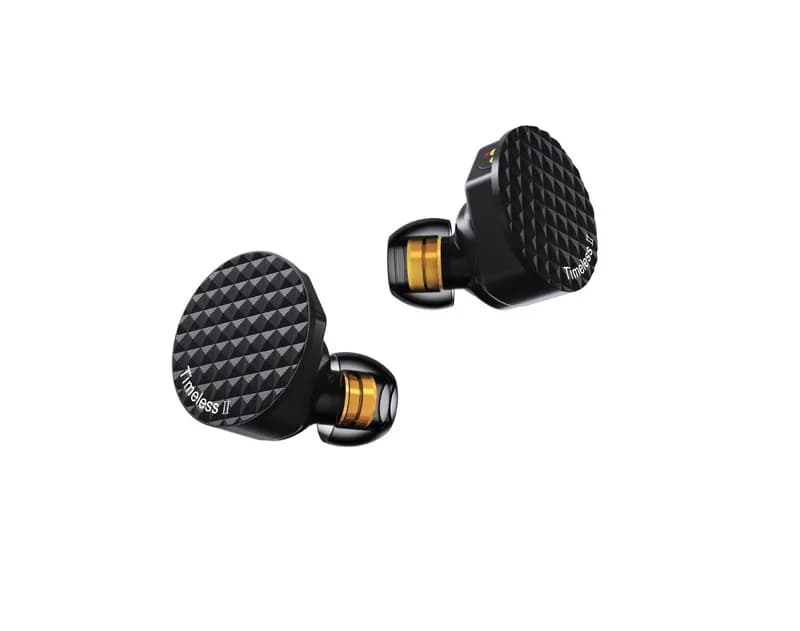
The Timeless II retains the distinctive circular metal-shell design associated with the Timeless family.
The metal construction gives it a more substantial feel than many plastic IEMs, while the geometric exterior keeps the design visually distinctive without relying on excessive decoration.
At approximately 5g per side, the shells are not particularly heavy. The bigger issue is their physical size and shape.
The circular housing occupies more space around the ear than a conventional small ergonomic IEM. For average and larger ears, this can work very well. Smaller ears may experience pressure where the shell meets the outer ear.
The switch from the original model's MMCX connection to a 0.78mm 2-pin connector is also practical. 2-pin cables are widely available, making future replacement easier.
Comfort and Fit
Comfort is one of the areas where the Timeless II cannot be described as universally suitable.
The weight is reasonable, and once properly positioned, the shells can remain stable. However, the large circular shape means that ear anatomy matters considerably.
For average-sized ears, two to four hours of use can be perfectly reasonable if the supplied tips provide a good seal. Smaller ears are more likely to encounter pressure points.
The nozzle and eartip combination also have a noticeable effect on both comfort and sound. A deeper seal can increase bass perception, while different tip sizes can change the perceived treble balance.
Isolation is adequate for everyday listening, but this is not an IEM designed specifically for maximum passive noise isolation.
If you already know that large metal IEMs cause discomfort, the Timeless II deserves some caution before purchase.
Cable, Eartips, and Accessories
The included cable is one of the stronger parts of the package.
The 4-core 7N single-crystal copper cable is flexible enough for everyday use, while the modular termination allows the user to switch between 3.5mm and 4.4mm connections.
The package also includes multiple eartips, a carrying case, and four interchangeable tuning nozzles.
This is important because there is little reason to immediately spend extra money on an aftermarket cable. The stock cable is already practical and provides the connections most users are likely to need.
An aftermarket cable only becomes worthwhile if you have a specific preference for its ergonomics, length, or connector arrangement.
Sound Quality
The Timeless II's main attraction is its planar magnetic driver, but the sound is more balanced than the stereotypical "fast and bright planar" presentation.
The overall character can be described as:
clean, energetic, detailed, spacious, and relatively balanced, with controlled bass, clear mids, and extended treble.
The interchangeable nozzles can alter the final tonal balance, so the exact presentation depends partly on which configuration and eartips are used.
Bass
The bass is one of the Timeless II's more successful improvements over the traditional lean-planar approach.
Sub-bass extension is strong, and electronic music can produce convincing low-end depth without sounding loose or bloated.
The mid-bass has good speed and definition. Kick drums start and stop quickly, while bass guitar lines remain relatively easy to follow in busy mixes.
This is not a basshead IEM. The quantity is substantial enough for modern music, but the emphasis remains on control and texture rather than maximum physical impact.
Compared with a good dynamic-driver IEM, the Timeless II's bass can feel slightly less physically resonant even when the measured quantity is similar. That is one of the fundamental differences between planar and dynamic-driver presentations.
Midrange
The midrange is clean, articulate, and relatively spacious.
Male vocals are clear, but listeners who prefer thick, warm vocals may find them somewhat lean compared with warmer dynamic-driver IEMs.
Female vocals generally work particularly well because the clean upper-mid presentation helps maintain clarity and separation.
Guitars have good edge definition, while piano notes are relatively clean and well separated from surrounding instruments.
The Timeless II does not aim for an intimate, lush vocal presentation. Its strength is clarity rather than warmth.
Treble
Treble extension is another major strength.
Cymbals, guitar harmonics, electronic textures, and ambient details are easy to hear. There is plenty of air, which contributes to the sense of openness.
However, extended treble should not automatically be interpreted as better detail.
The Timeless II can sound energetic in the upper frequencies, and treble-sensitive listeners may find certain recordings somewhat intense.
For most listeners, the presentation is more controlled than the early generation of planar IEMs that became known for aggressive upper-frequency energy. Nevertheless, tip selection and tuning-nozzle choice remain important if you are sensitive to brightness.
Soundstage and Imaging
The Timeless II has a strong sense of space for an IEM.
Its soundstage is wider than many conventional single-dynamic-driver designs, and there is enough depth to prevent the presentation from sounding completely flat.
Imaging is also a strength. Instruments tend to occupy distinct positions rather than collapsing together during complex passages.
This is useful for classical recordings, live performances, game soundtracks, and competitive gaming.
It still cannot reproduce the physical scale of a good open-back headphone, but within the limitations of an IEM, the spatial presentation is one of the Timeless II's strongest qualities.
Dynamics and Transients
Fast transients are one of the clearest advantages of the planar driver.
Kick drums have quick attack and controlled decay, bass lines remain separated, and complex rock or metal arrangements can retain clarity when several instruments are playing simultaneously.
Electronic music also benefits from this behavior because rapid rhythmic changes remain well defined.
However, resolution and dynamics are not the same thing.
The Timeless II can retrieve a lot of information without necessarily producing the huge physical dynamic swings of a high-quality dynamic-driver IEM. Its presentation is more about speed, separation, and control than raw physical impact.
Tuning and Frequency Response
The Timeless II should not be treated as a completely neutral studio-monitoring IEM.
The interchangeable tuning nozzles provide several variations, and measurements from different sources do not always describe the tonal balance in exactly the same way.
Rather than forcing it into a strict V-shaped, U-shaped, or Harman category, it is more useful to describe the Timeless II as a modern, clean tuning with elevated bass, clear mids, and extended upper frequencies.
Frequency-response measurements can help explain the general tonal balance, but they cannot fully describe soundstage, imaging, transient behavior, or how the IEM interacts with an individual listener's ear shape and eartips.
Music Compatibility
Music Type | Performance | Suitability | Why |
|---|---|---|---|
Pop | Clear and layered | ★★★★★ | Good vocal and instrument separation |
Chinese Pop | Clean vocals | ★★★★☆ | Female vocals particularly clear |
Rock | Fast and energetic | ★★★★★ | Strong transient response |
Electronic | Deep and controlled | ★★★★★ | Good sub-bass extension and rhythm |
Classical | Spacious | ★★★★★ | Good separation and spatial positioning |
Jazz | Detailed | ★★★★★ | Strong instrument definition |
Folk | Clean and articulate | ★★★★☆ | Good guitar and vocal clarity |
Female Vocals | Clear and airy | ★★★★★ | Strong upper-mid and treble detail |
Gaming / OST | Spacious and precise | ★★★★★ | Good imaging and separation |
Film Soundtracks | Layered | ★★★★☆ | Handles complex arrangements well |
The Timeless II is particularly convincing with rock, electronic music, classical recordings, jazz, gaming soundtracks, and complex pop productions.
Listeners who primarily want intimate, thick, warm vocals may prefer a warmer dynamic-driver IEM.
Matching Different Listener Types
Bass lovers: 4/5
There is enough bass to make modern music enjoyable, but it is not a dedicated basshead tuning.
Vocal-focused listeners: 4/5
Vocals are clear and well separated, but the presentation is not especially thick or warm.
Detail-focused listeners: 5/5
Resolution, separation, transient speed, and spatial information are major strengths.
Listeners who prefer relaxed sound: 4/5
It can be comfortable for long sessions, but treble-sensitive listeners may need to adjust the nozzle and eartips.
Classical listeners: 5/5
The combination of separation, stage, imaging, and transient control works particularly well with orchestral recordings.
Gamers: 5/5
Positioning and separation are useful for footsteps, environmental sounds, and directional effects.
Driving Requirements
The 15.2Ω impedance and 108dB/V sensitivity make the Timeless II relatively easy to drive.
A decent USB-C dongle DAC is already enough for most users.
You do not need a powerful desktop amplifier just because this is a planar IEM.
A clean output is more important than extreme power. More amplification can provide additional headroom, but once the IEM has sufficient voltage and current, additional power does not automatically produce a dramatic improvement.
Source Pairing
Phone + basic dongle DAC
A perfectly reasonable combination for everyday use. The main limitation is usually the quality of the dongle rather than the IEM's power requirement.
Mid-range dongle DAC
This is probably the sweet spot for the Timeless II. A good dongle can provide a clean background and sufficient headroom without making the setup unnecessarily expensive.
Desktop DAC/amp
Useful if you already own one, but there is little reason to buy a large desktop amplifier specifically for the Timeless II.
The most sensible upgrade path is therefore source quality and convenience rather than chasing maximum amplifier power.
Noise and Compatibility
The Timeless II is not among the most extremely sensitive IEMs on the market, so it is less likely to expose hiss than some ultra-sensitive models.
It can be used with Android, Windows, macOS, and iPhone through a compatible USB DAC.
If audible background hiss appears, the first thing to investigate should be the output stage of the source rather than assuming that the IEM needs more amplification.
Competitors
Letshuoer S12 Pro
The S12 Pro is usually less expensive and remains one of the better-known planar options in the lower-priced segment.
It has a more energetic character and can be more aggressive in the upper frequencies. The Timeless II offers a more comprehensive package, more tuning flexibility, and a somewhat more refined overall presentation.
If budget is the priority, the S12 Pro is difficult to ignore. If you want a more complete mid-range planar package, the Timeless II makes more sense.
Hidizs MP145
The MP145 is another large planar IEM with a strong emphasis on spaciousness.
It can be a better match for listeners who prioritize a broad stage, but its large shell also creates fit considerations. The Timeless II is somewhat easier to position for some ears while offering more tuning flexibility.
Kiwi Ears Aether
The Aether uses a 15.3mm planar driver and focuses on a clean, controlled presentation with a relatively natural tonal balance.
It is worth considering if you want a planar IEM that feels somewhat less energetic in the upper frequencies.
Simgot ET142
The ET142 takes a different approach with a planar main driver combined with a piezoelectric high-frequency driver.
It is better suited to listeners who want to experiment with a hybrid-style technical presentation. The Timeless II is simpler in architecture but focuses on the consistency of a single planar driver.
Pros and Cons
Pros
Fast and highly resolving planar magnetic driver
Fuller bass than many traditional planar IEMs
Excellent treble extension and air
Strong separation and imaging
Spacious presentation
Four interchangeable tuning nozzles
0.78mm 2-pin connector
Modular 3.5mm/4.4mm cable
Good overall accessory package
Cons
Large circular shell may not suit small ears
Treble can still sound energetic to sensitive listeners
Midrange is not particularly thick or warm
Planar bass does not have exactly the same physical character as a strong dynamic driver
The $200+ price range has a lot of competition
Rating
Category | Weight | Score |
|---|---|---|
Sound quality | 35% | 4.5/5 |
Tuning | 15% | 4.5/5 |
Comfort | 15% | 4.0/5 |
Build and design | 10% | 4.5/5 |
Driveability and compatibility | 10% | 4.5/5 |
Cable and accessories | 5% | 4.5/5 |
Value | 10% | 4.0/5 |
Overall: 4.5/5.0
The value score is particularly price-sensitive. At a substantial discount below MSRP, the Timeless II becomes considerably more competitive. At full price, it faces several strong alternatives and therefore deserves a more careful comparison.
Who Should Buy the 7Hz Timeless II?
Recommended for
Listeners who enjoy planar magnetic IEMs
People who prioritize detail and separation
Rock, electronic, classical, jazz, and soundtrack listeners
Gamers who value imaging and spatial information
Users who want multiple tuning options
People who need both 3.5mm and 4.4mm connectivity
Listeners who already own a good dongle DAC
Not ideal for
Extreme bassheads
People who want very thick and warm vocals
Treble-sensitive listeners
People with very small ears
Buyers focused purely on getting the lowest possible price
Is the 7Hz Timeless II Worth Buying?
At around $229, the Timeless II makes the most sense for someone who already knows they like planar IEMs and wants a more complete mid-range model.
At around $200 or below, the value proposition becomes considerably stronger.
If your budget is closer to $130–$170, however, products such as the Letshuoer S12 Pro and Kiwi Ears Aether can provide a substantial portion of the planar experience for less money.
Owners of the original Timeless should also consider the upgrade carefully. The Timeless II is not simply a cosmetic refresh. Its improved bass presentation, tuning system, modular cable, and overall refinement provide legitimate reasons to upgrade, but the fundamental planar character remains familiar.
FAQ
What kind of sound does the 7Hz Timeless II have?
The Timeless II has a clean, energetic, and spacious planar sound. It combines controlled bass, clear mids, extended treble, strong separation, and fast transients.
Is the Timeless II good for vocals?
Yes, particularly if you prefer clear and detailed vocals rather than thick, warm vocals. Female vocals tend to benefit from its clean upper-mid and treble presentation.
Is the Timeless II good for bass?
It has substantial and well-controlled bass, but it is not a dedicated basshead IEM. Its main strength is speed, texture, and control rather than maximum physical impact.
Does the Timeless II need an amplifier?
No. A good dongle DAC is sufficient for most users. A desktop amplifier can provide additional headroom, but it is not necessary.
Can a phone drive the Timeless II?
Yes, provided the phone is connected to a suitable USB DAC or has a compatible headphone output.
Is the Timeless II comfortable?
It depends heavily on ear shape. The approximately 5g weight is reasonable, but the large circular shells may cause pressure for smaller ears.
What is the biggest weakness of the Timeless II?
Fit is the most obvious physical limitation. Tonally, the treble can also be somewhat energetic for sensitive listeners, while the midrange is not especially warm or thick.
Is the 7Hz Timeless II worth buying?
It is worth considering if you value planar speed, resolution, imaging, soundstage, and tuning flexibility and can find it at a competitive price. If you prioritize warm vocals, extreme bass, or a smaller shell, other IEMs may be a better match.
Final Verdict
The 7Hz Timeless II is more than a simple second-generation planar IEM. Its strongest achievement is combining the familiar strengths of planar technology—speed, resolution, separation, and spatial clarity—with a fuller low end, adjustable tuning, and a more practical modular cable system.
Its biggest advantage is balance. The bass has enough weight to avoid sounding thin, the midrange remains clear, the treble extends well, and the spatial presentation is one of the stronger aspects of the design. These characteristics make it particularly suitable for electronic music, rock, classical recordings, jazz, gaming, and complex modern productions.
The limitations are equally clear. The large circular shells will not fit every ear, treble-sensitive listeners may still find the upper range energetic, and the midrange does not have the thick, intimate character of warmer dynamic-driver IEMs. At full price, it also has to compete against a large number of increasingly capable planar models.
If you want planar speed, strong technical performance, spaciousness, and controlled bass, and your ears can accommodate the relatively large shells, the Timeless II has a convincing reason to exist. If your priorities are warm vocals, maximum bass impact, compact comfort, or the lowest possible price, there are other options that may make more sense.
The Timeless II is therefore best understood as a well-rounded mid-range planar IEM rather than a specialist monitor: technically capable enough for critical listening, but flexible enough for everyday music, gaming, and portable use.