How Much Should You Spend on a Hair Dryer? 2026 Price Guide
How much should you spend on a hair dryer in 2026? This guide breaks down what you get at every price point, from basic $20 models to premium $500 dryers. Compare budget picks from Remington and Conair with high-speed options from Laifen, Shark, T3, and Dyson. Learn which features actually improve drying, when expensive models are worth the upgrade, and how to choose based on your hair type.
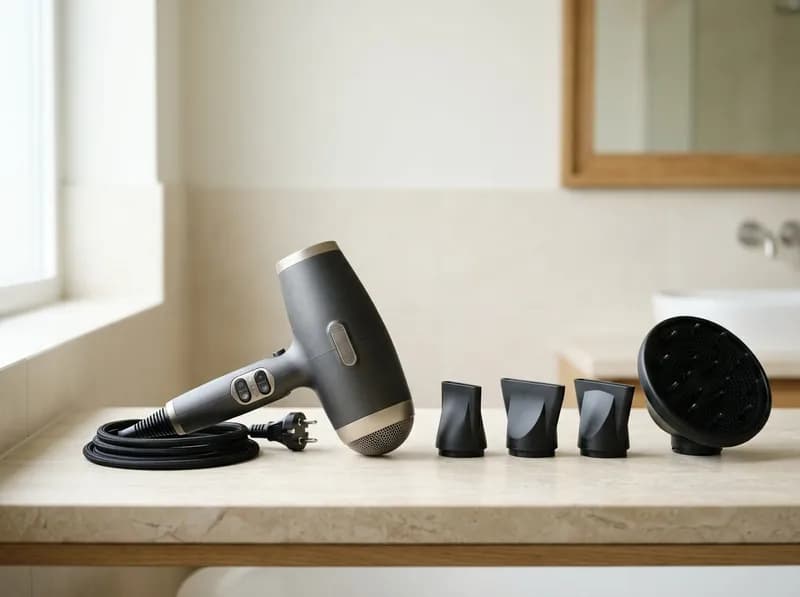
You don't need to spend $400 on a hair dryer to get good results. For most people, $40–$100 is enough for reliable everyday drying, with adjustable heat, multiple speed settings and useful attachments. A $20–$30 model can handle basic drying just fine, while dryers costing $200–$400 offer better ergonomics, more sophisticated temperature controls and additional styling features.
Whether those upgrades are worth paying for depends largely on how often you use your dryer and what you expect it to do.
A few details make the price comparison less straightforward than it first appears.
First, the 1,875-watt rating printed on many U.S. hair dryers is largely a reflection of household electrical limits, not a measure of drying performance. A $23 Conair and a $450 Dyson can advertise the same wattage despite having very different motors and airflow designs.
Second, electricity is a minor part of the ownership cost. Running a 1,875W dryer for 10 minutes every day costs approximately $22.81 per year at $0.20 per kWh, or about $114 over five years.
Third, expensive dryers don't automatically cause less hair damage. Research published in 2011 found that prolonged air-drying could damage the hair's internal cell-membrane complex. Using a dryer at a moderate temperature, keeping it approximately 15 cm from the hair and moving it continuously produced less overall damage than some air-drying conditions.
This guide compares the main hair dryer price ranges, examines independent laboratory results from 2026, and looks at which features justify spending more. It also covers budget recommendations, Dyson and Shark models, different hair types, electricity costs and how long a hair dryer should last.
1. How Much Should You Spend on a Hair Dryer?
For most households, the best value is between $40 and $100. Spending more can improve comfort and styling flexibility, but the benefits become increasingly specific as prices rise.
Price range | What to expect | Who should consider it |
|---|---|---|
Under $30 | Basic heat and speed controls, conventional motor, limited refinements | Occasional users and simple drying |
$30–$60 | Better attachments, AC motors and useful ionic features | Most budget-conscious shoppers |
$60–$100 | Better ergonomics and more capable conventional models | Everyday users |
$100–$200 | High-speed motors, improved airflow and styling options | Frequent users and people with demanding hair routines |
$200–$400 | Premium temperature management, lighter designs and advanced attachments | Regular stylers who value convenience |
$400+ | Specialized engineering, sensors and premium ergonomics | Buyers willing to pay for a particular experience |
Under $30: Basic drying
A budget hair dryer can be perfectly adequate if you have short or relatively easy-to-manage hair.
Models such as the Remington Damage Protection D3190 provide multiple heat settings, two speeds, a cool shot, a diffuser and a concentrator. You don't get the compact design or sophisticated temperature regulation of a premium dryer, but the basic functions are there.
$30–$60: The best starting point for most buyers
This is where conventional AC-motor dryers become attractive.
Models such as the Conair InfinitiPRO 1875W offer useful attachments, straightforward controls and an established design. They are generally heavier than high-speed digital dryers, but they provide a good balance of price and everyday functionality.
$60–$100: The everyday value range
At this level, buyers can find better-built traditional dryers and professional-style models.
For someone who uses a dryer several times a week, spending a little more can make sense if it improves handling, airflow or attachment quality.
$100–$200: A meaningful technology upgrade
This is where high-speed digital dryers become more accessible.
The benefits can include a smaller motor assembly, different airflow characteristics, improved temperature regulation and more convenient styling attachments.
The Laifen Swift and some Shark SpeedStyle configurations sit in this range.
$200–$400: Premium convenience
Premium dryers focus less on simply producing hot air and more on controlling how that air reaches the hair.
You may get lighter construction, better temperature monitoring, specialized attachments and more comfortable handling.
These features can be worthwhile if you style your hair every day. They are harder to justify if you only need to dry your hair after showering.
$400 and above: Luxury rather than necessity
At this price, buyers are paying for a particular combination of design, engineering, brand reputation and convenience.
The Dyson Supersonic range is the most recognizable example. Its technology is impressive, but it doesn't make a $50 dryer incapable of doing the basic job.
Why almost every U.S. hair dryer says 1,875 watts
The number comes from the electrical rating of a standard U.S. household plug.
A NEMA 5-15 connection is rated at 125 volts and 15 amps:
125 V × 15 A = 1,875 W.
At a nominal 120V supply, a 1,875W-rated heating element would draw approximately 14.4 amps if operating at that power.
This explains why wattage is a poor way to compare full-size dryers. Once you are looking at models around 1,600W and above, airflow design, motor characteristics and temperature regulation tell you much more about actual performance.
Electrical circuit requirements also matter. A 1,875W dryer can place a substantial load on a 15A household circuit. Bathroom circuits have specific requirements under the National Electrical Code, including 20A branch-circuit provisions under NEC 210.11(C)(3). Always follow the electrical requirements for the outlet and appliance rather than assuming every bathroom circuit can support every dryer.
2. What Independent Hair Dryer Tests Found in 2026
Three testing organizations offer useful perspectives on the current market: Consumer Reports, Good Housekeeping's Beauty Lab and Forbes Vetted.
Their winners are different because their testing methods and evaluation priorities are different.
Consumer Reports: Seven dryers tested
Consumer Reports' 2026 lineup included models ranging from $95 to $570.
Model | Test price | Notable findings |
|---|---|---|
Dyson Supersonic r | $570 | Highest overall score in the tested group |
Dyson Supersonic | $430 | Strong performance from the original design |
Dyson Supersonic Nural | $400 | Heavy, with small controls that are difficult to read |
Shark SpeedStyle Pro HD542 | $200 | Foldable design and convenient rotating attachments |
T3 Featherweight Stylemax | $210 | Solid performance, although the interface is busy |
Laifen Swift | $140 | Easy-to-read icons and magnetic rotating attachment |
RUSK W8less | $95 | Lowest-priced model in the group; attachment is difficult to change |
The Shark SpeedStyle Pro was particularly interesting. Consumer Reports described it as competing with Dyson at more than half the price. Its main usability criticism concerned the text labels.
The Laifen Swift also performed well in several practical areas. It had the easiest-to-read interface in the test and the lowest maximum outlet temperature, measured at 108°F.
Good Housekeeping Beauty Lab: 2026 winners
Good Housekeeping reported more than 320 hours of testing and 2,244 laboratory measurements.
Its category winners included:
Category | Winner |
|---|---|
Best Overall | Dyson Supersonic |
Best Value | InStyler Turbo Max Ionic |
Best Travel | Shark SpeedStyle |
Best for Frizzy Hair | SRI DryQ |
The Beauty Lab measured the Dyson Supersonic drying an 8-inch hair sample in 54 seconds.
The InStyler Turbo Max Ionic is particularly relevant to shoppers who want to stay below $100.
Forbes Vetted: 14 dryers compared
Forbes Vetted selected the T3 AireLuxe as its 2026 Best Overall hair dryer.
Unlike the compact high-speed designs from Dyson and Shark, the AireLuxe uses a traditional full-size format with multiple heat and speed settings.
What these tests tell us
Three conclusions are useful when comparing prices.
The most expensive dryer can win a test without being the best value. Consumer Reports gave the highest overall score to the $570 Dyson Supersonic r, but several lower-priced dryers also performed well.
The strongest value options are considerably cheaper. The Laifen Swift, RUSK W8less, Shark SpeedStyle Pro and InStyler Turbo Max Ionic all demonstrate that good performance doesn't require a $400 purchase.
There is no universal best hair dryer. Good Housekeeping selected the original Supersonic, Consumer Reports favored the Supersonic r, and Forbes Vetted chose the T3 AireLuxe. Their different results reflect different testing priorities.
3. Best Budget Hair Dryers Worth Buying in 2026
The following models cover different budgets and hair-care needs. Prices are approximate U.S. retail targets for October 2026 and may vary by retailer, color and bundle.
These recommendations are based on published specifications, available independent testing and product positioning. They should not be interpreted as the results of a new hands-on comparison of every model.
Laifen Swift — Around $140
Best for: Buyers who want high-speed airflow without paying Dyson prices.
The Laifen Swift is one of the more interesting options in the 2026 test results.
Consumer Reports found that it offered the easiest-to-read controls among the seven tested dryers. It also has a magnetic rotating attachment and a maximum outlet temperature of 108°F, the lowest in that particular test.
WIRED measured its noise level at 79 dB for the relevant comparison context, while the Dyson Supersonic r registered 80.1 dB.
The Swift uses a brushless motor rated at 110,000 rpm.
Its limitations are worth considering. The basic package has only one attachment, there is no one-touch cool shot, and Consumer Reports measured its cord at 71 inches. That is shorter than some competing models.
Buy it if: You want a compact high-speed dryer with relatively gentle measured outlet temperatures and straightforward controls.
Skip it if: You need multiple styling attachments, a dedicated cool-shot button or a longer cord.
Remington Damage Protection D3190 — $20–$30
Best for: Basic drying on a tight budget.
The D3190 is a practical entry-level option with:
1,875W power rating
Ceramic and ionic features
Three heat settings
Two speed settings
Cool-shot button
Diffuser and concentrator
It covers the features most people need for everyday drying without adding expensive styling technology.
The trade-off is its conventional design. It is not particularly lightweight or sophisticated, but that is expected at this price.
Conair InfinitiPRO 1875W AC Motor — $35–$55
Best overall budget pick for most households.
The InfinitiPRO is a straightforward AC-motor dryer with three heat settings, two speeds, a cool-shot button, removable filter, diffuser and concentrator.
Its main advantage is the combination of price and functionality. Buyers get a familiar professional-style design and useful attachments without paying for a high-speed digital motor.
It is heavier than many premium alternatives, but for ordinary home drying, that may not matter.
Conair InfinitiPRO DigitalAire — $100–$130
Best for thick hair on a moderate budget.
Good Housekeeping's Beauty Lab reported strong airspeed and below-average outlet temperature compared with the tested group. The lab also found it effective on thick and curly hair.
That combination is useful for dense hair: strong airflow helps move moisture out of the hair without relying entirely on higher temperatures.
The main drawbacks reported by reviewers include noticeable noise and controls that may take some getting used to.
BaBylissPRO Nano Titanium Portofino 6600 — $100–$150
Best traditional professional-style dryer.
The Portofino 6600 uses a conventional 2,000W AC-motor design.
Its published manual specifies:
Air speed: 140 km/h
Airflow: 75 m³/h
Weight: 19 oz
These specifications make it easier to evaluate than products that rely entirely on marketing descriptions.
Forbes Vetted has also identified the Nano Titanium line as a value-oriented option.
Its main disadvantage is its traditional full-size construction. Buyers looking for a compact digital dryer or a comprehensive curly-hair attachment system may prefer another model.
RUSK W8less Professional 2000W — $90–$130
Best lightweight professional-style option.
Consumer Reports included the RUSK W8less in its 2026 test lineup at $95, making it the least expensive model in that group.
It offers a straightforward interface and a professional-style design.
However, Consumer Reports found that its single included attachment was difficult to change. Buyers who regularly switch between a diffuser and concentrator should consider that limitation.
Shark SpeedStyle HD331 — $130–$180
Best step-up option for digital drying and styling.
The standard Shark SpeedStyle combines high-speed airflow with electronic temperature management and a range of styling attachments.
Shark claims that its system takes 1,000 temperature readings per second and keeps airflow below 230°F.
The SpeedStyle family includes several versions:
SpeedStyle
SpeedStyle Pro HD542
SpeedStyle Pro Flex
Their attachment bundles and prices differ, so check the model number before comparing listings.
The standard SpeedStyle is a reasonable upgrade for people who want more styling flexibility than a conventional budget dryer provides.
Two more options from Good Housekeeping
InStyler Turbo Max Ionic — Under $100
Good Housekeeping selected this model as its 2026 Best Value winner. It is worth considering if you want a relatively inexpensive dryer with independent laboratory recognition.
SRI DryQ
Selected as Good Housekeeping's Best for Frizzy Hair, the DryQ is another option for buyers focused on frizz management. Its U.S. availability is more limited than that of Conair, Remington or Shark.
Budget hair dryer comparison
Model | Approx. price | Main advantage | Main drawback |
|---|---|---|---|
Remington D3190 | $20–$30 | Complete basic feature set | Conventional design |
Conair InfinitiPRO AC | $35–$55 | AC motor and useful attachments | Relatively bulky |
RUSK W8less | $90–$130 | Lightweight professional format | Limited attachment selection |
Conair DigitalAire | $100–$130 | Strong airflow for thick hair | Noise and control design |
BaBylissPRO Portofino 6600 | $100–$150 | Published airflow specifications | Traditional full-size design |
Laifen Swift | Around $140 | High-speed motor and low measured outlet temperature | One attachment in basic package |
Shark SpeedStyle HD331 | $130–$180 | Digital airflow and styling options | Bundle differences |
For most budget shoppers, the Remington D3190 and Conair InfinitiPRO are sensible starting points. If you want a more substantial technology upgrade, the Laifen Swift is particularly interesting. Thick-haired users should also consider the Conair DigitalAire and BaBylissPRO Portofino.
4. Dyson Hair Dryers: Supersonic, Supersonic Nural and Supersonic r
Dyson occupies the premium end of the hair dryer market. Its three main Supersonic models share the same broad objective but differ in ergonomics, sensors and attachment technology.
Model | Approx. regular price | Documented October 2026 promotional price | Main distinction |
|---|---|---|---|
Supersonic r | $570 | $454.99 | Compact design and professional-style handling |
Supersonic Nural | $449.99 | $329.99 | Scalp Protect sensing |
Original Supersonic | $399.99–$430 | $299.99 | Established design and attachment system |
Promotional prices were documented on Dyson's U.S. website during October 18–24, 2026. They are snapshots rather than guaranteed current offers.
Dyson Supersonic r
The Supersonic r is the top-scoring model in Consumer Reports' 2026 test.
Its smaller, lighter design is the main reason to consider it. WIRED measured its weight at approximately 0.7 lb, about 30% smaller and 20% lighter than the original Supersonic.
Other specifications include:
110,000-rpm Hyperdymium motor
1,700W power rating
Four heat settings
Three airflow speeds
Cold-shot function
6-foot cord
RFID-enabled attachments that recall saved settings
The main compromise is noise. WIRED measured the Supersonic r at 80.1 dB, compared with 77 dB for the Nural.
It also lacks the Nural's Scalp Protect mode and is designed for 120V markets, so it is not suitable for overseas use simply by adding a plug adapter.
Most importantly, the r is not dramatically faster than the original Supersonic. Its advantage is primarily handling and design.
At $570, that distinction matters. It makes more sense for someone who dries their hair every day than for an occasional user.
Dyson Supersonic Nural
The Nural adds several features designed to improve comfort and temperature management.
Its main features include:
Scalp Protect mode, which uses a time-of-flight sensor to measure distance from the scalp
Attachment recognition
Pause-detect functionality
Automatic temperature adjustments
The sensor reduces heat as the dryer approaches the head.
Consumer Reports was less impressed with the Nural's usability than some other reviewers, describing it as heavy and criticizing its small controls. WIRED, on the other hand, rated it positively and measured lower noise than the Supersonic r.
These findings are not necessarily contradictory. A dryer can offer useful technology and still have a less convenient interface.
The Nural is a better choice for buyers who specifically want scalp-distance sensing and automatic adjustments. It is less compelling if those features are not part of your routine.
Original Dyson Supersonic
The original Supersonic remains a strong option, particularly when discounted.
Good Housekeeping selected it as its 2026 Best Overall hair dryer. The Beauty Lab's 54-second result on an 8-inch hair sample provides a useful benchmark.
It offers Dyson's established airflow and attachment system without the additional sensors of the Nural or the redesigned body of the Supersonic r.
For buyers who want a Dyson but don't need the newest technology, the original model is usually the more sensible purchase.
Dyson buying advice: Compare promotional prices before paying full retail. The October 2026 offers brought the original Supersonic down to $299.99 and the Nural to $329.99, making them considerably more competitive.
5. Shark Hair Dryers: SpeedStyle, SpeedStyle Pro and FlexStyle
Shark is one of Dyson's strongest competitors in the premium hair styling market. Its products are generally less expensive, although the different SpeedStyle versions can make comparisons confusing.
Shark SpeedStyle Pro HD542 — Around $200–$250
The SpeedStyle Pro is the most interesting Shark option in Consumer Reports' 2026 comparison.
Consumer Reports described it as competing with Dyson at more than half the price.
Its features include:
High-speed airflow
IQ Speed regulation
Foldable body
Rotating attachments
Temperature management
The attachments can click into place and rotate without requiring the user to remove the existing attachment.
Consumer Reports measured its maximum outlet temperature at 115°F and identified difficult-to-read text labels as its main usability weakness.
For buyers who want premium styling features without Dyson pricing, it is one of the strongest alternatives.
Shark SpeedStyle HD331 — Around $130–$180
The standard SpeedStyle is a less expensive option.
It offers electronic temperature monitoring and multiple styling attachments, depending on the package.
Shark claims that the system takes 1,000 temperature readings per second and keeps airflow below 230°F.
Its weight is approximately 1.69 lb.
Check the exact HD model number when shopping. SpeedStyle, SpeedStyle Pro and SpeedStyle Pro Flex are not interchangeable product names, and their included accessories differ.
Shark FlexStyle — Around $250–$300
The FlexStyle is not simply another hair dryer. It is a convertible styling system that can switch between a conventional dryer and several styling configurations.
Depending on the package, attachments can include:
Curling barrels
Smoothing brushes
Concentrators
Diffusers
Its appeal is replacing a separate hair dryer and styling tool with one device.
The FlexStyle is also considerably less expensive than the Dyson Airwrap, which occupies a similar multifunction styling category.
However, if you only want to dry wet hair, the additional styling functions may not justify the purchase.
Who should buy Shark? People who want high-speed airflow, temperature management and styling attachments without paying Dyson prices.
Who should skip it? Buyers who already own a good $50–$100 dryer and rarely use styling accessories.
6. T3 AireLuxe: A Premium Traditional Hair Dryer
Approximate price: $224.99
Forbes Vetted selected the T3 AireLuxe as its 2026 Best Overall hair dryer from a group of 14 contenders.
Unlike Dyson and Shark's compact high-speed designs, the AireLuxe uses a traditional full-size body.
Its main features include:
Five heat settings
Three speed settings
Digital controls
Ionic output
Paddle brush and 2.5-inch round brush in specified packages
The 15 heat-and-speed combinations offer flexibility for different hair types and styling routines.
Forbes Vetted highlighted its drying performance and the smooth finish it produced. The recessed buttons are also a practical design choice because they are less likely to catch hair during use.
One particularly useful feature is the volume-boost button, which switches off the ionic generator. This can help fine hair retain more volume.
Check the exact SKU before buying because the diffuser is included in some configurations and sold separately in others.
The AireLuxe is a good choice for buyers who prefer a conventional dryer with premium controls rather than a compact digital design.
7. Are Expensive Hair Dryers Really Better?
Sometimes, but the difference depends on what you are paying for.
A $300–$500 dryer may offer better temperature regulation, more comfortable handling and a more versatile attachment system. Those improvements can make daily styling easier.
They do not necessarily mean the dryer will cut drying time in half or produce dramatically healthier hair.
Do expensive hair dryers dry hair faster?
Not always.
Good Housekeeping's Beauty Lab recorded a 54-second drying time for an 8-inch hair sample using the original Dyson Supersonic.
However, WIRED's testing of the newer Supersonic r found that it took approximately 10 minutes to dry fine hair, roughly comparable to the original model.
These figures come from different test conditions and should not be compared as if they were a controlled head-to-head experiment.
Actual drying time depends on:
Hair length and density
Individual strand thickness
How much water remains after towel-drying
Airflow and temperature
Distance between the dryer and hair
Attachment design
Drying technique
Someone with thick, long hair may notice a meaningful improvement from a stronger, well-designed airflow system. Someone with short hair may see very little difference.
Do expensive hair dryers cause less damage?
A premium dryer can help control heat exposure, but price alone does not protect hair.
A frequently cited 2011 study published in Annals of Dermatology, titled "Hair Shaft Damage from Heat and Drying Time of Hair Dryer," compared different drying conditions over repeated treatment cycles.
Several findings are worth understanding:
The air-dried group showed cell-membrane-complex damage.
The researchers did not observe cortex damage in the tested groups.
Drying at approximately 15 cm with continuous movement produced less overall surface damage than close-range, high-temperature drying.
Surface cracks and bulges increased with higher temperatures and repeated treatments.
The study challenges the assumption that air-drying is always the gentlest option.
Hair that remains wet for a prolonged period can experience structural changes. Using a dryer at a moderate temperature and reasonable distance may be a better approach.
This does not mean blow-drying is harmless. High temperatures and repeated exposure can still damage the hair shaft.
The practical takeaway is simple: temperature, distance and drying time matter more than the brand name on the dryer.
Are brushless digital motors better?
Brushless motors allow manufacturers to build compact dryers with high rotational speeds and sophisticated electronic controls.
Dyson's Hyperdymium motor and Laifen's high-speed motor are examples.
However, brushless does not automatically mean better drying performance or longer product life.
A well-designed conventional AC-motor dryer can also provide strong airflow and years of reliable home use.
Compare the complete appliance rather than choosing based on motor terminology alone.
Can a $100 dryer deliver most of the benefits of a $400 model?
For basic drying, yes.
The difference becomes more noticeable when you look at specific features:
Feature | Lower-priced options | Premium options |
|---|---|---|
Airflow | Often sufficient for everyday drying | More advanced airflow engineering |
Temperature control | Manual heat settings | Electronic regulation and sensors |
Weight | Usually heavier | Often lighter or better balanced |
Attachments | Basic diffuser and concentrator | Magnetic, rotating or specialized attachments |
Controls | Mechanical switches or simple buttons | Digital controls and automatic settings |
Styling convenience | Good for basic routines | More specialized styling options |
The Laifen Swift at around $140 offers high-speed airflow and a low measured outlet temperature. The Shark SpeedStyle Pro adds more attachment flexibility and temperature management. The Dyson Supersonic r adds compact handling and RFID-enabled accessories.
These are meaningful differences, but they are not essential for everyone.
If your main goal is simply to dry your hair, a good $50–$100 model can do the job.
8. Which Hair Dryer Features Are Worth Paying For?
Not every feature advertised on a hair dryer makes a noticeable difference.
Some improve everyday usability. Others are mainly marketing distinctions.
Feature | Practical benefit | Worth paying extra? |
|---|---|---|
Brushless digital motor | Compact design and electronic control | Sometimes |
Ionic technology | Reduces static and helps manage frizz | A small premium |
Ceramic heating | Heating-element design | Not by itself |
Tourmaline | Can increase ion output | Limited evidence for broader claims |
Infrared | Marketed as inside-out drying | Generally not |
Multiple heat settings | Better control over temperature | Yes |
Multiple speed settings | Better control over airflow | Yes |
Cool shot | Helps finish a style | Yes, if you style regularly |
Diffuser | Helps distribute airflow for curls | Essential for many curly-hair routines |
Concentrator | Directs airflow for brush styling | Useful |
Intelligent heat control | Helps regulate temperature | Worth considering |
Lightweight construction | Reduces arm fatigue | Yes |
Low noise | Improves comfort | Only when independently measured |
Removable filter | Makes cleaning easier | Yes |
Ionic technology: useful, but not a miracle
Ionic generators produce negative ions that help neutralize static electricity.
This can make hair easier to manage and reduce the appearance of frizz.
However, ionic technology is not a substitute for heat protection and does not prevent all structural damage.
It can also reduce volume in fine hair. The T3 AireLuxe's ability to switch off ionic output is useful for people who prefer a fuller finish.
Paying a small amount extra for ionic functionality is reasonable. Paying $100 more simply because a dryer has an ionic label is not.
Ceramic and tourmaline: don't overvalue the labels
Ceramic heating elements are intended to distribute heat more evenly.
Tourmaline is associated with ion generation, and manufacturers often advertise higher ion output than ceramic-based designs.
The problem is that the broader claims about shinier hair, reduced damage and superior drying are not supported by extensive independent head-to-head testing.
Treat ceramic and tourmaline as secondary considerations rather than primary buying criteria.
Infrared: the inside-out drying claim is questionable
Some manufacturers advertise infrared technology as a way to dry hair from the inside out.
The explanation is difficult to reconcile with how water absorbs infrared radiation. Water absorbs infrared energy strongly, and the hair shaft is extremely small.
There is also limited independent comparative evidence showing that infrared dryers outperform conventional designs in meaningful everyday use.
If a dryer performs well, look at its measured airflow and temperature rather than paying extra for an infrared label.
Intelligent temperature control: a more meaningful upgrade
Temperature regulation is one of the premium features with a clearer practical purpose.
Dyson uses temperature monitoring, Shark advertises frequent temperature readings, and the Supersonic Nural adds scalp-distance sensing.
These systems are designed to manage temperature fluctuations and reduce excessive heat exposure.
They do not eliminate damage, but they offer more control than a dryer with only basic high, medium and low settings.
For fine, color-treated or frequently styled hair, this feature is worth considering.
Weight: one of the most overlooked specifications
A lightweight dryer can make a bigger difference to everyday comfort than another marketing feature.
Consider two dryers:
A $40 model weighing 1.8 lb
A $150 model weighing 1.1 lb
If you spend 20 minutes drying long hair every morning, the lighter model may be much more comfortable.
This is one reason the Dyson Supersonic r's compact 0.7-lb design is relevant to its price. Buyers are paying for easier handling, not necessarily dramatically faster drying.
Noise: look for independent measurements
High-speed motors are not automatically quieter.
WIRED measured the Dyson Supersonic r at 80.1 dB and the Nural at 77 dB. Consumer Reports measured the Laifen Swift at 79 dB.
These figures show why claims such as "whisper quiet" should be treated cautiously.
Noise measurements are useful only when the testing distance and methodology are known.
Removable filters and warranty coverage
A removable filter makes it easier to clear accumulated dust, lint and hair from the intake.
A clogged filter can restrict airflow and make the dryer operate less efficiently. Regular cleaning is a simple maintenance habit that can help extend its useful life.
Warranty coverage is another useful comparison point. Dyson, Shark and T3 commonly offer two-year limited warranties on their hair dryer lines, while many budget models provide shorter coverage.
A longer warranty is reassuring, but it does not guarantee that a $400 dryer will outlast a $40 model.
9. Best Hair Dryer for Different Hair Types
The right dryer depends on your hair type and styling routine as much as your budget.
Fine or thin hair
Fine hair benefits from controllable airflow and moderate temperatures.
The Laifen Swift is worth considering because Consumer Reports measured its maximum outlet temperature at 108°F, the lowest in its 2026 test group.
The T3 AireLuxe is another option, particularly because its ion-off function can help maintain volume.
Suggested budget: $40–$150.
Thick or coarse hair
Thick hair generally needs strong airflow and a dryer that remains comfortable to hold during longer sessions.
Good options include:
Conair InfinitiPRO DigitalAire: strong airspeed in Good Housekeeping's testing
BaBylissPRO Portofino 6600: published airflow and airspeed specifications
Shark SpeedStyle Pro: high-speed airflow and temperature management
Suggested budget: $70–$180.
Don't assume a 2,000W dryer will necessarily dry faster than a well-designed 1,600W model.
Curly and coily hair
For curly and coily hair, the diffuser can be more important than the motor.
Look for:
A sufficiently deep diffuser bowl
Prongs suited to your curl pattern
Stable low-speed airflow
Moderate heat settings
The Remington D3190 and Conair InfinitiPRO are affordable choices when sold with a suitable diffuser.
Shark SpeedStyle bundles are also worth considering, but check whether the exact package includes one.
Suggested budget: $40–$150.
Long hair
Long hair takes more time to dry, making weight, cord length and airflow particularly important.
The Dyson Supersonic r is attractive because of its lightweight construction. The T3 AireLuxe is another option for buyers who prefer a traditional dryer.
The Laifen Swift's 71-inch cord, measured by Consumer Reports, is worth considering if you need extra reach.
Suggested budget: $60–$225.
Short hair
A simple conventional dryer is usually enough.
There is little reason to spend several hundred dollars unless you particularly value premium styling features or a lightweight design.
Suggested budget: $20–$50.
Color-treated or damaged hair
Prioritize adjustable heat, consistent temperature and a cool-shot function.
Intelligent temperature management can be useful, but good technique remains important:
Start with moderate heat.
Keep the dryer approximately 15 cm away.
Keep it moving rather than concentrating heat in one spot.
Use an appropriate heat protectant.
Suggested budget: $40–$150.
10. How Much Does It Cost to Run a Hair Dryer?
The electricity cost of using a hair dryer is relatively small compared with the purchase price.
Assume:
Daily use: 10 minutes
Electricity price: $0.20/kWh
Ownership period: Five years
No repairs or resale value
A 1,875W dryer consumes:
1.875 kW × 10/60 hours = 0.3125 kWh per session.
Over one year:
0.3125 × 365 = 114.06 kWh.
At $0.20 per kWh, that works out to approximately $22.81 annually.
A 1,600W dryer costs approximately $19.47 per year under the same assumptions.
Five-year ownership cost
Dryer category | Purchase price | Assumed power | Five-year electricity | Five-year total |
|---|---|---|---|---|
Budget | $30 | 1,875W | $114.06 | $144.06 |
Midrange | $70 | 1,875W | $114.06 | $184.06 |
Upper-midrange | $150 | 1,875W | $114.06 | $264.06 |
Premium | $400 | 1,600W | $97.33 | $497.33 |
The premium dryer saves approximately $16.73 in electricity over five years compared with the assumed 1,875W models.
That is a small saving relative to the $370 difference in purchase price.
Annual ownership cost
Assuming five years of use:
Purchase price | Annualized purchase cost | Annual electricity | Annual total |
|---|---|---|---|
$30 | $6 | $22.81 | $28.81 |
$70 | $14 | $22.81 | $36.81 |
$150 | $30 | $22.81 | $52.81 |
$400 | $80 | $19.47 | $99.47 |
If you use your dryer only three times a week, the electricity costs fall considerably:
1,875W dryer: approximately $9.75 per year
1,600W dryer: approximately $8.32 per year
The difference is just $1.43 annually.
The bottom line: Buy a hair dryer for its performance, comfort and features, not because you expect a premium model to save money on electricity.
Time may be a more important consideration. If a better dryer saves five minutes every day, that adds up to roughly 30 hours over five years.
11. How Long Should a Hair Dryer Last?
A typical household hair dryer can provide around three to five years of regular use, although actual lifespan varies significantly.
Light users may keep a dryer for seven years or longer. Professional stylists who use their equipment for several hours every day may need replacements much sooner.
Motor type can influence expected durability:
Motor type | General lifespan guidance |
|---|---|
Conventional AC | Around 5–7 years |
Conventional DC | Around 3–5 years |
Premium brushless | Some designs are rated toward 8–10 years |
These are broad industry estimates, not guaranteed product lifespans.
Watch for the following replacement signals:
Burning smells
Noticeably weaker airflow
New rattling or whining noises
Drying sessions taking much longer than before
Intermittent operation or electrical problems
Cleaning the intake filter is one of the easiest ways to maintain a dryer. Dust and hair can restrict airflow, increasing operating temperatures and placing additional stress on the appliance.
Warranty length is useful when comparing products, but it should not be confused with a verified lifespan.
12. Should You Buy a Hair Dryer Brush Instead?
A conventional hair dryer is not the only option.
Hot-air brushes such as the Revlon One-Step Volumizer combine drying and styling in one device. They are particularly popular with people who want a smooth, voluminous finish without using a separate dryer and round brush.
The Revlon One-Step product category typically costs around $30–$55, depending on the model and retailer.
Its appeal is straightforward: dry and shape the hair in the same routine.
A hot-air brush can be a good alternative if you have straight or wavy, medium-length hair and primarily want a smooth finish.
However, it is not ideal for every hair type.
Hair type or routine | Hot-air brush suitability |
|---|---|
Straight hair | Very good |
Wavy hair | Very good |
Medium-length hair | Very good |
Thick hair | Depends on density and drying time |
Coily hair | Generally less suitable |
Very short hair | Often difficult to use |
Diffuser-based curly styling | Regular dryer is preferable |
Hot-air brushes also concentrate heat around the brush surface and generally offer less sophisticated temperature regulation than premium digital dryers.
If your goal is simply to dry and smooth your hair, a $40 hot-air brush may be more useful than a $225 traditional dryer.
If you prefer to dry your hair first and style it afterward, a conventional dryer with a concentrator and cool-shot button is the better choice.
13. How Much Should You Spend Based on Your Routine?
The following recommendations bring the price ranges and product choices together.
Buyer profile | Recommended budget | What to prioritize |
|---|---|---|
Occasional user | $20–$35 | Basic heat and speed controls |
Everyday user | $40–$80 | Airflow, attachments and removable filter |
Thick or long hair | $70–$180 | Strong airflow and comfortable weight |
Curly or coily hair | $40–$150 | Diffuser and low-speed control |
Fine or damaged hair | $40–$150 | Moderate heat and temperature consistency |
Frequent home styling | $100–$225 | Ergonomics and styling attachments |
Premium convenience | $200–$570 | Temperature management and advanced design |
Professional stylist | $100–$400+ | Weight, serviceability and cord design |
A few straightforward recommendations:
Occasional use: The Remington D3190 is enough for most basic drying needs.
Everyday use: The Conair InfinitiPRO AC is a sensible balance of price, controls and attachments.
Thick or long hair: Consider the Conair DigitalAire or BaBylissPRO Portofino.
Curly hair: Choose the diffuser first, then compare the dryers that include it.
Frequent styling: The Shark SpeedStyle and T3 AireLuxe offer more styling flexibility.
Professional use: Prioritize ergonomics, durability, serviceability and cord design over consumer marketing features.
14. Final Hair Dryer Shortlist for 2026
Here are the models worth comparing across the main price ranges.
Best budget and midrange options
Model | Approximate price | Best for |
|---|---|---|
Remington D3190 | $20–$30 | Basic drying under $30 |
Conair InfinitiPRO AC | $35–$55 | Everyday value |
RUSK W8less | $90–$130 | Lightweight professional-style drying |
Conair DigitalAire | $100–$130 | Thick hair |
BaBylissPRO Portofino 6600 | $100–$150 | Traditional professional-style performance |
Laifen Swift | Around $140 | High-speed digital drying |
Best premium options
Model | Approximate price | Best for |
|---|---|---|
Shark SpeedStyle Pro | $200–$250 | Premium features at a lower price than Dyson |
T3 AireLuxe | $224.99 | Premium traditional-format drying |
Dyson Supersonic r | $570 | Lightweight handling and advanced attachments |
Dyson Supersonic | $399.99–$430 | Established Dyson performance, especially on sale |
Dyson Supersonic Nural | $449.99 | Scalp-distance sensing and automatic temperature adjustment |
Prices are approximate and promotional offers can change the relative value considerably.
15. Frequently Asked Questions
How much should you spend on a good hair dryer?
For most people, $40–$100 is enough for a good everyday hair dryer. This range provides useful heat settings, adequate airflow and practical attachments without the expense of a premium digital model.
A $20–$30 dryer is sufficient for basic drying, while frequent stylers may benefit from spending $100–$200.
Is a $30 hair dryer good enough?
Yes. A $30 model from Remington, Conair or Revlon can handle ordinary home drying.
Look for multiple heat settings, at least two speed settings, a cool-shot function and an attachment suited to your hair type.
The Remington D3190 is a good example of a budget model with a relatively complete feature set.
What is the best budget hair dryer under $50?
The Remington D3190 is a good choice for buyers who want to spend less than $30.
The Conair InfinitiPRO 1875W AC Motor is another strong option at approximately $35–$55, particularly if you prefer a conventional AC-motor design.
If you can spend more, the Laifen Swift offers a more advanced high-speed design.
Are expensive hair dryers really better?
They can be better in specific areas, including temperature regulation, weight, airflow engineering and attachment systems.
However, the improvement in drying performance is not proportional to the price increase. Consumer Reports' 2026 testing gave its highest overall score to the $570 Dyson Supersonic r, but several models below $200 also performed well.
Is Dyson worth the money?
Dyson can be worth the price if you dry your hair every day and value lightweight handling, specialized attachments and temperature management.
The original Supersonic is particularly attractive when discounted. The Nural is worth considering if you want its scalp-sensing features.
For occasional basic drying, a $50–$140 model is generally a better value.
Is Shark a better value than Dyson?
Shark generally offers more features for the money.
Consumer Reports described the $200 SpeedStyle Pro as competing with Dyson at more than half the price and measured its maximum outlet temperature at 115°F.
Dyson has advantages in certain areas, including compact designs, attachment technology and the Nural's scalp-distance sensing.
The better choice depends on which features matter most to you.
Does a more expensive hair dryer cause less damage?
Not automatically.
Advanced temperature regulation can help reduce excessive heat exposure, but technique matters just as much.
Research published in Annals of Dermatology in 2011 found that drying at approximately 15 cm with continuous movement produced less overall damage than some prolonged air-drying conditions.
Use moderate heat, keep the dryer moving and avoid concentrating hot air on one section of hair.
Why does every hair dryer say 1,875W?
The figure comes from the 125V × 15A rating of a standard U.S. NEMA 5-15 connection.
It represents an electrical rating ceiling rather than a measure of drying performance.
A $23 Conair and a $450 Dyson can share the same advertised wattage while using very different motor and airflow designs.
How many watts do I need in a hair dryer?
Most full-size household hair dryers fall between approximately 1,500W and 1,875W.
Once you reach around 1,600W, wattage becomes a relatively poor indicator of performance. Airflow, temperature control and motor design matter more.
Why does my hair dryer trip the breaker?
A high-wattage hair dryer can draw a substantial amount of current.
At 120V, a 1,875W load draws approximately 14.4 amps, which can exceed the allowable continuous load on a shared 15A circuit.
Bathroom circuits have specific electrical requirements, and a dryer should be used according to the circuit and appliance ratings. Avoid running other high-power appliances on the same circuit.
If a breaker repeatedly trips, stop using that outlet until the cause has been checked.
Is ionic technology worth paying extra for?
Ionic technology can reduce static and help manage frizz by neutralizing electrical charges on the hair.
It is useful for some hair types, but it is not a substitute for heat protection.
Fine hair may also lose volume with strong ionic output. A small price premium is reasonable, but it should not be the main reason to buy a more expensive dryer.
Is air-drying better than blow-drying?
Not necessarily.
The 2011 Annals of Dermatology study found cell-membrane-complex damage in the air-dried group, while controlled blow-drying at approximately 15 cm with continuous movement produced less overall damage.
This does not mean every blow-drying routine is safe. High heat and close-range exposure can still damage hair.
The best approach is to avoid prolonged wetness while keeping drying temperatures moderate.
How long should a quality hair dryer last?
Around three to five years is a reasonable general expectation for regular household use, although some models last much longer.
AC-motor dryers are commonly associated with longer service life than conventional DC models, while premium brushless designs may have longer rated lifespans.
Clean the intake filter regularly and replace the dryer if you notice burning smells, weak airflow or unusual noises.
What is the best hair dryer for thick hair?
The Conair InfinitiPRO DigitalAire is worth considering because Good Housekeeping reported strong airspeed and good results on thick hair.
The BaBylissPRO Portofino 6600 is a traditional professional-style alternative, while the Shark SpeedStyle Pro offers high-speed airflow and temperature management.
What is the best hair dryer for curly hair?
Look for a good diffuser rather than choosing based on motor speed alone.
The Remington D3190 and Conair InfinitiPRO are affordable options when sold with a diffuser. Shark SpeedStyle models are also worth considering, but check the attachment bundle.
For heat-sensitive curls, the Laifen Swift's low measured maximum outlet temperature is another point in its favor.
When do Dyson and Shark hair dryers go on sale?
Dyson has offered recurring discounts of approximately 25–27% during promotional periods. Its October 18–24, 2026 offers included the original Supersonic at $299.99, the Nural at $329.99 and the Supersonic r at $454.99.
Shark SpeedStyle Pro discounts have also approached 40% during major retail events such as Prime Day.
If you are not in a hurry, comparing promotional prices is worthwhile.
Can a Revlon One-Step hair dryer brush replace a regular hair dryer?
For straight or wavy medium-length hair, often yes.
A hot-air brush can dry and smooth hair in one routine, making it a practical alternative to using a dryer and round brush separately.
However, it is less suitable for very thick, coily or very short hair. It also offers less flexibility than a conventional dryer with a diffuser and concentrator.
If your main goal is a smooth finish, a $30–$55 hot-air brush may be all you need.
16. Final Verdict: Don't Spend More Than Your Hair Routine Requires
The right budget depends on how often you dry your hair and which features you actually use.
Budget | What you can reasonably expect |
|---|---|
$30 | A capable basic dryer |
$50–$60 | A good everyday appliance |
$100 | Better ergonomics and professional-style options |
$140–$180 | High-speed digital designs and stronger feature sets |
$200–$250 | Premium temperature management and styling convenience |
$300–$570 | Advanced attachments, sensors and premium ergonomics |
For most households, $40–$100 is the sensible spending range.
The Conair InfinitiPRO and Remington D3190 cover ordinary drying needs without unnecessary expense. The Laifen Swift is one of the more interesting upgrades in the 2026 independent testing data, while the Shark SpeedStyle Pro and T3 AireLuxe offer more advanced styling features.
Dyson remains a premium choice, particularly for people who use a dryer every day and appreciate its compact design and attachment system. Its value improves considerably when purchased during promotional periods.
The best purchase is not necessarily the most expensive dryer. It is the one that suits your hair type, drying routine and preferred styling method.
Before spending another $200 on a dryer, consider whether a suitable diffuser, a good brush or a heat protectant would make a bigger difference to your daily routine.
Related GuidesMore →
Philips Norelco 5000 vs 7000 vs 9000: Features, Prices and Value Compared
Choosing between the Philips Norelco Series 5000, 7000, and 9000 depends on your shaving routine, skin comfort needs, and budget. This 2026 buying guide compares representative models, including the Series 5300, Series 7000, older Series 9000, and newer i9000 Prestige Ultra. Learn which features justify an upgrade, how replacement-head costs affect long-term value, and why checking the exact model number matters before you buy.

Best Skincare Gift Sets Under $50: Top Picks for Every Skin Type
Looking for the best skincare sets under $50 in 2026? This guide compares affordable kits from CeraVe, BYOMA, The Ordinary, Avène, Bubble, and PEACH & LILY, with options for everyday hydration, acne-prone skin, sensitive skin, and gifting. Compare prices, product sizes, owner reviews, sunscreen inclusion, and sale history to find a set that fits your routine without paying for products you will never use.
Best Braun Electric Shaver in 2026: Every Series Compared and How to Choose
Braun's electric shaver lineup ranges from affordable Series 3 models to the premium Series 9 Pro+ and NEVO. This guide explains the differences between each series, why the Series 5 and Series 6 share essentially the same platform, and how to decode Braun's model numbers. It also compares recent U.S. prices, attachment and cutting-head compatibility, warranty coverage, and long-term ownership costs to help you make a better-informed purchase.